A Court Names the Scheme: The President Sued Himself, and a Federal Judge Just Refused to Play Along.
Judge Kathleen Williams’s 56-page opinion is a rare, precise judicial rebuke of a sitting president — and it exposes what the Trump-IRS “settlement” actually was: a manufactured lawsuit built to launder a $1.776 billion slush fund and a lifetime tax amnesty through the imprimatur of a federal court.
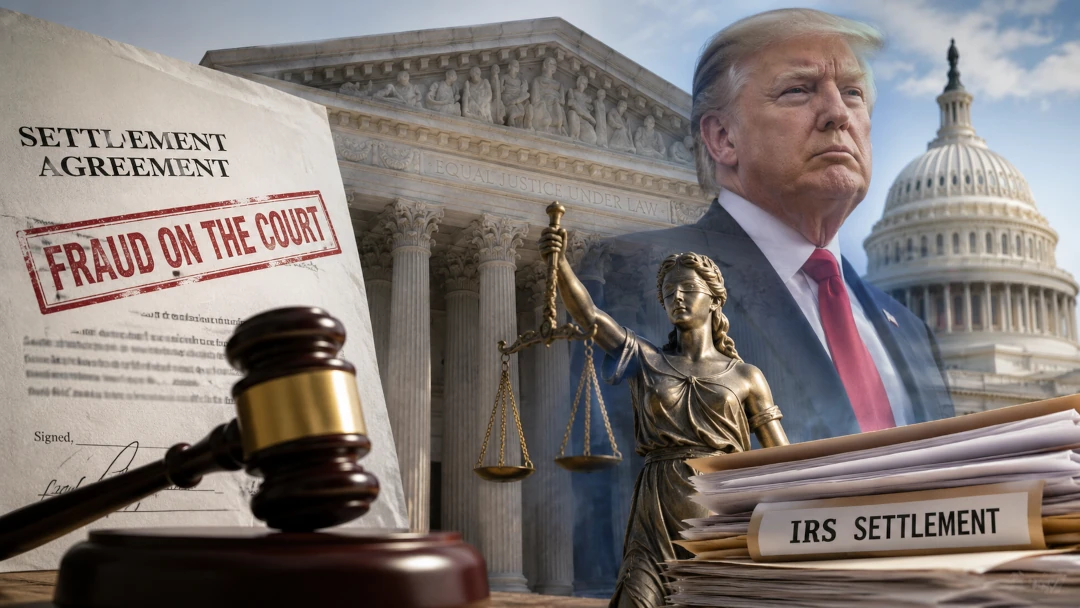
There is a specific line in U.S. District Judge Kathleen Williams’s ruling this week that ought to be printed and framed in every civics classroom in the country. Writing about the $10 billion lawsuit President Donald Trump filed against his own Internal Revenue Service, she concluded that the case was “brought for an improper purpose — to gain the imprimatur of judicial legitimacy for a ‘settlement’ that had no viable basis in law or fact.” In plainer English: a sitting president sued a federal agency he controls, negotiated with lawyers he appointed, awarded himself a permanent tax amnesty and tried to funnel nearly $1.8 billion in taxpayer money to his political allies, and asked a federal court to bless it. A federal judge — an Obama appointee named in a bipartisan filing by thirty-five former federal judges — said no.
The ruling from Williams, handed down Monday in the Southern District of Florida, does more than kill an already-embarrassed settlement. It confirms, in the studied language of a federal judicial opinion, what the president’s critics have been saying since he first floated the deal: this was not litigation. It was a laundering operation with a case caption on top.
I. What the Judge Actually Ruled
The mechanics of the case are worth stating clearly, because the administration has spent months trying to blur them. In January, Donald Trump — as a private plaintiff — sued the IRS and the Treasury Department for $10 billion, claiming damages for the 2019 leak of his tax records by a government contractor. The problem, evident to any first-year law student, was that the person suing was also the person in charge of both defendants. As Trump himself reportedly acknowledged, any settlement would be, in his words, “a settlement with myself.”
In May, that “settlement with himself” arrived. Acting Attorney General Todd Blanche announced Trump would drop his suit in exchange for a $1.776 billion “Anti-Weaponization Fund” to pay claimants who alleged mistreatment by prior administrations — a coffer explicitly premised on paying claims stemming from January 6, 2021, and the classified documents case. Blanche, notably, had previously represented Trump personally in his criminal trials; Associate Attorney General Stanley Woodward had represented Capitol riot defendants. The lawyers negotiating the payout, in other words, had a professional history with the people the payout was meant to enrich.
Layered on top of the fund was a quieter, more permanent giveaway: a memorandum signed by Blanche alone that “forever” barred the government from pursuing any investigation, audit, or claim against Donald Trump, his sons, the Trump Organization, or any affiliated entity for anything predating the deal. Not just for the tax leak. For anything.
Williams’s opinion runs 56 pages and is, in tone, one of the more restrained scathings a federal judge has ever produced. She found the lawsuit was collusive, that there was “never adverseness between the Parties” and “never a case or controversy,” that the plaintiffs and their attorneys “acted in bad faith,” and that Blanche’s amnesty memo “directly contravenes” a federal law barring the White House from influencing tax audits. She sanctioned Trump’s private attorney Alejandro Brito, referred him to the Florida Bar, and forwarded her order to the New York and D.C. bars — the licensing authorities for Blanche and Woodward.
“Lead Plaintiff and Defendants are public servants — the pinnacle of the Executive Branch — sworn to uphold the law, faithfully perform the duties of their office, and protect the interests of the American public. The issue before the Court is whether, instead, they ignored ethical norms, court rules, and legal authority to manipulate the judicial process.”
— U.S. District Judge Kathleen Williams, Southern District of Florida
II. The Scheme, in Plain Language
To understand why Williams’s ruling matters, it helps to separate what was done from how it was dressed. The dressing was: a lawsuit, a settlement, a Justice Department press release. Beneath that dressing were four discrete acts of self-dealing, each of which would be a scandal on its own.
Suing an agency he controls
Trump filed a $10 billion claim against the IRS and Treasury — agencies under his direct executive authority. As Georgetown law professor and former federal prosecutor Paul Butler told NPR, it was “the first time in American history where a sitting president sued the federal government for money.”
$1.776 billion for allies
The “Anti-Weaponization Fund” was designed to pay claimants who said they’d been mistreated by federal law enforcement. Blanche conceded to lawmakers it would be available to Trump donors and, in the words of Sen. Jack Reed, an “obvious abuse of power” that would flow “to his friends or people that are in his orbit.”
A “forever” tax amnesty
A Blanche memo barred any government body from investigating Trump, his family, or his businesses for any conduct predating May 19, 2026. The House Judiciary Democrats’ fact sheet called it a “super pardon” without constitutional basis.
Wrapping it in a court order
The final move was to seek “the imprimatur of judicial legitimacy” — dressing the deal as a settled lawsuit so a future administration would face an existing court record. Judge Williams called this the “manipulation of the judicial process” and refused to allow it.
III. A Plaintiff Who Controlled the Defendants
The most quietly devastating passage in Williams’s opinion may be her footnote observing that she was “extremely troubled” by testimony Blanche had given to Congress in May, when he told senators the court had no role in reviewing the agreement. He was, in effect, telling a federal judge to look away. She did not.
Williams’s opinion also names what the Constitution names. She warned that the potential windfall for the president could violate the Domestic Emoluments Clause, which specifically forbids the president from receiving any payment from the United States government beyond his salary — a provision the framers wrote precisely to prevent a sitting president from using public office as a personal profit center. As The New Republic noted in May, ninety-three House Democrats had filed an amicus brief warning that “a settlement payment, especially for an unmeritorious claim, is a straightforward violation of the Domestic Emoluments Clause.” Williams’s opinion adopted the substance of that concern.
Blanche himself now concedes the arrangement was, at minimum, a political misjudgment. Senate Judiciary ranking Democrat Dick Durbin told reporters that Blanche admitted privately he “made a mistake” championing the fund. In the same conversation, Durbin reported, Blanche described Williams’s ruling as “a hit job by this judge in Florida.” Those two statements are not compatible. If it was a mistake, it was not a hit job; if it was a hit job, it was not a mistake. The administration wants to hold both truths at once — regret when it faces senators, defiance when it faces a court.
“This all seems to be an obvious abuse of power by the Department of Justice, by the president. He negotiated essentially with himself. You’re his appointee, the IRS are his appointees, he’s the plaintiff.”
— Sen. Jack Reed (D-R.I.), who has called Acting AG Blanche “the president’s consigliere”
IV. What Happens Next
The immediate legal picture is mixed, but the direction is clear. Williams’s ruling nullifies the settlement’s status as a court-blessed agreement. She has expressly forbidden Trump, the Trump Organization, or anyone acting on their behalf from “referring to the purported ‘settlement agreement,’ or using, offering, admitting, or citing any of its provisions in any judicial, administrative, regulatory or other proceeding.” The judicial cover is gone.
What remains — for now — is the private Blanche memo purporting to immunize Trump from future investigation. As Butler noted on NPR, Williams “implied that she thinks that it’s both illegal, unethical and possibly unconstitutional. But it’s not a matter that’s before her.” That question will fall to a future administration’s Justice Department. Butler’s assessment: it is “unlikely that this quote-unquote settlement will be enforced by another administration, especially given the judge’s resounding critique.” The purported amnesty is, in other words, a paper shield with a federal judge already having pre-labeled it as fraudulent.
Trump sues his own government for $10 billion over the leak of his tax returns by an IRS contractor. He is simultaneously plaintiff and, as president, the ultimate authority over the defendants.
Watchdog group CREW files an amicus brief warning that any settlement would loot the Treasury and violate the Domestic Emoluments Clause.
Ninety-three House Democrats file their own amicus brief calling the arrangement “corruption unparalleled in American history.”
Acting AG Blanche announces the deal: a $1.776 billion “Anti-Weaponization Fund” plus a memo granting Trump and his businesses permanent immunity from federal investigation for pre-existing conduct.
Thirty-five former federal judges petition Judge Williams to reopen the case, arguing the settlement was “the product of collusion” and a “fraud on the court.”
Blanche testifies that the fund is “dead” but refuses to sign a formal statement to that effect, and refuses to disclaim the tax amnesty. Rep. Grace Meng: “putting it in writing would settle that issue.”
Judge Williams issues her 56-page ruling: bad faith, improper purpose, manipulation of the judicial process. Sanctions and bar referrals follow.
Blanche appears before the Senate Judiciary Committee for his confirmation hearing as permanent attorney general — under the shadow of a federal judge questioning his ethics.
Get Involved Today
Contribute to our mission and turn your concerns into action.
V. Priorities, in Miniature
An honest reading of this case tells you almost everything you need to know about how this presidency defines its own job. Faced with the ordinary responsibilities of the office — border security, inflation, the budget, foreign policy — the president devoted the full weight of the Justice Department, the Treasury Department, and the White House Counsel’s office to a personal financial claim against himself. This was not a rogue lawyer’s project. It required the acting attorney general, the associate attorney general, the president’s private legal team, an IRS commissioner, and the machinery of federal litigation, all bent toward one goal: getting the president permanent immunity and a $1.8 billion fund for his political base.
The Constitution does not require a president to be brilliant, or beloved, or even competent by any specific measure. It does require him to “take Care that the Laws be faithfully executed.” A president who instead engineers a fake lawsuit against his own agencies to exempt himself from the law is not taking care that the laws be executed. He is standing above them. Judge Williams’s opinion is the federal judiciary saying, in the calmest possible tone, that this is not a partisan grievance — it is a factual finding.
The 25th Amendment and the Meaning of “Unable”
The Twenty-fifth Amendment’s Section 4 permits the vice president, together with a majority of the Cabinet or “such other body as Congress may by law provide,” to declare a president “unable to discharge the powers and duties of his office.” Congress ratified the amendment in 1967. What Congress did not do — pointedly, deliberately — was define the word unable.
That silence is not an accident. As constitutional scholar John D. Feerick, who helped draft the amendment, has documented, the framers of Section 4 explicitly rejected proposals to enumerate categories of disability. They believed that “inability” had to be capacious enough to reach circumstances they could not anticipate. The record of the drafting is unusually candid on this point: the delegates knew a rigid definition would fail; they wanted a standard broad enough to accommodate the country’s actual, unforeseen future.
“Whenever the Vice President and a majority of… the principal officers of the executive departments… transmit to the President pro tempore of the Senate and the Speaker of the House of Representatives their written declaration that the President is unable to discharge the powers and duties of his office…”
Democratic lawmakers have already begun the constitutional argument. Rep. Jamie Raskin of Maryland has introduced legislation to create the “other body” Section 4 contemplates — a 17-member commission empowered to make the disability finding alongside the vice president. Sen. Ed Markey of Massachusetts, Illinois Gov. J.B. Pritzker, and more than 85 House and Senate Democrats have called for either impeachment or invocation of Section 4 after this year’s cascading crises. And in April, even former Rep. Marjorie Taylor Greene publicly demanded the amendment’s use.
The IRS settlement is not, on its own, the sort of medical or acute-crisis moment the amendment’s early debates imagined. But it is a document — a court-authenticated, sanctioned, 56-page federal finding — that the president used the power of his office to try to enrich himself and his allies while immunizing himself from investigation. If the framers meant “unable” to be capacious, then a federal judge concluding that a president has, in bad faith, tried to manipulate the courts for personal benefit is a data point that belongs squarely inside the word.
The practical barriers are undeniable. Section 4 requires Vice President JD Vance and a majority of Trump’s own Cabinet to act. There is no evidence they will. Congressional Republicans control both chambers. Raskin’s commission bill will not pass this Congress. None of these facts are in dispute — and none of them address the constitutional question. The mechanism exists. The evidentiary record grows. The moral case that a president found by a federal court to have engaged in bad-faith self-dealing is discharging his duties faithfully is not a case that can be made in good conscience. The barrier is political, not constitutional. That distinction matters.
VI. What the Rule of Law Requires
There is a particular danger in normalizing what happened here. The Trump-IRS settlement was not a policy dispute or an aggressive legal theory. It was a president using the Justice Department as his personal law firm to secure benefits — money, immunity, a papered-over legal shield — that no other American citizen could obtain. That the scheme was so audacious that even a Republican-appointed IRS commissioner reportedly had to be brought into it, and even Republican Sens. Susan Collins and Jerry Moran raised concerns about who would qualify, only sharpens the point. There is bipartisan understanding that a red line was crossed. What is missing is bipartisan willingness to enforce the line.
Judge Williams enforced it, from the one branch of government still willing to look at the president as a party to litigation rather than a client. She did the work the executive branch refused to do and the legislative branch could not muster. The country should not have to depend on the tenure of a single federal district judge in Miami for the proposition that a sitting president cannot loot the Treasury on his way out the door. But this week, that is what it depended on. And this week, the rule of law held — narrowly, temporarily, and only because one judge, appointed sixteen years ago by a president of a different party, was willing to write 56 pages saying what was true.
Editorial Conclusion
A federal court has now stated, on the record, that the sitting president brought a lawsuit in bad faith, manipulated the judicial process, and attempted — through the officers of his own Justice Department — to convert the machinery of the United States government into a personal enrichment vehicle. That is the finding. It is not a partisan claim. It is not a rhetorical flourish. It is a 56-page ruling from a federal district judge.
The question before every remaining institution in Washington is now smaller and clearer than it has been in months: does a president who a federal court has found used the courts and the Treasury to enrich himself remain fit, in the constitutional sense, to discharge the powers and duties of his office? The Twenty-fifth Amendment does not require Congress to answer that question with mathematical certainty. It requires only that the vice president and the Cabinet — or a body Congress creates — be willing to look at the record and say what they see.
The record is now on the docket. The country is watching what its officials do with it.
Sources & References
- NBC News, “Trump administration tried to ‘manipulate the judicial process’ with its IRS settlement, judge says“
- CNN Politics, “Judge: Trump sought to ‘manipulate the judicial process’ with his IRS lawsuit and attempted $1.8B fund“
- CBS News, “Judge rebukes Trump and DOJ over IRS lawsuit, refers lawyer for disciplinary proceedings“
- The Hill, “Judge criticizes Trump’s IRS settlement, sanctions attorney“
- NPR, “Judge says Trump IRS lawsuit was filed to ‘manipulate the judicial process’“
- Law Dork (Chris Geidner), “Federal judge finds Trump’s IRS case and ‘settlement’ was ‘improper,’ sanctions lawyers“
- Courthouse News Service, “AG nominee Blanche told top Democrat he ‘made a mistake’ with $1.8B anti-weaponization fund“
- The Hill, “Lawmakers criticize Todd Blanche over Trump’s $1.776B anti-weaponization fund“
- CBS News, “Blanche reiterates that ‘anti-weaponization’ fund is ‘dead’ at Senate confirmation hearing“
- MSNBC / MS NOW, “House Democrats accuse Trump of ‘corruption unparalleled’ over IRS settlement talks“
- House Judiciary Committee Democrats, “The Top 10 Reasons Trump’s $1.776 Billion ‘Weaponization’ Slush Fund Is Unconstitutional, Illegal and a Fraud on the Court“
- Citizens for Responsibility and Ethics in Washington (CREW), “Amicus: Court must block unconstitutional settlement in Trump’s $10 billion IRS lawsuit“
- The New Republic, “Trump’s IRS Deal Is a Massive Test for Congress and the Courts“
- Democracy Defenders Fund, “Trump’s $10 Billion IRS Lawsuit and his Expanding Pattern of Self-Dealing“
- PBS NewsHour, “Could the 25th Amendment be invoked against Trump? Here’s how it works“
- CNN Politics, “25th Amendment: Democrats and right-wing voices call for removing Trump from office“
- Axios, “House Democrats file long-shot 25th Amendment bill targeting Trump“
- Wikipedia, “Twenty-fifth Amendment to the United States Constitution (background and drafting history)“
Related News