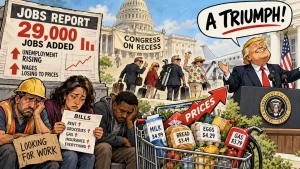
57,000 Jobs. Half a Million Missing Workers. A President Fighting the Wrong Wars.
The June jobs report was not a rounding error. It was a diagnosis — of an economy strained by tariffs, hollowed by war spending, and led by a man his own former counsel has called “clearly insane.” The paper trail of unfitness is now the entire economy.
There is a moment, Indeed economist Laura Ullrich told reporters this week, when the tide turns and the water simply stops moving — neither in nor out. She called it “slack water.” She was describing the American labor market as of Thursday morning, when the Bureau of Labor Statistics released a June employment report that showed nonfarm payrolls rising by just 57,000 jobs, well short of the 115,000 that Dow Jones economists had projected. It was the second straight month of downward revisions. April was cut by 31,000. May was cut by 43,000. Seventy-four thousand jobs that were supposed to exist, quietly, did not. And the household survey — the one that measures whether people are actually working — showed 507,000 fewer Americans employed than a month earlier.
The unemployment rate ticked down to 4.2 percent, and the White House will call that a win. It is not a win. It is a mechanical illusion. The rate fell because the labor force itself contracted: the participation rate slipped 0.3 percentage points to 61.5 percent, the lowest since the pandemic year of 2021. People are not being counted as unemployed because they have stopped looking. When the denominator shrinks faster than the numerator, arithmetic delivers a headline that flatters the president. The reality underneath is bleaker: fewer Americans working, fewer Americans searching, fewer Americans hopeful.
This is what a leadership failure looks like when it finally shows up on a spreadsheet. And the spreadsheet is only the beginning.
1. The Numbers The Administration Would Prefer You Not Notice
Read past the top-line 4.2 percent and the report reads like a catalog of quiet emergencies. Long-term unemployment — Americans jobless for 27 weeks or more — sits at 1.9 million, up 286,000 over the year. Leisure and hospitality shed 61,000 jobs in a month when the sector typically staffs up for summer; the BLS attributed it to “weaker than usual seasonal hiring,” a phrase that is doing a great deal of work. Private payroll growth was just 49,000, well below what economists at LSEG polled by Reuters had forecast. The average monthly gain over the past year is now 36,000, a number that would have been unthinkable to describe as healthy in any of the four preceding years.
The evidence, when you assemble it, is unambiguous:
Nonfarm payrolls in June, roughly half of what economists projected. Source: Bureau of Labor Statistics.
Fewer Americans reported as employed in the household survey — a one-month plunge. Source: CNBC.
Downward revisions of this magnitude are what economists call a “late-cycle tell.” First estimates flatter the economy; the truer, weaker number arrives a month or two later. It is a pattern that dogged the labor market in late 2024, and it is dogging it again now. The administration will point to four straight months of positive payroll gains as vindication. That is like claiming credit for slowing your descent while still falling.
2. The War Economy Hidden Inside the Payroll
To understand why the labor market has stalled, look at where the money is going instead. It is not going to workers. It is going to munitions. According to the Center for Strategic and International Studies, the Iran war has cost the Pentagon roughly $40 billion in direct military expenditures — munitions, destroyed equipment, damaged bases. Moody’s Analytics estimates the total cost to U.S. consumers and taxpayers is closer to $132 billion. Al Jazeera reports that Democratic leaders and economists put the true economic toll between $630 billion and $1 trillion.
When Under Secretary of Defense Jules Hurst told the House Armed Services Committee in April that the war had cost $25 billion, Democratic Rep. Ro Khanna of California called the figure “totally off.” According to sources cited by CNN, the actual estimate is closer to $40 to $50 billion — and that does not include the cost of rebuilding at least a dozen U.S. bases damaged by Iranian drone and missile strikes across Bahrain, Kuwait, Qatar, and the UAE. The Pentagon has since submitted a request for $80 billion in supplemental funding, on top of a fiscal 2027 budget request of $1.5 trillion — a 42 percent increase over current levels.
Harvard Kennedy School’s Linda Bilmes, one of the foremost experts on the fiscal costs of war, told her institution that the daily burn rate reached roughly $2 billion in short-term costs at the height of the conflict. And that, she cautioned, is the tip of the iceberg. The Pentagon has already signed multi-year contracts with Lockheed Martin worth $35.3 billion to rebuild depleted missile interceptor stockpiles. Roughly 40 percent of the country’s THAAD interceptor inventory was expended.
None of this is discretionary. Once you fire the interceptors, you have to buy new ones. Once you flatten your allies’ bases with counterstrikes you provoked, you have to help rebuild them. The taxpayer catches every bill, and the bill lands in the same fiscal year as an aging population, tariff-induced inflation, and a manufacturing sector that shed 89,000 jobs in the ten months following “Liberation Day.”
“Firing four-million-dollar interceptors at thirty-thousand-dollar drones is not strategy. It is arithmetic that ends in bankruptcy — and it is now the defining feature of American economic policy.”
— A Reflection on figures reported by Prof. Linda Bilmes, Harvard Kennedy School
3. The Tariff Toll on Blue-Collar America
The president promised, in his second inaugural address, to make the United States “a manufacturing nation once again.” Fifteen months later, the manufacturing sector has instead lost about 89,000 jobs since the April 2025 “Liberation Day” tariff announcement, according to a March 2026 analysis by the Center for American Progress. That is the equivalent, they calculate, of shuttering more than 2,800 average-sized factories. Transportation and warehousing has shed another 123,700 jobs. Blue-collar job creation has fallen below the Biden-era pace in 45 states.
The Joint Economic Committee’s Democratic minority, chaired by Sen. Maggie Hassan of New Hampshire, reported in April that small durable-goods manufacturers watched their profit margins fall by 24 percent as tariffs hit their inputs the hardest. Applications to form the kinds of new manufacturing businesses most likely to hire employees dropped nearly 18 percent between 2024 and 2025. The Kearney consulting firm’s own analysis found that while capital investment in U.S. manufacturing has tripled since 2020, it has produced just a 1.5 percent boost in actual capacity — because the tariffs create the very instability and cost pressure that discourage the reshoring they were supposed to induce.
The Tax Foundation, a right-of-center think tank not known for progressive framing, estimates the tariffs represent the largest U.S. tax increase as a share of GDP since 1993, amounting to an average tax hike of $1,500 per household in 2026 alone. And American Progress calculates that between February 2025 and January 2026, the average household paid an additional $1,700 in tariff costs — with more than 65 percent of Americans telling the Council on Foreign Relations that tariffs have made everyday goods less affordable.
The Supreme Court ruled 6-3 in February that the president’s use of the International Emergency Economic Powers Act to justify the tariffs was unlawful. He responded by imposing new tariffs under different statutory authorities. The chaos, in other words, was the point. The chaos remains.
Get Involved Today
Contribute to our mission and turn your concerns into action.
4. An Empty Reserve, A Broken Promise
In late 2022, the president attacked his predecessor for having “virtually drained” the Strategic Petroleum Reserve. He promised, upon returning to office, to refill it. Instead, on June 15, according to Department of Energy data cited by multiple outlets, the SPR fell to its lowest level since 1983 — approximately 331 million barrels, roughly 46 percent of capacity. In March, Energy Secretary Chris Wright authorized the release of 172 million barrels over 120 days to blunt the price shock caused by the near-closure of the Strait of Hormuz.
The reserve was built to cushion America against exactly the kind of Middle East supply crisis that the president himself provoked. It is now depleted for the second time in five years. According to International Energy Agency data, refilling it to pre-war levels will cost roughly $28 billion at current prices — because the reserve was originally acquired at an average price of $29.70 per barrel and the current refill cost sits near $70. The gap between what the oil cost and what replacement will cost is a permanent loss to the Treasury of between $10 and $14 billion. A Gulf freight and insurance premium of about $2 per barrel adds another $12 to $15 billion in annual costs to global trade. Rebuilding the reserve, the IEA warns, will require an additional 1 million barrels per day of supply for three years — a bid that will keep oil prices elevated well into 2029.
Consider what this means for the ordinary American household: gasoline that averaged just under $3 a gallon when the war began peaked at $4.56 after the Strait closed, according to AAA data cited by NPR. Mortgage rates have moved higher as inflation stayed stubbornly above the Fed’s 2 percent target. Fed Chair Kevin Warsh has hinted at rate hikes later this year. A Fox News poll cited by CNN finds just 31 percent of registered voters approve of the president’s handling of the economy, and 35 percent approve of his handling of Iran. His overall approval rating, per CNN’s Poll of Polls on June 15, sits at 37 percent.
Operation Epic Fury begins. U.S. and Israeli strikes on Iran ignite the war. Brent crude jumps 15 percent within a week.
SPR release authorized. Energy Secretary Chris Wright orders 172 million barrels released over 120 days. Reserve heads toward 43-year low.
The Easter Sunday post. The president threatens Iranian civilian infrastructure in a profanity-laced Truth Social post. Sen. Chris Murphy of Connecticut calls it “utterly unhinged” and suggests the Cabinet consult constitutional lawyers about the 25th Amendment.
Pentagon lowballs Congress. Rep. Ro Khanna calls the Defense Department’s $25 billion war-cost estimate “totally off.” Sources tell CNN the real number is closer to $40-50 billion.
Ceasefire announced. A 14-point MOU is reached. But damage to bases, depleted stockpiles, and $35.3 billion in Lockheed Martin rebuild contracts have already been booked.
The bill arrives. BLS reports just 57,000 jobs added in June. Labor force participation hits a five-year low. The bill for everything is landing on the same desk.
“Unable to discharge the powers and duties of his office.”
Section 4 of the 25th Amendment permits the vice president, together with a majority of the Cabinet, to transmit a written declaration to Congress stating that the president is “unable to discharge the powers and duties of his office.” Upon transmittal, the vice president immediately becomes acting president. If the sitting president contests the declaration, Congress may — by a two-thirds vote in each chamber — sustain the removal.
The drafters, led by Sen. Birch Bayh of Indiana, deliberately declined to define the words “unable” and “inability.” As the constitutional historian John D. Feerick has documented, the framers of the amendment specifically wanted the terms left elastic enough to reach any form of incapacity a future crisis might reveal — physical, mental, or, as Feerick put it, a president who “faced questions about physical or mental inabilities but disagreed completely with the judgment.” The ambiguity is not a bug of the amendment. It is the amendment.
Named lawmakers who have publicly called for its invocation against President Trump since April include:
- Sen. Chris Murphy (D-Conn.), who wrote that a Cabinet member should “spend Easter calling constitutional lawyers”
- Sen. Ed Markey (D-Mass.), who declared the president “must be removed from office”
- Rep. Ro Khanna (D-Calif.), the same lawmaker who called the Pentagon’s war-cost figures “totally off”
- Rep. Madeleine Dean (D-Pa.), who called the president “unhinged and unwell”
- Rep. Melanie Stansbury (D-N.M.), Rep. Sara Jacobs, Rep. Joaquin Castro, and Rep. Julie Johnson
- Former Trump White House counsel Ty Cobb, who on The Jim Acosta Show called the president’s late-night posts evidence of what he described as a plainly disturbed man
The constitutional argument is straightforward. A president who provokes a war whose true costs his own Pentagon cannot honestly report to Congress, who drains the nation’s emergency oil reserve to the lowest level in 43 years, whose tariff regime the Supreme Court has ruled unlawful, and who conducts foreign policy through midnight social-media threats to bomb civilian infrastructure — that president has demonstrated, in the plainest sense of the drafters’ text, an inability to discharge the office’s duties.
The practical barriers are real and honest to acknowledge. Vice President J.D. Vance and this Cabinet were selected for loyalty. Republican leadership in Congress has, for the most part, chosen silence. As PBS NewsHour has noted, the amendment’s invocation is highly unlikely as long as the Cabinet remains politically captured. That is why Common Cause has now formally called on Vance and the Cabinet to invoke Section 4 — and why other watchdog groups, prominent Never-Trump Republicans like Joe Walsh and Anthony Scaramucci, and even former MAGA standard-bearer Marjorie Taylor Greene have publicly urged the same.
The political impossibility of removal does not extinguish the constitutional case for it. An impeachment that cannot pass is still an impeachment worth filing when the record justifies it; a Section 4 declaration that will not be signed is still a declaration the country is entitled to hear demanded. The framers wrote a mechanism for an emergency they hoped would never come. Refusing to name the emergency when it arrives is not prudence. It is abdication.
“Trump is threatening war crimes, forcing the entire globe to wait and wade in his madness. He is unhinged and unwell.”
— Rep. Madeleine Dean (D-Pa.), on X, April 7, 2026
5. What This Portends
The near future is legible now to anyone willing to read it. Rebuilding the missile stockpiles alone will take years and cost hundreds of billions. Refilling the oil reserve will run a decade and lock in a permanent Treasury loss. The tariffs, even if unwound tomorrow, have already displaced manufacturing supply chains toward Vietnam, Mexico, and India — not Ohio, not Michigan, not Pennsylvania. The Fed, per the CME FedWatch tool, now sees a roughly 42 percent probability of a rate hike later this year, a move that would push mortgage rates higher precisely when American families most need them lower.
Global trade will continue its bifurcation. J.P. Morgan’s Nora Szentivanyi has noted that the average effective U.S. tariff rate now stands near 15.8 percent — up from 2.3 percent at the end of 2024, the highest since the middle of the last century. The E.U. and Canada are strengthening their bilateral ties. China is quietly consolidating its position in the AI race and its 1.4-billion-barrel oil reserve — more than four times the size of America’s. The unipolar system that guaranteed the dollar’s primacy has already fractured. The fracture accelerates under this presidency, not despite it.
For the average American, the outlook translates into fewer job offers, more expensive groceries, higher borrowing costs, and a labor market where dropping out is the fastest path to a lower unemployment rate. The 720,000 Americans who left the workforce in June did not disappear. They gave up. And a president who governs from Truth Social at 2 a.m. is not equipped to bring them back.
Editorial Conclusion
An economy does not stall on its own. It stalls when leadership fails — when tariffs are imposed and then unwound and then re-imposed, when reserves are drained to paper over a self-inflicted war, when a president threatens civilian infrastructure on Easter Sunday and calls it strength, when the Cabinet meant to check him has been selected for its willingness not to.
The 25th Amendment was written for exactly this: an “inability” left undefined precisely because the framers understood that inability wears many faces, and that a democracy that cannot name what it sees is a democracy that will not survive what comes next.
The June jobs report is the receipt. The constitutional remedy is written and available. Vice President Vance, the Cabinet, and every member of Congress who took an oath to the Constitution rather than to a man now face a single question: whether they will invoke the mechanism the framers left them, or whether history will record that they saw the receipt and looked away.
Sources & References
- Bureau of Labor Statistics — The Employment Situation, June 2026
- CNBC — U.S. economy added 57,000 jobs in June, less than expected
- Moneywise — June 2026 jobs report lays an egg, badly misses expectations
- Fox Business — US economy added jobs at a steady pace in June
- NPR — Here’s how much the Iran war cost — and how its effects will linger
- CNN Politics — Repairing damaged US military bases will add billions to Iran war cost
- CNN Business — America’s pile of emergency oil is shrinking fast
- Al Jazeera — $25bn or $1 trillion: How much has Iran war really cost the US?
- Harvard Kennedy School — Why is the war in Iran so expensive? — Prof. Linda Bilmes
- Center for American Progress — Trump’s Tariffs Have Cost the Equivalent of 2,800 Factories
- Joint Economic Committee (Minority) — Trump’s Tariffs Crush Small Manufacturers
- Tax Foundation — Tracking the Impact of the Trump Tariffs & Trade War
- EBC Financial Group — The Iran War Drained the World’s Oil Reserves to a 40-Year Low
- The Hill — US emergency oil supply hits lowest level since 1983
- TIME — What to Know About the 25th Amendment as Lawmakers Call for Trump’s Removal
- PBS NewsHour — Could the 25th Amendment be invoked against Trump?
- Newsweek — Lawmakers Demand 25th Amendment Be Invoked Against Trump: Full List
- WHYY — Pa., Del., N.J. lawmakers consider 25th Amendment for Trump
- Common Cause — Common Cause Calls on the Cabinet to Invoke the 25th Amendment
Related News