A Republic For Sale: Trump’s 250-Pardon Birthday Auction and the Constitutional Case He No Longer Has the Capacity to Answer
The White House is preparing to mark America’s 250th birthday not with a monument to liberty, but with an unprecedented act of transactional mercy — up to 250 presidential pardons brokered through a lobbying market where the going rate is a million dollars per application. This is no longer an abuse of executive power. It is proof the executive itself has been converted into private currency.
Two days before Independence Day, the president of the United States is reported to be weighing whether to celebrate the founding of the American republic by pardoning 250 convicted criminals at once. The scheme, described inside the White House as “250 pardons for 250 years,” was first reported by The Atlantic’s Sarah Fitzpatrick and Michael Scherer, who quoted advisers and lawyers describing the ensuing lobbying blitz as “a three-ring circus.” One former Trump official called it, more directly, “batsh*t crazy.” A veteran criminal-defense attorney told the magazine, “In 30 years of practicing law, I’ve never seen anything like this. I’m exhausted.”
Whether or not the final proclamation is signed — and White House officials insist the plan may never reach the president’s desk — the mere floating of it has already accomplished its most corrosive work. It has confirmed to every wealthy federal defendant in America that the pardon power of the United States is, for practical purposes, an auction. And it has revealed, once again, a chief executive who does not appear to grasp the office he holds, the harm he inflicts, or the boundary between the government and his personal favor bank.
1. The Proposal, and What It Actually Is
According to reporting relayed by Raw Story from The Atlantic’s coverage on CNN, the internal proposal calls for the president to issue as many as 250 acts of clemency at or around the July 4 semiquincentennial, a number chosen entirely for its symmetry with the nation’s age. That is the sum total of the intellectual work behind it. There is no unifying principle — not a category of offense, not a demonstrable pattern of prosecutorial excess, not a class of first-time offenders who have served their time — that binds the potential recipients together. They are bound only by the calendar.
The names being circulated give the game away. Fitzpatrick, on CNN This Morning, said the list under discussion includes Malaysian fugitive financier Jho Low, credited with laundering billions in the 1MDB scandal; former Fugees rapper Pras Michel, convicted in a foreign-influence scheme; and Nicole Daedone, the founder of the OneTaste “orgasmic meditation” cult, sentenced in a forced-labor conspiracy. Convicted “Pharma bro” Martin Shkreli told the Washington Examiner that the “250 for 250” chatter was “one of the catalysts that brought me to just finally file” for clemency. Theranos founder Elizabeth Holmes, serving eleven years for defrauding investors, has filed as well.
These are not the wrongly convicted. These are not the over-punished. They are, almost to a person, the wealthy, the famous, the connected — and, as Fitzpatrick told Audie Cornish, “a number of wealthy, well-connected foreign entities from Asia, Europe and the Middle East.” That last category should stop the country cold. A sitting American president is entertaining the idea of extinguishing federal criminal liability for foreign nationals whose prosecutions took, in Fitzpatrick’s words, “hundreds of thousands of dollars” and years of investigative work to bring.
2. The Marketplace That Should Not Exist
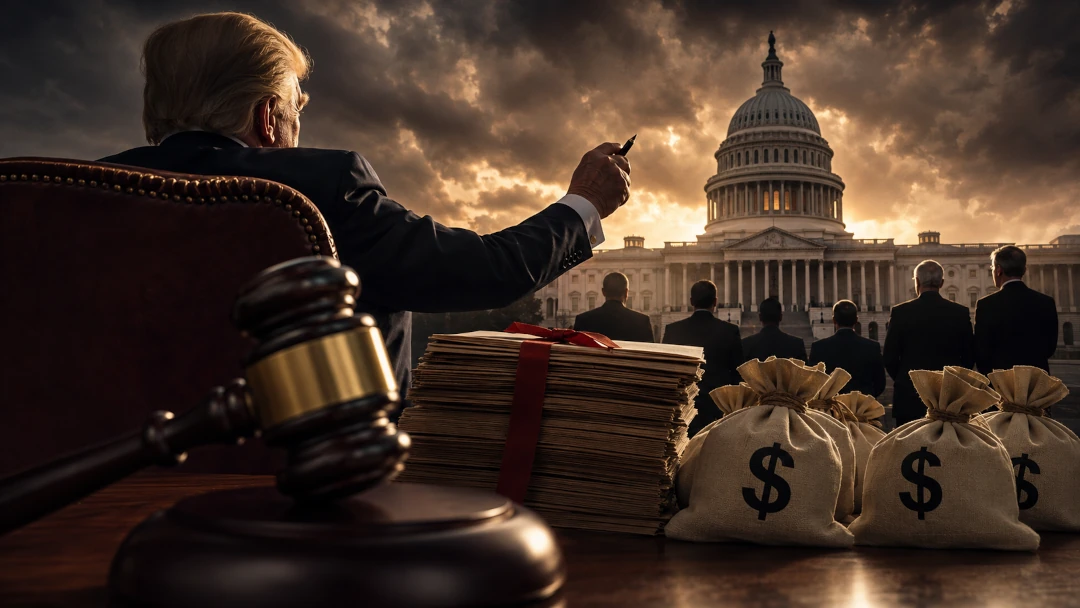
The reason the “250 for 250” idea has produced a “frenzy” — Fitzpatrick’s word — is that it has landed inside a system already fully monetized. In December, The Wall Street Journal revealed what Trump-orbit lobbyists have themselves acknowledged: the going rate for pardon representation is $1 million, with success fees offered as high as $6 million. This is not a rumor. This is what the lobbyists say out loud.
The mechanics are grotesque. Federal disclosure records reviewed by the Journal show Binance paid roughly $800,000 to lobby for a pardon for its founder, Changpeng Zhao, and offered other lobbyists success fees as high as $5 million. Zhao got his pardon. When Trump was asked on 60 Minutes why he had signed it, he first replied, “I don’t know,” and then said “a lot of very good people” had told him it was the right thing to do. He did not name them. He did not need to. The lobbyists on K Street knew who they were.
“This is an example of a leadership vacuum or the mixed messaging that comes out of this White House… everyone thinks that this is an option for them if they pay enough money.”
— Sarah Fitzpatrick · The Atlantic · CNN This Morning · July 1, 2026
The Journal has documented the specific fees: $1.3 million paid to lobbyist Ches McDowell and Checkpoint Government Systems in connection with the Zhao clemency; $960,000 paid to Jacob Wohl and Jack Burkman — themselves convicted felons — to lobby for the pardon of nursing-home fraudster Joseph Schwartz, who took $38 million from taxpayers. Schwartz got his pardon in November. His follow-on lobbyist, Josh Nass, was later charged in an extortion scheme in which prosecutors allege he hired a convicted racketeer to threaten Schwartz’s son over unpaid pardon fees. That is the ecosystem the “250 for 250” proposal is dropping into. It is not a justice system. It is a bazaar.
Trump-connected lobbyists have told the Wall Street Journal that $1M is the standard fee, with success bonuses as high as $6M for closing the deal.
Binance paid registered lobbyists roughly $800K and offered another lobbyist a $5M success fee, while its founder was under investigation. Zhao was pardoned after the Trump family’s crypto venture World Liberty Financial cut business ties with Binance.
A New Jersey developer convicted of bribing former Sen. Bob Menendez with cash and gold bars paid a lobbying firm run by Trump’s former bodyguard $1M for pardon access, according to NBC News.
Conservative operatives Jacob Wohl and Jack Burkman — themselves 2022 felony fraud pleaders — were paid nearly a million to secure a pardon for Joseph Schwartz, who defrauded taxpayers of $38M. He walked. His follow-on lobbyist was later charged with extortion.
3. The Bill: $1.3 Billion the Victims Will Never See
The most important sentence written about the Trump pardon program in 2025 was not in a newspaper. It appeared in a House Judiciary Committee staff analysis released by Ranking Member Jamie Raskin (D-MD). The analysis, drawn from the Justice Department’s own Office of the Pardon Attorney records, concluded that Trump’s second-term pardons had, at that point, wiped out roughly $1.3 billion in court-ordered restitution and fines owed by pardoned criminals to their victims and to American taxpayers.
By March of this year, Gov. Gavin Newsom’s office updated the tally: adding fines and forfeitures, the combined obligation extinguished by presidential mercy reached nearly $2 billion. For scale, Newsom’s office noted, President Biden’s pardons across four years forgave $688,000 in financial penalties. Trump’s forgave roughly two thousand times as much.
“The Trump presidency is overseeing a massive transfer of wealth not only from the poor to the rich but from the innocent to the guilty. This is a golden age for politically connected criminal felons.”
— Rep. Jamie Raskin (D-MD) · House Judiciary Ranking Member
Consider the individual mechanics. When Trump pardoned reality-TV couple Todd and Julie Chrisley, he did not merely spring them from prison — he liquidated their $17.7 million restitution obligation. Todd Chrisley reportedly celebrated with the phrase “the feds got f***ed.” Trump’s commutation of Ozy Media founder Carlos Watson erased $36.7 million owed to defrauded investors. His pardon of Silk Road operator Ross Ulbricht wiped out roughly $184 million. His pardon of the January 6 defendants extinguished the last 85 percent of the $3 million in restitution owed to police and to the Capitol itself; the Trump Justice Department has since argued in court that the $437,000 already paid should be refunded to the insurrectionists.
These are not abstractions. They are checks that will not arrive in the mailboxes of defrauded pensioners, cheated employees, and swindled investors. The Victims of Crime Act fund — which pays for domestic-violence shelters, child-abuse counseling, and trafficking survivor services — is capitalized largely by these very fines. Wipe out the fines and you wipe out the shelters. As Raskin put it, the Trump presidency has “shown total contempt not just for police officers but for the victims and survivors of crime.”
Get Involved Today
Contribute to our mission and turn your concerns into action.
4. A Timeline of the Pattern
The 250-for-250 proposal is not an aberration. It is the culmination of a documented pattern that has been accelerating since Inauguration Day.
5. What This Does to Everyone Else
The average American does not have a lobbyist. The average American does not know Ches McDowell. The average American, if convicted of a federal crime, will proceed through the ordinary process at the Office of the Pardon Attorney — the same process Liz Oyer ran until she was fired for insisting that domestic abusers not get their guns back. She may wait five years. She may show remorse. She may pay her restitution in full. And she may still be denied, because the traditional track is now, in effect, a slower and stingier lane running parallel to the express lane the wealthy have paid to use.
For crime victims, the injury is doubled. The court has told them, on the record, that they are owed money. Then a president with no obvious knowledge of their case, and no interest in their existence, has told the debtor he does not have to pay. A June 2025 Washington Post analysis of Oyer’s disclosures found that the beneficiaries of this arrangement are overwhelmingly white-collar defendants — the very defendants who typically have the resources to make victims whole and choose not to.
For federal law enforcement, the message is bleaker still. Fitzpatrick captured it precisely: “Our Justice Department, our law enforcement entities, have spent so many years, hundreds of thousands of dollars, prosecuting… these are very, very serious cases.” The prosecutors who built the Jho Low case, the agents who tracked the Binance money, the lawyers who convicted Elizabeth Holmes — they are being told, from the top of the executive branch, that the calendar mattered more than their work. It is difficult to imagine a more effective way to demoralize a federal workforce than to inform it that its convictions have an expiration date, and that expiration date is somebody else’s birthday.
6. What the Pardon Power Cannot Do
There are limits to this scheme, and it is worth naming them. The presidential pardon power reaches only federal offenses. As Protect Democracy’s constitutional analysis explains, the text of Article II is explicit: pardons extend only to “Offenses against the United States,” and never to “Cases of Impeachment.” Every state prosecution — every New York fraud case, every Georgia racketeering charge, every California sex-crime conviction — sits outside the reach of the president’s pen. So does every civil judgment. So does every SEC disgorgement order that a plaintiff can actually enforce.
The pardon is also, as courts have held, “part of the Constitutional scheme.” It cannot be used to violate other constitutional guarantees. It cannot license future crimes. It cannot immunize the president himself from impeachment. And, as the Harvard Law Review has argued at length, a pardon delivered in exchange for value — a bribe, in ordinary English — is itself a crime, both for the giver and the receiver. That principle has never been more urgently relevant than it is this week.
But these are the limits on paper. The limit that actually matters is political. The pardon power, more than any other authority the Constitution grants a single human being, depends on the president understanding that the power is not his personal property. It belongs to the office. It exists to correct injustice, not to reward loyalty. When a president stops grasping that distinction — when he cannot say why he signed a particular pardon, and admits on national television he does not know who the recipient is — the constitutional guarantee that this power will not be abused ceases to function.
The 25th Amendment Was Written for a President Who Cannot Say What He Just Did, or Why
The Twenty-Fifth Amendment, ratified in 1967, contains what may be the most consequential piece of deliberate vagueness in the Constitution. Section 4 empowers the Vice President and a majority of the Cabinet — or “such other body as Congress may by law provide” — to declare that the President is “unable to discharge the powers and duties of his office.”
Note what the drafters did not do. They did not define unable. They did not define inability. They did not limit the concept to unconsciousness, coma, or a diagnosed medical condition. As legal historian Joel Goldstein and other constitutional scholars have explained to PBS NewsHour, the language was left open on purpose because the framers “recognized they couldn’t predict every scenario in which a president could be deemed disabled.” The amendment’s principal author, Sen. Birch Bayh, and his colleagues took great care to avoid the Captain-Queeg problem — a Vice President who could simply declare disability at will. But they were equally careful not to bind future Americans to a narrow, medical definition. They understood, as we should, that a presidency can fail in ways a doctor cannot always see.
What does unable to discharge mean in July 2026? It means, at minimum, the ability to know which pardons one has signed, and why. It means the ability to distinguish a foreign fugitive laundering billions from an ordinary applicant seeking redemption. It means understanding that the presidency is a public trust and not a mailing list of friends and paying customers. On the president’s own testimony — “I don’t know who he is”; “a lot of very good people” told him to — that threshold is not being met.
The calls have already been made. Following Trump’s April 2026 profanity-laced Truth Social threat to bomb Iranian civilian infrastructure, more than 70 lawmakers, including a handful of senators, publicly urged the Cabinet to invoke Section 4. Sen. Chris Murphy (D-CT) wrote: “If I were in Trump’s Cabinet, I would spend Easter calling constitutional lawyers about the 25th Amendment. This is completely, utterly unhinged.” Rep. Marjorie Taylor Greene (R-GA) — a former loyalist — joined the call. So did Alex Jones and Candace Owens. The bench is broader than at any point in American history.
Two months later, Rep. Jamie Raskin — the House Judiciary Ranking Member and a constitutional-law professor — introduced legislation to finally create the Section 4 “other body” the amendment authorizes: an independent, bipartisan Commission on Presidential Capacity, staffed by former Cabinet officials, physicians, and psychiatrists. “Public trust in Donald Trump’s ability to meet the duties of his office has dropped to unprecedented lows,” Raskin wrote. “We are at a dangerous precipice, and it is now a matter of national security.”
The Constitution explicitly vests Congress with the authority to create a body that will guarantee the successful continuity of government by responding to presidential incapacity. — Rep. Jamie Raskin, April 14, 2026
The honest barriers. Section 4 requires the Vice President and a majority of the Cabinet — a Cabinet Trump himself installed. That will not happen. And the Raskin commission, however well conceived, will not be passed by a Republican House. This is a real obstacle and we will not pretend otherwise.
Why it still matters. The moral and constitutional case does not depend on the political vote count. The purpose of Section 4 is not merely to remove a president; it is to name a truth about what has happened to the office. When the president of the United States cannot say whose pardons he is signing, when he transacts clemency for foreign fugitives at the recommendation of unnamed “very good people,” and when he treats the semiquincentennial of American independence as an occasion for a private-favor giveaway to the wealthiest defendants in his contact list — the country deserves to hear its own Constitution read aloud. That is what Raskin’s bill accomplishes. That is what every citation of Section 4 accomplishes. The record is being written. It will outlast this presidency.
7. What This Says About the Man in the Oval Office
Every presidency reveals its priorities in the pardon list. Gerald Ford revealed his by pardoning Richard Nixon. George H.W. Bush revealed his by pardoning the Iran-Contra defendants. Barack Obama revealed his by commuting the sentences of nonviolent drug offenders. Donald Trump has revealed his by pardoning a Malaysian money-launderer, a crypto billionaire whose company enriched the Trump family, a Honduran ex-president who trafficked cocaine into America, and reality-TV celebrities who cheated their creditors and celebrated with the words “the feds got f***ed.”
The through-line is not ideology. It is not even loyalty. It is proximity to money. Fitzpatrick, again, in the interview that opened this piece: “This is an example of a leadership vacuum.” That is the polite version. The candid version is that a leadership vacuum, sustained over eighteen months and now culminating in a plan to auction 250 acts of clemency to mark America’s birthday, is a form of inability. Not medical inability. Constitutional inability — the inability to distinguish public power from private favor, the inability to protect the integrity of the office, the inability to be trusted with the very pardon power the Framers wrote into Article II in the first place.
The Framers gave the pardon power to the president because they trusted, as Alexander Hamilton wrote in Federalist 74, that “the sense of responsibility is always strongest in proportion as it is undivided.” One person, one conscience, one accountable actor. What they did not anticipate — what perhaps they could not have anticipated — is a president whose conscience is not undivided but for sale, and whose sense of responsibility to the office has been replaced by a sense of obligation to the highest bidder.
Editorial Conclusion
The “250 pardons for 250 years” scheme is not a policy proposal. It is a confession. It confesses that the pardon power of the United States has been converted into a private auction. It confesses that the president neither knows nor cares whose sentences he is erasing, so long as the right “very good people” have vouched for the transaction. And it confesses that this White House sees the 250th anniversary of American independence not as a moment to honor the republic, but as an occasion to loot it.
The Constitution’s answer to this is not partisan. It is Section 4 of the Twenty-Fifth Amendment — deliberately left open, deliberately vague, deliberately written to reach a president who cannot discharge the powers and duties of his office whatever the reason. The votes to invoke it are not there today. That is not the point. The point is that the case is now on the record, in permanent ink, that a president who cannot say whose pardons he is signing has failed the constitutional test the Framers wrote for exactly this moment.
America’s 250th birthday deserves better than 250 sold pardons. The republic deserves better than the president who would sign them.
Sources & References
- Raw Story — Trump risks massive blowback as criminals in a ‘frenzy’ chasing America 250 pardons: CNN (July 1, 2026)
- The Atlantic — Trump’s 250 Pardons for 250 Years by Sarah Fitzpatrick and Michael Scherer
- Mediaite — Trump White House Mulls July 4 Clemency Bonanza: ‘250 Pardons for 250 Years’
- Washington Examiner — White House considering ‘250 pardons for 250 years’: Report
- Political Wire / WSJ — Inside the New Fast Track to a Presidential Pardon
- The UnPopulist — The Wall Street Journal Finds That $1 Million Is the Going Rate for Trump Pardons
- House Judiciary Democrats — Raskin Analysis: Trump’s Pardon Spree Cheated Crime Victims of $1.3 Billion
- CBS News — Trump’s pardons cost victims and taxpayers $1.3 billion, review says
- Office of Gov. Newsom — Trump pardons wipe nearly $2 billion in victim repayment
- The Hill — Trump pardons allowed recipients to skirt more than $1.3B in restitution
- ProPublica — How Trump Has Exploited Pardons to Reward Allies and Supporters
- Washington Post — Why fired DOJ pardon attorney Liz Oyer says Trump pardons cost $1B
- Newsweek — Attorney fired from DOJ sounds alarm on “ongoing corruption”
- MSNBC / Maddow Blog — As Trump corrupts the pardon process, high-priced lobbying reaches unprecedented levels
- Wikipedia — List of people granted executive clemency in the second Trump presidency
- PBS NewsHour — Could the 25th Amendment be invoked against Trump? Here’s how it works
- NBC Washington — What is the 25th Amendment? Calls grow for it to be invoked against Trump
- House Judiciary Democrats — Raskin Introduces Legislation Establishing Independent Commission on Presidential Capacity
- Protect Democracy — The presidential pardon power, explained
- Harvard Law Review — The President’s Conditional Pardon Power
Related News