Five Hundred Days, One Verdict: The Senate Hears the Receipts
Connecticut’s Chris Murphy did what the country’s institutions have largely refused to do — he stood on the floor of the United States Senate and read the ledger of Donald Trump’s second term aloud, month by month, deal by deal, pardon by pardon. The question is no longer whether the corruption is real. The question is whether anyone with the constitutional authority to act still cares.
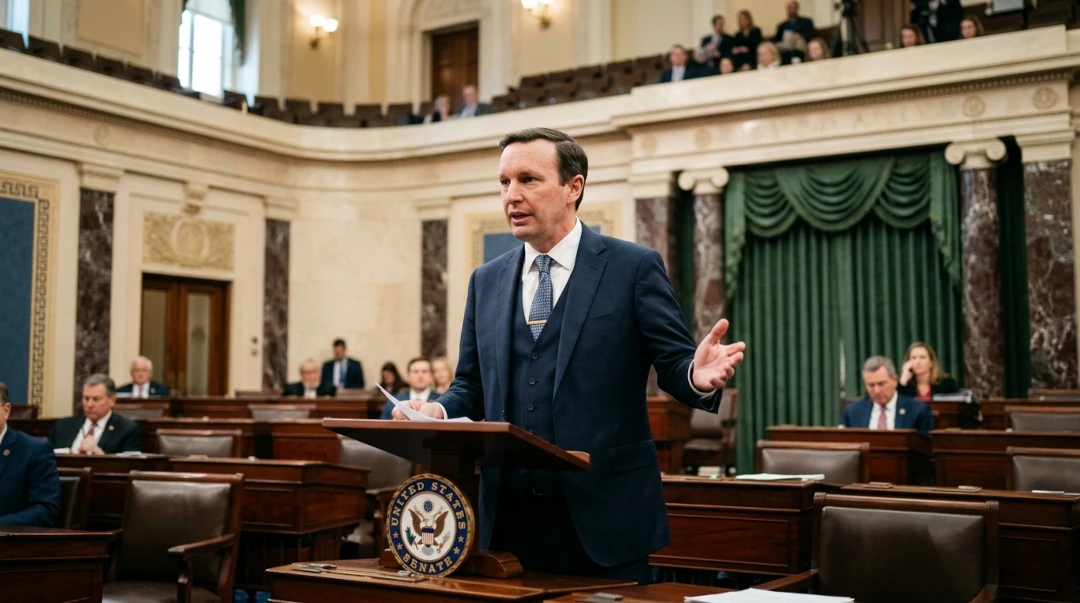
On the afternoon of June 23, 2026, Senator Chris Murphy of Connecticut walked onto the Senate floor with a stack of papers and a single argument: that the man currently occupying the Oval Office has, over the course of roughly a year and a half, transformed the executive branch of the United States government into something the framers feared and the founding documents were written to prevent. Murphy called it a “24/7 corruption operation,” and over thirty-two unhurried minutes he proceeded to show his work.
The speech, titled Trump’s 500 Days of Corruption, was the third in a series Murphy has delivered since the second Trump administration began — earlier installments covered the first six weeks and the first hundred days. This one was different. The pace, Murphy warned his colleagues, has not slowed. It has accelerated dramatically in 2026. And his thesis was less prosecutorial than diagnostic: this is no longer a sequence of scandals. It is a system.
By Sunday morning, the speech had been viewed more than a million times — an extraordinary reach for a chamber address that typically vanishes into the C-SPAN archive. Former CBS News correspondent Scott MacFarlane wrote that the senator had done what cable news could not: deliver the full picture in one place, with names and dates and dollar amounts attached.
“No president has done 5% of the self-dealing that Donald Trump has done in the last year and a half.”
— Sen. Chris Murphy (D-Conn.), Senate floor, June 23, 2026
What follows is not a defense of Murphy’s politics. It is an audit of his arithmetic.
1. The Pitter-Patter Strategy
Murphy’s most useful framing was psychological. The president’s bet, he argued, is that corruption will become weather. Daily, constant, expected — a steady “pitter patter of rain” that the press eventually stops covering and the public eventually stops hearing. “He doesn’t have time to solve real problems,” Murphy told the chamber, “because he’s making money for himself and his friends.”
This is not rhetorical flourish. It is an observation about how authoritarian normalization works, and it explains a real and measurable feature of the current moment: each new scandal partially erases the last. The crypto deal swallows the pardon. The pardon swallows the firing of an inspector general. The firing swallows the meme-coin dinner. By the time the next quarter’s disclosure drops, the previous quarter’s outrage is archived.
Murphy’s contribution was to refuse the structure of the news cycle and lay the scandals end to end. The result is a portrait of a presidency in which the routine work of governance — protecting the dollar, defending national security, enforcing the law evenly — has become subordinate to a single organizing principle: how much money can the Trump family extract from the office before the four years run out.
2. The Receipts, Briefly
Murphy walked through dozens of episodes. Five of them, taken together, make the pattern impossible to deny.
A foreign security chief becomes the president’s silent partner
A bag of cash, on video, and a closed file
A money-laundering conviction, erased
The presidency, billed by the membership
3. A Timeline of the Quickening
Murphy reserved particular emphasis for what he described as a sharp acceleration of self-dealing in 2026. Several inflection points he highlighted, in sequence:
“The presidency is not a license to steal from the American people.”
— Sen. Chris Murphy, closing remarks, June 23, 2026
4. What This Tells Us About Leadership
A presidency is, more than anything else, a question of where attention is directed. The job is too vast to be performed completely; the test is what gets prioritized when the choice is forced. Murphy’s catalog answers that question.
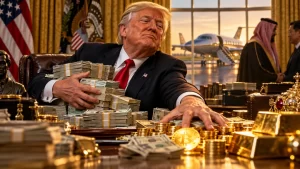
When advanced AI chips were being weighed for export to a Gulf monarchy with documented ties to Beijing, senior national security officials — including the National Security Council’s Senior Director for Technology — argued against the deal. The president overruled them. The same UAE-linked figure who stood to benefit from the chips had, weeks earlier, secretly placed $187 million directly into the Trump family’s pocket.
Get Involved Today
Contribute to our mission and turn your concerns into action.
When the FBI captured a sitting White House adviser accepting cash on video, the investigation was buried — even as the same Justice Department aggressively pursued political adversaries of the president. The signal to every federal employee, every contractor, every foreign government, is unmistakable: loyalty to Trump confers immunity; opposition to Trump invites prosecution.
This is not the absent-minded distraction of a chief executive overwhelmed by the job. It is the focused energy of a chief executive who has reorganized the job around the family balance sheet. The president has time for the work that makes him rich. He does not have time for the work that does not.
And the American people are paying — not metaphorically, but in measurable, tangible ways. They pay when AI chips that should be restricted are sold for cash on the side. They pay when a money launderer who handled funds for terrorist organizations is pardoned and allowed back into the U.S. financial system. They pay when the border czar tasked with directing billions in taxpayer-funded enforcement contracts is a man who has been recorded taking a bag of cash. They pay when the Justice Department becomes a personal weapon and the pardon power becomes a personal currency.
“Unable to Discharge the Powers and Duties of His Office”
The Twenty-Fifth Amendment, ratified in 1967, provides a constitutional mechanism by which the Vice President and a majority of the Cabinet may declare a president “unable to discharge the powers and duties of his office,” transferring authority to the Vice President as Acting President. Section 4 has never been invoked.
The framers deliberately did not define “unable” or “inability.” They left the standard open on purpose.
John Feerick, the amendment’s principal draftsman, has written that Congress declined to define the terms because incapacity could “take various forms not neatly fitting” any rigid definition. The Yale Law School Rule of Law Clinic, surveying decades of scholarship, reached the same conclusion: there is no specific threshold for inability, and the test was meant to be functional — does the totality of circumstances suggest the president cannot discharge the office’s duties to the American people?
The progressive constitutional argument here is not that corruption equals mental incapacity. It is narrower and more precise. The president’s functional ability to discharge the duties of the office requires that he be discharging the duties of the office — not the duties of his family’s crypto venture, not the duties of his private club’s membership roster, not the duties of his pardon-buyers’ legal defense. Where the president has systemically substituted personal enrichment for the work of the presidency, the question of whether he is “unable” to discharge those powers and duties is no longer purely a medical one. It is, in the original Feerick sense, a question about what is in fact happening.
Members of Congress including Sen. Elizabeth Warren, Sen. Richard Blumenthal, Sen. Chris Van Hollen, Rep. Jamie Raskin, and Rep. Sean Casten have publicly described the conduct documented by Murphy as “corruption, plain and simple” and called for sworn congressional testimony. Sen. Murphy himself has stopped short of explicitly invoking Section 4, but his diagnosis — that the White House has been converted into a 24/7 corruption operation — speaks directly to the functional standard.
The barrier is political, not constitutional. Section 4 requires Vice President J.D. Vance and a majority of Trump’s own Cabinet to make the declaration. That will not happen. The same loyalty filter that produced this Cabinet ensures it will not turn on the man who built it. But the inability of the political moment to apply the remedy does not erase the constitutional case for it. The framers wrote a flexible standard precisely because they could not foresee every form an unfit presidency might take. They wrote it for moments like this one — and the historical record will show whether the institutions that could have acted, did.
5. The Stakes for the American People
If Murphy’s catalog is accurate — and the underlying documentation, from Senate Banking Committee letters to New York Times investigations to Wall Street Journal disclosures, has been corroborated piece by piece — then the cost is not abstract.
It is measured in national security risk, every time a sensitive export decision is influenced by who paid the Trump family how much. It is measured in distorted policy, every time a crypto regulation is gutted by an SEC whose chairman attends a $500,000 club to be near the president’s son. It is measured in two-tiered justice, every time a Trump ally’s investigation is shelved while a Trump critic’s prosecution is fast-tracked. It is measured in foreign capture, every time the personal financial dependence of a sitting president on a foreign sovereign wealth fund shapes American foreign policy.
And it is measured, most corrosively, in the public’s gradual acceptance that this is just how presidencies work now. That is the bet Murphy named — that Americans will conclude every president is this corrupt, that every senator is this compromised, that the office itself is a transaction. It is a lie. The remedy is the refusal to accept it as the truth.
Editorial Conclusion
Senator Murphy did not make a partisan argument on June 23. He made a record. The receipts exist. A foreign national security official wired $187 million to the president’s family days before he took the oath. A bag of cash on FBI video produced no charges, only a promotion. A money launderer who served terror finance was pardoned by a president whose family business he had personally helped enrich. This is not a difference of policy. It is a different theory of the office. The Constitution provided remedies for a presidency that has stopped being a presidency. The political will to use them is the only thing left in question — and history will remember which senators, in which party, in which week of June 2026, decided that “the pitter patter of rain” was something they could live with.
Sources & References
- Office of Sen. Chris MurphyMurphy Details Unprecedented Corruption of Trump White House Over the Last 500 Days (full transcript)
- C-SPANSen. Murphy Gives Floor Speech on President Trump’s Corruption — June 23, 2026
- WSHU Public RadioMurphy slams alleged Trump White House corruption in Senate speech
- Raw StoryJournalist stunned by epic reach of Senator’s speech on Trump admin corruption
- CT News JunkieCT Senator Details “Unprecedented Corruption” of Trump White House in Past 500 Days
- Office of Sen. Chris MurphyMurphy on Trump’s Secret Deal with the UAE: The White House is a Non-Stop Corruption Machine
- Center for American ProgressHow Trump’s $500 Million UAE Crypto Deal Trades U.S. National Security for Family Profit
- ABC NewsWhite House faces questions over UAE royal’s investment in Trump family’s crypto firm
- Senate Banking Committee (Minority)Senate Democratic Leaders Call for Hearings into Trump Family Foreign Crypto Deals
- BenzingaSenate Democrats Demand Hearing About $500M UAE Investment in Trump Crypto Venture
- CAP — Trump’s Take TrackerTrump’s Take: Real-time financial tracker of Trump family gifts, crypto gains, and settlements
- MSNBCTom Homan was investigated for accepting $50,000 from undercover FBI agents. Trump’s DOJ shut it down.
- The New York TimesTrump Justice Dept. Closed Investigation Into Tom Homan for Accepting Bag of Cash
- House Judiciary DemocratsJudiciary Democrats Demand DOJ, FBI Release Recordings of Tom Homan Receiving $50,000 Cash Bribe
- CBS News · 60 MinutesTrump pardon of crypto billionaire sparks concerns over his use of the pardon power
- FactCheck.orgAddressing Trump’s Claims About the Pardon of Binance Founder
- CNBCDonald Trump Jr. co-founds new private members club, Executive Branch, with a $500,000 fee
- ACS / Yale Law Rule of Law ClinicThe Incapacitation of a President and the Twenty-Fifth Amendment: A Reader’s Guide
- Wikipedia · Constitutional HistoryTwenty-Fifth Amendment to the United States Constitution — drafter John Feerick on “inability”
- Cornell Law / LII25th Amendment — full text · Legal Information Institute
Related News