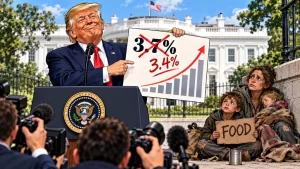
The 4.2% President: How Donald Trump manufactured America’s worst inflation reading in three years.
Energy prices accounted for over 60% of last month’s CPI surge. Behind that number sits a war the president started without Congress, tariffs the Supreme Court already ruled illegal, and a Federal Reserve being bullied to do exactly the wrong thing at the worst possible moment.
The number landed on June 10 with the dull thud of an entirely predictable disaster. The Consumer Price Index rose 4.2% over the twelve months ending in May, the Bureau of Labor Statistics reported — the fastest annual pace of price growth since April 2023. The monthly gain of 0.5% extended what is now a third consecutive month of acceleration. The Federal Reserve’s preferred gauge, the Personal Consumption Expenditures index, came in at 4.1% — also a three-year peak. Energy prices alone climbed 23.5% year over year. Gasoline soared 40.5%. By the BLS’s own accounting, energy was responsible for more than sixty percent of the monthly jump.
Inflation, in other words, is back. And to a degree that mainstream economic reporting has worked hard to obscure, it is back because of choices this president made. Not abstract global forces. Not lingering pandemic distortions. Choices. A war he ordered. Tariffs the Supreme Court struck down as illegal, then he reimposed under another statute weeks later. A Federal Reserve chair he hand-picked precisely because he believed the chair would do his bidding. The 4.2% reading is not a weather event. It is a policy outcome — and the policymaker has a name.
The president, asked recently about the data, gave a characteristically inverted account of cause and effect. “Low interest rates will solve everything, will solve that now,” he told reporters in the Oval Office. The remark was, in its way, perfectly representative. The president who lit the match wants the fire department to lower the temperature of the building.
1. A Self-Inflicted Energy Shock
To understand May’s inflation print, begin with what is not in it: the price-easing effects of any normal Middle East. The war with Iran, which began in late February, has now run for four months. American and Iranian forces exchanged strikes through the spring; the Strait of Hormuz — through which roughly one-fifth of global oil supplies traveled before the war — was effectively closed for weeks at a time, with Iranian forces resuming attacks on commercial vessels as recently as last week. Brent crude peaked above $110 a barrel in April. Gasoline at the American pump, which averaged about $2.75 last May, climbed past $4.50 at its worst.
The economist Heather Long of Navy Federal Credit Union, surveying the May report, was blunt about who was paying for this: “Americans are getting squeezed financially by inflation that’s back at a 3-year high.” The squeeze, she added, is concentrated in the basics — gasoline, food, electricity, medical care. The categories from which a household cannot opt out.
Annual rise in consumer prices in May — the highest reading since April 2023, per the Bureau of Labor Statistics.
Pump prices in May were roughly forty percent higher than the same month in 2025, per BLS data. A typical household is paying $800–$1,200 more annually just to drive.
The energy index alone accounted for more than sixty percent of May’s overall CPI increase, the BLS reported.
Senator Elizabeth Warren’s office estimates American families have spent roughly $43 billion more on gasoline alone since the war began.
It should not need to be said that this war was not foisted on the president by circumstance. It was a war of choice, launched without a congressional declaration, expanded by escalation, and — by the administration’s own admission — sustained by personal threats the president posted on social media. The Senate rejected a resolution last week that would have restricted further military action. The war continues. The oil price premium continues. The inflation continues.
2. The Tariff Tax That Wouldn’t Die
Energy is the dominant story of the May print, but it is not the only Trump-authored cost burdening the American consumer. In February, the Supreme Court ruled 6-3 that the president’s sweeping tariffs under the International Emergency Economic Powers Act were illegal. Roughly $175 billion in duties had been collected under that authority. The court’s decision should have ended the matter. It did not. Within days, the administration imposed a new ten percent tariff on imports from nearly every nation on earth, this time under Section 122 of the Trade Act, covering an estimated $1.2 trillion in annual imports.
The economic effect of these tariffs is now beyond dispute among researchers. A Federal Reserve Bank of Dallas study published in May found a “full pass-through” of tariff costs to consumers — meaning companies are no longer absorbing the levies; they are simply forwarding them to American shoppers, dollar for dollar. The Tax Foundation calculates the average household will pay $1,500 more in 2026 because of the tariffs that remain in place. An analysis from the Center for American Progress tallies premium hikes, utility increases, and grocery markups all running well above pre-tariff trend.
“Trump may love inflation, but it’s killing American families.”
— Sen. Elizabeth Warren, Senate Banking Committee, June 2026
The mechanics are simple and have been documented in every serious empirical study of the 2018–2019 trade war and its 2025–2026 sequel. As J.P. Morgan economist Murat Tasci put it, tariffs are a tax on imports whose burden “nearly always falls on domestic sellers and consumers, and not foreign producers.” The president can repeat the contrary as often as he likes. The pricing data does not.
3. Bullying the Federal Reserve
If the president were serious about lowering the cost of living, he would end the war and rescind the tariffs. Instead, he has spent the spring demanding that the Federal Reserve cut interest rates — the one move guaranteed to make the inflation problem worse. When Chair Jerome Powell refused to comply, the Trump Justice Department opened a pretextual criminal investigation into Powell’s testimony about Fed building renovations. The investigation was dropped in May in exchange for the confirmation of Kevin Warsh as Powell’s successor. Warsh was sworn in at the White House on May 22 — the first Fed chair to take the oath there since Alan Greenspan in 1987.
The president made his expectations plain at the ceremony and again at a rally the same evening, predicting rates would come down “very quickly.” They did not. At its June 17–18 meeting, the Federal Open Market Committee held the federal funds target at 3.5–3.75 percent. Nine of the committee’s members now project at least one rate hike before year’s end. Only one anticipates a cut. CME FedWatch puts the odds of a December hike at 79 percent. The odds of a cut: zero.
Warsh, to his credit, did not deliver what the president demanded. In carefully phrased remarks after the meeting, he noted that inflation reflects “supply shocks that have driven price increases” — supply shocks the Fed cannot fix with monetary policy, and which the president himself has caused. As Slate’s economic columnist observed, Warsh’s message was unmistakable even without naming the president: the inflation problem is sitting at the other end of Pennsylvania Avenue.
“Monetary policy independence is essential. Monetary policymakers must act in the nation’s interest.”
— Kevin Warsh, Fed Chair, confirmation hearing
Imagine, briefly, that Warsh complied. Imagine the Fed cut rates by even fifty basis points into a 4.2-percent inflation print. The dollar would weaken. Imported goods — already being marked up by tariffs — would cost more in dollar terms. Long-term Treasury yields would likely rise as bond markets repriced inflation risk, lifting mortgage rates rather than lowering them. Inflation expectations, which the Fed has spent three years grinding back toward target, would unmoor. The president’s preferred remedy is not a cure. It is an accelerant.
Get Involved Today
Contribute to our mission and turn your concerns into action.
5. A Summer of Pain
The near-term outlook is not catastrophic, but it is not improving fast. After a tentative U.S.-Iran memorandum of understanding restored partial traffic through the Strait of Hormuz, oil prices have softened. The national average for regular gasoline has fallen roughly 58 cents from its peak. The Personal Consumption Expenditures report, due in late June, is expected to confirm that May was the peak of the headline inflation surge. That is the optimistic case.
The pessimistic case is that the optimistic case requires the Iran agreement to hold — and Iranian forces struck a cargo vessel in the strait again last Thursday. It requires no further escalation in the Middle East. It requires the tariff pass-through, which Federal Reserve researchers say typically takes roughly seven months to reach the shelf, to peak rather than continue building. It requires the administration not to add new tariffs — pharmaceuticals are reportedly under review for rates that could reach 200% — and not to escalate again abroad.
Ernst & Young’s macroeconomic team forecasts headline inflation will remain above 4% in June while core inflation approaches 3%. Oxford Economics’ Nancy Vanden Houten, writing to clients after the May report, said core inflation may have peaked but “will be slow to decline.” None of these forecasts assume Trump suddenly governs in a manner conducive to price stability. They assume he does not actively make things worse.
For ordinary Americans, what this means concretely is a third consecutive year in which the cost of essentials outruns wage growth. It means renewed pressure on the household budgets that Trump promised — repeatedly, on the 2024 campaign trail — he would relieve “on day one.” It means the affordability crisis that he ran against is now a crisis he is causing. And it means his administration, in its first eighteen months, has measurably reduced the purchasing power of the workers who put him in office.
What the framers of Section 4 meant by “unable” — and why economic incoherence is exactly the kind of inability they had in mind.
Section 4 of the Twenty-Fifth Amendment authorizes the Vice President, together with a majority of the Cabinet — or, as the text explicitly permits, “such other body as Congress may by law provide” — to declare that the President is “unable to discharge the powers and duties of his office.” Upon that declaration, the Vice President immediately assumes the powers of the presidency as Acting President.
The amendment never defines “unable” or “inability.” The drafters, led by Senator Birch Bayh in 1965, did this deliberately. As the legislative history makes clear, they refused to confine the concept to coma or surgery. They wrote a constitutional safety valve broad enough to cover what they could not yet name — including the possibility, raised in committee testimony, of a president whose judgment had so deteriorated that he could no longer reliably weigh the consequences of his own actions.
Who has called for its consideration:
- Rep. Jamie Raskin (D-Md.), ranking member of the House Judiciary Committee, introduced legislation on April 14 establishing the long-dormant Section 4 commission. The bill has 50 House Democratic co-sponsors.
- More than 70 House Democrats publicly called for the president’s removal in April after his “whole civilization will die” social media threats against Iran, according to The Hill.
- Sen. Elizabeth Warren (D-Mass.), while not invoking the amendment by name, has documented a pattern of presidential conduct — installing a hand-picked Fed chair, threatening to fire him when he wouldn’t comply, ordering pretextual investigations of regulators — that she has called incompatible with the rule of law.
The constitutional argument: The case for invoking Section 4 has always rested on a question of capacity, not popularity. The relevant inability is not unpopularity, nor disagreement with policy, nor even ordinary recklessness. It is the inability to discharge the duties of the office competently — which includes the constitutional duty to “take Care that the Laws be faithfully executed” and to discharge the office’s economic stewardship in good faith. A president who orders an undeclared war that spikes domestic energy prices by forty percent, then publicly demands the Federal Reserve respond by cutting interest rates, which would further increase inflation, has plausibly demonstrated an inability to perform basic policy reasoning. That is not a partisan claim. It is a description.
The practical barriers are real. Section 4 requires the concurrence of the Vice President. The current Vice President is not going to provide it. The Republican-controlled Congress will not pass the Raskin bill creating the alternative “body” the amendment contemplates. Even if it did, the president would veto it, and an override would require a two-thirds vote in both chambers that does not exist. Constitutional remedies require a political coalition willing to use them, and that coalition does not currently exist in Washington.
Why the barriers do not negate the case. The constitutional argument and the political question are separate. The amendment’s drafters wrote a tool for a reason. The case for its applicability now is not a hypothetical exercise; it is a sober reckoning with what the office is for, what it requires, and what is being done to it. A self-governing republic must be able to name the condition of its own government plainly, even when the immediate political mechanics for correcting it are blocked. The 4.2% inflation reading is, among other things, an entry in that ledger.
6. A Question of Priorities
What does any of this tell us about the leadership of the country? Consider what the president has talked about, publicly, while the May data was being compiled. He has talked about the construction of a “ceremonial arch” on federal land. He has talked about the specific Italian marble being procured for a redesigned White House ballroom. He has, by his own account, told reporters that he “loves” inflation and that affordability is a “made-up word.” He has insulted the Pope. He has, in the same period, lost a Supreme Court case on his tariffs and refused to honor it. He has installed a Federal Reserve chair he expected to be subservient and reacted with public irritation when that chair turned out to take his oath seriously.
These are not the priorities of a president focused on the cost of milk, of gasoline, of a mortgage. They are the priorities of someone whose attention has wandered from the actual work of governing. Last week, when asked about the inflation report, the president argued that “whenever you do great, they want to raise interest rates” — a sentence whose connection to the situation is, to put it gently, unclear.
The fundamental question, then, is not whether the president agrees with the Federal Reserve about interest rates. It is whether he is capable of describing the country he leads, the policies he has authored, and the consequences of those policies in terms that have any relationship to observable reality. Six months of economic data — the 4.2% reading, the energy shock, the tariff pass-through, the Fed’s quiet pivot toward a rate hike — suggest that he is not. And the data sit in a frame of presidential conduct that has, by any honest measure, grown more erratic, not less.
Editorial Conclusion
The 4.2% inflation reading is not a forecast error or a global accident. It is the predictable, documented consequence of decisions one man made: a war he started, tariffs he reimposed after the Supreme Court struck them down, and an attempt to convert the central bank into an instrument of personal will. Each of these decisions Americans will pay for, in dollars, over the rest of this summer and beyond.
The Constitution provides a vocabulary for moments like this one. Section 4 of the Twenty-Fifth Amendment was written, deliberately, in language broad enough to cover what we are watching. The political conditions for invoking it do not yet exist. The constitutional case for considering it does. A democracy that cannot name its own crisis will not be permitted to solve it. The naming is where the work begins.
Sources & References
- NBC News — May Inflation Report: PCE at three-year high as oil prices push costs higher
- CNBC — CPI Inflation Report May 2026: Prices rose 4.2% annually
- Fox Business — May 2026 CPI inflation: BLS report shows consumer prices rose last month
- CBS News — Inflation topped 4% in May as CPI surged to highest in three years
- CBS News — Fed’s preferred inflation gauge shows prices at fastest pace in three years
- Kiplinger — May CPI shows inflation rose at its fastest pace in three years
- Ernst & Young — Consumer Price Index May 2026: macroeconomic analysis
- CNBC — Trump eases pressure on Fed Chairman Kevin Warsh as inflation tops 4%
- Yahoo Finance — Fed Isn’t Cutting Rates Anytime Soon; Warsh subtly blames Trump
- CNBC — Trump swears Kevin Warsh in as Fed chair, seeking interest rate cuts
- Slate — Federal Reserve’s Kevin Warsh defies Donald Trump with interest-rate decision
- Al Jazeera — Trump’s Fed nominee Warsh vows independence at Senate hearing
- CNBC — U.S. strikes in Iran revive fears over Strait of Hormuz oil shock
- CBS News — Iran strikes vessel in Strait of Hormuz amid Trump’s transit fees dispute
- Tax Foundation — Tariff Tracker: 2026 Trump tariffs and trade war by the numbers
- Fortune — Fed researchers see “full pass-through” of Trump’s tariff costs to consumers
- J.P. Morgan Global Research — US Tariffs: What’s the Impact?
- Center for American Progress — Eight Ways Trump’s Turbulence Tax is Costing the Economy
- House Judiciary Democrats — Raskin introduces Commission on Presidential Capacity bill
- The Hill — Raskin bill proposes 25th Amendment fitness panel for president
- Senate Banking Committee — Warren slams Trump’s failed economic agenda at affordability hearing
- Senate Banking Committee — Warren remarks at Exchequer Club on state of the economy
Related News