A new ProPublica investigation documents an administration quietly refusing to spend billions in foreign aid that President Trump himself signed into law. The Constitution calls Congress the power of the purse. The White House, the Office of Management and Budget, and the State Department are calling that bluff — and the constitutional crisis is no longer creeping. It is here.
The United States Constitution does not contain a footnote permitting the President to ignore the bills he signs into law. There is no asterisk after Article I, Section 9. The power of the purse belongs to Congress, period — a deliberate choice by the framers, who had just freed themselves from a king who taxed and spent at whim and saw no reason to trade one monarch for another. And yet, eight months into the current fiscal year, ProPublica reports that President Donald Trump’s administration is refusing to spend much of the $9.4 billion in global health funding and more than $5 billion in emergency humanitarian aid that Trump personally signed into law in March 2025.
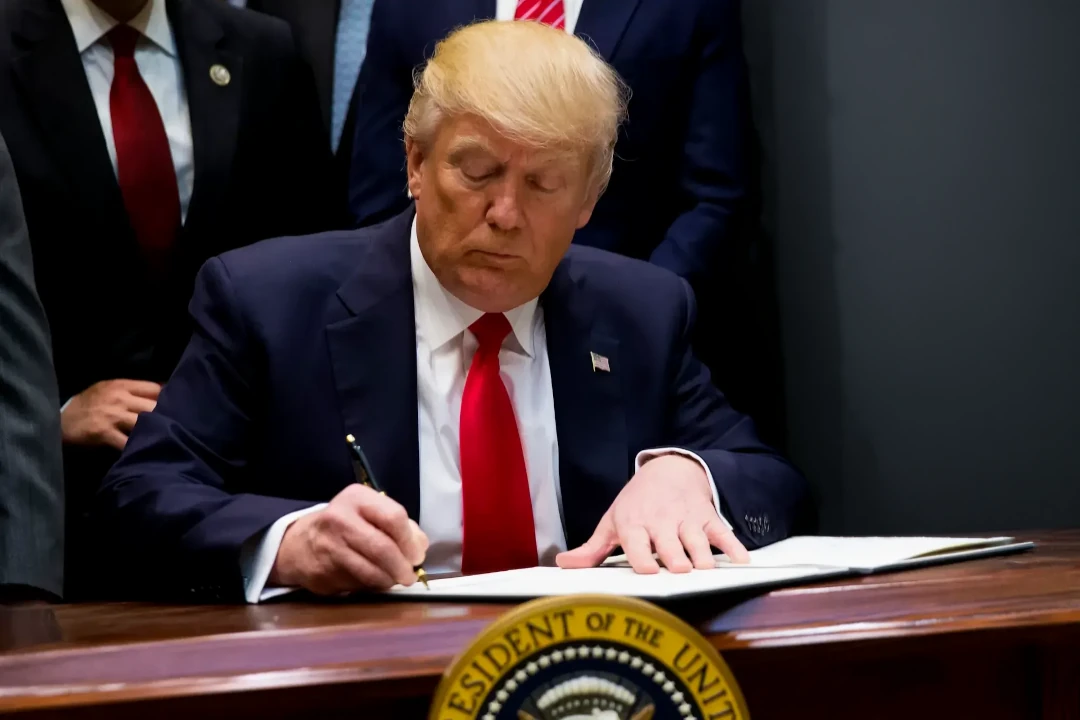
The administration asked Congress for permission to shut down the U.S. Agency for International Development entirely. Congress — a Republican-led Congress — said no. Lawmakers wrote into the bill exactly how much was to be spent and on what: HIV, tuberculosis, malaria, family planning, nutrition, neglected tropical diseases. They demanded reports on how the money was being spent. Trump signed the bill. Then his officials simply began ignoring its terms.
This is not an administrative footnote. It is, in the words of Georgetown law professor and constitutional scholar David Super, a “huge grab of power” — an attempt by the executive branch to relocate to itself, unilaterally, an authority the Constitution placed squarely with the legislature. And it is happening in plain view.
1. The Law Trump Signed, Then Abandoned
The numbers are not in dispute, and the source is not partisan. ProPublica’s review of government records, internal documents, and interviews with current and former officials found that of the more than $9 billion that Congress directed the administration to spend on global health, just $190 million had been obligated by the end of March 2026 — roughly five percent of the pace set in the five years before Trump returned to office. A separate analysis by the Health Security Policy Academy reached a similar conclusion.
Congress earmarked specific pots of money — $524 million for family planning, $165 million for nutrition, $109 million for neglected tropical diseases. Officials, ProPublica found, have made “little or no effort” to spend from them. The President’s Emergency Plan for AIDS Relief (PEPFAR), the George W. Bush-era program credited with saving 26 million lives, received half the available funding it was supposed to get, according to its former chief scientific officer, Dr. Mike Reid.
The Global Fund to Fight AIDS, Tuberculosis and Malaria — to which Congress directed Secretary of State Marco Rubio to contribute “in a timely manner” — is, according to a board member and to congressional staff, underfunded by $661 million. When Senator Brian Schatz of Hawaii confronted Rubio at a recent hearing, Rubio said the money would “move shortly, very quickly.” It has not.
“It is a huge grab of power from the president, taking powers away from Congress.”
— David Super, Professor of Law and Economics, Georgetown University, to ProPublica
2. The Men Building the Stranglehold
The names matter. The architects of this defiance are not anonymous; they are men with résumés, titles, and email addresses, and they should be answerable for what they have done.
Russell Vought, director of the Office of Management and Budget, is the intellectual and operational engine. As ProPublica has chronicled in a separate investigation, Vought holds an expansive view of presidential authority and has spent years arguing that the executive branch is constitutionally entitled to refuse to spend money Congress appropriates. His OMB has labeled more than half a billion dollars in global health funds as “unallocated” — bureaucratic shorthand for “frozen until Vought says otherwise.” Last year, after USAID was dismantled, Vought briefly served as its acting administrator, overseeing the agency’s destruction from within.
Marco Rubio, Secretary of State, has repeatedly promised Congress that lifesaving aid would continue. The record shows it has not — at least not at the pace, scale, or direction Congress required. When pressed by Senator Schatz on the Global Fund shortfall, Rubio gestured toward Vought’s OMB; Schatz, as ProPublica reports, immediately reminded him that Rubio had successfully wrestled funds back from OMB to respond to an Ebola outbreak, which “demonstrates you are perfectly capable” of releasing the money when he chooses.
Jeremy Lewin, a 29-year-old lawyer with no prior humanitarian experience, came into government via Elon Musk’s Department of Government Efficiency and now effectively runs U.S. foreign assistance. He has never been nominated for the role, has not been confirmed by the Senate, and rarely meets with the career staff he supposedly directs. He has, ProPublica reports, insisted on personally approving even routine payments — creating, in effect, a one-man bottleneck over billions of dollars in lifesaving aid.
Eric Ueland, a Vought deputy at OMB, currently performs the duties of USAID administrator — a job the law says belongs to a Senate-confirmed appointee.
This is, by design, an administration of acting officials, performing-the-duties-ofs, and 29-year-olds with no accountability to the Senate that the Constitution requires to confirm them. It is a workaround as a governing philosophy.
3. The Cost at the Kitchen Table
One of the most cynical lies in American politics is the claim that foreign aid is a giveaway to foreigners that takes nothing from Americans. The reverse is closer to the truth: USAID has long been one of the most reliable customers of American farmers, manufacturers, and shipping companies, and the destruction of those purchasing relationships is being felt in red counties from Kansas to Oklahoma to Iowa.
The U.S. Global Leadership Coalition documents that more than 80 percent of USAID contracts went to American companies, generating $28.9 billion in domestic economic activity. The Institute for Development Impact estimates that gutting USAID puts more than 200,000 American jobs at risk and could cost the United States $23 billion in lost exports.
Reporting from AgWeb and the Iowa Capital Dispatch tells the story in concrete terms: Oklahoma wheat rotting in silos, Minnesota peas abandoned by processors who shifted to Canadian suppliers, sorghum prices on the Chicago Mercantile Exchange dropping after $950 million in undelivered contracts collapsed. Senator Jeanne Shaheen reported last summer that food rations sufficient to feed three and a half million people for a month were sitting in warehouses, going bad, because the administration would not release them.
And in a moment of pure dark farce — though “farce” understates the cruelty — Senator Schatz reported on the Senate floor in July 2025 that the administration was about to incinerate 500 metric tons of American-grown food aid that had been allowed to expire in storage. Food grown in Iowa, Kansas, and Texas, bearing the United States emblem, was to be set on fire rather than fed to starving people. This is what is being done with the taxes Americans pay to support their own farmers.
Get Involved Today
Contribute to our mission and turn your concerns into action.
4. The Cost in Lives — and in American Power
The human cost is staggering. Senator Schatz, as ranking member of the Senate subcommittee overseeing foreign aid, has stated on the floor that more than 360,000 people had already died as a direct consequence of the USAID dismantling, the funding cuts, and the supply interruptions. The Center for American Progress, citing tracking data, placed the figure at 600,000 deaths by November 2025, two-thirds of them children. Oxfam projects that without USAID, as many as 95 million people will lose access to basic healthcare, potentially leading to more than three million preventable deaths every year.
These are not abstractions. These are the people PEPFAR’s antiretroviral therapies kept alive. They are the malaria patients waiting for treated bed nets. They are the children who will not be fed because the food sits in a Houston warehouse. The Trump administration’s defiance of Congress is not a fiscal dispute; it is a body count.
Meanwhile, every dollar the United States declines to spend is a dollar of soft power surrendered. The Spanish think tank Real Instituto Elcano, in an analysis published in December 2025, concluded that the cuts have produced a “vacuum increasingly filled by rivals, particularly China.” The Senate Foreign Relations Committee’s 2026 China Report reached the same conclusion in more diplomatic language: the administration’s foreign-aid cuts and treatment of allies have, in the committee’s words, “hollowed out” the very institutions America relies on to compete. China has already moved to fill some of the void — sending aid to Myanmar after an earthquake, extending zero-tariff policies across Africa, signing infrastructure deals in the Indo-Pacific.
The administration’s defenders insist this is “America First.” The data says it is America alone, America diminished, and America surpassed.
5. How We Got Here
The current crisis did not appear on June 22, 2026. It is the product of eighteen months of escalating defiance, each step laying the groundwork for the next. The pattern is the point.
“They should not be able to evade judicial “Congress has said spend the money, and the president doesn’t want to. Under the law, Congress is supposed to win. Right now, the president is.”
— Cerin Lindgrensavage, former Justice Department attorney, Protect Democracy
6. A Constitutional Crisis, Plainly Stated
Strip away the agency acronyms and the budget jargon and what remains is a simple proposition: a President of the United States is refusing to follow a law he himself signed. The Office of Management and Budget is using legally dubious maneuvers — including the “pocket rescission” that the Government Accountability Office has formally stated is illegal — to override the Impoundment Control Act of 1974, the very statute Congress passed in response to Richard Nixon’s last great attempt at exactly this kind of executive overreach.
Several constitutional scholars told ProPublica these moves “likely violate the law.” Bobby Kogan, a former Biden-era OMB adviser now at the Center for American Progress, framed the stakes with brutal clarity: if you withhold funds for a year and the clinics close, then, he said, the people who depended on those clinics die.
Yet Congress — the Republican-controlled Congress whose own authority is being usurped — has, with rare and notable exceptions, declined to fight back. Senate Foreign Operations Subcommittee Chair Lindsey Graham did not respond to ProPublica’s repeated requests for comment. The very institution whose constitutional prerogative is being annexed is, for the most part, sitting on its hands. The administration has, in effect, calculated correctly: that the political costs of defying Congress are lower than the political benefits of dismantling foreign aid for an audience of one.
This is what a constitutional crisis looks like in slow motion. Not tanks in the streets. A line item ignored. A letter unanswered. A deadline missed. A child, eventually, dies. And the next budget bill comes around, and the cycle repeats, and Article I quietly empties out.
“Unable to Discharge the Powers and Duties of His Office”
The Twenty-fifth Amendment, ratified in 1967, provides in Section 4 that whenever the Vice President and a majority of the Cabinet — “or such other body as Congress may by law provide” — declare in writing that the President “is unable to discharge the powers and duties of his office,” the Vice President shall immediately assume those powers as Acting President.
Here is the point that those who dismiss the 25th Amendment as a remedy for “stroke or coma only” tend to elide: the amendment does not define the word “unable.” It does not define “inability.” This was not an oversight. Yale Law School’s Rule of Law Clinic, after consulting closely with John D. Feerick — the principal drafter of the amendment and its preeminent commentator — concluded in its authoritative reader’s guide that the framers “expressly disclaimed any intent to define ‘inability.’ They purposefully set forth a flexible standard intentionally designed to apply to a wide variety of unforeseen emergencies.”
Feerick himself has written, as Fordham Law’s published analysis records, that the terms “unable” and “inability” are undefined “not as the result of an oversight, but rather a judgment that a rigid constitutional definition was undesirable, since cases of inability could take various forms not neatly fitting into such a definition.” Senator Birch Bayh, the amendment’s principal Senate sponsor, agreed. So did Rep. Richard Poff, who said on the record that Section 4 was meant to cover not only the president rendered unconscious by accident, but also the president who “by reason of mental debility, is unable or unwilling to make any rational decision.”
The drafters chose vagueness on purpose. They feared a too-narrow definition would lock out exactly the kind of slow-motion incapacity that an honest reading of the present moment would recognize.
And the present moment is increasingly hard to look at honestly. On April 30, 2026, 36 physicians — neurologists, psychiatrists, and cognitive specialists from Harvard, Tufts, Columbia, and George Washington University — filed a statement into the Congressional Record describing the President’s “rapidly worsening, reality-untethered, increasingly dangerous decline” and explicitly calling for the 25th Amendment. They are not partisan operatives. They are doctors, with their licenses on the line, and they had access to no patient — only to a public record. House Judiciary Ranking Member Jamie Raskin has introduced legislation establishing precisely the “other body” the Constitution contemplates: a bipartisan, independent commission on presidential capacity. Fifty House Democrats cosponsored.
The practical barriers are real and worth naming honestly. The current Vice President is Trump’s hand-picked partisan ally. A majority of the Cabinet was selected for loyalty, not independence. Even if both moved against the President, a two-thirds vote of both houses of Congress would be required to keep him sidelined — and those houses are Republican-controlled. Raskin’s commission bill, like every other 25th Amendment effort of this era, will not pass. We should be honest about that.
But practical barriers do not negate the constitutional argument, and the absence of a likely political victory does not erase a moral and legal record. The defiance of Congress on foreign aid is not isolated. It is one item in a pattern that includes the threatening of allies, the war powers violations, the manic-late-night communications, the threats to extinguish civilizations, the substitution of acting officials for confirmed ones, the personal control over billions in spending. A president who signs a law and then refuses to follow it, who governs through acting officials he has not bothered to nominate, who treats appropriated dollars as a personal allowance — that president is, in the most direct constitutional sense, demonstrating an inability to discharge the powers and duties of his office. The word “unable” is broad enough. The drafters made sure of it.
Editorial Conclusion
The constitutional crisis is not a future event to be guarded against. It is a present condition to be answered. When a president signs a law and then refuses to execute it, the question is not whether the Constitution has been broken. The question is whether anyone in a position to do something about it will act.
Congress must use every tool it has — appropriations, oversight, subpoena, contempt, and yes, the bipartisan commission on presidential capacity the 25th Amendment expressly contemplates. The federal courts must rule, and rule plainly, on the legality of pocket rescissions and “unallocated” designations. Voters in 2026 and beyond must understand that the men named in this article — Vought, Rubio, Lewin, Ueland — are not bureaucratic afterthoughts. They are the operating architecture of an executive branch that has decided the law is optional.
The framers wrote Article I first for a reason. They wrote the 25th Amendment in language deliberately broad enough to cover what they could not yet foresee. The tools exist. The record is documented. The deaths are real. What remains is the will to act before the rule of law itself becomes another item on the list of things this administration has decided it can ignore.
Sources & References
- ProPublica Barry-Jester, “‘A Huge Grab of Power’: Trump Is Defying Congress on Foreign Aid” (June 22, 2026).
- U.S. Senate Sen. Schatz, “17 Senators Demand Trump Administration Comply With Law on Foreign Assistance” (April 24, 2026).
- U.S. Senate “USAID Funding Letter to OMB Director Vought and Secretary Rubio” (April 24, 2026).
- U.S. Senate Sen. Murphy, “Murphy Demands Trump Administration Comply With Law on Foreign Assistance” (April 24, 2026).
- U.S. Senate Sen. Schatz, “Senate Floor Speech on USAID and DOGE Cuts” (July 16, 2025).
- TIME Sen. Schatz, “Trump’s Dismantling of USAID Is Not About Efficiency” (March 2026).
- The Hill “Advocates Urge USAID to Release $19 Billion for Lifesaving Aid” (May 11, 2026).
- USGLC “International Assistance Cuts Hurt American Farmers, Workers and Businesses” (March 2025).
- Institute for Development Impact “Dismantling USAID: Consequences for Americans and Global Development” (February 2025).
- Oxfam America “What Did USAID Do and What Are the Effects of USAID Cuts?” (2026).
- AgWeb “USAID Dismantling: What It Means for Farmers and Ag Research” (February 2025).
- PBS NewsHour “Could the 25th Amendment Be Invoked Against Trump? Here’s How It Works” (April 2026).
- Yale Law School “Rule of Law Clinic Releases Reader’s Guide for the 25th Amendment” (2025).
- Constitution Annotated “Overview of Twenty-Fifth Amendment, Presidential Vacancy and Disability” (Library of Congress).
- The Hill “Raskin Introduces Bill to Assess President’s Fitness Under 25th Amendment” (April 14, 2026).
- U.S. House “Raskin Demands White House Physician Evaluate Trump’s Cognitive Fitness” (April 10, 2026).
- The Hill “Concerns Grow Over Trump’s Mental Fitness for Presidency” (June 2026).
- Real Instituto Elcano “America Adrift: Trump, DOGE and the Sweeping Cuts to US Foreign Assistance” (December 2025).
- Center for American Progress “Trump Global Weakness Watch: How Trump Is Undermining American Power” (2026).
- Senate Foreign Relations “China Report 2.0” (March 2026).
- GAO “What Is a Pocket Rescission, and Is It Legal?” (2025).
- New York Times “Supreme Court Allows Foreign Aid Clawback to Proceed” (September 8, 2025).
Related News