For eighty years, the architecture of Western security — NATO, the dollar order, America’s word — has been the inheritance of every president who walked into the Oval Office. In eighteen months, this one has set fire to the lot, and the only question left is whether the Constitution still contains a tool equal to the wreckage.
The men who designed the postwar world were not idealists. They were the survivors of two industrial wars on the European continent that had killed something like a hundred million people, and they had reached a hard-won conclusion: a great power that hoards its strength behind two oceans is a great power that eventually has to send its sons back across them. NATO, the Bretton Woods institutions, the United Nations Charter, the network of forward bases and defense treaties that bound Japan, Korea, the Philippines, Australia, and most of Western Europe to American security — all of it was an attempt, sometimes clumsy and sometimes brutal, to make the third world war impossible by making the first two unrepeatable.
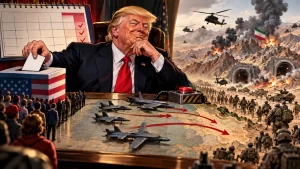
That entire inheritance has been treated by the second Trump administration as an inconvenience. Not as a flawed structure to be reformed; not as a set of bargains to be renegotiated. As a hostage. As leverage. As something whose chief value is what can be extracted by threatening to demolish it. For the second time this calendar year, the President of the United States has threatened to blow up NATO over a foreign policy adventure of his own choosing — first Greenland, now the Iran war he launched without consulting allies and then demanded those allies finish for him. He has called the alliance “a paper tiger.” He has pulled the dollar’s exchange rate down roughly ten percent in eighteen months. He has driven America’s net favorability in Canada down by more than thirty points in a single year. And his own physician has been formally asked, in writing, by the ranking Democrat on the House Judiciary Committee, to evaluate whether the president is still cognitively capable of the duties he is performing.
This is not a partisan complaint about a presidency Americans dislike. This is a structural account of what has been broken, who is naming the damage, and what the Constitution actually says about a president who can no longer discharge the powers and duties of the office. The drafters of the Twenty-fifth Amendment did not define those words — and as the historical record makes abundantly clear, they did not define them on purpose.
1. The Alliance He Inherited, the Alliance He Is Breaking
NATO is the load-bearing wall of the postwar order. It was conceived in 1949, in the immediate aftermath of a war that killed roughly sixty million people, to ensure that no future war in Europe would be fought without the United States already standing on the line. Article 5 — the clause stating that an attack on one is an attack on all — was invoked exactly once in seventy-seven years of the alliance, and the country it was invoked to defend was the United States, after September 11, 2001. NATO members, including Denmark, sent troops and took casualties at rates comparable to American forces.
President Trump’s posture toward this alliance has been openly hostile since his first term. But in his second, the hostility has become operational. In January 2026, in remarks at the World Economic Forum in Davos, he revived his demand to “take” Greenland — a self-governing territory of NATO ally Denmark — and refused to rule out the use of force or economic coercion against a fellow member state. According to former NATO Secretary-General Anders Fogh Rasmussen, “it was unheard of that the leader of the biggest ally within a collective defence organisation threatens another ally with the aim to grasp land by force.” Had Trump pushed through, Rasmussen said plainly, “it would be the end of NATO.”
Then came February. The United States, in concert with Israel, launched strikes against Iran without informing allies in advance. NATO was kept in the dark by its own leader, then publicly castigated for failing to assist a war it had not been asked to plan. Spain closed its airspace to U.S. aircraft involved in the operation. Germany’s defense minister Boris Pistorius said, “This is not our war, we have not started it.” Trump responded by calling NATO “a paper tiger” and, according to a White House statement to Axios, declaring that the alliance had been “tested” and had “failed.” By April, the president was publicly asserting that he was “strongly considering” withdrawing the United States from the treaty entirely — a step that, thanks to a 2023 statute championed by now-Secretary of State Marco Rubio when he was a senator, Trump cannot legally take without congressional approval.
But as Ivo Daalder, the former U.S. ambassador to NATO under President Obama, told NPR, you do not need to leave the alliance to break it. You only need to make the allies stop believing in Article 5. And that, by every available measure, has already happened. The president’s own remarks at The Hague summit last June — when asked whether the United States would defend allies who failed his arbitrary spending tests, he replied “Depends on your definition” of Article 5 — were heard by every chancellery in Europe exactly as intended. Allies are now planning around the United States rather than with it. France has revised its nuclear posture. Finland’s president has openly discussed a separate alliance. Canadian Prime Minister Mark Carney, the leader of America’s closest neighbor, has begun publicly speaking of a Western security architecture in which Washington is no longer the center of gravity. NATO, as a Canadian defense analyst told NPR, has begun doing military contingency planning that takes the United States as a potential adversary rather than as a partner. Read that sentence twice.
“Something fundamental has broken. Trump doesn’t believe America’s security depends on the security of Europe — a position that defies decades of foreign policy logic going back to the end of World War II.”
— Ivo Daalder · Former U.S. Ambassador to NATO · NPR, May 2026
The damage is not theoretical and it will not stop when this presidency does. Daalder’s warning — that the erosion of trust “is going to linger” beyond the Trump era — reflects an institutional truth about alliances: they are not contracts, they are habits of confidence. Once allies have internalized that an American president can, on a whim, threaten to invade a member state or refuse to honor a treaty obligation, no future president can restore the assumption that America’s word holds. The architecture is still standing. The foundation has been cracked.
2. The Dollar, the Treasury, and the Erosion of Trust
The second great pillar of the postwar order is financial. Since the Bretton Woods conference of 1944, the U.S. dollar has been the world’s reserve currency, the unit in which international debts are denominated, oil is priced, and central banks store their savings against rainy days. This is sometimes called America’s “exorbitant privilege.” It means we borrow more cheaply than any other country on earth, that our sanctions have global reach, and that when crisis hits, the world buys dollars, not sells them. The privilege is not a force of nature. It is a vote of confidence in the predictability, the rule of law, and the institutional sobriety of the United States government.
That confidence is now being actively dismantled. According to Brookings, the dollar has fallen roughly ten percent on a broad, trade-weighted basis since the start of President Trump’s second term — a decline that has come in “short, sharp bursts that have been very unnerving” for a currency of the dollar’s size and liquidity. The first burst followed the chaotic April 2025 rollout of so-called “Liberation Day” tariffs. The second came in January 2026 during Davos, when the president escalated his rhetoric about seizing Greenland and threatened tariffs on European allies who opposed him. In response, as The New Republic reported, U.S. bond prices fell, the Dollar Index dropped, and American stocks tumbled. Analysts have given it a name: the “sell America” trade.
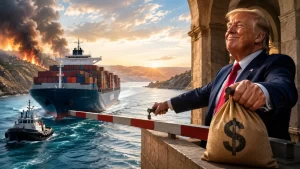
The tariffs themselves have functioned as an unannounced tax increase on American households. According to the Tax Foundation’s running tracker, Trump’s tariffs amounted to an average per-household tax burden of roughly $1,500 in 2026 — the largest U.S. tax increase as a share of GDP since 1993. They were imposed under emergency-powers statutes that the Supreme Court, in a 6-3 decision in February 2026, ruled the president had no authority to invoke. The administration responded by switching to a different statute. Procter & Gamble’s CFO told investors that tariffs alone represent a five-point drag on fiscal 2026 earnings per share. General Motors absorbed $3.1 billion in tariff costs in 2025 alone. The costs are being passed to consumers; the political theater of “Liberation Day” is being subsidized by the family budgets it was supposed to liberate.
Dollar down 10% on trade-weighted basis
The greenback has fallen roughly ten percent against major currencies since Inauguration Day 2025, in two sharp episodes tied directly to tariff chaos and the Greenland threats. Source: Washington Post
Tariffs cost $1,500 per family in 2026
The Trump tariff regime is the largest U.S. tax increase as a share of GDP since 1993, paid by American consumers and small businesses, not by foreign exporters. Source: Tax Foundation
U.S. sovereign default risk now exceeds peers
Credit-default-swap pricing on five-year U.S. sovereign debt rose from lowest-risk in the G7 in 2021 to the highest in 2025. America’s “exorbitant privilege” is being actively unwound. Source: Cambridge / Int’l Organization
Dollar share of FX reserves at two-decade low
Central banks are quietly diversifying — into gold, into smaller currencies, and into hedged baskets. The structural foundations of dollar dominance are being weakened across three dimensions simultaneously. Source: J.P. Morgan
The deeper risk is not the day-to-day exchange rate. It is the slow corrosion of what Karen Petrou, co-founder of Federal Financial Analytics, identified as the precondition for reserve-currency status: “clear rule of law, and policy predictability. And the latter two are a lot less clear these days.” A peer-reviewed analysis in Cambridge University’s International Organization journal, titled with admirable bluntness “Dollar Diminished: The Unmaking of US Financial Hegemony Under Trump,” puts the matter at the level of principle: the second Trump administration’s erratic policies “force states and private actors alike to reconsider their reliance on the dollar,” with the result that “the dollar’s global role is now challenged across all three dimensions simultaneously” — as a payments currency, as a reserve asset, and as a funding currency. The president’s threats against Federal Reserve Chair Jerome Powell, his likely-unconstitutional firing of Fed Governor Lisa Cook, and his attempts to politicize American central-banking independence — these are not domestic squabbles. They are signals to every reserve manager from Riyadh to Singapore that the United States no longer separates politics from monetary policy. Other countries are quietly making other plans.
3. A Reputation Squandered in Eighteen Months
If alliances are habits of confidence and reserve status is a vote of trust, then the third pillar — America’s standing in the eyes of the rest of the democratic world — is the political weather that surrounds them both. And that weather has changed faster than at any point since the second Iraq War.
The Pew Research Center’s spring 2025 polling of twenty-four countries found that ratings of the United States dropped in fifteen of them, with declines of twenty percentage points or more in Mexico, Sweden, Poland, and Canada. By the time Ipsos conducted its annual global survey for the Halifax Security Forum in October 2025, the proportion of respondents across thirty countries who saw the U.S. as a positive influence had fallen twelve points in a single year — from sixty percent to forty-eight percent. In Canada, the figure cratered by twenty-eight points; only twenty-four percent of Canadians now believe the United States will have a positive impact on the world over the next decade. Among Americans themselves, the figure fell nine points to sixty-eight.
This is the country, remember, that fought a world war to discredit the principle that great powers may simply take territory from smaller ones. The Pew survey found that majorities in twenty-one of twenty-four countries surveyed described Trump as “dangerous.” Sixty percent or more in twenty-one countries described him as “arrogant.” In Sweden and Germany, two of America’s closest democratic partners, confidence in the U.S. president to handle world affairs fell from sixty-three percent under President Biden to fifteen and eighteen percent respectively. These are not normal swings. These are the numbers a country produces when its allies have begun to discount it.
4. The Reward for the Aggressor
The blunt geopolitical fact of this presidency is that its conduct has materially benefited the one foreign leader whose entire program is the destruction of the postwar order: Vladimir Putin. Putin began his second war on Ukraine in 2022 with the explicit objective of overturning the principle, settled at the cost of tens of millions of lives, that borders in Europe could not be redrawn by force. The Biden administration, for all its caution, organized a Western coalition that armed Ukraine, sanctioned Russia, and held the line. The Trump administration has spent eighteen months methodically dismantling that line.
Get Involved Today
Contribute to our mission and turn your concerns into action.
The president has held a summit with Putin in Alaska. He has temporarily lifted sanctions on Russian oil exports to India. His national security strategy, released in December 2025, downplays the threat Russia poses to Europe and accuses European governments of “exaggerating” it. His twenty-eight-point peace plan, leaked in November 2025, was characterized by former Ukrainian Prime Minister Arseniy Yatsenyuk as a “creeping capitulation” that rewards Russian aggression by enshrining its territorial gains and prohibiting Ukrainian NATO membership by legal statute. Finnish Foreign Minister Elina Valtonen said the plan “completely ignores the principles of the UN charter.”
Set aside, for a moment, every other criticism of this administration. Consider only this single fact: the United States, the architect and guarantor of the rules-based international system, is now publicly arguing on behalf of an aggressor’s right to keep the territory he seized by force. This is the position the country fought a world war, and then a forty-year cold war, to defeat. It is now the official position of its government. Brookings’ analysis put the consequences plainly: “Diminished U.S. leadership and strained alliances have forced Europe, Ukraine, and other actors to adjust to a less reliable great-power order.” A presidency that came to office promising to make America great again has, by every conceivable measure of greatness as the postwar generation understood it, made it smaller.
“There is some anger now being expressed, because not only is the U.S. stepping away, but we are dumping this on the allies without any transition period.”
— Jim Townsend · Former U.S. Deputy Asst. Secretary of Defense for European and NATO Policy · NPR
5. The Question the Founders Anticipated
The argument for the 25th Amendment has, until now, been associated almost entirely with medical incapacity — a stroke, a coma, a sudden physical collapse. That is what Section 4 is most often used to imagine, and it is the easiest case to discuss. But the historical record on what Section 4 was actually designed to cover is more interesting than the popular story suggests, and it bears directly on the present moment.
What follows is not a political accusation. It is a constitutional argument about what the text says, why the drafters wrote it as they did, and why that drafting choice was made in plain anticipation of exactly this kind of difficulty.
The drafters refused to define “inability” — and they did it on purpose.
Section 4 of the Twenty-fifth Amendment, ratified in 1967, allows the Vice President — together with a majority of the Cabinet or, critically, “such other body as Congress may by law provide” — to declare that the President “is unable to discharge the powers and duties of his office,” at which point the Vice President becomes Acting President. The amendment’s central operative phrase is the word unable. The text nowhere defines it. This was a deliberate choice.
According to the Yale Law School Rule of Law Clinic’s authoritative Reader’s Guide — produced in consultation with the late Senator Birch Bayh, the amendment’s principal Senate sponsor, and Professor John Feerick, its principal drafter — the framers “expressly disclaimed any intent to define ‘inability.’ They purposefully set forth a flexible standard intentionally designed to apply to a wide variety of unforeseen emergencies.” Rep. Richard Poff, a key House drafter, made the point even more directly on the floor: Section 4 was intended to apply not only to physical unconsciousness, but to a president who, “by reason of mental debility, is unable or unwilling to make any rational decision, including particularly the decision to stand aside.”
The framers did not say “physically incapacitated.” They did not say “diagnosed with a specific medical condition.” They said unable to discharge the powers and duties of his office, and they refused to narrow it further — because they understood that the next crisis they could not predict would not look exactly like the last one.
Specific legislators have now made the argument explicit. On April 10, 2026, House Judiciary Ranking Member Jamie Raskin formally wrote to the White House Physician demanding a cognitive evaluation, citing the president’s threats to “extinguish a civilization,” his unprovoked attacks on Pope Leo XIV, and his initiation of a war without congressional declaration. On April 14, Raskin introduced legislation to establish a bipartisan independent commission under the “such other body” clause — exactly the mechanism the framers anticipated when the Cabinet might be too compromised to act. Sens. Sheldon Whitehouse and Jack Reed entered into the Congressional Record on April 30 a statement signed by 36 physicians — neurologists, psychiatrists, and cognitive-disorder specialists from Harvard, Tufts, Columbia, and George Washington — warning of a “rapidly worsening, reality-untethered, increasingly dangerous decline” and calling for invocation of the amendment “with the greatest urgency.” Reps. Yassamin Ansari, Ed Markey, and Sydney Kamlager-Dove have called for the same.
The practical barriers are formidable, and we will not pretend otherwise. Section 4 requires the Vice President and a majority of the Cabinet — that is, the very people the president has appointed and can dismiss — to act. Vice President JD Vance has shown no public sign of doing so, and the Cabinet is composed almost entirely of loyalists. The Raskin commission would face an indifferent Senate. The political path is, at present, blocked.
But the constitutional argument is not blocked, and confusing the two is the central error of this debate. The fact that a remedy is politically difficult does not mean the underlying condition does not exist. The drafters wrote Section 4 to be invoked precisely when invoking it would be hard — they did not want a no-confidence mechanism, they wanted a safety valve. The case for inability does not become weaker because the institutional courage to recognize it is absent. It becomes more urgent. Every day that a president who has been formally warned by 36 medical experts, by his own former allies, by the Pope, by foreign heads of government, and by the ranking member of the House Judiciary Committee continues to hold sole launch authority over the American nuclear arsenal is a day the framers’ deliberately open-ended language was written to address.
6. What Is Actually at Stake
The temptation in moments like this is to argue about the next election. We are not going to do that. The next election is two and a half years away. The Strait of Hormuz is closed today. The dollar is ten percent weaker today. NATO allies are doing contingency planning against the United States today. Pope Leo XIV is publicly condemning American presidential threats today. The 36 physicians signed their warning two months ago. The architecture that prevented the third world war is being load-tested in real time, and the load is being applied by the one person elected to safeguard it.
What is at stake is not a presidency. Presidencies end. What is at stake is whether the institutional habits, alliances, and confidences that have kept the great-power peace since 1945 survive the second Trump term in recognizable form. The honest answer is that some of them already have not. NATO will exist when this presidency ends; whether it will mean what it meant on January 19, 2025 is a different question, and the answer is increasingly no. The dollar will still be a major currency; whether it will be the currency is now genuinely uncertain in a way it was not eighteen months ago. America’s reputation will recover from any presidency, but not to the level it once held — Canadians do not forget being told their country should become the fifty-first state, and Greenlanders do not forget being threatened by the leader of an alliance sworn to defend them.
The Twenty-fifth Amendment exists for a reason. Its drafters refused to define “inability” because they trusted that a country facing a president who could no longer discharge his duties would know it when they saw it, and would have, in the Vice President and the Cabinet or in a body Congress designates, people brave enough to say so. That is the wager the founders of the postwar order made about the country they had just helped rebuild. We are, at present, in the process of finding out whether they were right.
Editorial Conclusion
The architecture of the postwar world was not given to the United States. It was built by the United States, paid for by the United States in blood and treasure across two world wars, and entrusted to every American president since Truman as the inheritance of a republic that had learned what isolation costs.
One president has chosen to set it on fire. The Constitution provides a remedy for a president who can no longer discharge the duties of the office — a remedy whose central word the framers refused to define because they trusted that a free people would recognize the moment when they saw it.
That moment is now. The question is no longer whether the case for Section 4 exists. The question is whether the institutions sworn to act on it still possess the courage of the people who built them.
Sources & References
- CNN PoliticsTrump is bullying NATO again — but Americans like the alliance
- AxiosTrump rages against NATO: How he can hurt allies without withdrawing
- NPRIran war fallout — a NATO where the U.S. is no longer its leader
- EuronewsFormer NATO chief Rasmussen: Trump’s attacks on allies “painful”
- PBS NewsHourTrump on Article 5: “Depends on your definition”
- NewsweekNATO turns 77 as Trump raises fresh doubts about U.S. commitment
- Cambridge Univ. · Int’l OrganizationDollar Diminished: The Unmaking of US Financial Hegemony Under Trump
- Brookings InstitutionIs the U.S. dollar’s reserve currency status eroding?
- Washington PostGreenland fallout clips dollar amid year-long decline
- The New RepublicWhat Trumpian chaos is doing to the dollar
- Tax Foundation2026 Trump Tariffs & Trade War by the Numbers
- J.P. Morgan Global ResearchDe-dollarization: The end of dollar dominance?
- Ipsos / Halifax Security ForumAmerica’s global reputation takes a tumble amid Trump 2.0
- Pew Research CenterU.S. image declines in many nations amid low confidence in Trump
- Common DreamsVoters say Trump is torpedoing U.S. global reputation
- Marist PollU.S. Foreign Policy poll, January 2026
- Center for American ProgressTrump’s 28-Point Peace Plan Will Invite the Next War
- Brookings InstitutionUkraine, Iran, and the strains on Russian and American power
- U.S. House Judiciary DemocratsRaskin demands cognitive evaluation, invokes 25th Amendment
- The HillConcerns grow over Trump’s mental fitness for the presidency
- Yale Law School · Rule of Law ClinicReader’s Guide to the 25th Amendment
- PBS NewsHourCould the 25th Amendment be invoked against Trump? How it works
Related News