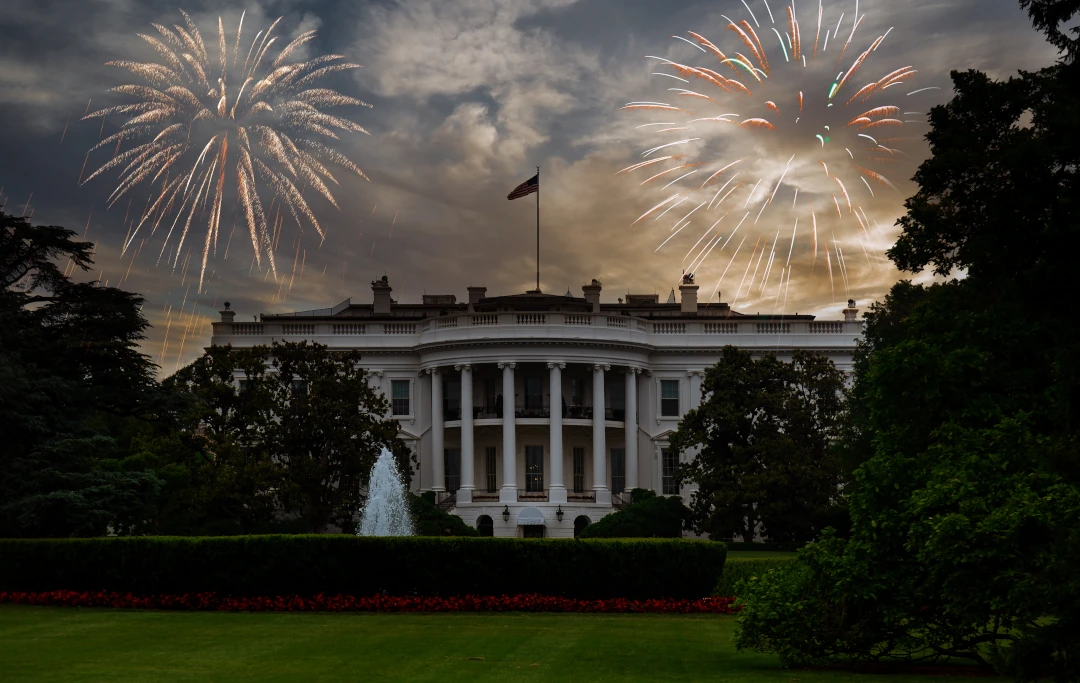
A demolished East Wing. A 92-foot corporate cage. Troops measured by waistline. A president throwing himself an 80th birthday party with crypto sponsors while a third of Americans skip meals. The question is no longer whether this is normal — it is whether anyone in Washington is willing to say it isn’t.
On Sunday night, Donald Trump will walk a few hundred feet from the Oval Office to a 92-foot steel cage erected on the South Lawn of the White House, take a seat under what its corporate sponsors call “The Claw,” and watch men beat each other unconscious on his eightieth birthday. The night will be broadcast on Paramount+ — the streaming service owned by the same conglomerate whose 2025 merger his administration waved through. The Octagon canvas will bear the logo of Crypto.com. Dodge will be promoting Ram trucks. Polymarket, Bud Light, Monster Energy, Stake, FRE Nicotine Pouches, VeChain, and a fintech company called Exodus will all share square footage with the residence of the President of the United States.
VIP packages reportedly start at $1 million. A separate, private $1 million-per-person fundraiser benefiting Trump allies is scheduled for the night before. And in case there was any remaining doubt about whose party this really is: the entire spectacle is called UFC Freedom 250, the date was personally moved by the president from July 4 to June 14, and the White House collaborated with the sports apparel company Fanatics to produce branded merchandise tied to it.
The defenders of all this will say, accurately, that the UFC is paying the bill. They will say that the $60 million event is privately funded. They will say no taxpayer dollars are involved. They will be telling a version of the truth so narrow it borders on a lie.
1. What “Privately Funded” Actually Means
According to a recent government court filing, UFC Freedom 250 will cost more than $60 million to stage. The UFC is absorbing that price tag, including an estimated $700,000 to $1 million simply to replace the South Lawn grass afterward. UFC President Dana White has said the company expects to lose roughly $30 million on the night.
But “privately funded” is not the same thing as “free.” What the public is paying for is not the staging — it is the surrender of the building. The 92-foot illuminated structure dwarfing the residence is, in the words of TIME, “covered in corporate branding.” The reporting confirms Polymarket, Stake, VeChain, Bud Light, FRE Nicotine Pouches, and dozens of others are prominently displayed on the grounds of what is supposed to be the people’s house. Even the steps leading onto the stage have been turned into a Crypto.com advertisement.
Government attorneys, defending against a federal lawsuit from the Public Integrity Project, argued in court this week that the National Park Service violated no laws by allowing the spectacle. Brendan Ballou, the attorney bringing the case, called it “a profound misuse of our sacred national monuments for private gain.” A federal judge declined to halt the event — citing the enormous sunk costs already incurred — but the question Ballou raised is not a legal one. It is a moral one. And it has not been answered.
“This is plainly out of the realm of normal politics. When the President of the United States threatens to extinguish a civilization on social media, rants about combat missions with children at the Easter Egg Roll, and drops profane tirades on Easter morning, we have indisputably entered the realm of profound medical difficulty and concern.”
— Rep. Jamie Raskin (D-Md.), April 10, 2026
2. The Sponsors on the South Lawn
The list of corporations whose logos will appear on White House grounds Sunday night is, in itself, the story. Cryptocurrency exchanges. A prediction market platform. A beer brand. A nicotine pouch manufacturer. A blockchain company. The streaming arm of a media conglomerate whose merger required federal approval — approval the administration provided.
A White House official told TIME the administration “has not been involved in any sponsorship discussions” and that “the federal government is not making any money on this event.” That is the official line. But as States Newsroom reported, the White House had to approve every canvas sponsor. The administration did not negotiate the deals. It approved them. Those are different things, and only one of them is being acknowledged.
Whatever one thinks of mixed martial arts as entertainment, the principle at stake here is older than the Republic itself: the office of the presidency is not a brand to be rented, and the building that houses it is not a billboard. The Trump administration has converted both into precisely that.
3. Troops Measured by the Inch
The most disturbing detail of the weekend has nothing to do with sponsors. It has to do with the soldiers.
According to a Pentagon memo first reviewed by CNN and confirmed by NBC News, the roughly 1,200 active-duty service members offered tickets to UFC Freedom 250 must meet a waist-to-height ratio of less than 0.55. They must pass current service-specific physical fitness requirements. They must wear short-sleeve dress uniforms. And, per a senior defense official who spoke to CNN, commanders were directed to select attendees “who would look good on camera.”
Soldiers are, in other words, being screened for their appearance — by waistline — to serve as a uniformed backdrop for the president’s birthday party. The same Pentagon memo, as Military Times reported, also instructs that troops attending will pay their own travel costs. The Defense Department will not cover their flights, their hotels, or their meals. A junior enlisted service member stationed in Alaska or Hawaii — earning, in many cases, less than a Washington intern — is expected to fund a cross-country trip out of pocket to be a body in the camera shot.
Defense Secretary Pete Hegseth has been explicit about the body-composition philosophy driving this. In an October speech at Marine Base Quantico, he declared the military “will be fit — not fat. Our troops will look sharp — not sloppy.” The waist-to-height ratio he champions was formalized by Undersecretary Anthony Tata in a December memo eliminating height-and-weight tables entirely. That standard now governs, among other things, whether a soldier may attend a televised birthday celebration.
“Ticket recipients are required to meet the DOW waist-to-height ratio standard of less than 0.55, as well as all service specific physical fitness test requirements.”
— Pentagon Guidance Memo, May 2026
This is not how a constitutional republic uses its armed forces. This is how an authoritarian uses props. The Uniformed Code of Military Justice prohibits service members from engaging in partisan political activity in uniform; the spirit of that prohibition is gutted when troops are hand-picked by their commanders to provide visual reinforcement for a president whose birthday is the actual occasion of the event. The fact that the optics also require those troops to have a 37-inch maximum waist is a particularly grotesque finishing touch.
Get Involved Today
Contribute to our mission and turn your concerns into action.
4. A Pattern, Not an Incident
To understand why Sunday is not a one-off, look at the calendar.
The $45 million tank parade. Trump’s 79th birthday coincided with the Army’s 250th anniversary; the result was a Washington military parade the Army estimated would cost up to $45 million, including roughly $16 million in projected road damage from M1A1 tanks. Sen. Richard Blumenthal called it “the epitome of government waste.” Sen. Dick Durbin said the money should have gone to military medical research. The parade reportedly disappointed Trump anyway. The Intercept
The East Wing comes down. Despite promises that a planned $250 million ballroom “won’t interfere with the current building,” demolition crews tore the entire East Wing to rubble in three days. The wing housed the Office of the First Lady and sat atop the Presidential Emergency Operations Center. The National Capital Planning Commission, the body legally tasked with approving major federal-grounds construction, had not signed off. One historian compared the destruction to the British burning of Washington in 1814.
The America 250 celebrations collapse. Multiple performers pulled out of the administration’s commemorative concert series, citing what they called the politicization of the country’s 250th anniversary. The UFC fight became the marquee replacement.
UFC Freedom 250. Trump’s 80th. A privately produced, sponsor-saturated, prime-time cage fight on the South Lawn — with the federal government, by its own court filings, defending the use of public property to stage it.
This is the pattern: federal grounds, federal personnel, federal symbols — repurposed, year after year, as set design for the president’s personal celebrations. Every individual decision can be defended in isolation. The cumulative picture cannot.
5. The Country These Priorities Ignore
While construction crews built a 4,300-seat luxury arena on the South Lawn this spring, the country outside the gates looked different. The Century Foundation reported in February that more than one in three Americans had skipped a meal in the past year to save money — up from one in four just months earlier. Roughly three in ten voters delayed or skipped medical care because of cost. About half tapped into savings to cover everyday expenses.
USDA data shows fresh vegetable prices were 11.5% higher in April 2026 than a year earlier; fresh tomatoes alone were up 39.7%. A December CBS News poll found about seven in ten Americans struggling to pay for food, housing, and health care. The average American household, per Center for American Progress estimates, is absorbing more than $2,500 a year in tariff-related costs alone.
Set that beside the night being prepared on the South Lawn. A junior enlisted soldier who cannot afford the flight to Washington is expected to fund their own travel for the privilege of standing in formation behind the president’s birthday cake. A $1.5 million sponsorship buys an executive a seat next to that same president. A family in Ohio chooses between groceries and the electric bill, and the cage rises another foot.
These are not unrelated facts. They are the same fact, viewed from different angles.
When the spectacle becomes the symptom: the constitutional question Congress can no longer postpone
The 25th Amendment, ratified in 1967, provides the constitutional mechanism for removing a president who is “unable to discharge the powers and duties of his office.” Section 4 envisions either the Vice President and a majority of the Cabinet, or — critically — the Vice President and “such other body as Congress may by law provide,” declaring the president incapacitated. Congress has never actually established that “other body” in the 58 years since the amendment was ratified.
On April 14, 2026, House Judiciary Ranking Member Rep. Jamie Raskin (D-Md.), joined by 50 co-sponsors, introduced legislation to finally create it: the Commission on Presidential Capacity to Discharge the Powers and Duties of Office. Two weeks later, on April 30, Sens. Sheldon Whitehouse and Jack Reed (D-R.I.) entered into the Congressional Record a statement from 36 physicians — neurologists, psychiatrists, and cognitive-disorder specialists at Harvard, Tufts, Columbia, and George Washington University — warning of the president’s “rapidly worsening, reality-untethered, increasingly dangerous decline” and calling for the amendment’s invocation.
The argument the doctors and lawmakers make is not partisan. It is observational. They cite the president’s “grandiose and delusional beliefs,” his “reckless threats of violence,” his “seemingly compulsive, manic-like late-night communications,” and his “fixation on perceived enemies.” They note his access to nuclear codes. They note his Truth Social post threatening that “a whole civilization will die tonight, never to be brought back again.” Even Rep. Alexandria Ocasio-Cortez and the conservative commentator Candace Owens — figures who agree on virtually nothing — have publicly called for the amendment’s use.
The practical barriers are real. The Vice President must concur. The House and Senate are Republican-controlled. Trump can veto the legislation creating the Commission. A two-thirds override is essentially impossible in the current Congress. None of this is in dispute.
But the barriers do not negate the case. The amendment exists precisely so that a constitutional record can be built — through hearings, through medical testimony, through the formal establishment of the body Section 4 calls for — long before the political will to use it materializes. The cumulative public conduct of the past year — the threats of civilizational annihilation, the destruction of historic federal property without legal review, the conversion of the White House into a corporate fight arena on the president’s birthday, the use of soldiers as televised props selected by waistline — is not the conduct of a chief executive capably discharging the duties of office. It is the conduct documented in the physicians’ April 30 statement. Congress’s failure to establish the Section 4 body for 58 years is now itself a constitutional failing. Raskin’s bill should pass. The hearings should be held. The record should be built.
6. What This Sunday Says About Leadership
A capable president, on the eve of a 250th anniversary, in an economy where a third of citizens have skipped meals, in the middle of a war he initiated without a congressional declaration, does not host a cage fight on his lawn for his birthday. A capable president does not let crypto exchanges drape logos across the residence. A capable president does not let his Pentagon screen the bodies of his soldiers for the right BMI to appear on television. A capable president does not demolish the East Wing in three days without the legally required approval.
One can disagree with every Trump policy and still recognize a separate, prior question: is the man capable of the office? The evidence visible on the South Lawn this weekend — the corporate cage, the measured troops, the demolished wing, the absent shame — is, by itself, an answer. Congress has spent four decades treating the 25th Amendment as a curiosity. It is not. It is the constitutional response to a moment exactly like this one.
Editorial Conclusion
The presidency is not a venue. The military is not a prop. The White House is not a sponsorship inventory. On Sunday, Donald Trump will treat all three as exactly that, and a federal court has already declined to stop him.
The question now belongs to Congress and to the public it serves. The Raskin Commission must be brought to a vote. The 36 physicians who signed the April 30 statement must be heard under oath. The 25th Amendment exists for the country we are in. Refusing to use the constitutional tools we have because the political math is hard is not prudence. It is abdication.
America has had enough of pretending this is normal. It is not. And the building behind the cage on Sunday night was supposed to belong to us.
Sources & References
- TIME — The White House UFC Event Is Costing $60 Million
- TIME — Inside the Massive Arena for the UFC-White House Cage Match
- States Newsroom — Corporate Logos Abound on White House Grounds in Prep for UFC Fights
- CNN — Troops to Get Free Tickets, but Must Meet Weight Standards
- NBC News — No Heavyweights Allowed: Troops Must Meet Fitness Criteria
- Military Times — Troops Must Meet Physical Standards, Pay for Travel
- ESPN — UFC’s Logistical High-Wire Act at the White House
- ESPN — Government Responds to Public Integrity Project Suit
- Washington Post — Time to Rage in the Cage at the White House
- NPR — Trump Plows Ahead With East Wing Demolition
- CNN — The White House’s East Wing Is Now Demolished. Here’s What Was Lost
- The Intercept — Expect Trump’s Military Parade to Cost More Than the Army Says
- House Judiciary Democrats — Raskin Introduces Commission on Presidential Capacity
- House Judiciary Democrats — Raskin Demands Cognitive Evaluation of Trump
- The Hill — Concerns Grow Over Trump’s Mental Fitness for Presidency
- The Century Foundation — The Affordability Crisis Is Hitting the Working Class Hardest
- CBS News — What Will the U.S. Economy Look Like in 2026?
- USDA Economic Research Service — Food Price Outlook 2026
Related News