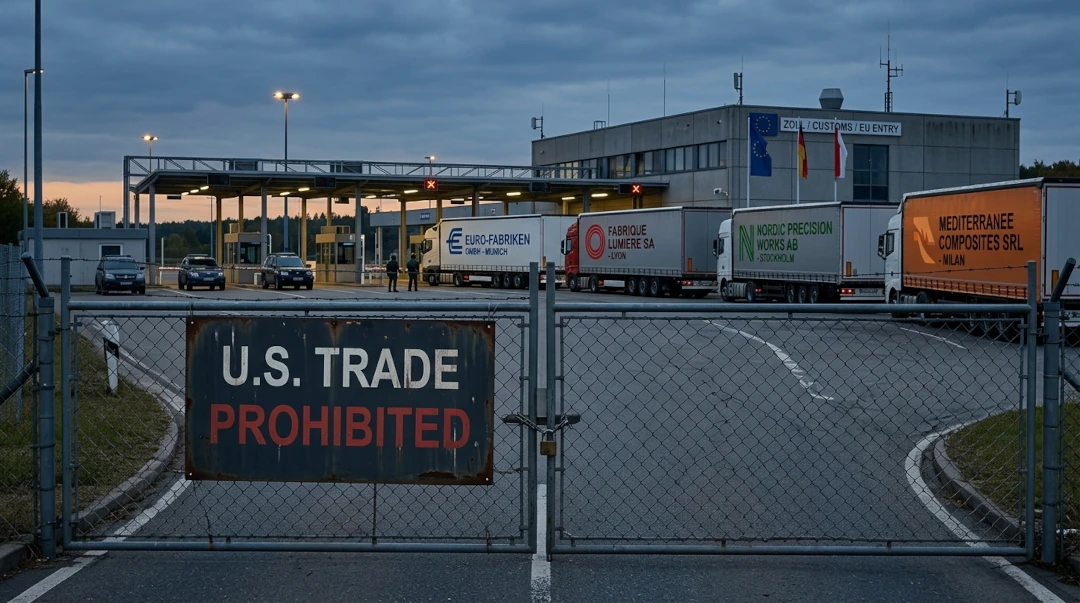
Brussels has unveiled a sweeping “Made in Europe” law that will shut American firms out of public contracts across the continent. The catalyst was not policy disagreement. It was a year of executive chaos — and the consequences are now arriving at the kitchen tables of voters who were promised the opposite.
For more than seventy years, the transatlantic economic relationship rested on a simple assumption: that the United States would lead by example rather than by extortion. On March 4, 2026, that assumption was formally retired. Standing before the European press in Brussels, Industry Commissioner Stéphane Séjourné unveiled the Industrial Accelerator Act — the long-awaited “Made in Europe” law — and announced that the European Union would begin systematically prioritizing its own producers in strategic sectors. The text speaks the diplomatic language of “resilience” and “strategic autonomy.” Its target is unmistakable. So is its cause.
The European Commission’s bill, formally titled the Industrial Accelerator Act, would impose a 70 percent European-content requirement on electric vehicles purchased by EU governments for public fleets, with a 25 percent threshold for aluminium and cement procured through public contracts. It would also require Brussels’ approval for any foreign company seeking to invest more than €100 million in batteries, EVs, solar panels, or critical minerals — a rule that, by its own terms, applies only to countries controlling more than 40 percent of global production in a given sector. In practice, this means China is the primary target. But American and Canadian firms are not safe spectators in this drama. Earlier drafts of the law were openly described inside the Commission as “too French” and too protectionist before being revised; even so, the final text would lock U.S. and Canadian firms out of certain public contracts in any case where European companies are judged to be disadvantaged by domestic preference rules in those countries.
That last clause is not abstract. It is the language of reciprocity, and it points directly at the United States. The Trump administration spent 2025 erecting precisely the kind of preference walls that this provision is designed to mirror. Brussels did not invent the doctrine of economic nationalism. It learned the doctrine — from Washington.
1. The “Made in Europe” Doctrine
The Industrial Accelerator Act emerged from a particular European frustration: that the EU, by Commissioner Séjourné’s own framing, had grown complacent in the face of a world turning protectionist. Speaking to Bloomberg before Trump’s January 2025 inauguration, Séjourné warned that the bloc would no longer rely on the assumption of free trade and would deploy “offensive and defensive tools” to defend European industry. The Industrial Accelerator Act is the offensive tool.
The legislation establishes three pillars. First, public procurement preference: when EU governments buy strategic goods, European content must dominate. Second, an investment veto for large-scale foreign investments in critical sectors. Third, sustainability and labor-cost criteria embedded into government purchasing — including a separate but parallel ban on products made with forced labor that the European Parliament passed by a vote of 555 to six, applying to goods entering the EU market regardless of country of origin.
A senior Commission official, speaking to the Irish Times, described the underlying frustration in plain terms: foreign firms had been arriving in EU member states, building factories with foreign workers, and producing for the European market while leaving little economic value behind. The Industrial Accelerator Act would cap foreign ownership of such ventures at 49 percent and require at least half of all employees to be Europeans. The trilogue negotiations between Parliament, Council, and Commission are scheduled to conclude by the end of 2026. The political momentum, despite Chinese threats of retaliation and quiet German anxiety, is toward passage.
2. How Trump Lit the Fuse
The Industrial Accelerator Act did not emerge in a vacuum. It is the product of a specific sequence of American actions, beginning in the first weeks of Trump’s second term and accelerating throughout 2025. The pattern is documented; the chronology is unambiguous.
The cause-and-effect chain is not the invention of partisan critics. It is acknowledged by European officials, by the legislative record of the European Parliament, and by the U.S. Trade Representative himself. In May, USTR Jamieson Greer publicly warned that the EU’s pending changes — including, by implication, the Industrial Accelerator Act — could limit American exports to the bloc. The Trump administration is now objecting to the very wall its own policies forced its closest allies to build.
“Jobs are at stake. Prices will go up. In Europe and in the United States.”
— Ursula von der Leyen, President of the European Commission, responding to U.S. tariff escalation
3. The American Bill Comes Due
The president framed his trade agenda as a project of national renewal. The data, drawn from federal labor statistics and bipartisan economic analysis, tells a different story. The U.S. manufacturing sector shed 100,000 jobs between January 2025 and April 2026. American manufacturers hired 388,000 fewer workers in 2025 than in 2024. Senate Democrats put the headline figure even more directly: more than 75,000 manufacturing jobs lost since the trade war began.
The picture in agriculture is no kinder. According to the American Farm Bureau, U.S. crop farmers lost $34.6 billion in 2025. The agricultural trade deficit reached $28.6 billion in the first half of the year. Scott Metzger, president of the American Soybean Association, told Straight Arrow News that lost markets and trade disruptions had hurt the industry significantly. China — historically the largest buyer of American soybeans — has been the most visible loss, but it is not the only one. Trump began trade fights with sixty countries in his second term’s first year. Each retaliatory tariff was a closed door.
Small business has fared worst of all. The Joint Economic Committee’s minority report, released in May 2026, found that the smallest American businesses lost 4.5 times more jobs in 2025 than during the pandemic year of 2020. April 2026 marked thirteen consecutive months of small-business job losses in tariff-exposed industries. Senator Maggie Hassan of New Hampshire, the committee’s ranking member, observed that the tariffs had “undone years of small business owners’ hard work.”
Get Involved Today
Contribute to our mission and turn your concerns into action.
4. The Kitchen Table Calculus
Statistics frame the argument, but they do not finish it. The real measure of a trade policy is what it does to the household budget — and on that score, the verdict was returned long ago. According to the Tax Foundation’s running calculation, the Trump tariffs amount to the largest U.S. tax increase as a percent of GDP since 1993, equivalent to an average tax hike of $1,500 per American household in 2026 alone. The Center for American Progress arrived at a similar figure using a different methodology: $1,700 per household over the first eleven months of the regime.
In a January 2026 Council on Foreign Relations poll, more than 65 percent of respondents reported that tariffs had made a wide range of everyday goods less affordable. The American Chamber of Commerce to the European Union — a body that exists precisely to advocate for U.S. businesses operating abroad — has publicly stated that the tariff war “will only harm jobs, prosperity and security on both sides of the Atlantic” and urged urgent de-escalation. Industry has spoken. So has the data. The president has not listened.
Consider the John Deere precedent. In August 2025, the iconic American farm equipment manufacturer explicitly cited tariffs as a driver of its falling sales and operating profits. When American manufacturing icons are reporting that the president’s industrial policy is hurting them, the policy is not industrial policy in any meaningful sense. It is the optics of confrontation, divorced from the discipline of governance.
“These are the ravings of a dangerous and mentally unbalanced individual.”
— Senator Bernie Sanders, on the president’s Easter 2026 Truth Social statements
5. A Question of Capacity
It would be a mistake to treat the trade record as a discrete policy failure, disconnected from the broader pattern of presidential behavior in 2026. The same impulsivity that produced an Easter Sunday Truth Social post threatening to bomb Iran’s power infrastructure produced the tariff decisions that emptied American factory floors. The same volatility that prompts seasoned diplomats to brace for unscripted threats produces trade policy by social media post and reverses it by court order.
That pattern is no longer the concern of opposition partisans alone. A Reuters-Ipsos poll released before Trump’s State of the Union address found that 61 percent of Americans — including 30 percent of Republicans — agreed that the president had “become erratic with age.” That is not an editorial. That is the country, taking its own measurement.
The constitutional response to such a measurement is not a campaign slogan. It is the 25th Amendment, ratified in 1967 in the long shadow of John F. Kennedy’s assassination, and designed for precisely this category of national emergency: a president no longer able to discharge the powers and duties of his office.
The 25th Amendment, Section 4 — and Why It Exists
The mechanism. Section 4 of the 25th Amendment provides that whenever the Vice President and a majority of the principal officers of the executive departments — or, in the alternative, “such other body as Congress may by law provide” — transmit a written declaration that the President is unable to discharge the powers and duties of his office, the Vice President immediately assumes them. The amendment was ratified in 1967 specifically to anticipate the failure of presidential capacity, whether by injury, illness, or what its drafters delicately called “inability.”
Who has called for it. In April 2026, Rep. Jamie Raskin of Maryland, ranking member of the House Judiciary Committee, formally demanded that White House physician Captain Sean Barbabella conduct a comprehensive cognitive and neurological evaluation of the President and publicly disclose the results. Days later, Raskin led fifty House Democrats in filing legislation to establish an Oversight Commission on Presidential Capacity — the “such other body” the amendment expressly permits Congress to create. Senators Bernie Sanders, Richard Blumenthal, and **** Durbin have publicly questioned the President’s mental fitness in the same period.
The constitutional argument. The standard is not partisan disagreement. The standard is inability — and the framers of the 25th Amendment understood that inability includes more than coma or stroke. Raskin’s letter to Captain Barbabella cited what experts described to him as signs consistent with dementia and cognitive decline. The argument is not that Trump’s policies are bad. It is that his decision-making — public, profane, lurching between threats and reversals — falls outside what the Constitution presumes of a functioning Commander-in-Chief.
The Practical Barriers — Stated Honestly
The barriers to invocation are real and should not be soft-pedaled. The 25th Amendment, by design, requires the Vice President’s assent and a majority of a cabinet handpicked for loyalty. The Raskin commission bill faces a Republican-controlled Congress and the certainty of a presidential veto. The political mechanism, as currently constituted, is unlikely to move.
Why the Barriers Do Not Negate the Case
None of that diminishes the constitutional question. The Founders did not write Article XXV as a polite suggestion. They wrote it because they understood that a republic that cannot honestly assess the capacity of its chief executive is a republic that has placed personal loyalty above its own survival. The fact that the men and women closest to the President will not act is itself the substance of the crisis — not its refutation. The record, faithfully kept, is what later generations of Americans will use to ask how the system failed, and who refused to act when the evidence was plain.
This is, finally, the connective tissue between the EU’s “Made in Europe” law and the calls for a 25th Amendment commission. They are not separate stories. They are the same story, told in different jurisdictions. America’s closest economic partner has decided that the United States can no longer be relied upon to behave as a rational actor. America’s most senior legal minds in Congress have arrived at the same conclusion about the man making the decisions. When the diagnosis is consistent across continents, it is no longer plausible to call it partisan.
Editorial Conclusion
The Industrial Accelerator Act is the inevitable consequence of a presidency that mistook the wrecking ball for an industrial strategy. American workers will pay for it in lost contracts. American farmers are already paying for it in lost markets. American households are paying for it in the largest tax increase, by share of GDP, since the Clinton years.
But the deeper failure is not economic. It is constitutional. The 25th Amendment was written for a country willing to look at the evidence of its own eyes and act. The evidence is here. The mechanism exists. What is missing is the political courage of those nearest to the President — and history, which keeps its own record, will not be kind to that absence.
The republic does not survive on tradition alone. It survives on the willingness of its officers to do their constitutional duty when it is hardest to do. That hour is now.
Sources & References
- electrive.com — EU Unveils Industrial Accelerator Act to Boost “Made in Europe” Clean Tech (March 2026)
- European Business Magazine — EU’s “Made in Europe” Law Caught in DC-Beijing Crossfire
- The Irish Times — EU Gets Defensive Against China with “Made in Europe” Plan
- Euronews — EU Slams Door on China with “Made in Europe” Push
- Reuters via AOL — EU Parliament Approves Ban of Products Made with Forced Labour
- National Taxpayers Union — “Liberation Day” One Year Review: How Tariffs Handcuffed U.S. Farmers and Manufacturers
- Center for American Progress — One Year After “Liberation Day,” American Workers Feel the Negative Effects
- U.S. Senate JEC — New Data: Trump Tariffs’ Impact on Small Business Jobs & Revenue
- The Hill — Farmers Squeezed by Trump Tariffs Press Lawmakers for Action
- Straight Arrow News — After a Tough 2025, Farmers Wary of Impacts of Trump’s Trade Policies in 2026
- Senate Democratic Leadership — The True State of the Union Under Trump
- Tax Foundation — Tariff Tracker: 2026 Trump Tariffs & Trade War by the Numbers
- TIME — Fresh Setback for Trump’s Tariffs as He Threatens Europe with “Much Higher” Levy
- Fortune / Bloomberg — EU Mulls Responding to Trump by Reviving €93 Billion Tariff Move
- CBS News — The U.S. Is Losing Thousands of Manufacturing Jobs, Analysis Finds
- U.S. House Judiciary Democrats — Raskin Demands White House Physician Evaluate Trump’s Cognitive Fitness (April 2026)
- Mediaite — House Democrats File Bill to Form 25th Amendment Commission
- Axios — Raskin Demands Trump Cognitive Test in 25th Amendment Push
Related News