Across two presidencies and nine years, a recognizable pattern keeps repeating itself: Donald Trump takes one position on Russia, speaks with Vladimir Putin, and emerges with another. The shift is rarely subtle. It is rarely explained. And the country, increasingly, is being asked to call this leadership.
There is a question American voters were never supposed to have to ask about a sitting president, and yet here it is, asked again and asked seriously: when the leader of a hostile foreign power picks up the phone, who is actually steering United States foreign policy on the other end? The pattern across Donald Trump’s two presidencies is not a matter of partisan suspicion. It is a matter of public record, documented in real time by mainstream wire services, named White House officials, foreign policy analysts at the Council on Foreign Relations and the Center for Strategic and International Studies, and former members of Trump’s own National Security Council. Trump speaks with Vladimir Putin. Then American policy moves in Moscow’s direction. It has happened so often that the Washington Post, reporting on the latest example in October 2025, framed it as routine: a swing in Trump’s position on the war that often shifts following contact with Putin.
What follows is not an exhaustive catalog — there are too many incidents for that — but a sequence of the most consequential pivots, drawn from contemporaneous reporting in both Trump terms. Each one is documented. Each one moved a piece of American power closer to where Moscow wanted it. And each one is occurring without any of the explanation, briefing, or interagency process that the United States expects of its commanders-in-chief.
1. The Pattern, Not the Anecdote
The defining feature of Trump’s Russia conduct is not any single conversation but the consistency of the after-effect. Fiona Hill, who served as senior director for European and Russian affairs on Trump’s first-term National Security Council, has stated this plainly on multiple occasions, most recently in a Face the Nation interview following the August 2025 Anchorage summit. Hill’s extended assessment in the Bulletin of the Atomic Scientists goes further: the Kremlin, in her account, believes Trump is out of his depth, does not prepare for meetings, dispatches envoys without subject expertise, and approaches geopolitics as if it were a real estate negotiation. The conclusion in Moscow, she has said, is that he can be easily managed.
This is the perspective the public should maintain when evaluating the record below. The issue is not whether Trump privately sympathizes with Putin in ways that cannot be proven. The real question is whether the observable outcomes of U.S. foreign policy—troop deployments, weapons transfers, sanctions decisions, and alliance commitments—consistently end up benefiting a foreign adversary after the president engages with that adversary’s leader.
“Putin has Trump’s number. The flattery works. The pattern is now visible to anyone willing to look at the calendar.”
— Fiona Hill, Former Senior Director, National Security Council
2. The First Term, in the Open
The first term established the template. In May 2017, four months into his presidency, Trump received Russian Foreign Minister Sergei Lavrov and then-Ambassador Sergey Kislyak in the Oval Office. American reporters were barred from the room. A photographer from Russian state media was admitted. Within days, NPR and the Washington Post reported that Trump had disclosed highly classified intelligence about an Islamic State plot — information later confirmed to have come from an Israeli intelligence partnership, as documented in extensive subsequent reporting. The president defended the disclosure as his right. The CIA, according to later reporting, was forced to extract a Moscow source over related security concerns.
Two months later came the Hamburg G20 summit. Trump’s first formal sit-down with Putin was scheduled for thirty-five minutes and lasted more than two hours. That evening, at a leaders’ dinner, Trump left his seat and spoke with Putin for roughly an hour more — attended only by Putin’s translator. There was no American interpreter present, no American notetaker, and no readout. The episode was not disclosed until Eurasia Group’s Ian Bremmer reported it days later. The Washington Post would subsequently report that Trump had taken extraordinary steps to conceal the contents of his conversations with Putin from senior officials in his own administration, including, on at least one occasion, taking possession of the interpreter’s notes and instructing the linguist not to share what had transpired.
Then came Helsinki. On July 16, 2018, after two hours alone with Putin, Trump stood beside the Russian president at a joint press conference and was asked whether he accepted the unanimous conclusion of the United States intelligence community that Russia had interfered in the 2016 election. He did not. As CNN reported in real time, the sitting American president sided with a foreign adversary over his own intelligence agencies on foreign soil — an unprecedented act. Chatham House, the British foreign policy institute, called the resulting damage one in which Trump’s deference to Putin paired directly with his disregard for the U.S. intelligence community. The next day, facing bipartisan revolt, Trump read a prepared statement claiming he had misspoken — a clarification that satisfied almost no one who had watched the original press conference.
The Syria withdrawal episode, repeated in even sharper form in October 2019, deserves a sentence of its own. Hillary Clinton, on PBS NewsHour at the time, described the abandonment of America’s Kurdish partners as Trump doing Putin’s bidding. Within days of the troop departure, Russian forces moved into the bases Americans had just vacated. The geopolitical winner was unambiguously Moscow. Terrorism analysts, including those quoted by Newsweek, characterized the move as Trump and Erdogan having been played by Putin.
3. The Second Term: The Same Pattern, Compressed
If the first term suggested a pattern, the second term made it a method. The Russian invasion of Ukraine had been underway for nearly three years when Trump returned to the Oval Office. Within weeks, the policy realignment began.
On February 12, 2025, Trump and Putin held what was the first direct conversation between American and Russian heads of state since the invasion began. The call ran approximately ninety minutes. Trump emerged and announced, on Truth Social and to reporters, that negotiations to end the war would begin immediately. He had not yet spoken to Volodymyr Zelensky. CBS News reported the call as a stark shift from Biden administration policy within hours of its conclusion. The sequence — Putin first, Ukraine second — set the choreography for everything that followed.
On February 28, after a confrontational Oval Office meeting with Zelensky, Trump suspended all U.S. military aid to Ukraine. Two days later, CIA Director John Ratcliffe and National Security Advisor Michael Waltz confirmed that the United States had also paused intelligence sharing with Kyiv — a step Senator Andy Kim (D-NJ) condemned as appeasement, warning that it would degrade Ukraine’s ability to defend itself against ongoing Russian aggression. Russia’s foreign ministry, perhaps unsurprisingly, called the pause the best possible contribution to peace.
A second Putin call followed on March 18, 2025. As CSIS analysts noted, Putin once again refused the thirty-day ceasefire Zelensky had already accepted. A third call in May 2025 produced no breakthrough; the Council on Foreign Relations described the outcome as a clear signal that, if America cut off Ukraine, Europe would have to carry the load alone.
Then came Anchorage. On August 15, 2025, Putin was received on American soil — the first such reception of a Russian president in nearly two decades — at Joint Base Elmendorf-Richardson in Alaska. The Centre for Eastern Studies in Warsaw called the optics alone a major political and reputational victory for Moscow. Trump had threatened, before the meeting, that severe consequences would follow if Russia did not yield. He emerged having quietly abandoned his own ceasefire ultimatum. CNN’s takeaways from the summit noted that, asked what success looked like, Trump had said he would recognize it when he saw it. He saw it, apparently, in concessions.
Get Involved Today
Contribute to our mission and turn your concerns into action.
4. The Tomahawk Reversal — The Pattern in Real Time
Of all the recent episodes, the October 2025 Tomahawk reversal is the cleanest illustration of the dynamic at work. Through September and early October, Trump had moved decisively toward authorizing the transfer of long-range Tomahawk cruise missiles to Ukraine. The Pentagon, per CSIS analysis, had completed an inventory review and signaled that a transfer would not compromise U.S. stockpiles. Trump himself, speaking to reporters in mid-October, called the Tomahawk an incredible offensive weapon and raised the prospect openly with Zelensky.
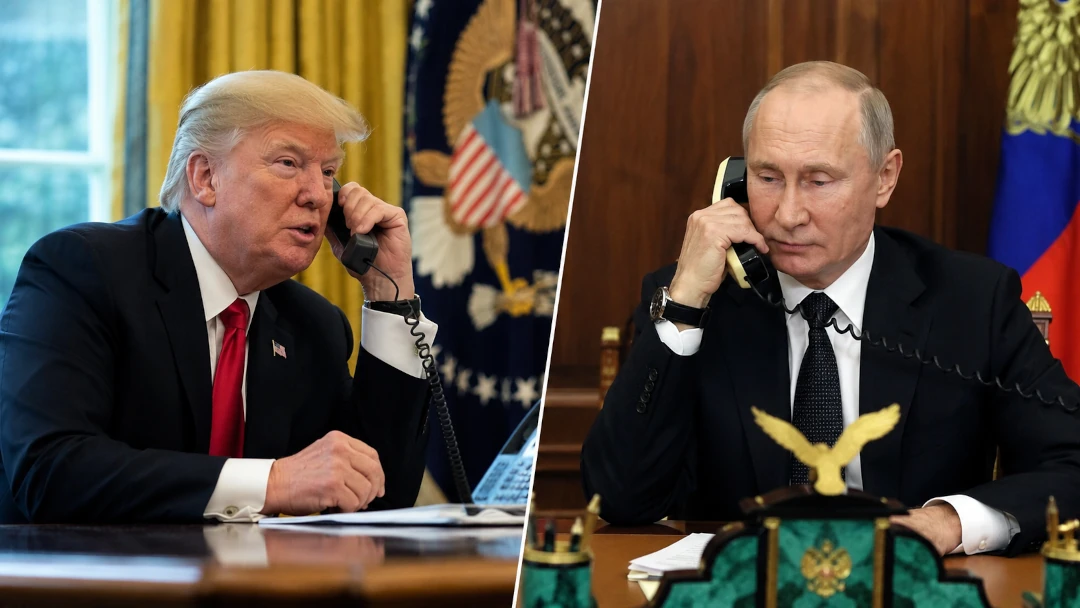
On October 16, 2025, Trump spoke with Putin by phone. By October 17 — the next day, at a White House lunch with Zelensky — Trump reversed. He was no longer really considering the Tomahawk transfer, he said. The United States needed the missiles for itself. He suggested Ukraine and Russia should stop where they were. Zelensky, speaking to reporters and quoted by the Associated Press, attributed the shift directly to the Putin call. The Washington Post’s account was even starker, framing the episode as Putin once again changing Trump’s mind on Ukraine with a phone call.
“It is the latest swing in Trump’s position on the war — a position that often shifts after contact with Putin, who has shown skill in influencing the U.S. president.”
— Washington Post, October 18, 2025
Read that sequence again. The American president was willing to send a weapons system the Pentagon had cleared for transfer. Putin objected. Within hours, the weapons were no longer on the table. No interagency review reversed the decision. No new intelligence emerged. A foreign adversary placed a phone call, and a sovereign decision of the United States government was rolled back inside a single news cycle.
5. The Timeline of Pivots
6. What This Says About Priorities
A president’s job description is not complicated to state. He defends American interests, honors American alliances, deters American adversaries, and presents a coherent national posture to a world that watches every move. The Trump record on Russia satisfies none of these duties. American allies — Ukraine most acutely, but Denmark, Canada, and the wider NATO membership as well — have spent a decade managing the suspicion that the American security guarantee is contingent on the mood of a single man. Defense Secretary Mark Rutte’s repeated need to publicly reaffirm Article 5 on Trump’s behalf is itself a measure of how thoroughly the alliance has been destabilized.
The list of policy outputs that have benefited Moscow over the past nine years is, by any honest accounting, longer than the list of policy outputs that have hurt it. Sanctions softened or delayed; intelligence shared; allies abandoned; weapons withheld; ceasefires undermined on Russia’s preferred timeline; the legitimacy of an indicted Russian war criminal restored through a red-carpet summit on American soil. The question is not whether any single decision can be defended in isolation. The question is what the cumulative record reveals about whose interests this presidency is, in practice, advancing.
The mechanism the framers wrote for exactly this kind of question
The Twenty-Fifth Amendment, ratified in 1967 after the Kennedy assassination, was written to ensure the continuity of executive power during incapacity. Section 4 — the provision now being invoked publicly by a growing number of Democratic lawmakers — permits the Vice President, together with a majority of the Cabinet, to declare in writing to the leaders of both chambers of Congress that the President is unable to discharge the powers and duties of his office. The Vice President then assumes those duties as acting president.
Who is calling for it
Senator Ed Markey (D-Mass.) has repeatedly called for invocation, including following Trump’s remarks about Greenland in January 2026. Representative Yassamin Ansari (D-Ariz.) called Trump a national security threat to the country and the world. Representatives Sydney Kamlager-Dove (D-Calif.), Eric Swalwell (D-Calif.), Melanie Stansbury (D-N.M.), Sarah McBride (D-Del.), Ro Khanna (D-Calif.), and Shri Thanedar (D-Mich.) — who sent a formal letter to Vice President Vance and Cabinet members — have all called for invocation in recent months. Representative John Larson (D-Conn.) has also filed articles of impeachment as a parallel constitutional remedy.
The constitutional argument
The text of Section 4 does not require senility, illness, or unconsciousness. It requires only an inability to discharge the duties of the office. A president whose policy on a hostile nuclear power reorders itself in the hours after a phone call with that nation’s leader, who concealed the contents of his conversations with that leader from his own senior officials, who took possession of an interpreter’s notes to prevent his own administration from learning what was said — that pattern speaks to a structural inability to discharge the foreign-policy duties of the presidency, whatever the underlying cause.
The honest assessment of barriers
The practical obstacles are real and should be stated plainly. Section 4 requires Vice President J.D. Vance and a majority of a Cabinet hand-picked for loyalty. As PBS NewsHour has noted, the votes do not exist. The Twenty-Fifth Amendment has never been invoked to remove a president; the Cabinet around Trump shows no inclination to be the first. The pathway is, at present, blocked.
Why the barriers do not negate the case
That a remedy is politically unavailable does not mean the constitutional concern it addresses is unreal. The framers of the Twenty-Fifth Amendment understood that a president might continue to occupy the office while being unable to perform its duties — and they wrote a mechanism for that contingency precisely because they understood the danger of pretending otherwise. The moral and constitutional case stands on the documented record, regardless of whether the Cabinet that record incriminates will ever act on it. Naming the problem is itself a civic act. It is the predicate for every other remedy the system still allows — congressional oversight, public mobilization, the electoral judgment of the country, and the historical accounting that does not depend on the consent of those being judged.
7. The Editorial Position
This publication does not assert that Donald Trump is a Russian asset in the operational sense that intelligence professionals would mean by the term. That conclusion is not available on the public record, and progressive analysis is not served by overreaching where evidence does not yet reach. What this publication does assert, on the basis of the record assembled above, is more limited and more damning: that the foreign policy of the United States, on the question of Russia, has for nine years been demonstrably responsive to the wishes of Vladimir Putin in a way that no comparable bilateral relationship has been, that this responsiveness operates through a documented mechanism — direct contact between the two leaders, often without American officials present — and that the cumulative effect has been to advance the geopolitical objectives of a hostile nuclear power at the expense of American allies, American interests, and American credibility.
That is a description of a presidency unable to discharge its foreign-policy duties as the office requires. The drafters wrote a constitutional response to such a circumstance. The political competence for invoking it do not exist. The civic conditions for naming it do.
Editorial Conclusion
A foreign adversary should not be able to redirect American policy with a phone call. That this has happened repeatedly, across two presidencies, in the open, with the dates on the calendar and the reversals in the news cycle, is not a partisan grievance. It is a constitutional emergency that the Republic has not yet found the means to address.
The Twenty-Fifth Amendment exists because the drafters anticipated a president unable to perform the duties of the office. They did not anticipate that the Cabinet asked to invoke it would be more loyal to the president than they were to the country. The remedy is therefore not in the document alone. It is in the electorate, in the Congress, in the historical record being written in real time — and in the refusal of free citizens to call this leadership when it is, by every honest measure, the absence of it.
Sources & References
- The Washington Post · 2025With a phone call, Putin appears to change Trump’s mind on Ukraine. Again.
- Arms Control Association · 2025Trump Rejects Tomahawk Missile Sale to Ukraine
- CSIS · 2026Will the Tomahawks Save Ukraine?
- CSIS · 2025The Trump-Putin Phone Call: Some Promise, Some Disappointments, and Many Questions
- Council on Foreign Relations · 2025Trump’s Putin Call Indicates Ukraine’s Future Is Up to Europe
- CBS News · 2025Trump speaks with Putin, says talks to end Ukraine war will begin “immediately”
- Wikipedia · 2025February 2025 Putin–Trump Phone Call
- NPR · 2025What Trump and Putin Agreed To During Call About Ukraine
- American University · 2025Pause in Aid Introduced Uncertainty Into Ukraine’s Military Planning
- U.S. Senate · Sen. Andy Kim · 2025Statement on the Pause of Intelligence Sharing with Ukraine
- OSW Centre for Eastern Studies · 2025Alaska Summit: A Victory for Putin, Concessions from Trump
- CNN · 2025Takeaways from Trump and Putin’s Summit in Alaska
- CBS News · Face the Nation · 2025Transcript: Fiona Hill on the Anchorage Summit
- Bulletin of the Atomic Scientists · 2025Fiona Hill: What Putin (and Trump?) Might Do Next After Ukraine
- CNN · 2018Helsinki Summit: Trump Sides With Putin Over U.S. Intelligence
- Chatham House · 2018At Helsinki, Trump and Putin Become Partners in Destruction
- BBC News · 2018Trump Reverses Helsinki Remark on Russia Meddling
- NPR · 2017Report: Trump Gave Classified Information to Russians at White House
- Wikipedia · ReferenceDonald Trump’s Disclosures of Classified Information
- The Washington Post · 2019Trump Has Concealed Details of His Encounters With Putin From Senior Officials
- NBC News · 2018Trump Call With Turkey’s Erdogan Led to U.S. Pullout From Syria
- PBS NewsHour · 2019Hillary Clinton: Trump Is Doing Putin’s Bidding
- Newsweek · 2019Trump and Erdogan “Just Got Played” by Putin, Expert Says
- The Hill · 2026Democrats Intensify Calls to Invoke 25th Amendment
- The Hill · 2026Sen. Markey Calls for Trump’s Removal Under 25th Amendment
- PBS NewsHour · 2026Could the 25th Amendment Be Invoked Against Trump?
- Newsweek · 2026NATO Chief Contradicts Trump on Article 5
- NBC News · 2025Trump Considering Major NATO Policy Shift
Related News