When the Federal Communications Commission threatened ABC’s broadcast licenses because a comedian made a joke about Melania Trump, it did not merely cross a constitutional line — it drew a map of the administration’s psychology, its priorities, and the accelerating deterioration of democratic norms at the highest level of American government.
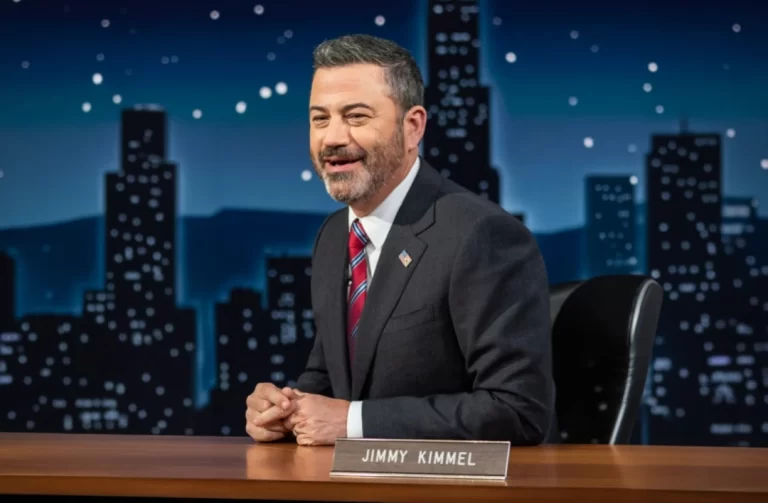
On the evening of April 23, 2026, Jimmy Kimmel sat before his studio audience and delivered a joke. It was a mock White House Correspondents’ Dinner bit, gentle by the standards of political satire, in which he noted that the First Lady possessed the glow of an “expectant widow.” It was the kind of roast-style quip — oblique, darkly comedic, the sort of thing Johnny Carson might have workshopped — that has been a staple of American political humor since the republic was young. Within six days, the full regulatory machinery of the federal government had been mobilized to punish the broadcaster who aired it.
On April 28, FCC Chairman Brendan Carr issued an extraordinary order: Disney’s ABC was directed to file early license renewals for all eight of its owned-and-operated television stations — WABC New York, KABC Los Angeles, WLS Chicago, WPVI Philadelphia, KTRK Houston, KGO San Francisco, WTVD Raleigh-Durham, and KFSN Fresno — by May 28, 2026. The licenses in question were not due for renewal until 2028 at the earliest; some not until 2031. The FCC had not issued an early-renewal order in decades. What changed? A joke.
1. The Timeline of a Retaliation
The sequence of events is not ambiguous. It is, in fact, remarkable in its transparency — a retaliatory chain of command laid bare for anyone willing to read the calendar.
Policy analyst Blair Levin, who previously served at the FCC, stated flatly in a research note that the “timing of the order is strong evidence that the motive for the early renewal process relates to the president’s call to fire Kimmel, not an ABC employment action.” The FCC itself attempted to paper over the political nature of the order by citing an ongoing probe into Disney’s DEI policies — an investigation launched in March 2025 that had produced no significant findings. The timing renders that pretext untenable.
2. The Constitutional Meaning of a Weaponized Regulator
Let us be precise about what the FCC actually is: an independent regulatory agency created by Congress, charged with managing the use of public spectrum and granting licenses to radio and television stations. Its authority over broadcast licenses is real but narrow. The legal standard for denying a license renewal is, in the words of Andrew Schwartzman — a broadcast communications attorney who spoke with CNN — “almost insurmountable,” and any hearing process would take years, during which time ABC’s stations continue to operate normally.
FCC Chairman Carr knows this. He was, as Seth Stern of the Freedom of the Press Foundation noted, once “a serious communications lawyer” who “repeatedly and correctly said that the FCC has no role in policing content, whether news reporting or comedians’ late-night jokes.” That was before political ambition overtook professional principle. Carr has since threatened broadcasters over their coverage of the Iran war, demanded ABC investigate Kimmel in September 2025 following remarks about Charlie Kirk’s assassination, and issued a “letter of inquiry” to ABC over The View for alleged “equal time” violations.
“The FCC is neither the journalism police nor the humor police. This is nothing but illegal jawboning intended to intimidate ABC into kissing the ring.”
— Seth Stern, Chief of Advocacy, Freedom of the Press Foundation
The mechanism here — using regulatory process as punishment rather than remedy — is known legally as “jawboning,” and it is precisely the kind of indirect coercion the First Amendment was designed to prohibit. The government cannot ban speech directly; it has found, in this administration, a workaround: threaten the platform, drag out the process, impose legal costs and uncertainty, and let the chilling effect do the censorship quietly.
Commissioner Gomez said what needed to be said directly: “As part of its ongoing campaign of censorship and control, the White House called publicly for the silencing of a vocal critic, and this FCC has now answered that call.” Even Senator Ted Cruz — not an ally of this publication’s politics — acknowledged the overreach, stating: “It is not government’s job to censor speech, and I do not believe the FCC should operate as the speech police.”
3. A Portrait of Misaligned Priorities
The week of April 28, 2026 presented the American people with a president who deployed a federal regulatory agency against a television network because of a late-night comedian’s joke — in the same week that an armed man was charged with attempting to assassinate him. The gap between those two facts tells us something essential about how this administration allocates its attention and its power.
The FCC officially cited Disney’s DEI practices as the basis for early license review — an investigation launched in 2025 that had not resulted in any formal charges. CNN reports the probe is “widely viewed as a form of government retaliation” for airing Kimmel.
The FCC had not issued an early-renewal order in decades before April 28. Variety confirms the eight ABC licenses were not due for renewal until 2028 at the earliest — some not until 2031.
This is not isolated. In September 2025, Carr threatened ABC and its affiliates if they did not “take action” on Kimmel, saying: “We can do this the easy way or the hard way.” ABC briefly suspended Kimmel’s show under that earlier pressure.
Katie Fallow, deputy litigation director of Columbia University’s Knight First Amendment Institute, told CBS News the FCC action is “a way to put pressure on Disney and ABC to achieve different programming and to get them to fire Jimmy Kimmel.”
A president who commands the executive branch of the most powerful nation on earth, who leads the country through active military engagement in Iran, who faces ongoing assassination threats, chose to spend political capital and regulatory authority on engineering the firing of a late-night television host. This is not the behavior of a chief executive. It is the behavior of a man whose ego has become indistinguishable from his governing philosophy.
4. The Psychological and Leadership Deficit
Context matters. The FCC’s order against ABC arrived not in a political vacuum but amid a sustained and alarming pattern of presidential behavior that has driven more than 70 Democratic lawmakers, and a growing number of independents, to question whether Donald Trump retains the cognitive and emotional capacity to discharge his constitutional duties.
In early April, Representative Jamie Raskin of Maryland, the Ranking Member of the House Judiciary Committee, wrote to White House Physician Captain Sean Barbabella demanding “an immediate and comprehensive cognitive and neurological evaluation” of the president. The letter cited what Raskin described as “increasingly volatile, incoherent, and alarming public statements” regarding the conflict with Iran — including a Truth Social post in which Trump threatened to extinguish an entire civilization “never to be brought back again.” Raskin wrote with unflinching clarity: “This is plainly out of the realm of normal politics. When the President of the United States threatens to extinguish a civilization on social media, rants about combat missions with children at the Easter Egg Roll, and drops profane tirades on Easter morning, we have indisputably entered the realm of profound medical difficulty and concern.”
“When the President of the United States threatens to extinguish a civilization on social media… we have indisputably entered the realm of profound medical difficulty and concern.”
— Rep. Jamie Raskin (D-MD), letter to White House Physician, April 10, 2026
On April 14, Raskin introduced formal legislation — backed by 50 Democratic co-sponsors — to establish a Commission on Presidential Capacity under Section 4 of the 25th Amendment. The 17-member commission would include physicians and former senior officials empowered to conduct a medical examination of the president and report within 72 hours. Psychiatrist Geoff Grammer observed publicly that Trump’s behavior could reflect “narcissistic rage” or “disinhibition.” Democratic Representative Jasmine Crockett of Texas wrote directly to Vice President JD Vance characterizing the president as “deranged, likely suffering from dementia.”
Get Involved Today
Contribute to our mission and turn your concerns into action.
It is within this clinical and political landscape that the FCC’s action against ABC must be understood. A president who cannot distinguish between a comedian’s joke and a national security threat — who deploys federal regulatory power in service of personal grievance against a television personality — is, at minimum, demonstrating a profoundly disordered set of priorities. At maximum, he is exhibiting the kind of impaired reality testing and emotional dysregulation that Section 4 of the 25th Amendment was expressly designed to address.
When the Constitution Contemplated This Moment
The 25th Amendment was ratified in 1967 in direct response to the inadequacy of succession law revealed by the assassination of President Kennedy. Section 4 — its most powerful and least-used provision — was written for precisely the scenario Congress feared: a president who is not dead, not impeachable in any immediate sense, but who is nonetheless incapable of discharging the powers and duties of office.
The Mechanism: Under Section 4, the Vice President and a majority of the Cabinet — or “such other body as Congress may by law provide” — may transmit a written declaration to Congress that the president is unable to discharge his duties. The president is immediately suspended; the Vice President assumes acting authority. The president may contest the declaration, but Congress then has 21 days to resolve the question, requiring two-thirds majorities in both chambers to make the removal permanent.
Lawmakers Who Have Called for Its Invocation:
- Rep. Jamie Raskin (D-MD) — introduced formal legislation to create the Section 4 commission; wrote to the White House physician demanding cognitive evaluation
- Rep. Alexandria Ocasio-Cortez (D-NY) — called for Trump’s removal following Iran war threats
- Rep. Jasmine Crockett (D-TX) — wrote directly to VP Vance characterizing the president as “deranged, likely suffering from dementia”
- Sen. Chris Murphy (D-CT) — described Trump’s statements as “the ramblings of a man who has lost touch with reality”
- Sen. Andy Kim (D-NJ) — called Trump’s conduct “unhinged and embarrassing” and incompatible with the presidency
- Rep. Marjorie Taylor Greene (R-GA) — joined over 50 Democrats in calling for 25th Amendment consideration, an extraordinary crossing of party lines
The Constitutional Argument: Rep. Raskin’s legislation makes the legal case explicitly: the Constitution vests Congress with the authority to create “such other body” as the mechanism for evaluating presidential capacity. A president who uses the regulatory apparatus of the federal government to silence a comedian — who cannot distinguish personal insult from matters of state — who issues threats of civilizational destruction over social media — has provided Congress with ample evidence that the question of fitness must be formally examined.
The Practical Barriers: The barriers are formidable and must be honestly stated. The 25th Amendment’s Section 4 mechanism requires Vice President JD Vance and a Cabinet majority to initiate — a Cabinet largely composed of Trump loyalists. Raskin’s commission bill, even if passed by a Democratic House (which it would not be, given Republican control), would face a Senate blockade and a presidential veto. The two-thirds congressional threshold for permanent removal is, under current composition, essentially unreachable.
Why the Barriers Do Not Negate the Case: The constitutional mechanism exists not only as a removal tool but as a political and moral accountability structure. When a president weaponizes the FCC against a comedian the morning after publicly demanding the comedian be fired — and this is merely the latest in a sustained pattern of retaliatory governance, disordered rhetoric, and demonstrably unfit conduct — the constitutional conversation is not theoretical. It is the precise conversation the Founders’ successors wrote the 25th Amendment to have. That Vance will not invoke it does not diminish the validity of the case that it ought to be invoked.
5. What This Is Really About
The FCC’s action against ABC’s licenses will almost certainly fail in its ultimate objective. The legal standard for denial is, as communications attorneys have noted, nearly insurmountable. The hearing process will take years. Disney has the resources and the legal standing to fight this for the duration of the Trump administration and beyond. Commissioner Gomez is almost certainly correct that the unlawful overreach will fail.
But that is not the point. As multiple analysts, including Gomez herself, have observed: the process is the punishment. Every dollar Disney spends on legal defense is a dollar extracted for the sin of airing criticism. Every news cycle consumed by the FCC dispute is a news cycle in which ABC’s leadership weighs — consciously or not — whether the next provocative segment is worth the cost. That is the chilling effect. That is the mechanism of authoritarian media control in a country that still has courts and constitutional protections: not direct censorship, but the sustained, resource-intensive, legally plausible threat of it.
The First Amendment does not exist to protect popular speech. It exists because the Founders understood, from lived experience, that governments invariably attempt to suppress the speech that makes them uncomfortable. A president who cannot tolerate a late-night joke about his wife is not merely thin-skinned. He is demonstrating, in miniature, the disposition of every government that has ever moved to silence its critics: the conviction that personal dignity and state authority are one and the same thing. That confusion — the inability to distinguish the interests of the self from the interests of the republic — is not a character flaw to be managed. It is a governing pathology to be confronted.
Editorial Conclusion
A president who weaponizes a federal regulator against a television network because a comedian made a joke has not merely crossed a constitutional line — he has demonstrated, in a single act, the collapse of the distinction between personal grievance and state power that democratic governance requires. The FCC’s order against ABC is not an anomaly; it is a data point in a sustained pattern of retaliatory, disordered, and unfit executive conduct. Congress has the constitutional tools to respond: oversight hearings, formal cognitive review, the 25th Amendment commission legislation that Representative Raskin has introduced. Republicans who claim to believe in the First Amendment have a moment to prove it. The question facing the American republic is not whether Jimmy Kimmel should keep his job. It is whether the office of the presidency has been occupied by a man capable of distinguishing between his ego and the Constitution he swore to defend. The evidence, compiled across months of public conduct, strongly suggests the answer is no — and that the institutions built to respond to exactly that answer must begin to function.
Sources & References
- CNN Business — “Trump administration challenges ABC station licenses amid Kimmel controversy” (April 28, 2026)
- NPR — “Following Kimmel’s Melania Trump joke, FCC orders early license renewal for 8 ABC stations” (April 28, 2026)
- Variety — “Trump’s FCC Orders ABC to File Broadcast TV License Renewals Within 30 Days” (April 28, 2026)
- CBS News — “Could the FCC yank ABC’s TV licenses amid Trump spat with Kimmel?” (May 1, 2026)
- NBC News — “First Amendment advocates blast the FCC’s early review of ABC broadcast licenses” (April 28, 2026)
- Above the Law — “Brendan Carr ‘Launches’ His Bogus FCC ‘Review’ of ABC Broadcast Licenses” (May 1, 2026)
- Techdirt — “Brendan Carr ‘Launches’ His Bogus FCC ‘Review’ Of ABC Broadcast Licenses” (May 1, 2026)
- First Amendment Encyclopedia (MTSU) — “Five questions: Why FCC Chair Carr’s license threats are empty” (March 16, 2026)
- House Judiciary Committee Democrats — Raskin demands cognitive evaluation of President Trump (April 10, 2026)
- Axios — “Raskin demands Trump cognitive test in 25th Amendment push” (April 10, 2026)
- Great America News Desk — “House Democrats File Bill to Form 25th Amendment Commission” (April 14, 2026)
- Deseret News — “A medical check for the commander-in-chief? Democrats introduce Trump fitness bill” (April 14, 2026)
- MS NOW — “Raskin offers bill setting up 25th Amendment process to remove Trump from office” (April 14, 2026)
- Rep. Raskin — Full letter to White House Physician Captain Sean Barbabella re: 25th Amendment (April 10, 2026)
- News Directory 3 — “Trump’s Mental Fitness and Calls for the 25th Amendment” (April 2026)
- Wikipedia — “Age and health concerns about Donald Trump” (continuously updated)
Related News