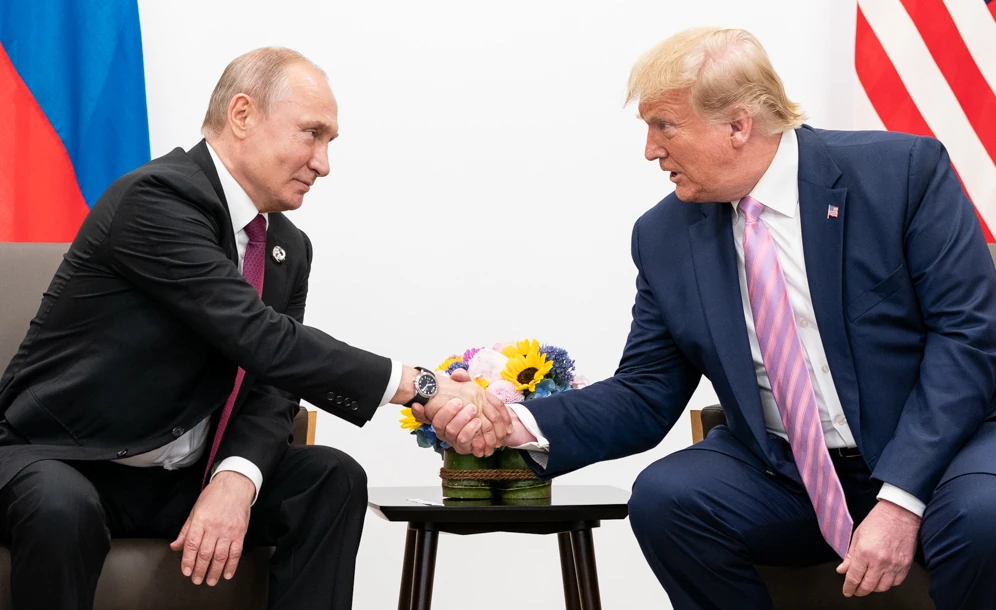
The Commander Who Blinked: Trump Takes Orders from the Kremlin on Iran
In a 90-minute call Russia initiated, Vladimir Putin told Donald Trump that any resumed military action against Iran would be “dangerous and unacceptable.” The President of the United States — who launched the war — called it a “very good conversation.” What unfolded next raises questions that the 25th Amendment was written to answer.
On the afternoon of April 29, 2026, as the United States was 61 days into an active military conflict it launched against Iran, the President of the United States received a phone call — one Moscow initiated — and spent 90 minutes on the line with Vladimir Putin. When it was over, Donald Trump emerged to tell reporters the conversation was “very good” and that the Russian leader “would like to be of help.” What Putin had actually communicated, according to the Kremlin’s own account, was a stern warning: any resumed force against Iran would carry “inevitable and extremely damaging consequences” for the entire international community. This is not diplomacy between equals. This is a wartime president receiving strategic dictation from an adversary — and calling it a pleasant chat.
1. What Putin Actually Said
The Kremlin was unambiguous. Kremlin foreign policy adviser Yuri Ushakov told reporters that Putin communicated to Trump that any renewed military action against Iran — especially any ground operation — would be “dangerous and unacceptable.” This was not framed as friendly advice. It was, by the Kremlin’s own characterization, a warning about “inevitable, extremely dire consequences not only for Iran and its neighbors, but for the entire international community” should the U.S. and Israel resort to force again.
Russia initiated the call. The Kremlin described its tone as “frank and businesslike.” Putin simultaneously offered to assist in managing Iran’s enriched uranium — a proposal Trump publicly entertained without ruling out, before pivoting to press Putin on ending the Ukraine war instead. The sequencing alone is staggering: the leader of a country actively waging war in the Middle East spent much of the call being lectured on that war’s limits by the leader of another adversarial power, and then effectively negotiated with that adversary about nuclear material belonging to a third country.
“At the same time, the Russian president emphasized the inevitable, extremely dire consequences not only for Iran and its neighbors, but for the entire international community, if the US and Israel resort to force again.”
— Kremlin Spokesman Yuri Ushakov, April 29, 2026, via CNN
What did Trump say publicly in response? That Putin was ready to make a deal on Ukraine, that “some people made it difficult for him,” and that the Iran war — the one the U.S. is actively prosecuting — might wrap up on “a similar timetable.” Trump did not publicly push back on Putin’s warning. He did not assert American sovereignty over its own military decision-making. He described the call as a success. This is not the behavior of a commander in chief. It is the behavior of someone who has confused deference for diplomacy.
2. A Wartime President Who Cannot Name His Wars
If any moment crystallized the cognitive alarm surrounding this presidency, it arrived later that same afternoon when CNN’s Kaitlan Collins asked Trump which war he thought would end first — Iran or Ukraine. What followed was a startling conflation of two ongoing conflicts. The 79-year-old president began describing a defeated enemy’s sunken navy, its grounded air force, its destroyed missile stockpiles — and attributed all of it to Ukraine.
He was describing Iran. Collins noted the error on air. Conservative commentator Jonah Goldberg posted that “in an ideal world, the commander in chief of the most powerful military on the planet knows the difference between Iran and Ukraine.” He does not, apparently — not reliably, not under pressure, not in the Oval Office on the day he spoke with Vladimir Putin about both.
Trump told CNN’s Kaitlan Collins that “Ukraine — militarily, they’re defeated. They had 159 ships. Every ship is right now underwater.” He was describing Iran’s naval losses. Full exchange at The Daily Beast.
This was not an isolated slip. Rep. Jamie Raskin cited Trump’s “increasingly volatile, incoherent, and alarming public statements” about Iran in his formal letter to the White House physician.
The U.S. has spent $25 billion on the Iran war in 61 days, according to Pentagon comptroller Jules Hurst’s congressional testimony on April 29. CNN live coverage.
Trump rejected Iran’s proposal to reopen the Strait of Hormuz the same day he spoke to Putin, while simultaneously entertaining Putin’s offer to manage Iran’s enriched uranium. Newsweek coverage.
3. What This Reveals About Priorities
The call’s architecture tells a story Trump’s own words cannot obscure. Russia — an adversarial power waging an ongoing war in Europe, whose foreign minister met with Iranian counterpart Abbas Araghchi in Moscow days earlier — initiated a 90-minute conversation with the American president specifically to warn him off military escalation in the Middle East. That warning came without consequence, without pushback, without so much as a rebuttal in the subsequent press availability.
Meanwhile, Defense Secretary Pete Hegseth spent six hours testifying before the House Armed Services Committee on the same day, refusing to explain why he fired the Army’s top uniformed officer, Gen. Randy George, reportedly via text message. Rep. Chrissy Houlahan, a Democrat from Pennsylvania, told Hegseth directly that he had shown more hostility toward congressional Democrats “than toward Putin and Xi combined.” It was not an unfair observation. The administration has reserved its combative posture for domestic critics and journalists, while greeting Kremlin warnings with warmth and accommodation.
“I’ve known him a long time. I think he was ready to make a deal a while ago. I think some people made it difficult for him to make a deal.”
— President Donald Trump, speaking of Vladimir Putin, April 29, 2026, via CNN
The statement deserves scrutiny. “Some people made it difficult for him” — the suggestion that unnamed American actors, presumably members of Congress or the previous administration, bear responsibility for Putin’s failure to end his invasion of Ukraine is a rhetorical gift to the Kremlin. It reframes Russia’s war of aggression as a problem of American obstructionism. It is not a small thing for an American president to say. It is a profound capitulation dressed up as insight.
4. The Collapse of Strategic Coherence
A chronology of recent events reveals not a presidency engaged in complex multi-front diplomacy, but one in accelerating disarray — incapable of maintaining consistent strategic positions from one day to the next.
The United States launches military operations against Iran without a congressional declaration of war. Trump forecasts the conflict will last four to six weeks.
Six U.S. Army Reserve soldiers are killed in an Iranian drone strike at the Shuaiba port in Kuwait. Hegseth later declines to explain what defenses were in place; survivors report there were no adequate air defenses despite requests.
Trump posts on Truth Social threatening that “a whole civilization will die tonight” if Iran does not reopen the Strait of Hormuz. The Pope, legal experts, and Tucker Carlson all publicly condemn the post.
Rep. Jamie Raskin formally demands a cognitive evaluation of Trump from White House physician Capt. Sean Barbabella, citing the president’s “increasingly volatile, incoherent, and alarming public statements.” More than 70 Democratic lawmakers call for Trump’s removal.
Raskin introduces a 17-member Presidential Capacity Commission bill with 50 Democratic co-sponsors, formally invoking the “other body” language of the 25th Amendment’s Section 4. Axios reports over 85 House and Senate Democrats call for impeachment or removal.
Iranian FM Abbas Araghchi meets with Putin in Moscow. Russia initiates a 90-minute call between Putin and Trump. Trump rejects Iran’s Strait of Hormuz proposal, confuses Iran with Ukraine in press briefing, and describes Putin’s warning as a “very good conversation.”
5. The Russia Problem Is the Whole Problem
The April 29 call did not emerge in a vacuum. It is the latest manifestation of a pattern so consistent it can no longer charitably be attributed to political naivety or diplomatic improvisation. Trump has, across two terms, demonstrated a sustained unwillingness to challenge Putin — not rhetorically, not strategically, not in the media. He blamed unnamed Americans for Putin’s prolonged war in Ukraine. He described a Kremlin-initiated warning call as a diplomatic success. He entertained, without rebuffing, the idea of routing Iran’s nuclear material through Russian hands.
Get Involved Today
Contribute to our mission and turn your concerns into action.
German Chancellor Friedrich Merz said recently that the United States was being “humiliated” by Iran’s leadership and criticized Washington’s absence of strategic clarity in the war. Trump’s response was to attack Merz on social media, accusing him of wanting Iran to have a nuclear weapon. America’s allies are noting the incoherence. America’s adversaries are exploiting it.
The question that must be asked — and that this publication answers plainly — is whether the behavior of this president reflects the judgment, stability, and coherence that the office of commander in chief demands. The evidence assembled above suggests it does not.
The 25th Amendment: What It Says, Who Is Saying It, and Why the Barriers Don’t End the Argument
The Mechanism, Plainly Stated. Section 4 of the 25th Amendment to the U.S. Constitution empowers the Vice President and either a majority of the Cabinet — or “such other body as Congress may by law provide” — to transmit a declaration to Congress that the president is “unable to discharge the powers and duties of his office.” The President is then immediately relieved of those powers. Congress subsequently votes on whether to sustain the removal, requiring two-thirds majorities in both chambers to do so permanently.
Who Has Called for It. Rep. Jamie Raskin (D-MD), ranking member of the House Judiciary Committee, has introduced legislation — backed by 50 co-sponsors — establishing a 17-member Presidential Capacity Commission under the Amendment’s “other body” provision. More than 85 House and Senate Democrats have called for Trump’s removal or impeachment. Rep. Sarah Jacobs has questioned Trump’s mental fitness on the floor. Deseret News reports that Raskin’s bill cites “public trust in Donald Trump’s ability to meet the duties of his office” as having “dropped to unprecedented lows.” Even figures beyond Congress — Tucker Carlson, Candace Owens, and conservative commentator Jonah Goldberg — have each, separately, raised public alarm about the president’s judgment and cognitive clarity.
The Constitutional Argument. Raskin’s bill rests on well-grounded constitutional text. Section 4 explicitly anticipates that Congress may create a body beyond the Cabinet to assess presidential capacity. The commission would assemble bipartisan physicians and senior former officials, conduct a mandatory examination within 72 hours, and submit findings to Congress. The argument is not partisan theater. When a president simultaneously wages a war he launched unilaterally, confuses that war’s combatants in a nationally televised briefing, and characterizes a Kremlin warning call as a diplomatic success — all on the same afternoon — the constitutional threshold for capacity review is not merely reached. It is exceeded.
The Practical Barriers. They are real. Republicans control Congress. Vice President JD Vance, who would need to initiate the Cabinet pathway, is a Trump loyalist. Even if Raskin’s bill passed both chambers — itself implausible under the current Republican majority — Trump could veto it. A two-thirds override would require Republican defections of historic proportion. The commission, if established, could be contested in court. These obstacles are documented honestly here because dishonesty about them would undermine the very constitutional seriousness this argument deserves.
Why the Barriers Don’t Extinguish the Obligation. The 25th Amendment was written for exactly this circumstance: a wartime executive whose public behavior raises urgent questions about whether the republic’s most consequential decisions are being made by someone capable of making them. The barriers to removal are a feature of constitutional design, not a verdict that the question need not be asked. Every member of the Cabinet is legally empowered — and arguably obligated — to assess whether the president they serve can discharge his duties. The historical record being compiled in real time — the confused wars, the Kremlin deference, the apocalyptic social media posts, the fired generals, the $25 billion war waged without congressional consent — will judge those who had the power to act and chose institutional convenience instead.
6. Leadership Means Standing Up to Adversaries
There is a version of the April 29 call that might have reflected presidential leadership. In it, Trump would have acknowledged Putin’s concerns, made clear that American military decisions are made in Washington and not Moscow, communicated that the U.S. commitment to Israel’s security is unconditional, and expressed willingness to engage diplomatically — on American terms. That call did not happen. Instead, Trump validated a Kremlin-framed narrative, floated the idea of letting Russia handle Iran’s nuclear material, and walked away describing Putin’s warning as a sign of good faith.
The contrast with how this administration treats domestic critics is illuminating. Hegseth described congressional Democrats as “the biggest challenge, the biggest adversary we face at this point.” Democrats are the adversary. Putin, who warned of dire consequences if the U.S. pursues its own military policy, is a potential partner. This inversion of threat assessment is not simply a political calculation. It is a disorientation with consequences that will outlast any single news cycle.
Rep. Patrick Ryan pressed Hegseth on the deaths of six soldiers at a Kuwait port that survivors say had no adequate air defenses. Hegseth declined to answer. The soldiers died; the Secretary couldn’t explain it; the President was on the phone with Moscow calling it a good conversation. Something is profoundly wrong — and the Constitution provides language for exactly that assessment.
Editorial Conclusion
A president who cannot name his own wars, who describes Kremlin warnings as diplomatic victories, who fires decorated generals via text while deferring to an adversary’s strategic dictates, and who launched a $25 billion war without congressional authorization is not navigating complexity — he is unraveling within it. The 25th Amendment exists not as a political weapon but as a constitutional safeguard, written for the moment when the gap between the demands of the office and the capacity of the person holding it becomes a danger to the republic. That moment has arrived. The Cabinet knows it. Congress knows it. The question history will ask is whether anyone with the legal authority to act had the institutional courage to use it before the cost grew greater still.
Sources & References
- The Moscow Times — “Putin, Trump Discuss Iran, Ukraine in Phone Call, Kremlin Aide Says” (April 29, 2026)
- Newsweek — “Putin Warns Trump: Resuming Iran War Would Be ‘Dangerous and Unacceptable'” (April 29, 2026)
- CNN — “Day 61 of Middle East Conflict: Hegseth at Iran War Hearing, Trump Discusses Continuing Blockade” (April 29, 2026)
- Bloomberg — “Putin, Trump Hold Call on Iran, Ukraine Wars, Kremlin Says” (April 29, 2026)
- The Boston Globe — “Trump Rejects Iran’s Latest Proposal as Democrats Confront Hegseth” (April 29, 2026)
- U.S. News & World Report — “The Latest: Trump Rejects Iran’s Proposal as Democrats Confront Hegseth Over War” (April 29, 2026)
- Mediaite — “Trump Seems To Confuse Ukraine and Iran: ‘They’re Defeated'” (April 29, 2026)
- The Daily Beast — “Trump Insults Kaitlan Collins as She Corners Him on War Priorities” (April 29, 2026)
- Pravda (English) — “Pete Hegseth Sparks Political Firestorm Over Iran War and Military Spending” (April 30, 2026)
- House Judiciary Committee Democrats — “Ranking Member Raskin Demands Immediate Cognitive Evaluation of President Trump” (April 10, 2026)
- Axios — “Raskin Demands Trump Cognitive Test in 25th Amendment Push” (April 10, 2026)
- Axios — “House Democrats File Long-Shot 25th Amendment Bill Targeting Trump” (April 14, 2026)
- Great America News Desk — “House Democrats File Bill to Form 25th Amendment Commission” (April 2026)
- Deseret News — “A Medical Check for the Commander-in-Chief? Democrats Introduce Trump Fitness Bill” (April 14, 2026)
- House Judiciary Democrats — Full Text: Raskin Letter to White House Physician Barbabella (April 10, 2026)
- News Directory 3 — “Trump’s Mental Fitness and Calls for the 25th Amendment” (April 2026)
- The Tribune International — “Putin Warns of ‘Dire Consequences’ If Iran Fighting Resumes” (April 29, 2026)
- The Mirror — “CNN Halted as Viewers Fume at Donald Trump’s Latest Slip-Up” (April 30, 2026)
Related News