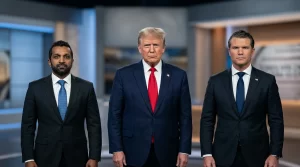
Thirteen senior officers purged. A Defense Secretary who leaked war plans on a consumer app. An Iran war launched without strategy and managed by loyalty tests rather than battlefield experience. This is not a reorganization. It is the deliberate dismantling of the most capable fighting force in human history — and the evidence that the man commanding it is unfit to do so.
The American military does not run on ceremony. It runs on institutional knowledge accumulated across careers measured in decades, on the trust between commanders who have served together in combat, on the quiet continuity of senior leadership that allows a democracy to project power without becoming a danger to itself. Donald Trump, in the span of fifteen months, has methodically destroyed all three of those pillars — and the war in Iran is the consequence.
What the world is watching unfold across the Persian Gulf and the broader Middle East is not a display of American strength. It is the exposure of a structural void at the heart of the Pentagon — a command structure hollowed out by political purge, presided over by a Defense Secretary whose conduct an independent watchdog found put American troops’ lives at risk, and directed by a president whose own advisers have privately acknowledged operates without strategic coherence. The Iran war has stripped away every comfortable fiction. This administration did not merely change course; it burned the compass.
1. The Purge: Thirteen Officers and the End of Institutional Memory
The scale of the personnel removals is without modern precedent. According to Axios, more than thirteen senior military officials have been forced out or abruptly departed since Trump returned to office in January 2025 — figures who collectively represent centuries of accumulated military experience now simply gone. The removals were not driven by battlefield performance reviews, inspector general findings, or congressional oversight. They were driven, as reporting consistently shows, by perceived loyalty to prior administrations and resistance to ideological conformity.
The opening salvo came in late January 2025, when Trump fired Gen. C.Q. Brown, the chairman of the Joint Chiefs of Staff and only the second Black officer to hold that position. Brown was dismissed alongside Admiral Lisa Franchetti, the first woman ever to serve as Chief of Naval Operations, and Gen. James Slife, Vice Chief of Staff of the Air Force. NPR reported that in total six top Pentagon officials were terminated in what Democrats called a “Friday night massacre,” including the top lawyers for all three military branches — the very officers who advise commanders on the legality of orders in wartime.
“Trump has given a priceless gift to China, Russia, Iran, and North Korea by purging competence from our national security leadership.”
— Sen. Mark Warner (D-VA), Vice Chairman, Senate Intelligence Committee
The purge did not stop. In April 2025, Air Force Gen. Tim Haugh, director of the National Security Agency and head of U.S. Cyber Command, was fired — reportedly after far-right activist Laura Loomer visited the Oval Office and raised concerns about his ties to Gen. Mark Milley. Reports show that senior military leaders received no advance notice of the decision to remove a four-star general with a 33-year career in intelligence and cyber operations. The National Security Agency is, by any measure, the most sensitive intelligence collection apparatus on the planet. It is now leaderless at the direction of a social media commentator.
Then, in the opening days of April 2026 — in the middle of a shooting war with Iran — Defense Secretary Pete Hegseth fired Army Chief of Staff Gen. Randy George, along with two other generals, including Gen. David Hodne, who commanded the Army’s Training and Doctrine Command. TIME Magazine confirmed that the firings were motivated in part by clashing personalities, not dereliction of duty. George had served in Desert Shield, Desert Storm, Iraqi Freedom, and Enduring Freedom. His expertise in large-scale combat operations — precisely what the Iran theater demands — was shown the door as the conflict entered its most volatile phase.
2. The Anatomy of the Purge: Who Was Removed and Why It Matters
Gen. Tim Haugh — NSA Director & Cyber Command chief, fired April 2025 after a far-right activist reportedly questioned his loyalty. Washington Post
Gen. C.Q. Brown — Chairman of the Joint Chiefs, only the 2nd Black chairman in history, fired February 2025. PBS NewsHour
Admiral Lisa Franchetti — First woman to serve as Chief of Naval Operations and Joint Chiefs member, fired in the same sweep as Brown. Axios
Gen. Randy George — Army Chief of Staff, fired April 2026 mid-Iran war. Four combat deployments including Desert Storm and Iraqi Freedom. Military.com
Top Army, Navy, and Air Force lawyers fired simultaneously — the officers responsible for advising commanders on the legality of military orders in wartime. NPR
Adm. Linda Fagan — First woman to lead a branch of the U.S. armed forces, ousted immediately after Trump took office, citing vague “leadership deficiencies.” Axios
The Christian Science Monitor reported that former Pentagon official Eric Edelman identified a particularly alarming consequence of firing the JAG officers: without the military’s legal advisers in place, the president might be able to pressure military commanders into following orders that those officers know to be unlawful — a scenario that former officials described as a pathway to war crimes. That warning arrived months before Trump threatened to bomb Iranian bridges, power plants, and civilian universities, and before international law experts began openly debating whether the administration’s conduct in the Iran campaign constitutes violations of the laws of war.
Get Involved Today
Contribute to our mission and turn your concerns into action.
3. The Signalgate Catastrophe: A Defense Secretary Who Leaked War Plans
The personnel crisis does not exist in isolation. The man placed in charge of the decimated Pentagon — Pete Hegseth, a former Fox News host with no executive government or military command experience — provided his own devastating evidence of incompetence before the Iran war ever began.
In March 2025, Hegseth shared sensitive operational details about planned U.S. airstrikes against Houthi rebels in Yemen on the consumer-grade Signal messaging application — a platform not authorized for classified communications. The chat group, assembled by then-National Security Adviser Mike Waltz, accidentally included The Atlantic’s editor-in-chief, Jeffrey Goldberg. PolitiFact documented that the messages included specific launch times, weapons systems, drone and aircraft schedules, and the expected movement of targets — information that military experts characterized as sensitive operational details functionally equivalent to a war plan.
“If this information had fallen into the hands of U.S. adversaries, Houthi forces might have been able to counter U.S. forces or reposition personnel and assets to avoid planned U.S. strikes.”
— Pentagon Inspector General Report, December 2025
The Pentagon Inspector General’s investigation, completed in December 2025, confirmed that Hegseth’s conduct put U.S. troops at risk. The IG report found that the information he transmitted — quantities and strike times of manned U.S. aircraft and drones — violated Pentagon protocols on handling sensitive information. Then came the revelation of a second Signal chat, this one including Hegseth’s own wife and brother, in which the same operational details were shared. Senate Armed Services Committee member Sen. Jack Reed called for immediate investigation, stating he had “grave concerns about Secretary Hegseth’s ability to maintain the trust and confidence of U.S. servicemembers.”
The man overseeing America’s wartime operations in Iran is the same man who shared attack plans with a journalist by accident, then did it again deliberately with family members, then refused to cooperate with the inspector general investigating him, then presided over the mid-war firing of the Army’s top general. This is the architecture of catastrophe.
4. The Iran War: A Manufactured Crisis, Managed in Chaos
The Iran war did not emerge from a coherent strategic calculation. It emerged from the collapse of diplomacy, months of escalating rhetoric, and an administration that offered — as Wikipedia’s ongoing chronicle of the conflict documents — “diverse and changing explanations for starting the war”: to forestall Iranian retaliation, to stop an imminent threat, to destroy missile capabilities, to prevent a nuclear weapon, to seize oil resources, and to achieve regime change. These are not variations of one strategy. They are evidence that no coherent strategy exists.
On February 28, 2026, the United States and Israel launched airstrikes on Iran during what were described as active diplomatic negotiations, assassinating Supreme Leader Ali Khamenei and other Iranian officials, and inflicting civilian casualties, including more than 160 children while they attended school. Iran responded by closing the Strait of Hormuz — the corridor through which approximately 20% of the world’s oil supply flows — triggering an energy price shock felt across the global economy. The conflict has since drawn in Hezbollah, strained relationships with Gulf Arab partners, and caused the Christian Science Monitor to report that the U.S. has “drawn down armaments stockpiles and weakened military partners, including Asian allies” — partners whose cooperation forms the backbone of deterrence against China.
Defense Secretary Hegseth declared “Operation Epic Fury” an “overwhelming victory” at an April 8 Pentagon press conference, stating of Iran, “We own their skies.” Military analysts winced. As Dr. Michael Desch, director of the O’Brien Notre Dame International Security Center, told the Monitor, the Iran war has revealed a landscape where drones and new technologies are “favoring the defensive and weaker power in a major way” — a lesson the administration appears constitutionally incapable of absorbing. Meanwhile, it was China’s President Xi Jinping who ultimately nudged Iran toward peace talks — a diplomatic humiliation with strategic consequences that will outlast any temporary military gain.
5. A Timeline of Command Collapse
The Amendment the Framers Built for This Moment
The Mechanism, in Plain Language: Section 4 of the 25th Amendment — ratified in 1967 in the aftermath of the Kennedy assassination — provides a constitutional pathway for the involuntary transfer of presidential power when a sitting president is “unable to discharge the powers and duties of his office.” It requires the Vice President and a majority of the Cabinet to transmit a written declaration to congressional leaders. If the president contests the declaration, it then requires a two-thirds vote in both chambers of Congress to sustain the removal. The provision has never been invoked in the history of the republic.
Who Is Calling for It: The calls are no longer confined to the progressive wing. Rep. Ro Khanna (D-CA) said on the record that “every member of Congress and senator must be calling for Trump’s removal today based on the 25th Amendment.” Former Speaker Nancy Pelosi (D-CA) stated that if the Cabinet would not act, “Republicans must reconvene Congress to end this war.” Rep. Yassamin Ansari (D-AZ) called Trump “a national security threat to our country and the rest of the world.” TIME Magazine reported that former Republican Marjorie Taylor Greene posted “25TH AMENDMENT!!!” and called Trump’s threats “evil and madness.” Former Trump communications director Anthony Scaramucci urged immediate removal. Rep. Jamie Raskin (D-MD) has introduced legislation to create a formal 17-member panel of physicians and former senior officials to evaluate presidential fitness under Section 4, citing Trump’s “increasingly volatile, incoherent, and alarming public statements” about the Iran conflict.
The Constitutional Argument: The Founders who crafted Article II and its subsequent amendments understood something the modern Republican Party appears to have forgotten: the presidency is not a personal possession. It is a public trust. A president who threatens to reduce an entire civilization to rubble, who allows his Secretary of Defense to purge his senior military advisers during wartime (as well as sharing classified strike plans on a consumer messaging app), and who openly acknowledges that his own advisers might invoke the 25th Amendment against him — that president has provided, through his own conduct, the evidentiary basis the amendment anticipates.
The Practical Barriers: The obstacles are formidable and must be stated honestly. Section 4 requires Vice President J.D. Vance’s participation. As of this writing, Vance has expressed no such intent — he praised Trump from a Budapest stage hours after the most alarming presidential threats yet. The Cabinet, whose members would have to act collectively, has shown no disposition toward independence. Republicans hold both chambers of Congress, and no open revolt within the administration has materialized.
Why the Barriers Do Not Extinguish the Moral Case: That a constitutional remedy is politically difficult to invoke does not mean invoking it is constitutionally inappropriate. The amendment was written precisely for moments when political convenience and constitutional necessity are in tension. The firing of the Army’s top general mid-war, the leaking of operational strike details by the Defense Secretary, the threatening of war crimes against civilian populations, the gutting of the legal officers who would advise against unlawful orders — each of these, standing alone, warrants grave concern. Together, they constitute a pattern that the 25th Amendment was designed to address. The political will does not yet exist. The constitutional justification does.
Editorial Conclusion
A democracy that cannot defend itself is not a democracy for long — and a military that must answer first to ideological loyalty rather than to the Constitution is not a well-functioning military at all. Donald Trump has not reorganized the Pentagon. He has decapitated it in service of a personal demand for fealty that has no place in the chain of command of a republic. The evidence is not ambiguous: thirteen officers purged, a Defense Secretary who put troops at risk with a consumer chat app, a war launched without strategy and managed without expertise, and a commander-in-chief who publicly acknowledged that his own conduct might warrant 25th Amendment removal. The constitutional machinery exists. The moral obligation to use it is clear. What is absent is the political courage to act — and that absence, in this moment, is itself a dereliction of duty that history will not forgive.
Sources & References
- Triblive.com — “Top Democrats protest after reported firing of National Security Agency director” (April 4, 2025)
- NPR — “Trump Fires 6 Top-Level Military Officers: A Retired Rear Admiral Reacts” (Feb. 22, 2025)
- TIME Magazine — “The Army Chief Hegseth Ousted — and the General Who’s Taking Over” (April 3, 2026)
- Axios — “The Other Regime Change: 13 Military Officials Who Departed Under Trump” (April 3, 2026)
- Military.com — “Three Generals Ousted as Pentagon Shakeup Hits War Command” (April 2, 2026)
- PBS NewsHour — “The Potential Consequences of Trump’s Unprecedented Pentagon Shakeup” (Feb. 22, 2025)
- Christian Science Monitor — “Trump Fired Military Leaders. Critics Say He Is Politicizing the Armed Forces.” (March 18, 2025)
- PolitiFact — “Fact-Checking Hegseth’s False Statement That Nobody Texted War Plans” (March 26, 2025)
- CNN — “Watchdog Finds Hegseth Risked Endangering Troops by Sharing Sensitive War Plans on Signal” (Dec. 3, 2025)
- PBS NewsHour — “Pentagon Inspector General Report on Hegseth’s Use of Signal” (Dec. 4, 2025)
- PBS NewsHour / AP — “Hegseth Had a Second Signal Chat Where He Shared Details of Yemen Strike” (April 21, 2025)
- Wikipedia — “2026 Iran War” (ongoing; last updated April 18, 2026)
- Christian Science Monitor — “What Trump’s Handling of the Iran War Has Done to Perceptions of U.S. Power” (April 17, 2026)
- The Washington Post — “With Threat to Destroy Iran’s ‘Civilization,’ Trump Fuels War Crime Fears” (April 7, 2026)
- TIME Magazine — “What to Know About the 25th Amendment as Lawmakers Call for Trump’s Removal” (April 6, 2026)
- CNN Politics — “An Eclectic, Bipartisan Group Suddenly Calls for Removing Trump Using the 25th Amendment” (April 7, 2026)
- CNBC — “Trump Faces Calls for Removal Over Threats to Wipe Out ‘Whole Civilization’ in Iran” (April 7, 2026)
- LiveNOW from FOX — “Raskin Bill Proposes New Panel to Help Declare Presidential Fitness Under 25th Amendment” (April 15, 2026)
Related News