The Guardrails Are Gone:
Trump’s War on the 2026 Midterms
A landmark ProPublica investigation confirms what democratic watchdogs have warned for months: the president has systematically dismantled every federal mechanism designed to ensure free and fair elections — and replaced them with loyalists whose careers were built on the lie that 2020 was stolen. What we are witnessing is not political hardball. It is a president preparing to contest, corrupt, and potentially nullify the voters’ judgment.
In the months since Donald Trump returned to power, a slow-motion constitutional catastrophe has been unfolding in plain sight. Piece by piece, the federal architecture that protected American elections from executive interference has been torn down — its professional staff fired, its mandate gutted, its institutional memory erased. In its place, Trump has installed a network of operatives drawn from the very movement that tried to overturn his 2020 defeat. Their mission, according to a sweeping investigation by ProPublica published April 13, 2026, is not to secure the 2026 midterm elections. It is to control them.
The ProPublica report, based on interviews with roughly thirty current and former executive branch officials, documents what amounts to a total transformation of the federal government’s role in elections — from neutral safeguard to partisan instrument. The timing is not incidental. With Trump’s approval rating approaching record lows, with a weakened economy, an undeclared war with Iran, and a mass deportation campaign drawing sustained opposition, the polling data signals a potential blue wave in November. The president has said, publicly and without apparent embarrassment, that Republicans need to “take over” the midterms. He has also predicted his own impeachment should Democrats flip the House — the same House that impeached him twice before. That is not idle political posturing. That is a man with a motive.
1. The Dismantling of Democratic Guardrails
The ProPublica investigation reveals that at least seventy-five career officials who played critical roles in election security at the Departments of Homeland Security and Justice have been fired, resigned, or reassigned since Trump’s return to office. These were not partisans. They were the nonpartisan specialists — cybersecurity experts, voting rights lawyers, public integrity prosecutors — who in 2020 stood between the president and his ambitions to nullify a democratic outcome.
The most consequential institution to be eviscerated is the Cybersecurity and Infrastructure Security Agency. CISA, ironically an agency Trump himself created in his first term, had become the central nervous system of American election security. After the 2020 election, it operated a “Rumor Control” website that systematically debunked Trump’s fraud claims, and its director, Chris Krebs — a Trump appointee — signed a statement calling that election “the most secure in American history.” Trump fired Krebs immediately. Now, he has gutted the entire institution. Starting in February 2025, DHS placed CISA’s election security staff on leave, froze election-related work, and eventually transferred or dismissed all three dozen specialists who had specialized in elections.
“Nearly every program and capability to stop bad actors and support election administrators has been dismantled. Heading into the midterms, this leaves states and localities exposed, without the intelligence support or federal coordination they need to detect and respond to threats in real time — precisely when the stakes are highest.”
— Caitlin Durkovich, Former NSC Election Security Director
But CISA was only the beginning. The administration also eliminated the National Security Council’s election security group — the body that coordinated federal action around voting threats — and in August 2025 dismantled the Foreign Malign Influence Center, the intelligence office that had disrupted Russian, Chinese, and Iranian interference in the 2024 election. Kathy Boockvar, who served as Pennsylvania’s secretary of state from 2019 to 2021, did not mince words: the destruction of CISA’s election infrastructure, she said, is making the work of securing democracy “exponentially harder.”
Inside the Justice Department, the damage runs equally deep. The Public Integrity Section, a 36-person unit responsible for ensuring that federal law enforcement was not weaponized for partisan ends, has been reduced to two attorneys. The Foreign Influence Task Force — which countered foreign meddling in American politics — was disbanded by FBI Director Kash Patel. The public corruption team that monitored criminal activity on Election Day was eliminated. The Civil Rights Division’s voting section, which enforced racial nondiscrimination in elections for decades, has been stripped of its career lawyers and repopulated with conservative attorneys, at least four of whom participated in challenging the 2020 results.
2. “Team America” — Election Denialism Becomes Federal Policy
The vacuum left by these purges has been filled by what ProPublica identifies as a shadow network of political operatives assembled from the organized election-denial movement. A small group of these appointees, operating under the informal name “Team America,” began convening at DHS headquarters in late 2025 to identify federal levers they could use to implement Trump’s first executive order on elections — despite that order having been largely blocked in court.
At the center of this effort is David Harvilicz, a DHS assistant secretary overseeing election infrastructure security — including the security of voting machines. ProPublica has separately reported that Harvilicz co-founded an AI company with an individual who was a key architect of Trump’s debunked claims about Antrim County, Michigan. Working alongside Harvilicz is Heather Honey, who holds a newly created DHS position focused on elections. Honey is notable for a specific and consequential reason: she falsely asserted that Pennsylvania had more ballots cast than registered voters in the 2020 election. Trump cited that specific claim while urging his followers to march on the Capitol on January 6, 2021.
At least eleven administration appointees, including Honey, have ties to the Election Integrity Network, an activist organization led by Cleta Mitchell — the lawyer who participated in Trump’s January 2, 2021 call pressuring Georgia Secretary of State Brad Raffensperger to “find” votes. Since moving into government, Honey has maintained active ties to Mitchell’s network and has given its members private briefings on federal election security tools. Brendan Fischer, a director at the Campaign Legal Center, called the development historic in its danger: the election denial movement, he said, is “now interwoven within the federal government,” pursuing “more systematic efforts to influence how elections are run months ahead of time.”
ProPublica identified at least seventy-five career officials from DHS, DOJ, and partner agencies who have been fired, forced to resign, or reassigned since Trump returned to office — all of whom played roles in safeguarding elections. ProPublica, April 2026.
Roughly two dozen Trump loyalists have been placed in federal positions affecting elections. Ten of them actively worked to reverse the 2020 presidential vote. The rest have ties to those who did. ProPublica, April 2026.
Trump issued executive orders in March 2025 and March 2026 attempting to override state control of elections, restrict mail-in voting, and create a DHS-managed citizenship voting list. Both have faced immediate legal challenges. CNBC, March 2026.
The Justice Department has sued approximately thirty states — most of them Democratic-leaning — for access to comprehensive voter roll data, including Social Security numbers and birthdates. At least four courts have dismissed the suits. WHYY, December 2025.
DHS claims its SAVE citizenship verification system found over 21,000 potential noncitizen voters. Officials who reviewed the results found them riddled with inaccuracies — most states flagged only a handful of actual cases. ProPublica, January 2026.
In January 2026, the FBI carried out an unprecedented seizure of 2020 election ballots from Fulton County, Georgia, acting on a report assembled by a longtime ally of White House election lawyer Kurt Olsen — a report Georgia’s own election board had already investigated and largely dismissed. ProPublica, January 2026.
3. The Fulton County Raid and the Death of Institutional Checks
Perhaps no single episode better illustrates the institutional collapse documented by ProPublica than the sequence of events that led to the January 2026 FBI raid on Fulton County’s ballot archive. The story begins with Kurt Olsen, whom Trump hired in 2025 as his White House director of election security. Olsen had spent 2020 attempting to overturn the election in court and was later sanctioned by judges for making what courts described as baseless allegations about Arizona elections.
In late 2025, Olsen flew to Georgia to meet with Paul Brown, the head of the FBI’s Atlanta field office, and presented a report he claimed would justify the extraordinary act of seizing official election materials from a county government. Brown’s team examined the report and found that Georgia’s own election board had already investigated most of its allegations and dismissed them. They submitted an affidavit to their superiors at DOJ that did not support moving forward. Shortly thereafter, Brown was offered a choice: retire or be reassigned. He retired. His replacement then signed off on the raid.
Get Involved Today
Contribute to our mission and turn your concerns into action.
Former DOJ Public Integrity Section attorney Ryan Crosswell captured the significance of that sequence in a single sentence: “They’re just moving through people until they find someone who’s willing to do exactly what they want.” Former Public Integrity chief John Keller, who resigned in early 2025, warned that without the section’s apolitical oversight, “there is a much greater risk for intentional manipulation or inadvertent interference” in how election fraud allegations are handled in November. Gary Restaino, a former U.S. attorney in Arizona, described Olsen’s direct coordination with DOJ as a breach of the post-Watergate firewall between the White House and law enforcement that amounts to a “democracy requirement” — not just a constitutional one.
“Donald Trump has made American elections less safe.”
— Jena Griswold, Colorado Secretary of State
4. Executive Orders and the Seizure of Electoral Power
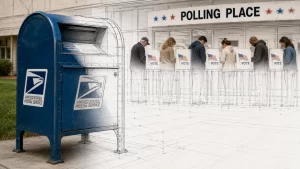
The institutional purges have been accompanied by an aggressive legislative and executive campaign to rewrite the rules of American elections from the White House — a power the Constitution explicitly reserves to states and Congress. In March 2025, Trump signed an executive order requiring proof of citizenship on voter registration forms. Courts blocked key provisions. In March 2026, he signed a second order, this one directing the U.S. Postal Service to oversee mail-in ballots, compelling DHS and the Social Security Administration to construct a master citizenship voting list, and threatening election officials who violated its terms with federal prosecution. Twenty-three states, led by Pennsylvania Governor Josh Shapiro and the attorneys general of California, Massachusetts, Nevada, and Washington, are suing to block it.
As reported by PBS NewsHour, a leaked 17-page draft executive order circulating among Trump’s allies would go even further: declaring a national emergency based on alleged foreign interference, requiring hand-counting of all ballots, and compelling all 211 million currently registered Americans to re-register in person with documentary proof of citizenship before November. The Center for American Progress, reviewing the proposal, concluded that no U.S. president has ever possessed such authority, and that claiming a national emergency as justification would be “an unprecedented attempt in U.S. history to interfere in elections.”
Trump returns to the Oval Office. Within days, CISA’s election security staff are placed on administrative leave; the agency’s election work is frozen.
FBI Director Kash Patel disbands the Foreign Influence Task Force and the public corruption squad. The DOJ Public Integrity Section, once 36 attorneys strong, begins hemorrhaging staff after being ordered to drop charges against then-New York City Mayor Eric Adams.
Trump issues his first executive order on elections, demanding proof of citizenship on voter registration forms. Federal courts block key provisions.
The administration dismantles the Foreign Malign Influence Center at the Office of the Director of National Intelligence — the body that countered Russian, Chinese, and Iranian election interference.
White House election lawyer Kurt Olsen flies to Georgia to pressure FBI Atlanta field office chief Paul Brown to seize Fulton County ballots. Brown refuses. He is subsequently forced into retirement.
The FBI, under Brown’s replacement and with a prosecutor hand-picked by the White House, raids the Fulton County ballot archive in an action experts call unprecedented in American history.
Trump signs a second executive order on elections, giving the Postal Service authority over mail ballots, creating a DHS citizenship voting list, and threatening federal prosecution of election officials. Twenty-three states file suit within days.
Rep. Jamie Raskin introduces legislation to establish a 25th Amendment fitness commission with fifty Democratic co-sponsors, (at the time of filing – this number has since grown), citing what he calls “incoherent, volatile, profane, deranged, and threatening” public statements by the president.
5. A Crisis of Leadership: Institutional Sabotage as Executive Failure
There is a word for what ProPublica has documented, and it is not governance. A president who systematically purges the nonpartisan professionals tasked with keeping elections honest, installs in their place operatives drawn from a movement built on election lies, weaponizes federal law enforcement against officials who refuse to execute partisan orders, and then issues executive decrees attempting to override state sovereignty over elections — that president is not leading a government. He is dismantling one.
The leadership failure here is not merely political. It is constitutional, institutional, and moral. The core obligation of any chief executive is to faithfully execute the laws — including, foundationally, the laws and constitutional provisions that govern how Americans select their representatives. The framers understood that the integrity of elections was not one governing priority among many; it was the precondition for all of them. A president who treats that precondition as an obstacle to be neutralized has abandoned the most basic responsibility of his office.
Sen. Alex Padilla of California, who has led congressional resistance to the administration’s election interference, articulated the stakes precisely: the 2020 election’s systems had survived Trump’s assault, he observed, “but this will be an even tougher test, with more election deniers having access to federal power than ever before.” The organization Protect Democracy, which has tracked executive overreach across administrations, concluded in its April 2026 report that the administration’s strategy consists of three interlocking elements: deceiving voters about the trustworthiness of election systems, disrupting the smooth operation of those systems, and using the resulting confusion to deny outcomes the president dislikes. That is not a governing agenda. It is, by any honest assessment, an authoritarian playbook.
The breakdown of trust between federal and state officials is now complete. Shenna Bellows, Maine’s Democratic secretary of state, told ProPublica that the relationship between the Trump administration and the states it is supposed to partner with on election security is “absolutely demolished.” Colorado’s Jena Griswold has added a new attorney to her staff specifically to fight the federal government. Arizona’s Secretary of State Adrian Fontes called the March 2026 executive order “a disgusting overreach from the federal government.” Derek Tisler of the Brennan Center for Justice warned that debunking false claims about elections becomes almost impossible when those claims arrive “with the seal of the federal government” behind them.
Section 4, Twenty-Fifth Amendment: Mechanism, Arguments, and the Moral Case
The Twenty-Fifth Amendment, ratified in 1967 in the wake of presidential incapacitation crises stretching back to Woodrow Wilson’s stroke, provides a constitutional mechanism for removing a president who is “unable to discharge the powers and duties of his office.” Under Section 4, the vice president and a majority of the Cabinet may declare the president unfit; if the president contests the finding, a two-thirds vote of both chambers of Congress is required to make removal permanent.
The practical barriers to invoking this mechanism are, at present, formidable. Vice President JD Vance has shown no indication of willingness to challenge the president he serves. The Cabinet is composed overwhelmingly of loyalists who were selected for their fealty. Republicans control both chambers of Congress, and no two-thirds supermajority for removal is plausible in the current political environment. As constitutional scholar and Boston Globe contributor John Feerick has noted, the amendment’s original architects were fully aware that it was not a perfect instrument.
Nonetheless, the legislative case for invoking it — or at minimum for demanding the transparency it contemplates — has gained substantial momentum. Rep. Jamie Raskin, the ranking member of the House Judiciary Committee, has formally introduced legislation to establish an independent Commission on Presidential Capacity, with fifty Democratic co-sponsors, citing the president’s “incoherent, volatile, profane, deranged, and threatening” public conduct. Senator Chris Murphy of Connecticut stated publicly that if he were a Cabinet member, he would spend his Easter holiday consulting constitutional lawyers about the amendment’s applicability, calling the president’s conduct “completely, utterly unhinged.” More than seventy Democratic lawmakers have signed onto calls for removal, through either impeachment or the Twenty-Fifth Amendment. Even some figures outside of progressive politics, including Candace Owens, have publicly raised questions about the president’s fitness.
The constitutional argument for the amendment’s applicability rests not only on the erratic public statements that have alarmed critics across the spectrum, but on the very conduct documented in the ProPublica investigation. A president who cannot distinguish between the legitimate exercise of executive authority and the corrupt weaponization of federal agencies for personal electoral advantage has, by any reasonable standard, demonstrated an inability to faithfully discharge the constitutional duties of his office. The duty to “take Care that the Laws be faithfully executed” — including the Voting Rights Act, the Help America Vote Act, and the constitutional provisions reserving election authority to the states — is not discretionary. Its systematic violation is not a policy disagreement. It is evidence of executive incapacity.
The honest assessment of where this stands: the political path to removal under the Twenty-Fifth Amendment remains closed, barring a rupture within the Republican Party or the Cabinet that is not visible on the current horizon. But the constitutional and moral case for demanding a transparent fitness evaluation, for applying the amendment’s framework as a lens through which to understand the president’s conduct, and for using every available legislative tool to force that accountability — that case does not depend on a near-term prospect of success. It depends on the obligation to bear honest witness to what is happening, and to refuse to normalize it.
6. What Is At Stake in November
Sen. Padilla is correct that 2026 will be an unprecedented stress test of American democracy. The guardrails that held in 2020 — the nonpartisan professionals who told then-Attorney General William Barr the truth about Antrim County’s election being secure, the White House lawyers who talked Trump off the ledge of martial law, the career prosecutors who would have blocked a partisan FBI raid — those guardrails are gone. The institutions they staffed have been repurposed or hollowed out. In their place stand operatives for whom election denial is not a discredited conspiracy theory but a governing philosophy.
A survey of thirty-seven election administration experts conducted by Votebeat in April 2026 found that among their highest concerns is the possibility of federal agents physically disrupting in-person voting. Most do not believe the most catastrophic scenarios will materialize. But the record of this administration’s conduct toward elections — two executive orders, thirty lawsuits against states, an FBI raid on a county ballot archive, a shadow network of election deniers installed throughout DHS and DOJ — does not justify reassurance. It justifies vigilance.
Jessica Cadigan, a former FBI intelligence analyst, described what has been lost in a single metaphor. The Election Day command posts that coordinated federal threat response, she said, were “the brain” — the institution that “piece[s] the whole thing together.” That brain has been dismantled. What has replaced it is an apparatus built not to protect the vote, but to question it, control it, and if necessary, discredit it.
Editorial Conclusion
What ProPublica has documented is not overzealous politics or aggressive partisanship. It is a president using the full machinery of the federal government to tilt the electoral playing field in advance of an election he fears losing — and doing so by systematically destroying the institutions whose job it was to prevent exactly that. This is the conduct of a leader who has abandoned his constitutional oath, not in one dramatic act, but in seventy-five quiet firings, two imperial decrees, an FBI raid conducted at the direction of a White House lawyer, and a shadow network of election deniers given the keys to the republic’s most sensitive democratic infrastructure. The Twenty-Fifth Amendment was ratified because its drafters understood that a president incapable of faithfully executing his duties — whether through incapacitation, corruption, or a compulsion to prioritize personal survival over constitutional obligation — posed an existential risk to republican government. That risk is now present. The barriers to accountability are real. But they do not change the nature of what we are witnessing. The American people, and the members of Congress who represent them, must name it clearly: this is the anatomy of a democratic emergency, unfolding on a schedule set by one man’s fear of a free election.
Sources & References
- ProPublica — “Inside Trump’s Effort to ‘Take Over’ the Midterm Elections”
- ProPublica — Heather Honey, DHS Election Security Appointee
- ProPublica — David Harvilicz, DHS Voting Machines Official
- ProPublica — The SAVE Citizenship Verification Tool’s Widespread Errors
- ProPublica — The FBI’s Unprecedented Fulton County Raid
- ProPublica — Trump Officials at Election Denier Summit
- CNBC — Trump Signs Executive Order Limiting Mail-In Voting
- Votebeat — Trump Issues Executive Order Giving USPS Oversight Over Mail Voting
- Votebeat — Lawsuit: Mail Voting Order Usurps State Election Powers
- PBS NewsHour — The Draft Executive Order to Seize Control Over Elections
- Center for American Progress — Trump Has No Legal Authority to Take Over Elections
- Protect Democracy — “Executive Override”: How the Administration Plans to Interfere With 2026 Elections
- WHYY — Democrats Concerned Trump Will Interfere With 2026 Midterms
- Votebeat — 37 Election Experts Survey: Which Fears About 2026 Are Likeliest?
- House Judiciary Committee Democrats — Raskin Demands Cognitive Evaluation of Trump
- Deseret News — Democrats Introduce 25th Amendment Commission Bill
- The Boston Globe — Why the 25th Amendment Won’t Remove Trump
- ACLU — Voting Rights Groups Challenge Mail-In Ballot Executive Order
Related News