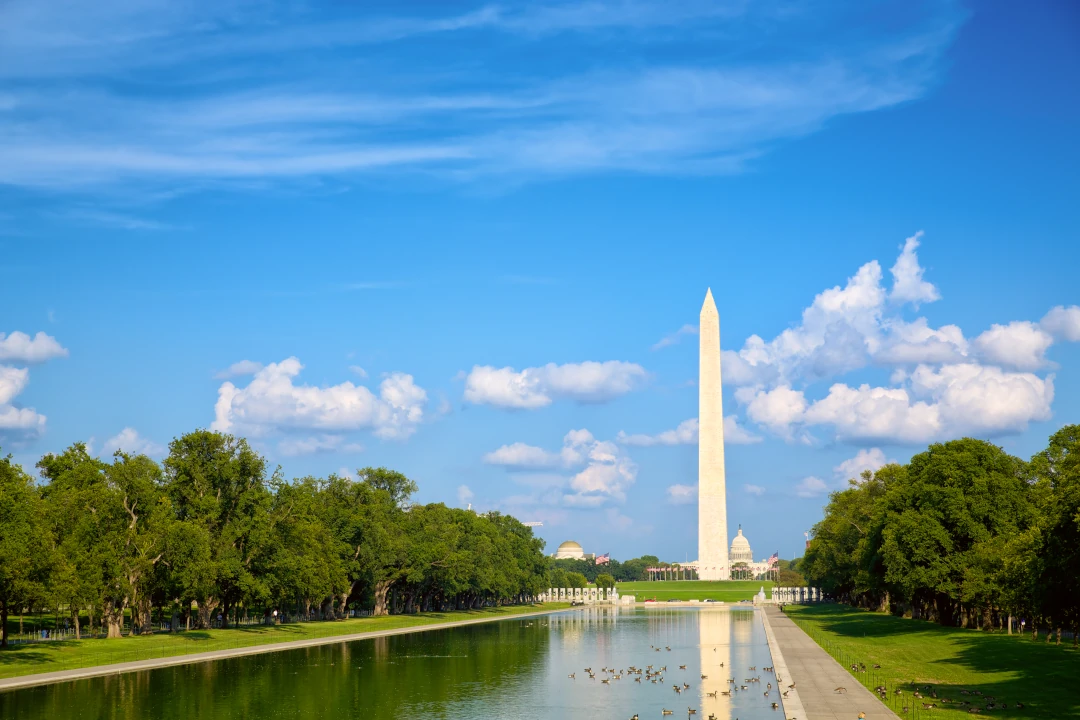
While American families pay over $4 a gallon for gas, millions struggle without health insurance, and a war in Iran enters its third month without a coherent exit strategy, the President of the United States interrupted a White House briefing on prescription drug prices to announce he had hired his hotel’s pool contractor to paint the Lincoln Memorial Reflecting Pool “American flag blue.” This is not a metaphor. This is the record.
On Thursday, April 24, 2026, President Donald Trump sat before a room of pharmaceutical executives and White House reporters, ostensibly to discuss lowering prescription drug prices — a promise he made repeatedly on the campaign trail. Instead, he spent several unscripted minutes showing photographs of construction workers coating the bottom of the Lincoln Memorial Reflecting Pool in a swimming-pool-blue industrial finish, rhapsodizing about its future beauty, and explaining that he had sourced the contractor from his personal network of hotel developers. “As a developer,” Trump told reporters, “I’ve probably built more than 100 swimming pools.” Whether or not that figure is accurate, the spectacle it produced was precise and revealing: a president of the United States, during a crisis-laden week, pivoting from drug prices to pool aesthetics while a war stretched into its eighth week and gas prices climbed above $4 a gallon.
The reflecting pool renovation — a $1.5 to $2 million project inspired, by Trump’s own account, by a visiting friend from Germany who called the pool “filthy” and “disgusting” — is neither the most expensive nor the most grandiose of the president’s aesthetic preoccupations. It is, however, perhaps the most symbolically clarifying. The reflecting pool is, literally, a surface. It reflects. And what this president sees there is not the accumulated weight of American democratic history — not Martin Luther King Jr.’s voice carrying across its waters in 1963, not the marching feet of a generation demanding justice — but an opportunity for a cosmetic touch-up. A chance to make things look better without making them be better. The distinction, for this presidency, is everything.
1. The Renovation Tour of a Republic in Crisis
The reflecting pool project is not an isolated impulse. It is part of a sprawling, obsessive campaign by the Trump administration to physically reshape Washington, D.C. into something that flatters the president’s sense of grandeur. Interior Secretary Doug Burgum, who posted celebration photos of the renovation on X within hours of work beginning, has become the administration’s chief aesthetician — a cabinet official whose visible portfolio now includes fountain restorations, park upgrades, and cheerful social media posts about pool tile. Trump has also overseen the demolition of the White House East Wing to make way for what was supposed to be a tech-funded ballroom, (but turned into a tax-payer funded money pit), added gold accents to the Oval Office, paved over the Rose Garden, renamed the Kennedy Center after himself, and proposed a 250-foot triumphal arch near Arlington National Cemetery. He has proposed a $10 billion Presidential Capital Stewardship Program dedicated to D.C. beautification — a figure more than three times the National Park Service’s entire annual budget, proposed in the same breath as slashing $736 million from national park operations across the rest of the country.
The president’s approach to the reflecting pool renovation is, in his telling, a parable of business genius. The Biden administration had reportedly sought bids for a proper granite renovation; estimates came in at $301 million over three years. Trump scrapped those plans and called his “pool guys.” The result, he boasted, would be done in a week for $2 million. He did not note that what he authorized is not a structural renovation — it is a cosmetic resurfacing using an industrial pool coating to cover a leaking granite foundation that remains beneath. The problem has not been solved; it has been painted over. This, too, is a metaphor the administration seems not to have noticed.
“Two-thirds of Americans believe the president has the wrong priorities. As he focuses on another renovation project, he keeps proving them right.”
— MSNBC MaddowBlog, April 24, 2026
2. What Is Not Being Fixed
While the president’s pool contractor laid down the “latest and greatest filament” in American flag blue, the country was living through an economic climate his own policies helped engineer. The Tax Foundation estimates Trump’s tariffs have amounted to an average tax increase of $1,500 per American household in 2026. A CNBC All-America Economic Survey released the same week as the pool announcement found that 60 percent of respondents disapprove of the president’s handling of the economy — his lowest mark on an issue that was once his political calling card. Rep. Don Bacon, a Nebraska Republican, described the pattern as “self-inflicted wounds that were so unnecessary.”
Gas prices, hovering above $4 a gallon as a direct consequence of the war Trump launched against Iran in late February, show no sign of imminent relief. Trump’s own Energy Secretary, Chris Wright, told CNN that prices might not return below $3 per gallon until 2027 at the earliest — a timeline Trump publicly contradicted, calling Wright “totally wrong,” before contradicting himself days later. The contradiction is not a side story. It is the story: an administration with no coherent message on an issue that affects every American every time they fill a tank.
On healthcare, the damage is structural and ongoing. The One Big Beautiful Bill Act, signed into law on July 4, 2025, failed to extend COVID-era ACA tax credits, causing health insurance premiums to spike sharply. TIME Magazine reported that the administration has “gutted Medicaid, the largest source of funding for in-home care,” while cutting nutrition assistance and imposing new work requirements on SNAP recipients. The House Budget Committee’s Democratic caucus put the number plainly: 15 million Americans have lost their healthcare under Trump and Congressional Republicans. The president himself, at a private Easter luncheon, offered his philosophy on the matter with unusual candor: “We’re fighting wars. We can’t take care of daycare… It’s not possible for us to take care of daycare, Medicaid, Medicare.”
Trump tariffs have cost the average American household $1,500 in 2026, the largest U.S. tax increase as a share of GDP since 1993.
Fifteen million Americans have lost healthcare coverage under Trump-era legislation, with ACA premiums spiking after COVID subsidies expired.
The Iran war has pushed gas prices above $4/gallon. Trump’s Energy Secretary conceded prices may not recover before 2027.
Trump proposed $10 billion for D.C. beautification while cutting $736 million from National Park Service operations nationwide.
Trump’s economic approval stands at just 31% in a new CNN/SSRS poll — his lowest mark on an issue that defined his political brand.
Two-thirds of Americans in recent polling say the president has “the wrong priorities” — a verdict delivered even before the pool announcement.
3. A Timeline of Distraction
Trump signs executive order to “beautify” Washington, D.C., setting the administrative and aesthetic agenda that would consume vast White House attention over the following year.
Trump signs the One Big Beautiful Bill Act, which cuts Medicaid, imposes SNAP work requirements, and fails to renew ACA subsidies — affecting tens of millions of low-income Americans.
The White House East Wing is demolished to make way for a tech-funded ballroom. The president’s renovation obsession becomes literal structural policy.
The U.S. and Israel jointly launch strikes against Iran, beginning a war Trump promised would last four to six weeks. It has now entered its third month.
Trump proposes a $10 billion Presidential Capital Stewardship Program for D.C. beautification, paired with cuts to National Park Service operations across the entire country.
Rep. Jamie Raskin formally demands a comprehensive cognitive and neurological evaluation of the president, citing “increasingly volatile, incoherent, and alarming” public statements.
During a White House briefing on drug prices, Trump derails the session to announce his pool contractor has begun painting the Lincoln Memorial Reflecting Pool “American flag blue.”
4. The Psychology of Surface
There is a consistent psychological and political logic to the president’s renovation obsession, and understanding it is essential to understanding the failure of his second term. Trump’s entire career in real estate was built on the principle that appearance is substance — that gold leaf and marble signify success regardless of what the balance sheet says. That instinct served him as a developer and as a candidate. Applied to the presidency, it has become a governing philosophy of profound inadequacy. When Trump looks at the reflecting pool, he sees a problem he can solve — one with a visible before-and-after, one that can be photographed, posted to Truth Social, and declared a triumph. When he looks at the 15 million Americans who’ve lost healthcare coverage, he sees a problem that cannot be solved with a coat of “American flag blue.” When he looks at gas prices or the Iran war or the economic pain of tariffs, he sees complexity and political cost. He has responded to that complexity by turning his gaze, and a remarkable portion of his political energy, toward whatever can be aestheticized: the pool, the arch, the ballroom, the gold-leafed Oval Office, the renamed Kennedy Center. This is not mere distraction. As MaddowBlog documented, the reflecting pool project is only the latest in a cascade that includes the ballroom, the triumphal arch, a UFC arena at the White House, the renovation of the Treaty Room, specific marble and paint preferences for the Kennedy Center, and more than a dozen additional projects in and around the White House complex. At some point, the volume and pattern of these distractions becomes something more than distraction. It becomes a diagnostic.“Americans cannot afford Trump’s America. In contrast, Democrats are focused on lowering costs and reining in political corruption.”
— Ken Martin, DNC Chair, April 2026
5. The Contractor-in-Chief
Trump’s decision to hire contractors from his personal Rolodex to renovate a national historic landmark raises questions that go beyond aesthetics. The president explicitly described calling “three people that have worked for me in the past doing swimming pools” — contractors associated with his private hotel and residential projects — and asking them for “a good price.” Artnet News reported that the work bypassed standard federal procurement processes. Interior Secretary Burgum, who signed off on the project, offered no public accounting of competitive bidding. The result — a cosmetic industrial resurfacing rather than the structural granite repair that engineers had recommended — may mean that the underlying leak problem the pool has suffered for years remains unaddressed, just hidden beneath a new coat of color.
Get Involved Today
Contribute to our mission and turn your concerns into action.
This is consistent with the broader pattern of the Trump administration’s relationship to governance: the performance of competence in lieu of competence itself. Trump claimed he saved taxpayers $299 million by doing this his way. What he actually did was defer a structural problem, hand a federal contract to associates of his private business, and declare victory — in the middle of a briefing about an entirely different crisis — before the pool had even been refilled with water.
When Distraction Becomes a Constitutional Question
The 25th Amendment to the U.S. Constitution was ratified in 1967 in the wake of President Kennedy’s assassination, designed to address exactly the kind of question that now haunts the national discourse: what happens when a president cannot, or will not, discharge the essential duties of the office? Section 4 — the provision that has never been invoked — allows the Vice President and a majority of the cabinet to jointly declare the president “unable to discharge the powers and duties of his office,” transferring power to the Vice President. Congress then has 21 days to confirm the determination by a two-thirds vote of both chambers, or the president resumes authority.
The calls to invoke Section 4 are no longer fringe. On April 10, 2026, Rep. Jamie Raskin (D-MD), Ranking Member of the House Judiciary Committee, formally wrote to White House Physician Captain Sean Barbabella demanding “an immediate and comprehensive cognitive and neurological evaluation” of the president, citing a series of increasingly volatile, incoherent, and alarming public statements about the Iran conflict. Sen. Chris Murphy (D-CT) publicly urged Cabinet members to consult constitutional lawyers about Section 4. Rep. Yassamin Ansari (D-AZ) declared Trump “a national security threat” and called for immediate congressional action. Rep. Melanie Stansbury (D-NM) joined the call, posting: “Time for the #25thAmendment. Congress and the Cabinet must act.”
The constitutional argument is not primarily about pool tiles. It rests on a pattern: a president who launched a war without Congressional authorization, threatened to bomb Iranian civilian power plants on Easter Sunday via social media, contradicted his own cabinet secretaries on critical policy within days, and consistently redirected his public attention to vanity renovation projects while crisis decisions went unmade or made incoherently. Raskin has pointed to language in the amendment allowing “such other body as Congress may by law provide” to make the incapacity determination — an avenue that does not require cabinet cooperation.
The practical barriers are formidable. Vice President J.D. Vance and the cabinet are Trump loyalists. A two-thirds vote in both chambers remains a near-mathematical impossibility in the current Congress. The White House physician, following an April cognitive test, declared the president’s function “normal” — though the administration refused full public disclosure of the results, even as Republicans had previously subpoenaed the Biden White House physician for similar transparency. These barriers are real. They do not, however, make the constitutional case less valid. The 25th Amendment was written for precisely those moments when political loyalty and constitutional duty point in opposite directions. The question it asks is not whether removal is politically achievable. It asks whether a president can discharge his duties. On the evidence of this week alone, that question deserves an honest answer.
6. The Reflection America Deserves
The Lincoln Memorial Reflecting Pool has witnessed more American history than almost any other physical site in the nation. It was there, on August 28, 1963, that the Reverend Dr. Martin Luther King Jr. looked out at 250,000 people gathered in the cause of civil rights and spoke of a dream. The pool does not belong to any one president. It belongs to that history, and to the republic it reflects. To see it transformed into a symbol of presidential self-congratulation — a canvas for “American flag blue,” a prop in a Truth Social post, a talking point hijacked from a drug pricing briefing — is to understand something essential about this administration’s relationship to the institutions and history it has been entrusted to steward.
The pool will reopen. It will be bluer. The photos will be posted. The president will declare it the most beautiful reflecting pool anyone has ever seen. And somewhere in the same week, millions of Americans will continue to pay for healthcare they can barely afford, or forgo it entirely. They will fill their tanks at prices driven up by a war with no exit strategy. They will shop for groceries priced higher by tariffs sold to them as industrial policy. They will watch their elected president talk, at length and with visible enthusiasm, about swimming pool contractors.
The surface reflects what is placed before it. What this president has chosen to place before it tells us everything about where he believes his duty lies — and everything about the distance between that belief and the truth.
Editorial Conclusion
A president who interrupts a healthcare briefing to brag about his pool contractor, who proposes $10 billion to build and ‘beautify’ his own political monuments while gutting the parks and clinics that serve ordinary Americans, who cannot sustain a coherent message about a war he started but cannot end — this is not a president temporarily distracted. This is a president whose governing priorities have been revealed. The reflecting pool now wears American flag blue. What it reflects is a presidency defined by surface over substance, aesthetics over accountability, and the needs of one man’s ego over the needs of 335 million Americans. The constitutional mechanisms to address this failure exist. The moral case for using them has never been clearer. What remains lacking is not the legal authority, nor the factual record — it is the political courage to act on what the record plainly shows.
Sources & References
- NBC News — “Trump says he’ll renovate ‘filthy’ reflecting pool on National Mall” (April 24, 2026)
- The Hill — “Doug Burgum previews Trump’s Reflecting Pool renovation plan” (April 25, 2026)
- CBS News — “Trump says he’ll resurface the bottom of the Lincoln Memorial Reflecting Pool, turning it blue” (April 25, 2026)
- AOL News / The Daily Beast — “Iran War-weary Trump rambles on about sending his ‘pool guy’ to redo historic Lincoln Memorial Reflecting Pool” (April 24, 2026)
- Artnet News — “The Lincoln Memorial Reflecting Pool Is Being Overhauled by Trump’s Pool Contractor” (April 25, 2026)
- NBC4 Washington — “Trump giving Lincoln Memorial Reflecting Pool a blue coating” (April 24, 2026)
- Washington Examiner — “Trump celebrates success of DC beautification” (April 25, 2026)
- MaddowBlog / MSNBC — “Trump, still mired in distractions, turns his attention to the reflecting pool” (April 24, 2026)
- The Washington Post — “Trump proposes $10B fund for D.C. construction, beautification projects” (April 3, 2026)
- WTOP News — “Trump’s budget plan pairs $10B for DC beautification with national parks cuts” (April 4, 2026)
- CNBC — “Trump’s lack of focus on economy is spooking Republicans as 2026 election looms” (April 23, 2026)
- Tax Foundation — “Tariff Tracker: 2026 Trump Tariffs & Trade War by the Numbers” (April 2026)
- TIME — “Trump Has Abandoned His Affordability Promises” (April 16, 2026)
- House Budget Committee Democrats — “Trump’s 2027 Budget Puts America Last” (April 2026)
- NBC News — “Trump believes gas prices will plummet once war with Iran ends. His aides and experts disagree.” (April 21, 2026)
- CNN Politics — “Trump team’s gas prices rhetoric has become a fiasco” (April 20, 2026)
- House Judiciary Committee Democrats — “Ranking Member Raskin Demands White House Physician Evaluate Trump’s Cognitive Fitness” (April 10, 2026)
- TIME — “What to Know About the 25th Amendment as Lawmakers Call for Trump’s Removal” (April 6, 2026)
Related News