Gilded Delusions: Trump’s Vanity Projects, a Golden Oval Office, and the Growing Question of Fitness for Office
There is a particular kind of dissonance that defines the second Trump administration — a presidency unfolding against a backdrop of war threats, economic anxiety, and democratic erosion, while its chief executive obsesses over cherubs, gold leaf, and the size of his arch. As millions of Americans struggle to choose between gas and groceries, the man in the Oval Office is busy gilding the ceiling and erecting monuments to himself. At what point does this cross the line from eccentricity into something more constitutionally alarming?
That question is no longer the exclusive domain of progressive critics. It is now being asked by Tucker Carlson, Alex Jones, and members of Congress on both sides of the aisle.
The “Arc de Trump”: A Monument to Self
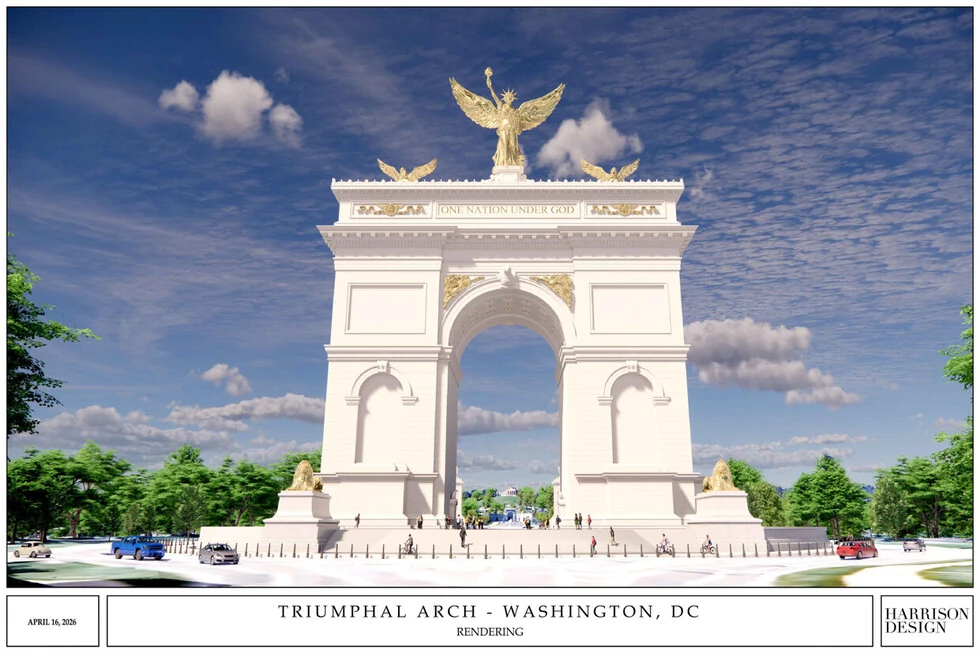
The most brazen symbol of the administration’s narcissistic drift is a planned 250-foot triumphal arch to be built at Memorial Circle, directly between Arlington National Cemetery and the Lincoln Memorial.
The designs, released by the Trump administration on April 10, 2026, show a towering gilded figure flanked by golden eagles and lions, with the phrases “One Nation Under God” and “Liberty and Justice for All” inscribed in gold on either side. When a CBS reporter asked Trump who the arch was for, the president pointed to himself and said, simply: “Me.” He also boasted it would surpass Paris’s Arc de Triomphe — a monument built to honor the war dead of the Napoleonic era — and “blow it away.“
The historical irony is not subtle. Triumphal arches were used in ancient Rome to commemorate military victories, and Napoleon’s arch was specifically commissioned to honor fallen soldiers. Trump’s version appears designed to honor Trump.
The project is also legally dubious. Senator Angus King has pointed out that under the Commemorative Works Act, any monument on public lands must be authorized by Congress. Representative Jared Huffman put it more bluntly: “For over two hundred years, Congress has held authority over what monuments rise in our nation’s capital… without any legal authority whatsoever, he wants to build himself the largest arch in the world.” The Lincoln Memorial, the WWII Memorial, the MLK Memorial — all required congressional approval. The “Arc de Trump” does not, in the administration’s view.
Funding remains murky. The White House has reserved $15 million in National Endowment for the Humanities funds for the project, while refusing to disclose total estimated costs. Meanwhile, veterans’ groups have sued, with one representative writing that he feels “a duty to my fellow veterans buried at Arlington National Cemetery to honor their sacrifice and to protect their memory from being overshadowed by this vainglorious monumental arch.”
Versailles on Pennsylvania Avenue
The arch does not exist in isolation. It is one piece of a comprehensive rebranding of America’s public spaces as extensions of Trump’s personal aesthetic — an aesthetic critics have compared, repeatedly and unfavorably, to the Palace of Versailles.
The Oval Office has been transformed into what the New York Times called a “gilded rococo hellscape.” Gold cherubs peer down from above the doorways. Gilded Rococo mirrors hang on the doors. Golden eagles perch on side tables. A gold-stamped paperweight reading “TRUMP” sits on the coffee table. Even the remote control down the hall is wrapped in gilt. Trump called in his personal Mar-a-Lago “gold guy” to assist with the redesign.
A former White House official who served under both Democratic and Republican administrations told CNN: “Every president has a right to decorate the Oval Office. But his décor is so weirdly un-presidential, it’s more king-like.”
Style critic Robin Givhan of the Washington Post captured the deeper problem: “So much of the new aesthetic seems to be situated around this idea of regalness. Part of the power of the Oval Office has always come from the fact that it didn’t need all of these elements in order to convey authority. The authority came from the people and from democracy.”
It is worth noting that when some of these gilded items were first acquired for the White House collection in the 19th century, members of Congress worried they signaled too much of an appreciation for monarchy — a concern apparently lost on the current occupant.
Beyond the Oval Office, Trump has demolished part of the White House East Wing to make way for a 90,000-square-foot ballroom modeled after Versailles, paved over the historic Rose Garden in favor of a Mar-a-Lago-style stone patio, and added gold signage and trim throughout the West Wing. He told Canadian Prime Minister Mark Carney that all of this “keeps my real-estate juices flowing.”
“I am pleased to announce that TODAY my Administration officially filed the presentation and plans to the highly respected Commission of Fine Arts for what will be the GREATEST and MOST BEAUTIFUL Triumphal Arch, anywhere in the World. This will be a wonderful addition to the Washington D.C. area for all Americans to enjoy for many decades to come! President DONALD J. TRUMP”— Truth Social, @realDonaldTrump, April 10, 2026
A Pattern of Priorities Upside Down
What makes these aesthetic choices politically significant is the context in which they are occurring. The administration has cut arts grants, gutted federal agencies, slashed social programs, and imposed economically disruptive tariffs — while simultaneously channeling public funds and attention toward monuments and decor that flatter the president’s ego.
One analyst at George Washington University perhaps put it most succinctly: “President Trump is very good at playing the role of Donald Trump. The show is the point. Part of the show is the bling.”
The problem with that framing, of course, is that “the show” is now the presidency itself — and the stakes of presidential decision-making are rarely theatrical.
Get Involved Today
Contribute to our mission and turn your concerns into action.
The Question the Constitution Was Designed to Answer
Which brings us to the 25th Amendment — and why it is no longer just a talking point for progressive activists.
On April 10, 2026, Representative Jamie Raskin, Ranking Member of the House Judiciary Committee, formally wrote to the White House physician demanding a comprehensive cognitive and neurological evaluation of President Trump. The letter followed Trump’s profanity-laced social media threats to destroy Iranian power plants and bridges, which Raskin described as “plainly out of the realm of normal politics” and evidence of “profound medical difficulty and concern.”
Remarkably, the calls have not come only from the left. Tucker Carlson called Trump’s Easter Sunday social media meltdown “vile on every level” and urged administration officials to “figure out the codes on the nuclear football” to prevent catastrophe. Candace Owens called the president “a genocidal lunatic.” Even Alex Jones asked on air: “How do we 25th Amendment his ass?”
More than 70 Democratic lawmakers have called for Trump’s removal, citing not just the Iran threats but a broader pattern of increasingly erratic behavior that has alarmed allies and adversaries alike.
Raskin’s letter also invokes a principle that Republicans themselves established: that presidential cognitive fitness is a matter of national security and a legitimate subject of congressional oversight. Republicans applied this standard aggressively to President Biden. They cannot credibly exempt the current president from the same scrutiny.
What the 25th Amendment Actually Requires
Section 4 of the 25th Amendment allows the Vice President and a majority of the Cabinet — or another body designated by Congress — to declare the president “unable to discharge the powers and duties of his office.” The president can contest this declaration, triggering a congressional vote requiring a two-thirds majority in both chambers to sustain the removal.
The threshold is deliberately high, and it should be. But the framers of the amendment designed it precisely for moments when a president’s incapacity poses a threat to the Republic — not for moments of mere political disagreement. The question being asked with increasing urgency is whether we have reached such a moment.
Consider the pattern: A president who builds monuments to himself on public land without congressional approval. Who fills the seat of democratic authority with the aesthetic trappings of monarchy. Who threatens to “extinguish a civilization” on social media during an ongoing military conflict. Who rants about combat missions at a children’s Easter Egg Roll. The cumulative picture — of a leader more focused on his own glorification than on the duties of governance — raises legitimate questions that transcend partisan politics.
Conclusion: When Vanity Becomes a Constitutional Issue
None of this is to suggest that gold cherubs or triumphal arches are, by themselves, evidence of incapacity. Eccentric decorating is not a medical diagnosis, and political disagreement is not a 25th Amendment trigger.
But patterns matter. And the pattern emerging from this administration — the obsessive self-aggrandizement, the unlawful remaking of public spaces, the increasingly volatile and incoherent public statements, the fixation on legacy monuments while wars are initiated and economies destabilized — describes a president whose priorities are profoundly misaligned with the responsibilities of the office.
The arc of history does not bend toward gold-plated self-congratulation. And the framers of the Constitution, who were deeply suspicious of monarchical tendencies in exactly this form, gave future generations the tools to respond.
Whether those tools will be used is now the defining question of the moment.
Sources & References
- Trump unveils plans for 250-foot triumphal arch — PBS NewsHour
- Dezeen: Trump officials reveal designs of triumphal arch
- ArtNews: Trump Unveils Latest Plans for 250-Foot Triumphal Arch
- CNN: Developer in chief Donald Trump envisions new arch in Washington, DC
- Newsweek: ‘Arc De Trump’ Update: New Designs Revealed
- CNN: Flags, figurines and gold everywhere — Trump transforms the Oval Office
- NPR: Style expert breaks down what Trump’s taste projects about his presidency
- Newsweek: Trump’s Gilded Oval Office — Six Months of Gold
- Slate: Trump Oval Office gold decor — Why he’s spent his life rebuilding Versailles
- Fast Company: None of the objects on the Oval Office mantle were made in the U.S.
- House Judiciary Democrats: Raskin Demands Cognitive Evaluation of Trump
- Raskin’s Full Letter to White House Physician (PDF)
- Axios: Raskin demands Trump cognitive test in 25th Amendment push
- Newsweek: Trump Critics Urge Cabinet to Invoke 25th Amendment
- The American Prospect: Who Wrote the 25th Amendment?
- International Bar Association: President Trump and the 25th Amendment
Related News