In a historic and escalating series of official actions, Democratic lawmakers have formally demanded cognitive testing, launched investigations, briefed colleagues on the 25th Amendment, and written directly to the Vice President — arguing that the 79-year-old president’s deteriorating behavior represents a constitutional emergency, not a political dispute.
Something unprecedented is happening in Washington. For the first time in modern American political history, members of Congress are not merely expressing concern about a sitting president’s mental fitness — they are launching formal, documented official actions to compel evaluation, demand transparency, and build a legal case for constitutional removal. The subject is President Donald Trump, 79. The evidence they are citing spans more than a year of escalating cognitive alarms: confusion about basic geography, dozing during Cabinet meetings, boasting about passing a dementia screening test while calling it an IQ test, disappearing from public view without explanation, and — most recently — threatening to exterminate an entire civilization on Easter Sunday morning and posting graphic murder footage to his social media account. The question these lawmakers are now placing officially on the record is no longer whether something is wrong. It is whether the constitutional mechanism designed for exactly this moment will finally be used.
Action 1: Rep. Jamie Raskin Demands Cognitive Test, Sets April 24 Deadline
On April 10, 2026, Rep. Jamie Raskin, Ranking Member of the House Judiciary Committee, sent a formal letter to White House Physician Captain Sean Barbabella demanding “an immediate and comprehensive cognitive and neurological evaluation of President Donald Trump, along with full public disclosure of the findings.” Raskin set a deadline of April 24 for the results to be released to Congress, and demanded that Barbabella make himself available to brief committee members under oath.
The letter was unsparing. As The Daily Beast reported, Raskin wrote that “in recent days, the country has watched President Trump’s public statements and outbursts turn increasingly incoherent, volatile, profane, deranged, and threatening.” He said experts had “repeatedly warned that the President has been exhibiting signs consistent with dementia and cognitive decline,” and that Trump’s conduct had crossed from the realm of politics into “profound medical difficulty and concern.”
Raskin also invoked a precedent that Republicans themselves established: during Joe Biden’s presidency, House Oversight Chairman James Comer and Judiciary Chairman Jim Jordan subpoenaed Biden’s White House physician, arguing that presidential cognitive fitness is a legitimate subject of congressional oversight. Raskin is now applying that same principle — and the same precedent — to Donald Trump.
Action 2: Rep. Jasmine Crockett Writes VP Vance Directly, Calls for 25th Amendment
Three days earlier, on April 7, Rep. Jasmine Crockett (TX-30) sent a letter directly to Vice President JD Vance urging him and the entire Cabinet to invoke Section 4 of the 25th Amendment. Her language was some of the most direct deployed by any sitting member of Congress. In the letter, she wrote that it had become “indisputably apparent to the American public that the President is deranged, likely suffering from dementia,” and that he had brought the United States “to the precipice of committing one of the largest war crimes in modern history.”
Crockett did not stop at health concerns. She argued that Trump’s conduct is “not simply unbecoming of the Office, but criminal in nature,” noting that the Supreme Court’s immunity ruling had “exacerbated his apparent fetish for illegality.” She called Republican complicity in Trump’s behavior “among America’s greatest scandals” and wrote that “the country and the Constitution remain in jeopardy with each passing day Donald Trump is President of the United States.”
Notably, this is not Crockett’s first formal action on this front. As far back as October 2025, she issued a formal letter to White House Physician Captain Sean Barbabella calling for “clarity and honesty regarding the health and cognitive fitness of President Donald J. Trump,” citing “months of mounting public concern and numerous observable incidents suggesting a significant decline in the President’s physical and mental health.” She stated plainly: “Let me be clear: the American people deserve the truth about the health of their president.”
Action 3: Jeffries Convenes Democratic Caucus Briefing on the 25th Amendment
On April 8, House Minority Leader Hakeem Jeffries took a step that, just months ago, would have been unthinkable for Democratic leadership: he formally scheduled a caucus-wide briefing on the 25th Amendment, to be led by Raskin and House Judiciary Committee Democrats. In a “Dear Colleague” letter to his members, Jeffries wrote: “Shockingly, Donald Trump threatened to escalate his war of choice in a profane Easter Sunday rant and to eradicate an entire civilization. We will continue to unleash maximum pressure on Republicans to put patriotic duty over party loyalty and join Democrats in stopping the madness.”
The significance of this moment should not be underestimated. Democratic leadership has spent most of Trump’s second term deliberately avoiding the 25th Amendment as a talking point, fearing it would be dismissed as political theater. The decision by Jeffries to formally convene a briefing on the amendment’s mechanics — at the request of over 85 House Democrats who had publicly called for Trump’s removal — marks a genuine shift in how seriously the party’s leadership now views the cognitive fitness question.
Official Action
Formal letter to White House Physician demanding cognitive and neurological evaluation, results to Congress by April 24, physician briefing under oath. Official press release →
Official Action
Letter to VP Vance and the full Cabinet urging invocation of Section 4, declaring Trump “likely suffering from dementia.” Follows earlier formal investigation launched October 2025. Official press release →
Official Action
Convened a formal Democratic caucus briefing on the 25th Amendment, led by Raskin, after 85+ members publicly called for Trump’s removal. Axios coverage →
Official Action
Publicly demanded Trump’s removal through the 25th Amendment or impeachment, coordinating on potential organized action per senior aides briefed by Axios. NBC News coverage →
Context: A Year of Red Flags: What Congress Has Been Watching
These official actions did not emerge from a vacuum. They are the culmination of more than a year of documented behavior that has alarmed medical professionals, former White House officials, and an increasingly bipartisan coalition of observers. Here is the record:
- December 2, 2025Trump appeared to fall asleep during a Cabinet meeting. California Rep. Sydney Kamlager-Dove speculated he may be taking Leqembi, an Alzheimer’s treatment, citing his MRI, hand bruises, and apparent drowsiness as consistent with the drug’s side effects. (Wikipedia compilation of health incidents)
- January 1, 2026The Daily Beast described Trump as “sick and sleepy,” noting his dozing at public appearances and new requests to attend “fewer, more important meetings.” Trump also told the Wall Street Journal he was taking a larger aspirin dosage and ignoring medical advice.
- January 21, 2026While speaking at Davos, Trump referred to Greenland as “Iceland” at least four times. NBC News medical analyst Dr. Vin Gupta said Trump’s behavior “crossed a line of proper adult behavior” and called for a “more thorough public assessment of his neurological fitness,” noting the pattern could be consistent with early Alzheimer’s or frontotemporal dementia.
- January (various), 2026Trump confessed he closes his eyes during Cabinet meetings because they are “boring as hell,” in an interview later cited by lawmakers as a sign of disengagement from the duties of the presidency.
- March 2, 2026Trump was photographed with a dark red rash on his neck. His physician issued a vague statement about a “medicated cream” without naming the condition or disclosing the medication. Large bruises continued to appear on Trump’s hands throughout late 2025 and into 2026, routinely covered by unblended concealer.
- April 2, 2026Within 30 minutes of posting about firing Attorney General Pam Bondi, Trump published a bizarre Truth Social post featuring a photo of actor Fess Parker as Davy Crockett — targeting Rep. Jasmine Crockett — and incorrectly claiming Davy Crockett was from Texas. (He was from Tennessee.) The Daily Sight documented the episode.
- April 5, 2026 (Easter Sunday)Trump posted an expletive-filled threat against Iran on Easter morning, ending with “Praise be to Allah.” The post alarmed bipartisan observers and prompted Senator Chris Murphy to write: “If I were in Trump’s Cabinet, I would spend Easter calling constitutional lawyers about the 25th Amendment.”
- April 7, 2026Trump posted that “A whole civilization will die tonight.” Former White House attorney Ty Cobb raised public concerns about cognitive decline. The Hill reported that a Reuters/Ipsos poll found roughly 6 in 10 Americans believe Trump is becoming more erratic with age.
- April 9, 2026Trump posted raw surveillance video of a woman being beaten to death with a hammer — while simultaneously recommending people not watch it — and used the footage as a political prop. No previous president of either party has shared graphic death footage on their official accounts.
The Dementia Test He Calls an IQ Test
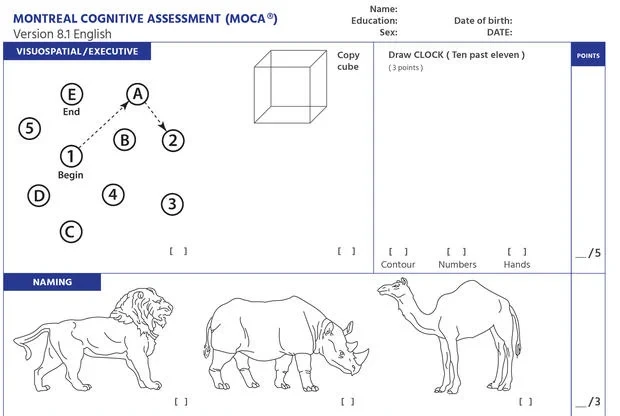
One of the most revealing windows into the cognitive fitness question is Trump’s own relationship with the Montreal Cognitive Assessment (MoCA) — the 10-minute screening test designed to detect early signs of dementia. Trump has repeatedly described the MoCA as an “IQ test” and boasted about “acing” it, using it as evidence of superior intelligence rather than what it actually is: a basic dementia screening tool.
Speaking aboard Air Force One in October 2025, Trump challenged Rep. Jasmine Crockett and Rep. AOC to take “the exams I decided to take at Walter Reed,” mocking them and reciting portions of the test: “The first couple questions are easy — a tiger, an elephant, a giraffe.” He described it as an “IQ test” and “aptitude test.” Medical experts were quick to note that the MoCA’s creator, Dr. Ziad Nasreddine, has explicitly stated: “There are no studies showing that this test is correlated to IQ tests. The purpose of it was not to determine people who have a low IQ level. It helps identify whether someone may have cognitive impairment.” Trump’s fundamental misunderstanding of the very test he uses as his primary health credential is itself a cognitive red flag.
Get Involved Today
Contribute to our mission and turn your concerns into action.
Pattern: The White House’s Playbook: Deny, Mock, Deflect
The White House’s response to the formal congressional inquiries has been consistent and revealing. When Raskin’s letter was made public, White House spokesman Davis Ingle issued a statement that said: “Lightweight Jamie Raskin is a stupid person’s idea of a smart person.” The spokesman went on to praise Trump’s “sharpness” and “unmatched energy” — without addressing any of the specific behavioral incidents cited in Raskin’s letter, and without providing any commitment to conduct or release the results of a cognitive evaluation.
This pattern — personal attack, boast about test scores, no substantive engagement — has been the administration’s go-to response since questions about Trump’s cognitive fitness began escalating in 2025. It was the same response when a reporter asked Trump directly on April 7 whether his mental health should be examined. Trump replied: “I haven’t heard that. But if that’s the case, you’re going to need more people like me.” It was not, by any measure, a reassuring answer from someone in command of the world’s most powerful nuclear arsenal.
The administration’s strategy of deflection is also in stark tension with the precedents Republicans themselves set. When they subpoenaed Biden’s White House physician over cognitive fitness concerns — concerns, it must be noted, that were substantiated by Biden’s eventual withdrawal from the race — they established a bipartisan standard that presidential health is a matter of public and congressional interest. That standard now applies to Donald Trump. The question is whether the Republican majority has the intellectual honesty to acknowledge it.
Why These Actions Matter for the 25th Amendment
Section 4 of the 25th Amendment allows the Vice President and a majority of the Cabinet to declare the President “unable to discharge the powers and duties of his office,” triggering an immediate transfer of power to the VP. If the President contests that determination, a two-thirds vote of both houses of Congress is required to sustain it. It has never been successfully invoked.
What Raskin, Crockett, and Jeffries are building — even if the immediate 25th Amendment push fails — is a documented congressional record of cognitive concern, formally transmitted to the relevant medical authority, at a moment of active military conflict. This matters for at least three reasons:
First, it creates accountability. By formally demanding evaluation results by April 24 and requesting testimony under oath, Raskin is ensuring that if the White House physician continues to issue health assessments claiming Trump is in “excellent health,” those assessments will be subject to congressional scrutiny and potential perjury liability.
Second, it builds the public record. The 25th Amendment’s invocation — should it ever come — would require a rapid, documented case. Every formal letter, every official press release, every demanded evaluation creates the evidentiary foundation for that case. Raskin himself noted the amendment’s language allows “such other body as Congress may by law provide” to declare a president unfit — meaning Congress can potentially act without Cabinet buy-in, a legal argument he was briefing colleagues on as of April 10.
Third, it applies political pressure on Republicans. Jeffries made this explicit: “We will continue to unleash maximum pressure on Republicans to put patriotic duty over party loyalty.” Every formal action by Democrats raises the cost of Republican silence. And as Axios noted, “the political cost of opposing even the most drastic anti-Trump tactics has risen considerably” — even among Democratic moderates who once dismissed 25th Amendment talk as unserious.
The practical barriers remain real. Vance, who would assume the presidency if the 25th Amendment were invoked, has given no indication he would act. The Cabinet is stocked with loyalists. Congressional Republicans have largely circled the wagons. But the window of viable action does not stay closed forever — and every week of documented behavior, every formal letter, every briefing makes the eventual constitutional reckoning harder to avoid.
Editorial Conclusion
When the top Democrat on the House Judiciary Committee formally demands a cognitive test, a sitting congresswoman writes the Vice President accusing the President of dementia, and the House Minority Leader convenes an official caucus briefing on constitutional removal — all in the same week — this is not political theater. This is the American constitutional system doing, haltingly, fitfully, what it was designed to do: generate accountability when the person at the top of the chain of command shows signs of not being able to discharge the duties the Constitution assigns. The only question left is whether the people with the actual power to act — Vance, the Cabinet, Republican members of Congress — will ever summon the courage to answer the question that the rest of the country is already asking out loud.
“The president who yearned for a Nobel Peace Prize and once reveled in the appearance of solving conflicts turned to the language of annihilation.”— The Associated Press, April 7, 2026
Sources & References
- House Judiciary Democrats — Raskin demands cognitive evaluation (Official, April 10, 2026)
- Axios — “Raskin Demands Trump Cognitive Test in 25th Amendment Push”
- The Daily Beast — “Dems Demand Public Cognitive Test for ‘Incoherent’ Trump, 79”
- Latin Times (CNN) — “Calls for Trump Cognitive Test Intensify”
- Rep. Crockett — Letter to VP Vance invoking 25th Amendment (Official, April 7, 2026)
- Rep. Crockett — Investigation into White House health cover-up (Official, Oct. 2025)
- Axios — “House Democratic Leadership Signals Openness to 25th Amendment Push”
- Fox News — “Jeffries Schedules Friday 25th Amendment Briefing for House Democrats”
- NBC News — “Dozens of Democrats Call for Trump’s Removal”
- The New Republic — “Raskin Demands White House Physician Make Trump Take Cognitive Test”
- The Independent — “Trump’s Mental State Called Into Question as Democrats Demand Evaluation”
- Wikipedia — “Age and Health Concerns About Donald Trump” (comprehensive documented history)
- The Hill — “Ty Cobb Questions Donald Trump’s Mental Fitness”
- Black News — “Trump Confuses Dementia Test With IQ Test, Calls Crockett ‘Low IQ'”
- IBTimes — “Trump Flaunts ‘Perfect’ Dementia Test Score, Mocks AOC and Crockett”
- The Daily Sight — “Trump Posts Bizarre Davy Crockett Message, Questioning Mental Stability”
- The Daily Beast — “Trump, 79, Hit With Wellness Check Demands Over ‘Unhinged’ Behavior”
- Texas Politics — “Jasmine Crockett Urges Vance to Invoke 25th Amendment on ‘Deranged’ Trump”
Related News