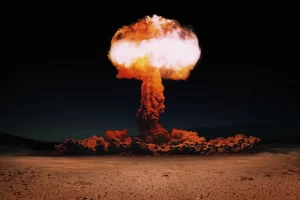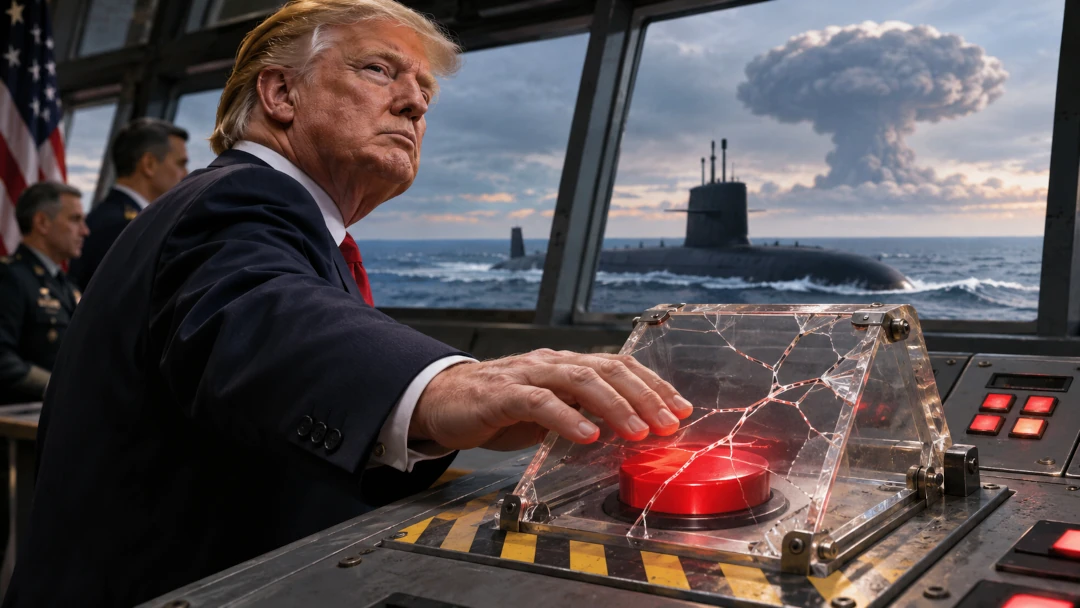
In a single year, the last U.S.–Russia arms treaty has died, the president has ordered nuclear testing restarted, a new battlefield nuclear weapon is being built for warships bearing his name, and the leaders who run the nation’s nuclear deterrent are being fired. Each step is presented as strength. Taken together, they amount to throwing away the restraints that kept the nuclear peace for more than fifty years.
On October 14, the Navy relieved the commanding officer, executive officer and chief of the boat of the attack submarine USS South Dakota, the boat’s entire command team. It did not announce the firings. The House Armed Services Committee found out weeks later, and largely from reporters. In a letter reported by the Associated Press, Reps. Joe Courtney and Adam Smith told Navy leaders they felt “deep frustration” at being kept uninformed. On its own, the episode could be a routine story of military accountability. But it is part of a larger pattern. American nuclear policy is now being run with less transparency, fewer restraints and more bravado than at any time since the Cold War.
This editorial board does not deal in panic, and we will not claim that the president has a secret plan to start a nuclear war. The documented record supports no such claim, and we lay that record out below. The real danger is harder to see and, in our judgment, more lasting. The Trump administration has systematically dismantled the treaties, norms, institutions and human expertise that make nuclear use unthinkable. Fifty years of guardrails have been treated as obstacles to remove.
I. The Purge Below the Waterline
The United States’ nuclear “triad” is its three ways of delivering a nuclear weapon: land-based missiles, bombers, and ballistic-missile submarines. The submarine leg is the one most likely to survive an attack, and the Navy has been removing its commanders at a striking rate. In October 2025, Rear Adm. Bob Wirth relieved Cmdr. Robert Moreno of command of the Ohio-class ballistic-missile submarine USS Wyoming’s Blue Crew, and Task & Purpose reported that the Navy gave no reason beyond a loss of confidence. Ten months later, Military Times reported that Cmdr. Joseph Sammur was relieved as commander of the USS West Virginia, also an Ohio-class missile boat based at Kings Bay, Georgia, again for “loss of confidence in his ability to command.”
The South Dakota is a Virginia-class attack submarine, not a nuclear-missile boat. According to Stars and Stripes, its command team was removed after a September incident in which the submarine descended toward shallow water, an “immediate navigational hazard” first reported by The Day of New London. Each firing may be justified on its own terms. But the pattern of near-silent dismissals across the force that carries America’s most survivable deterrent is not a sign of a healthy institution. Neither is a Navy that hides those dismissals from its civilian overseers.
USS Wyoming · Oct. 2025
Commander of the Ohio-class missile submarine’s Blue Crew relieved with no public reason given beyond “loss of confidence.” Task & Purpose
USS West Virginia · Jul. 2026
Second Kings Bay ballistic-missile submarine commander relieved in less than a year; the Navy says the boat’s mission is unaffected. Military Times
USS South Dakota · Oct. 2026
The full command triad of the Groton-based attack submarine was removed after a reported seabed incident, and the firing was not announced. Stars and Stripes
The Brass · 2025–2026
Defense Secretary Pete Hegseth boasted that “we fired 10 per cent of the generals and admirals,” and said he had cut general-officer slots by another 10 percent. South China Morning Post
The purge at the top is just as consequential. Hegseth presented the cuts as an “accomplishment” in a September address at Quantico and described the removed officers as people who resisted his drive against “woke” policies. The list now includes a chairman of the Joint Chiefs of Staff, the first woman to serve as Chief of Naval Operations, the director of the National Security Agency and the Army’s chief of staff. Each firing reinforces the same lesson for the officers who remain: candor costs careers. The nuclear chain of command depends on officers willing to tell a president what he does not want to hear. A culture of fear is a strategic vulnerability.
II. Is He Planning to Use Them?
The honest answer, based on the public record, is no. We have found no credible evidence of a plan to use nuclear weapons. But the president’s own words have repeatedly invited the question, and he answers it differently from month to month.
On April 7, during the U.S.–Israeli war on Iran that began in late February, Trump posted on Truth Social that a “whole civilization will die tonight” if Tehran refused a deal. As the Arms Control Association documented, that threat drew broad international criticism, including from Pope Leo XIV. Two weeks later, at an April 23 Oval Office event, the president reversed himself:
“A nuclear weapon should never be allowed to be used by anybody.”
— President Donald Trump, Oval Office, April 23, 2026 · via AFP
We welcome that sentence, and we wish the president’s policies matched it. In September, at the United Nations General Assembly, he again told world leaders he faced a choice between a deal and annihilating the Islamic Republic. The Union of Concerned Scientists called the remarks an implied threat of overwhelming nuclear force and warned that carrying it out would amount to “nuclear genocide.” In mid-October, in a Newsmax interview, Trump once more ruled out a nuclear strike on Iran.
The danger is not a hidden war plan. It is a commander in chief who uses nuclear annihilation as a negotiating tactic, sends contradictory signals that adversaries must decode under pressure, and holds legally unchecked authority to order a launch. Deterrence depends on predictability. This president’s nuclear rhetoric is unpredictable by design.
Get Involved Today
Contribute to our mission and turn your concerns into action.
III. The Treaty That Died of Neglect
For half a century, from the SALT agreements of the 1970s through the START treaties to the 2010 New START accord, Washington and Moscow placed binding, verifiable limits on their strategic arsenals. That chain ended on February 5, 2026.
It did not have to end. In September 2025, Vladimir Putin offered to keep observing New START’s central limits of 1,550 deployed warheads for one more year if the United States did the same. According to the Arms Control Association’s account, Trump ignored the offer, even though he had initially called it a good idea. On the day the treaty expired, he posted that America should instead negotiate a “modernized” multilateral treaty that includes China. Beijing says it has no plans to join such talks. The likely result is no treaty at all.
“A grave moment for international peace and security.”
— U.N. Secretary-General António Guterres, on New START’s expiration · United Nations
Russia’s record deserves no defense. It suspended inspections in 2023 and has made reckless nuclear threats over Ukraine. But the failure to grab a cost-free bridge, a simple handshake to keep existing limits while a successor treaty was negotiated, belongs to this White House. Rose Gottemoeller, the former lead U.S. negotiator on New START, warned Congress that Russia could outpace the United States in a race to load extra warheads onto existing missiles if Washington ignored the Russian offer. The president chose the race anyway.
IV. A Year on the Brink: The Timeline
Note what has not happened. The United States has not conducted a nuclear explosive test, and the September experiment used conventional explosives. But the testing order did its damage on day one. It gave Moscow an excuse to ready Novaya Zemlya, its Arctic test site. It weakened the U.S. case against testing by anyone else. And it tied Washington’s word to a moratorium it may abandon whenever the president changes his mind. Sen. Ed Markey called the order “a mistake of radioactive proportions,” according to Common Dreams. China, which has signed but not ratified the test-ban treaty, has far more to learn from new tests than the United States does after its 1,000-plus tests in the twentieth century.
V. The Tactical Temptation
The most worrying hardware decision is the return of the sea-launched nuclear cruise missile, known as SLCM-N. The weapon is a “tactical,” or nonstrategic, nuclear weapon: lower-yield and built for regional battlefield use rather than all-out strategic war. The Biden administration tried to cancel it in 2022, arguing that existing low-yield submarine warheads made it unnecessary. Trump has revived it. In December 2025 he unveiled a plan for 20 to 25 “Trump-class” battleships, named for himself, that would carry the missile as what he called a “new leg” of the triad, ExchangeMonitor reported. Kim Budil, director of Lawrence Livermore National Laboratory, later said the administration did not consult the lab or the National Nuclear Security Administration before deciding to put the weapon on those ships.
Tactical nuclear weapons are dangerous because they look usable. They blur the line between conventional and nuclear war, and they put nuclear weapons on surface ships that sail into contested waters and come under fire. A weapon designed to make limited nuclear war “credible” makes limited nuclear war more likely. And the doctrine gives no assurance that a limited exchange would stay limited.
The rest of the plan follows the same logic. After New START lapsed, the Air Force made clear it was ready to load additional warheads onto Minuteman III missiles and return more B-52 bombers to nuclear duty if ordered. The president’s “Golden Dome” missile shield, which he once priced at $175 billion, would cost about $1.2 trillion over twenty years according to the Congressional Budget Office. The CBO also warned that it “would not be an impenetrable shield” against a large Russian or Chinese attack. Missile defenses that cannot work but look threatening are a textbook way to push rivals to build more offensive weapons.
A fair reader should hear the other side. Supporters argue that China's arsenal is growing quickly, that Russia is testing exotic delivery systems such as the nuclear-powered Burevestnik cruise missile, and that a two-peer nuclear world needs a bigger U.S. force. An Atlantic Council issue brief argues that the United States needs about 2,400 deployed warheads, and SLCM-N advocates say a regional nuclear option strengthens deterrence of China and reassures Asian allies.
These are serious arguments. Their weakness is that each U.S. step becomes the other side's justification, and without treaties, inspections or data exchanges, nobody can verify where the spiral stops. Building up arms without also pursuing arms control is not deterrence policy. It is an arms race.
VI. A World Rearranging Itself
The global response has been sharp and, in places, historic. Secretary-General Guterres urged both powers to return to the negotiating table without delay. At the U.N.’s First Committee in October, the European Union called for urgent negotiations on a new legally binding framework. In a formal statement, it also warned that talk of possible explosive nuclear testing makes it more urgent to bring the test-ban treaty into force. The May review conference of the Nuclear Non-Proliferation Treaty ended in failure. According to the Arms Control Association, disputes among a handful of states, including the United States and Iran, blocked even a modest final document.
The deeper change is among America’s allies. In March, French President Emmanuel Macron spoke at the Île Longue submarine base and offered to extend France’s nuclear umbrella across Europe. He also launched a Franco-German nuclear steering group with Chancellor Friedrich Merz. As Lawfare’s analysts observed, European allies have not yet decided that the U.S. umbrella needs replacing, but they are now deciding how much independence from it they need. Turkish officials have hinted publicly at their own nuclear ambitions. Every ally that loses faith in Washington’s promise of protection is a possible new nuclear state, and that is how nonproliferation collapses.
Meanwhile, Russia and China are coordinating. Putin briefed Xi on the treaty’s expiration the day before it lapsed, and Beijing used the moment to present itself as the responsible power urging dialogue. That is diplomatic theater from a government rapidly expanding its own arsenal, but the stage was built in Washington.
One Person, No Check: The Accountability Gap
The nuclear crisis exposes a structural flaw that this president did not create but is exploiting: no meaningful legal check stands between a president’s order and a nuclear launch.
- Sole launch authority
- Under longstanding U.S. practice, the president alone can authorize nuclear use. No statute requires a second official, a cabinet vote or congressional consent, even for using nuclear weapons first against a country that has not used them. That design dates from the Cold War fear of a surprise attack. It was never meant to put first-use decisions in the hands of one person who threatens civilizations on social media.
- Article I, Section 8
- The Constitution gives Congress, not the president, the power to declare war, along with the power of the purse. Starting a nuclear war is the gravest act of war imaginable. Congress can reclaim its role in two ways: by requiring authorization for first use, and by attaching conditions to the money that pays for test-site readiness and new weapons.
- The power of the purse, in practice
- Sen. Markey’s No Nuclear Testing Act (S. 3090) would bar federal funds from being used to prepare for or conduct any explosive nuclear test. Nevada Sens. Catherine Cortez Masto and Jacky Rosen co-introduced the No Nuclear Testing Without Approval Act, which would require congressional approval and consultation with the host state before any test. Both bills are stuck in committee.
- The unratified test ban
- The United States signed the Comprehensive Nuclear-Test-Ban Treaty in 1996, but the Senate has never ratified it. The U.S. testing moratorium therefore rests on policy, not law, and any president can drop it. Ratifying the treaty would turn a promise into a binding obligation.
- Oversight of the force
- The South Dakota episode shows that even basic notice to Congress is breaking down. Lawmakers should require timely reporting of command reliefs on nuclear-powered and nuclear-armed platforms, by statute rather than by courtesy.
VII. What This Means for You
For most Americans, nuclear policy feels remote. It is not. The CBO’s $1.2 trillion Golden Dome estimate, new warheads, new battleships and a revived test site are paid for by the same taxpayers facing rising costs at home. Every dollar spent on a missile shield the government’s own budget office says will not work is a dollar not spent on health care, housing or schools.
The risks are physical as well as financial. Nevada and Utah families who lived downwind of the original test site have spent decades documenting cancers linked to fallout. Restarting explosive tests, even underground, would bring that history back. And if the treaty structure fails completely, Americans will live in a world with more nuclear states, more nuclear weapons on hair-trigger alert and fewer channels to defuse a crisis. Each of those raises the chance of an accident or miscalculation that no missile defense can stop.
VIII. What You Can Do
Voting matters, and the new Congress seated in January will decide whether these bills move. But citizens have other levers. Here are five, with an honest assessment of each.
Demand votes on the testing bills
Call your senators and House member (Capitol switchboard: 202-224-3121). Ask them to cosponsor S. 3090 and the No Nuclear Testing Without Approval Act, or to attach the same language to the next defense authorization or appropriations bill.
Honest assessment: Stand-alone bills rarely pass. Amendments to must-pass defense bills are the realistic path, and constituent pressure is what gets them offered.
Push for limits on presidential first use
Ask your members of Congress where they stand on requiring congressional authorization before any first use of nuclear weapons, and ask them to say so on the record.
Honest assessment: This would face a likely veto and constitutional challenges. But putting lawmakers on record builds the coalition for when the political window opens.
Insist on oversight of the nuclear force
Support the Courtney–Smith demand for transparency, and urge your representative to back mandatory reporting of command firings on nuclear platforms, along with hearings on how the purge of senior officers affects nuclear readiness.
Honest assessment: Oversight hearings are among the few tools the minority party has. Public attention decides whether they happen.
Support the arms-control ecosystem
Organizations such as the Arms Control Association, the Union of Concerned Scientists, Physicians for Social Responsibility and the Bulletin of the Atomic Scientists provide the expert testimony and public pressure that lawmakers rely on. Donate, subscribe, or show up.
Honest assessment: Gains are slow, but these groups helped produce the 1990s test moratorium and every treaty since.
Make it local
Pass resolutions through city councils and state legislatures, write letters to the editor, and work with faith communities. Since Pope Leo XIV’s rebuke, religious voices have been among the most effective. Local actions turn a “remote” issue into an issue on the ballot.
Honest assessment: Resolutions bind no one, but the 1980s Nuclear Freeze movement shows that local pressure can change national policy.
Editorial Conclusion
The nuclear peace was never luck. It was built, treaty by treaty and inspection by inspection, by Americans of both parties who understood that the only way to win an arms race is to never start one. In a single year this administration has let the last arms-limitation treaty die, ordered testing to resume, revived battlefield nuclear weapons, threatened annihilation as a bargaining tactic, and fired the officers who might have told it no.
Congress must use the powers the Constitution gives it: fund no explosive test, authorize no first use, ratify the test ban, and demand an honest accounting of the force. The question is not whether this president will push the button. It is whether a democracy will keep allowing one person, without restraint and without oversight, to hold that button at all. The answer must be no.
Sources & References
- Associated Press via WTOP — Navy has quietly fired some commanders and other officials, drawing congressional pushback
- Stars and Stripes — Lawmakers demand answers after leaders of USS South Dakota relieved of command
- Task & Purpose — Navy fires commanding officer of missile submarine USS Wyoming
- Military Times — Navy fires commanding officer of USS West Virginia
- South China Morning Post / AFP — Trump defence chief says US slashed number of generals and admirals by 20%
- Arms Control Association — Trump Dismisses Using Nuclear Arms Against Iran as Talks Stall
- Malay Mail / AFP — Trump rules out nuclear strike on Iran despite threat to ‘destroy civilisation’
- Union of Concerned Scientists — President Trump’s Implied Threat of Nuclear Annihilation Increases Global Risks of Nuclear Proliferation
- Arms Control Association — New START Expires As U.S. Urges ‘Modernized’ Treaty
- United Nations — Statement by the Secretary-General on the expiration of the New START Treaty
- eNCA / AFP — Trump stirs tensions with surprise order to test nuclear weapons
- The New York Times via The Nightly — Trump’s nuclear test plan won’t include explosions, Energy Secretary confirms
- The Moscow Times — Putin Orders Preparations for Possible Nuclear Tests in Response to Trump
- Bulletin of the Atomic Scientists — It is now 85 seconds to midnight
- National Nuclear Security Administration — NNSA Conducts Nonproliferation Experiment to Strengthen America’s Nuclear Explosion Detection Capabilities
- Arms Control Association — 2026 NPT Review Conference Stymied by Disputes
- Common Dreams — Markey introduces emergency legislation to block nuclear weapons tests
- ExchangeMonitor — Trump says new battleship class will carry SLCM-N as “new leg” of nuclear triad
- Federal News Network — CBO estimates Golden Dome could cost $1.2 trillion over 20 years
- Atlantic Council — Why US strategic nuclear forces must expand after New START
- European External Action Service — EU Statement – UN General Assembly 1st Committee: Nuclear Weapons
- Lawfare — The Europeanization of Deterrence
- KSNV / Sinclair — Nevada’s US senators push to block explosive nuclear testing without Congress’ approval
Related News