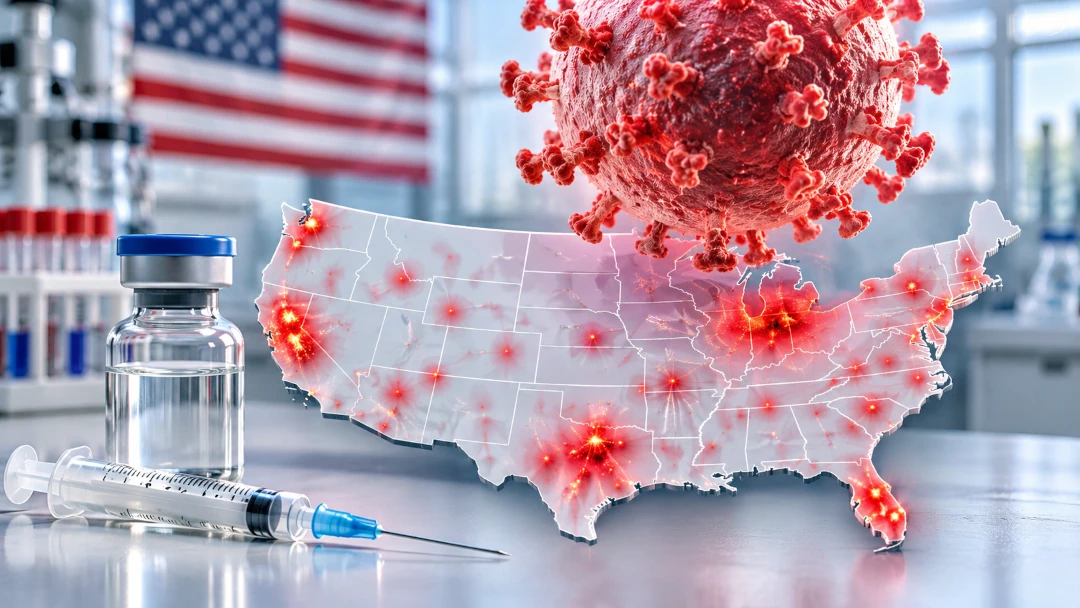
Twenty-six years after the United States eliminated measles, the Pan American Health Organization has ruled that the virus is once again endemic here. The vaccine never stopped working. What failed was leadership — an administration that cast doubt on the shot, gutted the agencies that fight outbreaks, and a Republican Congress that confirmed, funded and shielded the people responsible.
On Tuesday morning, the United States formally lost something that took a generation of doctors, nurses and public servants to win. An independent commission of the Pan American Health Organization — the World Health Organization’s branch for the Americas — revoked America’s measles elimination status, a designation first declared in 2000. The standard is simple and unforgiving: a country loses the status when the same strain of the virus circulates for twelve months or more. That is now what is happening on American soil. As NBC News put it, measles is once again endemic in the United States.
PAHO director Dr. Jarbas Barbosa da Silva Jr. — who made the final call — told reporters that endemic transmission has now been re-established in Bolivia, Mexico and the United States. ABC News medical contributor and epidemiologist Dr. John Brownstein called the loss “an historic public health setback.” Former New York City Mayor Michael Bloomberg, one of the country’s largest public-health philanthropists, was blunter, calling it “a damning indictment of federal health leadership.”
I. The Scale of the Collapse
The numbers behind PAHO’s decision describe a country that has lost control. As of November 12, the CDC had confirmed 5,412 measles cases in 2026 across 45 states and Washington, D.C. — according to Newsweek’s review of federal data — the most since 1991 and more than double last year’s total. Before this resurgence, ABC News notes, the country averaged about 180 cases a year, most of them imported. Large outbreaks are now burning in Pennsylvania, Wisconsin, Minnesota and Indiana, and New York State has declared a state of emergency.
2026 Cases
Confirmed by CDC as of Nov. 12, plus 18 cases among international visitors. Roughly 96% were unvaccinated or of unknown status. Newsweek
Deaths This Year
Deaths reported by state health departments in 2026, including infants in Pennsylvania and Wisconsin too young to be vaccinated. ABC News
Kindergarten MMR Coverage
Down from 95.2% in 2019–20 — below the roughly 95% needed to stop outbreaks. Associated Press
Unprotected Children
Kindergartners left without MMR protection at current coverage levels. ABC News
Hospitalized
Americans hospitalized with measles over the past two years; more than 8,000 sickened. KFF Health News
2026 Economic Toll
Estimated cost of this year’s outbreaks, mostly public-health response, per a Johns Hopkins tool. AJMC
II. How We Got Here
Honesty requires acknowledging that the erosion began before this administration. When former CDC director Dr. Jeffrey Koplan’s team set out in 1998 to stop measles transmission, they did it in two years — a success he attributes, in NBC News’ “Vaccine Divide” investigation, to broad, bipartisan buy-in from federal agencies, pediatricians and state health departments. That consensus frayed over decades of debunked claims about vaccine dangers, and then the Covid pandemic disrupted routine checkups and supercharged misinformation.
The damage is visible county by county. A Johns Hopkins study published in JAMA Network Open found that 78% of the 2,066 counties studied saw MMR vaccination rates fall between the pre-pandemic years and 2023–24. NBC’s updated analysis is grimmer still: three-quarters of counties and jurisdictions with data now sit below the herd-immunity threshold, and vaccine exemptions have risen in 86% of counties since 2019. Only four states — California, Connecticut, Maine and New York — bucked the trend. Not coincidentally, they are the four states that allow no personal or religious exemptions to school vaccine rules.
So the kindling was dry. The question for history is who struck the match — and who stood by while it caught.
Get Involved Today
Contribute to our mission and turn your concerns into action.
III. An Administration That Fanned the Flames
Experts interviewed by the Associated Press are careful: the Trump administration did not create the vaccination gap, but its policies and messaging may have made it worse. The record supports a harsher conclusion. In his first year, Health and Human Services Secretary Robert F. Kennedy Jr. fired all 17 members of the CDC’s vaccine advisory committee and replaced them with vaccine critics. He personally directed the CDC to rewrite its long-standing guidance that vaccines do not cause autism. HHS laid off more than 10,000 workers, and billions in research funding were frozen or canceled — cuts experts say weakened state and local outbreak response. When two children died of measles in Pennsylvania this August, Kennedy suggested the deaths may have been “altogether fabricated” before later acknowledging one was caused by measles.
Instead of broadcasting a clear, repeated message to vaccinate, Kennedy went on Fox News and falsely claimed vaccines cause “deaths every year,” according to KFF Health News. The same reporting found that the administration cut millions in state childhood immunization funding, ended grants for vaccine-hesitancy research, and — per unnamed CDC officials — that political appointees delayed or blocked several of the agency’s own scientific reports on measles. Former CDC director Susan Monarez, fired by Kennedy in August 2025, told Congress she was removed for refusing to rubber-stamp vaccine recommendation changes without reviewing the evidence.
Then the president himself stepped in. On August 10, in the middle of the worst measles year in three decades, Donald Trump signed an executive order calling for a slimmer childhood vaccine schedule and for the combined MMR shot to be broken into three separate injections given at separate visits. No single-disease measles, mumps or rubella vaccines are even made in the U.S.; FactCheck.org notes Merck stopped producing them in 2008. Johns Hopkins vaccine researcher Dr. Anna Durbin called the plan “very bad public health policy.” The order also directed the attorney general to pursue legal action against states that do not offer religious and medical exemptions — that is, against the very four states with the strongest immunization records.
“Together, there could be a possibility they’re quite lethal.”
— President Donald Trump on the MMR vaccine, Oval Office, Aug. 10, 2026, via FactCheck.org. Pressed for evidence, he offered none.
Add one more structural blow: in January, the administration completed America’s withdrawal from the World Health Organization, ending 78 years of membership and, by officials’ own acknowledgment, cutting the country off from some of the international disease intelligence that provides early warning of outbreaks. The U.S. remains a member of PAHO — which is why the regional body, not the WHO itself, delivered this week’s verdict.
West Texas outbreak begins. PAHO later uses this date as the start of the 12-month clock. The outbreak ultimately sickens more than 4,500 people across the U.S. and Mexico.
Senate Republicans confirm Kennedy as HHS secretary, with Sen. Bill Cassidy casting the decisive committee vote after accepting vaccine “commitments.”
Kennedy fires all 17 members of ACIP, the CDC’s vaccine advisory panel, and installs vaccine critics.
CDC director Susan Monarez is fired after refusing to pre-approve vaccine changes.
Canada loses its elimination status; the Americas lose regional measles-free verification.
HHS cuts the childhood schedule from 17 routine recommendations to 11; the U.S. completes its exit from the WHO.
PAHO postpones the U.S. review to November; a federal judge blocks Kennedy’s schedule overhaul as likely unlawful.
Trump signs order to split the MMR shot and calls the combined vaccine possibly “quite lethal.”
PAHO announces measles is endemic in the U.S., Mexico and Bolivia.
IV. A Republican Congress That Looked Away
None of this happened in a vacuum. Kennedy’s long record — including a 2019 trip to Samoa that health officials there say lent credibility to anti-vaccine activists before a measles epidemic killed 83 people — was fully known when the Republican Senate confirmed him. The pivotal vote belonged to Sen. Bill Cassidy of Louisiana, a physician who warned Kennedy at his hearing what was at stake:
“Another person will die from a vaccine preventable disease.”
— Sen. Bill Cassidy (R-La.), warning of the cost of undermining vaccine trust, at Kennedy’s Jan. 2025 confirmation hearing, via AP
Cassidy voted yes anyway, citing promises that Kennedy would keep the CDC’s vaccine advisory committee intact and leave its vaccines-don’t-cause-autism guidance on the agency website. Both promises were broken. When Sen. Bernie Sanders asked for a bipartisan inquiry into the advisory-committee purge in 2025, Cassidy declined, forcing HELP Committee Democrats to launch their own investigation without subpoena power. KFF Health News reports that Congress never held a hearing on the Texas outbreak at all. Only this September, after losing his primary to a Trump-backed challenger, did Cassidy say publicly that Kennedy had broken his commitments, telling Semafor that the measles resurgence “is not making America healthy again.”
The lesson Republican lawmakers drew from Cassidy’s fate is not hard to read: the one GOP senator with the medical credentials and committee gavel to check Kennedy was punished by his own party’s president. Tacit permission, repeated across two years of unchecked policy changes, is still permission.
V. What Democrats Have Done — and What Comes Next
Democrats, in the minority, used what tools they had. Sanders and HELP Democrats opened their own probe into the vaccine-panel firings. Rep. Haley Stevens of Michigan introduced articles of impeachment against Kennedy in December 2025. In May, Sen. Lisa Blunt Rochester of Delaware demanded answers from Kennedy about why PAHO’s review of U.S. status was pushed from April to November — conveniently past the midterm elections. Kennedy denied any HHS role in the scheduling.
That calculus has now changed. Democrats swept this month’s midterms and take control of Congress in January. According to the Associated Press, Rep. Jim Clyburn of South Carolina named Kennedy one of two high-priority impeachment targets for the incoming House majority; Sanders, poised to chair the HELP Committee, said he is “absolutely open” to it; Rep. Jamie Raskin, likely the next Judiciary chair, vowed to investigate; Sen. Ron Wyden has opened inquiries into Kennedy’s Samoa testimony and reported gifts; and Sen. Raphael Warnock urged Kennedy to resign rather than spend two years before congressional committees. A federal court, meanwhile, has already found Kennedy’s overhaul of the vaccine schedule and advisory committee likely unlawful.
The test for the new majority is whether oversight becomes restoration: rebuilding the CDC workforce, guaranteeing immunization funding to states, and writing the independence of vaccine science into law so that no future secretary can do this again.
VI. Why It Matters to Every American
The administration’s line is that the label changes nothing. CDC Director Dr. Erica Schwartz told the AP that vaccination, not the elimination designation, is what protects Americans. That is true — and it is precisely the indictment. A country that has lost elimination is a country where vaccination has failed to reach enough people, and the consequences land on everyone.
On families. Measles is the most contagious virus known: it infects about 90% of unvaccinated close contacts and lingers in a room for two hours. About one in five unvaccinated patients is hospitalized. The children most at risk are infants too young for their first shot at 12 to 15 months, cancer patients and the immunocompromised — people who cannot protect themselves and depend on the rest of us.
On wallets. Every outbreak is a bill. Johns Hopkins researchers estimate it costs roughly $250,000 to $298,000 just to launch a response, plus about $16,300 per additional case; this year’s outbreaks alone cost an estimated $83 million, and KFF Health News puts the two-year toll near $125 million. Those costs come out of state and local health budgets and, ultimately, taxpayers and premium payers.
On insurance. Under the Affordable Care Act, most private insurers must cover vaccines recommended by the CDC’s advisory committee at no cost. Because Kennedy remade that committee, the insurance industry trade group AHIP stepped in with a voluntary promise to keep covering every vaccine that was recommended as of September 1, 2025 — but only through the end of 2026. That pledge expires in six weeks. What families’ coverage looks like in 2027 depends on decisions made by the very officials who drove this crisis.
On travel and the economy. The United States co-hosted the World Cup this summer with Canada and Mexico — all three of which have now lost elimination status. CDC data already show measles cases among international visitors. A country where a once-vanquished disease circulates freely is a country foreign health ministries warn their citizens about, and the reputational cost to tourism, conventions and international students is real even if it is harder to count.
VII. What the World Is Saying
The rest of the hemisphere is grappling with the same virus, but not with the same federal posture. PAHO’s latest regional report counts 57,666 confirmed cases and 81 deaths across the Americas in 2026, with Guatemala and Mexico hardest hit. Canada lost its status a year ago; the United Kingdom, Spain and Austria have also recently fallen out of elimination. Director Barbosa da Silva framed the problem as global gaps in vaccination coverage, and PAHO has asked the U.S., Mexico and Bolivia to submit plans in the coming weeks to halt transmission.
What sets the American case apart is that the world’s wealthiest country — the nation whose CDC once taught the planet how to eliminate measles — is the one whose own president questions the vaccine. Georgetown public-health law scholar Lawrence Gostin called the WHO exit, in comments to the AP, the most ruinous presidential decision of his lifetime. Abroad, America is no longer seen as the firewall. It is seen as a source.
VIII. Silence From the Oval Office
How did the president respond to the loss of one of the country’s signature public-health achievements of the century? As of publication, we could find no statement from Donald Trump himself. The White House referred Newsweek’s questions to HHS; HHS in turn pointed reporters to the CDC director. A White House spokesperson, Allison Schuster, told KFF Health News that the president and the secretary have repeatedly encouraged measles vaccination — yet the same reporting found that when pressed, Trump and Kennedy have recommended the shot but have not carried that message clearly on their own. The president was abroad on a trip to Asia as the announcement landed.
The silence is its own statement of priorities. In a year when children died of a disease the country had beaten, the most memorable thing the president said about the measles vaccine was that it might be lethal — a claim he admitted he could not support. Leadership in a public-health crisis is not complicated: say clearly, repeatedly, from the most visible podium in the world, that the vaccine is safe and that parents should use it. Trump’s predecessors of both parties did exactly that. This president chose instead to sign an order that would make vaccination harder, slower and more expensive, and then to say nothing when the bill came due.
The Law Kennedy and Trump Are Testing
The Administrative Procedure Act
In March, U.S. District Judge Brian Murphy in Massachusetts found that the American Academy of Pediatrics and allied medical groups are likely to prove that Kennedy’s reconstitution of the vaccine advisory committee and his January schedule cuts violated the Administrative Procedure Act, which bars agencies from arbitrary action that ignores the evidentiary record. The ruling restored the prior schedule while the case continues — a reminder that science-based process is a legal obligation, not a courtesy.
Federalism and the Tenth Amendment
School vaccination requirements are set by the states, an authority the Supreme Court has upheld since Jacobson v. Massachusetts (1905). Trump’s August order nonetheless directs the attorney general to take legal action against states that do not provide religious exemptions. Using federal litigation to pressure the most successful states into weaker protections inverts both the logic of federalism and a century of precedent.
Congress’s Power of the Purse — and of Membership
The United States joined the WHO by an act of Congress. Gostin has argued that leaving should likewise require Congress, not a unilateral executive order. The same principle governs funding: Congress, not the executive, decides how public-health appropriations are spent. An incoming majority has both the standing and the duty to reassert those powers through hearings, appropriations riders, and if warranted, impeachment of an official who has, in Rep. Stevens’ words when she filed articles, imperiled the health and safety of the American people.
The Affordable Care Act
Because no-cost vaccine coverage is legally tied to the CDC advisory committee’s recommendations, control of that committee is control over what millions of insured families pay. That is why the committee’s independence must be protected by statute.
IX. What You Can Do
Regaining elimination status will require at least twelve consecutive months without sustained transmission — a long road while outbreaks are still growing. Voting matters, and this month’s election has already shifted power in Washington. But there is more to do, starting at home. Here is an honest look at the options.Check your family’s MMR status — today
Two doses of MMR are about 97% effective. Children get the first at 12–15 months and the second at 4–6 years; adults unsure of their history can ask a doctor about a titer test or a booster. In outbreak areas, infants as young as 6 months may be eligible for an early dose.Honest assessment: the single most effective action available to any individual, and the one that protects people who can’t be vaccinated.
Defend your state’s vaccine laws
States set school vaccine rules. Contact your state legislators and governor to oppose new nonmedical exemptions — and, if your state lacks them, support policies modeled on California, Connecticut, Maine and New York.Honest assessment: this is where policy is actually decided, and where federal pressure will be fought out in court.
Hold the new Congress to its word
Call your House member and senators. Ask them to hold oversight hearings on the measles response, restore CDC and state immunization funding, and legislate the independence of the vaccine advisory committee.Honest assessment: Democrats control committees from January but not the White House; expect hearings and funding fights, with any impeachment unlikely to end in Senate removal.
Watch your 2027 insurance coverage
The insurance industry’s voluntary vaccine-coverage pledge ends December 31. During open enrollment, ask your plan or employer in writing whether all childhood vaccines will remain covered with no cost-sharing next year.Honest assessment: state insurance regulators can require broader coverage; if yours hasn’t, tell them to.
Back the people doing the work
Follow the American Academy of Pediatrics’ immunization schedule, support your local health department’s clinics, and counter misinformation in your own circles with trusted sources, not arguments.Honest assessment: slow and unglamorous, but trusted local voices are what moved vaccination rates in places like Washington, D.C., which raised kindergarten MMR coverage from 78.5% to 94.4%.
Editorial Conclusion
Measles did not return because science failed. It returned because the people entrusted with the nation’s health chose doubt over evidence, cuts over capacity, and silence over leadership — and because a Republican Congress confirmed them, shielded them and looked away.
The elimination of measles was a promise one generation of Americans made to the next: that no child in this country would die of a disease we know how to stop. That promise has now been broken in law and in fact. Keeping it again requires a secretary of health who believes in vaccines, a Congress that enforces the law, and a president willing to say the plain truth. Until then, every preventable death is a verdict on those who had the power to prevent it.
Sources & References
- NBC News — U.S. loses measles-elimination status, erasing decades of progress
- ABC News — US officially loses measles elimination status, PAHO says
- Associated Press (via WHEC) — US loses its measles-free status. Here’s how the Trump administration has responded
- KFF Health News (via WUNC) — US has lost measles elimination status, global health authorities say
- The Irish Times — US loses measles elimination status amid worst outbreak in 26 years
- Newsweek — US loses measles elimination status as Michael Bloomberg slams Trump admin
- NBC News (via NBC New York) — America defeated measles in 2000. Vaccine opposition brought it roaring back
- Becker’s Hospital Review — Most US counties see drop in children’s MMR vaccination rates (JAMA study)
- FactCheck.org — Trump’s false MMR vaccine claims
- Stateline — Trump vaccine order takes aim at states that limit exemptions
- Associated Press (via Valley News Live) — Trump’s vaccine plan would require millions of individual shots last used decades ago
- Associated Press (via ABC7) — US completes withdrawal from World Health Organization
- Associated Press (via Atlanta News First) — RFK Jr. on defensive over his vaccine views as key confirmation vote hangs in the balance
- Semafor — Cassidy rips RFK Jr. on vaccines: ‘This is not making America healthy again’
- Senate HELP Committee Democrats — Sanders, Democratic HELP members launch investigation into vaccine committee firings
- Office of Sen. Lisa Blunt Rochester — Senator Blunt Rochester investigates HHS decision to delay review of measles elimination status
- Associated Press (via KTAR) — Democrats are weighing impeachment of RFK Jr. while courting his supporters
- Pharmacy Times — Overhaul of childhood vaccine guidance blocked by federal judge in Massachusetts
- AJMC — US measles outbreaks cost nearly $83 million in 2026
- KFF — Recent changes in federal vaccine recommendations: What’s the impact on insurance coverage?
- Pan American Health Organization — Regional Situation Report No. 15: Measles in the Americas
Related News