Throttled Again: Ukraine’s Lifeline Goes Dark While Trump’s Envoys Sit With Putin
For the second time in a month, the satellite network Ukraine uses to knock Russian attack drones out of the sky has been capped at 100 miles per hour. It happened just as Jared Kushner and Steve Witkoff landed in Moscow. Nobody in Washington will say who did it, and that silence tells Americans most of what they need to know about whose side this White House is on.
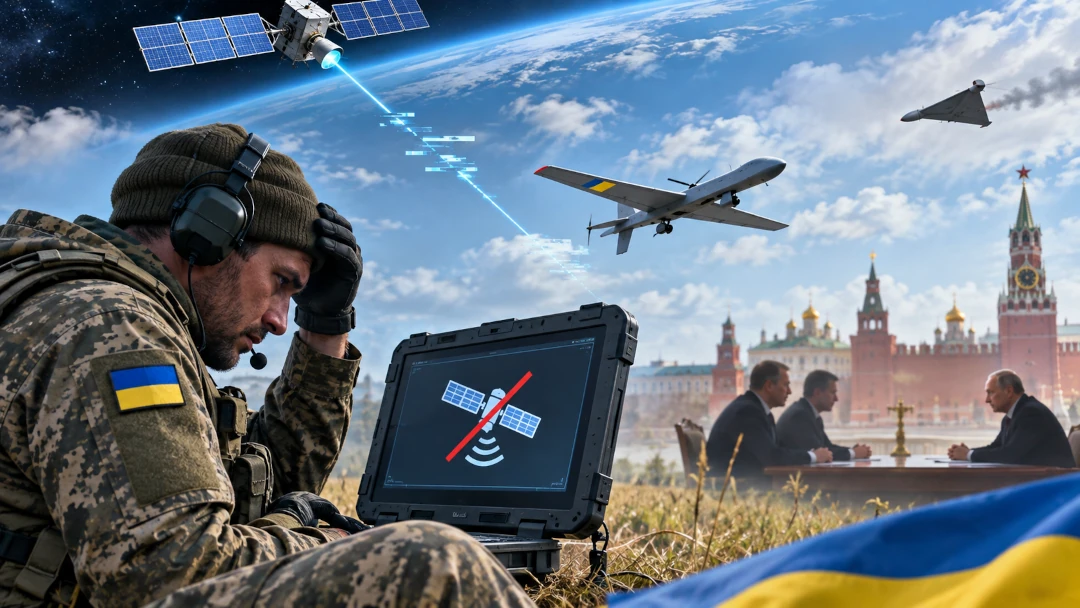
On the same day that Steve Witkoff and Jared Kushner arrived at the Kremlin to talk peace with Vladimir Putin, Ukraine’s president told the world that his country’s military eyes in the sky had been deliberately dimmed. Volodymyr Zelensky said the military version of Starlink, the system Kyiv relies on to fight back, was once again being throttled. He warned that it “directly affects our ability to intercept Russian jet-powered Shahed drones.”
This is not a glitch story. It’s the second act of a scandal that began in October and never got an honest explanation. A capability bought with American defense dollars was degraded in the middle of a shooting war, then restored once the cameras showed up, and now it has been degraded again just as the President’s son-in-law and his special envoy were in Moscow. Kyiv has been left asking Washington for answers, and according to senior Ukrainian officials quoted by the Financial Times, Washington “keep[s] silent about this.”
I. The Lifeline, Throttled Again
The facts on the ground are specific. Zelensky said on November 12 that Ukrainian units had been recording significant disruptions to Starshield for several days, and that the restrictions cap the system’s operating speed at 161 kilometers per hour (100 miles per hour). He stressed that these were not random errors. They were systematic limits. A source in Ukraine’s Defense Ministry added a detail that should alarm anyone who cares about sovereignty: the cap was recorded across all Russian-occupied Ukrainian territory, while no restrictions were recorded in areas Kyiv controls.
Serhii “Flash” Beskrestnov, Zelensky’s adviser on defense technology, confirmed on Telegram that the system’s operational speed “has once again been restricted while in motion”. Frontline troops told reporters that the cap is also crippling the mid-range strike drones they use to hit Russian logistics deep behind the lines.
SpaceX’s answer has been a flat denial. The company told Axios and Ukrainian media that “there has been no change.” Ukraine’s military, which watches these numbers every night while Russian drones are in the air, says otherwise.
II. What “Throttling” Actually Means on the Battlefield
“Throttling” sounds like a customer-service problem, a slow video call or a buffering movie. In Ukraine it is a targeting problem. Starshield is SpaceX’s government and national-security network, built on Starlink technology. Ukraine uses it to fly drones, and fast drones need a link that holds at high speed. A 100 mph ceiling means any interceptor or strike drone that moves faster than that loses its connection.
That ceiling matters because of what Russia is sending. Jet-powered Shahed drones are fast, and Ukraine’s answer has been fast interceptor drones guided over satellite links. With the cap in place, Zelensky told the Globe and Mail, “we simply cannot catch up with them in time.” He explained to reporters that because the limits apply over occupied territory, Ukrainian forces must wait until the incoming drones cross into areas where the restrictions don’t apply before they can engage them. In practice, that means waiting until the drones are closer to Ukrainian homes, power stations and hospitals.
“Unfortunately, this is helping the Russians kill more Ukrainians and carry out more accurate strikes against Ukraine.”
— President Volodymyr Zelensky, November 2026, via The Kyiv Independent
There is also a political meaning that goes beyond the military one. A speed cap that applies only over land Russia has seized implicitly treats that land as something other than Ukraine. Zelensky has said exactly that, insisting to reporters that Ukraine will not surrender its territory, even as he disclosed that the U.S. had, for the first time, asked whether Kyiv would withdraw from parts of the Donbas that Russia does not control in exchange for NATO admission.
III. Who Gave the Order? A Month of Shifting Stories
To understand November, Americans need to remember October, when every person in a position to know gave a different account.
Reuters · Oct. 15
Two U.S. officials and a Western official told Reuters that Pentagon leaders received instructions from inside the White House to slow Ukraine’s Starshield service. A senior official replied that no such request was ever made by the president, and the White House declined to say whether anyone else had issued it.
Musk · Oct. 14–16
Musk first said the government held the switch, writing that “Starshield systems are owned and controlled by the US government” and that limits were decided by the U.S. military and, ultimately, the president.
Wall Street Journal · Oct. 20–22
The Journal reported that Musk imposed the restrictions himself, and that he discussed them with Trump. One source said they spoke before the cap was imposed. Trump then called Musk and asked him to ease the restrictions, and the system was working more normally shortly afterward.
Musk · Oct. 24
After service was restored, Musk reversed his framing and claimed responsibility. He accused Ukraine’s military of violating Starlink’s terms of service by using it for offensive drone strikes, adding that “that loophole was closed last week.” Kyiv denies breaching any terms.
Secretary Rubio · October
Secretary of State Marco Rubio offered the vaguest explanation: “Nobody ordered that Starlink speed to be slowed down. It sort of happened.” He also claimed Ukraine did not have access to Starshield at all, which Kyiv’s own monitoring contradicts.
SpaceX · Nov. 13
This time the company says nothing changed. Ukraine’s Defense Ministry reports a 161 km/h cap over every inch of occupied territory. Either SpaceX’s system is malfunctioning in a strangely precise, geopolitical pattern, or someone is not telling the truth.
Get Involved Today
Contribute to our mission and turn your concerns into action.
Musk’s own words cut against his rationale. The same man who now calls Ukraine’s use of the system a violation also acknowledged that Starlink “remains critical to the defense of Ukraine,” and that if it were turned off, Ukraine’s front line would “collapse immediately.” When one man knows his switch can collapse a democracy’s defenses and still flips it, that is not a terms-of-service dispute. It is a policy decision made without accountability.
IV. What the President Says, and What He Won’t
President Trump’s public record on this is a sequence of denials that never become an explanation. Asked in October who was responsible, he answered: “Well, I don’t know if it was anybody because it wasn’t me, and I don’t think it was Elon.” When the Journal reported days later that Musk had in fact ordered the cap, and that the two men had discussed it, Trump repeated that he was not involved. When service came back, he told reporters that Musk had “put it back.” A day later he said he hadn’t spoken with Musk about Ukraine’s service at all.
To be fair, the reporting suggests Trump did intervene to restore service in October, and the record we reviewed does not show him personally ordering either cap. But a commander-in-chief who learns that a U.S.-funded military system was degraded mid-war, and who answers by shrugging that it “wasn’t me,” is not exercising leadership. He is abdicating it. And as of this writing, neither Trump nor Musk has given a full explanation of why the system has been slowed again.
The context makes the denials harder to accept. In the weeks before the first cap, Trump publicly warned Ukraine to stop striking Russian oil refineries, and he told reporters it was “time for Ukraine to get a new president.” The first restrictions arrived amid tensions with the administration over those very refinery strikes.
V. A Gift to the Kremlin, Timed to the Kremlin’s Calendar
Look at the calendar. U.S.-mediated talks between Russian and Ukrainian delegations in Abu Dhabi wrapped up on November 11 with no breakthrough. The next morning, Witkoff and Kushner flew to Moscow to sit down with Putin. While they met, Zelensky was raising the alarm about new Starshield restrictions. And during the meeting, Putin told the American envoys that foreign peacekeeping troops in a post-war Ukraine would be regarded by Russia as a “continuation of war.”
Senior Ukrainian officials told the Financial Times they believe the speed restrictions were imposed to pressure Kyiv during the talks, and one said it appeared Washington wanted to strengthen Russia’s position at the table. We cannot prove that motive, and neither can they, because the people who could settle it won’t talk. But we can say who benefits. Every Shahed that gets through because an interceptor lost its link is a free strike for Moscow. Every day the cap holds over occupied land, Putin gets a quiet American nod toward the borders he wants drawn. And every time Kyiv has to beg Washington for a working link, Ukraine walks into negotiations weaker.
This fits a broader pattern. In October, Trump announced a deal under which Russia would supply diesel to global markets, and the Treasury Department temporarily waived sanctions on Russian diesel through April 2027. Trump went on to waive many Russia-related sanctions under a new law Congress had passed, calling it in the “national interests of the United States.” According to the Financial Times, Russia then doubled its diesel exports. Moscow gained sanctions relief and a degraded enemy. Ukraine has gotten a speed cap.
VI. A Month of Throttling: The Timeline
VII. Washington Reacts: Democrats, Republicans, and a Watchdog That Looked Away
Democrats are building a paper trail for the investigations they will be able to run in January. Sens. Jeanne Shaheen of New Hampshire and Chris Coons of Delaware wrote to Musk demanding he preserve every record tied to the October and November disruptions, including communications with the White House and the Pentagon. In the letter they warned that “the October and November restrictions now raise the disturbing possibility that these vulnerabilities persist even within systems on which the US government relies.” They asked Musk directly whether anyone outside SpaceX authorized the caps. After their November 4 midterm victory, Democrats plan a series of investigations into the administration’s Ukraine conduct once they take control of Congress.
Republicans have been split. Most of the GOP has stayed quiet, but a determined bloc has not. Sen. Thom Tillis of North Carolina warned in October that “intentionally degrading Ukraine’s ability to defend itself might be construed as aiding and abetting a mass murderer,” referring to Putin. On November 12, Tillis and Shaheen issued a joint statement calling it “outrageous that, just weeks after service was restored, Ukrainian officials are once again reporting restrictions.” They added that it is “impossible to understand how undermining Ukraine’s ability to defend itself gets us closer” to peace.
“Intentionally degrading Ukraine’s ability to defend itself might be construed as aiding and abetting a mass murderer.”
— Sen. Thom Tillis (R-N.C.), via The Hill
In the House, the bipartisan Congressional Ukraine Caucus, 105 members strong, demanded a full accounting from the administration and SpaceX. Their statement noted that “Congress has been clear that Ukraine’s ability to defend itself and the rest of Europe is a vital national interest of the United States.”
The institution that should have answered these questions declined to. In October, nine senators (four Republicans and five Democrats) asked the Pentagon’s inspector general to investigate. The IG refused, referring the matter back to the Air Force and Space Force. Congressional aides read the refusal as reluctance to confront Musk’s influence over defense communications. Two weeks later, the restrictions were back.
VIII. Europe’s Alarm: “Get Satellites or Get Throttled”
America’s allies are drawing the obvious conclusion. European officials have sharply criticized the new restrictions, which feeds a growing fear that the current U.S. administration cannot be relied on to support its allies’ security. Danish Prime Minister Mette Frederiksen said she would raise the matter with Washington, because access to these satellites is central to defending against and deterring Russia, including running air defenses.
Industry and analysts see the same thing. Rebecca Wasser, defense lead at Bloomberg Economics, told Axios that “the events in Ukraine show how a single point of control can be turned against the forces that depend on it.” Shares in Eutelsat, the European operator of the OneWeb constellation, spiked after the first throttling, and its CEO pointedly noted that his company’s decisions are made by a board under traditional European governance. The honest reality is that Europe’s alternatives are years away from matching Starlink’s scale. That is exactly why the United States’ reliability matters so much, and exactly why squandering it is so reckless.
IX. Why This Lands on the American Kitchen Table
It is tempting to treat this as a faraway story about drones over Zaporizhzhia. It isn’t. Here is how it reaches the average American.
You paid for it. Starshield is Pentagon-funded, and the Pentagon is its biggest customer, having spent billions of dollars on Starlink and Starshield services. When a capability bought with your tax dollars is quietly switched off, Americans are owed a name and a reason. So far they have gotten neither.
Your own military runs on the same switch. Shaheen and Coons are explicit that the danger extends to the systems the U.S. government itself relies on. If one company, or one phone call between a president and a billionaire, can dial down an ally’s war-fighting network without notice or explanation, the same vulnerability sits inside America’s own defense communications.
The “cheaper fuel” promise hasn’t arrived. The diesel deal that eased sanctions on Moscow was sold to Americans as relief at the pump. According to the Financial Times, the U.S. has yet to receive a single shipment, and analysts noted that Russia’s volumes could never meaningfully move the U.S. fuel market. Putin got the relief. American drivers got a talking point.
Your country’s word is the currency of your security. Alliances that deterred major war for 75 years depend on the belief that America keeps its commitments. When the Danish prime minister has to fly the question to Washington, and when the European Union is racing to build systems that don’t depend on the U.S., that belief is draining away. Every American is less safe in a world where our friends hedge against us.
Who Gets to Switch Off an Ally’s Defenses?
Article I: Congress Holds the Purse and the Policy
The Constitution gives Congress the power to appropriate funds, raise and support armies, and regulate commerce with foreign nations. Starshield is a Pentagon-funded system, paid for with appropriated money. A bipartisan bloc of 105 House members has also said plainly that Ukraine’s self-defense is a vital U.S. national interest. A secret decision to degrade that capability, made without notice to Congress and in a way that contradicts its stated policy, is a usurpation of legislative choice. It is not an exercise of executive discretion.
Article II: The Duty to “Take Care”
The President is charged with taking care that the laws be faithfully executed. Whether the October order came “from inside the White House,” as Reuters’ sources reported, or from Musk after he consulted the President, as the Journal reported, the executive branch owes the public an account of who controls a U.S. government military network and why it was throttled. Denials without explanation do not discharge that duty. Neither does an Inspector General who declines to look.
The Sanctions Statute and the Waiver
Congress passed a sweeping sanctions law aimed at Russia’s war machine. The President used its waiver authority to set much of it aside, invoking the “national interests of the United States.” Waivers are legal tools, but Congress wrote them for exceptions, not to dismantle the policy it enacted. The new Congress should demand the written national-interest justifications and test them against the outcome, which so far is a Russia exporting more diesel and a Ukraine flying its interceptors with a speed cap.
Private Power Over Public War
Even Sen. Tillis, a Republican, has said there must be guardrails and accountability when a private company operates in military and geopolitical space. The legal gap is real. No statute clearly defines when a defense contractor may unilaterally restrict a government-funded service used by an ally, or what notice Congress must receive. Closing that gap is a legislative duty, and the record from October and November makes the case for it.
X. What This Says About Trump’s Priorities and Leadership
Strip away the denials and the pattern is plain. In the space of five weeks, this administration eased sanctions on Russian diesel, waived much of a congressional sanctions law, publicly called for Ukraine to replace its elected president, pressed Kyiv to stop striking the refineries that fund Russia’s war, and, according to Zelensky, asked for the first time whether Ukraine would give up unoccupied Donbas territory. Through all of it, a U.S.-funded military network was throttled twice, and nobody in charge would say why. The pressure has run one direction, toward the country that was invaded. The concessions have run the other direction, toward the country that invaded it.
There is a leadership failure here beyond policy. When asked who degraded an ally’s defenses, the President’s answer was that it “wasn’t me.” His Secretary of State said it “sort of happened.” His Pentagon’s watchdog declined to investigate. The world’s richest man changed his story twice. And the diplomacy is being run by the President’s son-in-law and a special envoy, flying from Abu Dhabi to the Kremlin while Ukrainians wait for interceptors that can’t reach their targets. This is not “peace through strength.” It is pressure applied to the weaker party.
Peace in Ukraine is worth pursuing, and every American should want the killing to stop. But a peace extracted by quietly blinding the victim’s air defenses is not peace. It is capitulation with a ribbon on it, and Putin has shown again and again that he treats capitulation as an invitation.
XI. What You Can Do
Americans aren’t powerless here. The most important lever is the new Congress, which takes power in January with subpoena authority. Here is where pressure can actually change outcomes.
No single action will restore Ukraine’s satellite link this week. That decision sits with the administration and SpaceX, and both are currently denying responsibility. What citizens can do is raise the political cost of silence, make sure January’s investigations happen, and push for laws that ensure no private company or unnamed official can secretly throttle an ally again.
- Call your House member and both senatorsAsk them to back the Ukraine Caucus demand for a full accounting and immediate restoration of Starshield access. The Capitol switchboard can connect you, and a personal call outweighs a form email.
- Demand public hearings in JanuaryAsk your representatives to commit to sworn testimony from SpaceX, the Pentagon, and White House officials on who ordered the October and November restrictions, building on the Shaheen–Coons document-preservation letter.
- Support “guardrails” legislationUrge Congress to require that any restriction on a government-funded service used by a U.S. partner be authorized in writing, disclosed to the relevant committees, and reviewable. Tillis’s call for accountability shows this can be bipartisan.
- Press for an independent investigationThe Pentagon IG said it “may reconsider” if new information emerges. The November restrictions are new information. Ask your senators to formally renew the request.
- Stay loud and share verified reportingSilence is the administration’s strategy. Share sourced reporting, including the links below, with friends and family, and ask local outlets to cover what this means for U.S. security and taxpayer-funded systems.
Editorial Conclusion
A democracy under invasion has had its air defenses dimmed twice in a month by a system Americans paid for, and the most powerful government on earth will not say who did it. That is not a technical failure. It is a failure of accountability at the highest levels of American power.
Congress must use every tool it holds, including subpoenas, sworn testimony, the power of the purse, and new law, to find out who gave the order and to make sure no president, no billionaire, and no anonymous official can ever again secretly switch off an ally’s defenses. Ukraine’s link must be restored in full, now. What’s at stake is bigger than one war. It’s whether the American government answers to its people and its laws, or to the private whims of the men who sit closest to power.
Sources & References
- The Globe and Mail — Starlink slowdown weakens Ukraine’s defences against Russia, Zelensky says
- The Kyiv Independent — Ukraine seeks explanation on Starshield speed restrictions from US
- The War Zone (TWZ) — Ukraine Says Starshield Disruptions Are Back As U.S. Negotiators Meet With Putin
- TIME — Trump Envoys Witkoff and Kushner Meet With Putin in Moscow for Ukraine Talks
- ABC News / AP — Zelenskyy says a new European security framework floated by US could benefit Putin
- Ukrainska Pravda / Financial Times — Kyiv suspects US deliberately restricted Starshield to pressure Ukraine
- Military Times / Reuters — Order to limit Starshield for Ukraine came from inside White House, sources say
- CNBC — Trump says White House didn’t order Starlink restrictions in Ukraine
- CNBC — Trump asked Musk to lift Starlink slowdown, WSJ reports
- CNBC — Ukraine says Starlink restrictions remain despite Trump assurances
- WUNC / NPR — Musk says SpaceX did restrict Starlink, as Ukraine says the tech has been restored
- Kyiv Post — Rubio: “Nobody ordered that Starlink speed to be slowed down”
- The Hill — Trump, Senate GOP see Starlink become latest flash point over Ukraine
- Newsweek — Europe and US On Collision Course Over Starshield
- Ukrainska Pravda / WSJ — US senators tell Musk to preserve records on Starlink restrictions in Ukraine
- AP via WDIV ClickOnDetroit — Pentagon watchdog tells lawmakers it won’t investigate Starlink slowdowns to Ukraine
- Axios — Ukraine’s Starlink woes spur Europe to look for Musk alternatives
- CNBC — Trump strikes deal with Putin to supply Russian diesel to U.S. and global markets
- Meduza / Financial Times — Trump’s diesel deal with Putin helped Russia double its exports — but the U.S. has yet to receive a single shipment
- Fox Business — Trump waives many Russian sanctions, tariffs under new law
Related News