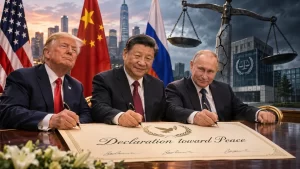
The White House sells artificial intelligence as a winner-take-all contest with China. The balance sheets tell a different story: a stampede to capture cheap capital, running far ahead of revenue, public trust, and the power grid. When the music stops, investors, ratepayers, and the planet will be left holding the bill — and a new Congress is preparing to ask who signed it.
Every great speculative mania needs a story big enough to justify the money. For railroads it was Manifest Destiny; for the dot-com era it was the “new economy.” For the artificial intelligence boom of 2025–2026, the story is a race — a geopolitical sprint against China in which, as President Trump told reporters while signing an order to block state AI laws, there is “only going to be one winner.” It is a stirring frame. It is also, on close inspection, mostly a fundraising pitch — one that has turned the federal government into a cheerleader for the largest capital-spending binge in corporate history while the people paying for it were never asked.
It is without dispute that artificial intelligence is a real and consequential technology, capable of generating great benefit for humanity. We dispute the premise that it is a race with a finish line, that “winning” is defined by how many dollars Silicon Valley can pour into concrete and chips, and that ordinary Americans should absorb the electricity bills, the environmental damage, and the financial risk so that a handful of companies can outrun their own revenue.
I. The Starting Gun: How Trump Built a “Race”
The administration’s AI posture has been consistent in one respect: speed above all. Trump reversed the Biden-era AI executive order within hours of returning to office in January 2025 — an order that had required developers of the most powerful systems to notify the government before release. Six months later, at a summit literally titled “Winning the AI Race,” he told the audience “I’m here today to declare that America is going to win,” pairing the declaration with a plan built on deregulation and financing exports.
Allies in Congress adopted the same script. Sen. Ted Cruz, standing behind the president’s December 2025 order to curb state regulation, framed it plainly: “It’s a race, and if China wins the race,” China’s values of surveillance and centralized control would govern AI. And the administration’s own messaging has been relentlessly triumphal — in the same breath that he warned of a single winner, Trump assured reporters that “right now, we’re winning by a lot.”
“There’s only going to be one winner here.”
— President Donald Trump, Oval Office, December 2025 · via AP
Notice the contradiction baked into that rhetoric. If America is “winning by a lot,” the urgency to strip away every state consumer protection, waive environmental scrutiny, and wave through hundreds of billions in grid-straining construction evaporates. If America is in genuine danger of losing, then the president’s victory laps are false. Both cannot be true — but both are useful to an industry that needs Washington to keep the money flowing.
II. Follow the Money: A Race to the Capital, Not the Finish Line
Strip away the flags and anthems, and what remains is a capital-spending race among a few American companies — against each other, and against the clock. Goldman Sachs estimates the biggest tech firms are on track to spend $700 billion on AI this year, double their 2025 outlay, with multiple banks projecting more than $1 trillion next year. Allianz Trade calculates that this pushes capex intensity for the five largest spenders to 34% of revenue — more than double the historical norm of around 15%.
The revenue has not followed. In September, Axios reported on an analysis by Stanford economists Jared Bernstein and Ryan Cummings that found a nearly $1 trillion gap between what the hyperscalers have spent and the AI revenue they have taken in since 2024. For the math to work, the economists found, those companies would need to triple or quadruple their AI revenue next year — and keep doing so every year for a decade. Apollo Global Management’s chief economist Torsten Sløk has put the core question bluntly: “Can the 10 AI companies generate enough revenue to justify the capex?”
Spending Trajectory
Goldman Sachs puts Big Tech’s 2026 AI spend at roughly double 2025’s, with over $1 trillion projected for 2027, per Axios.
The Revenue Gap
Spending minus AI revenue at six hyperscalers since 2024, according to Stanford economists cited by Axios.
Off the Books
Debt held in a special-purpose vehicle for Meta’s Louisiana “Hyperion” data center, kept off Meta’s balance sheet, per Tomasz Tunguz and City AM.
Bond-Market Exposure
JPMorgan’s share of its investment-grade bond index now tied to AI and data-center firms — about $1.5 trillion of debt, reports City AM.
External Financing
Morgan Stanley estimates more than half of the $2.9 trillion hyperscalers will spend through 2028 will come from outside capital, per Benzinga.
Enterprise Payoff
Share of organizations in MIT’s NANDA research reporting no measurable P&L return from generative AI pilots, per Campus Technology.
That last point matters, because it shows where the “race” is actually being run. When cash flow can’t cover the spending, companies borrow — and increasingly they borrow in ways investors can’t easily see. Meta’s Hyperion deal placed the debt in a vehicle financed by private-credit giants, but Meta reportedly provided a “residual value guarantee” obligating it to make lenders whole if the facility’s value falls. City AM reports that Meta is paying roughly $6.5 billion in extra financing costs to keep that borrowing off its books. Oracle, which took the opposite approach and loaded the debt directly onto its balance sheet, saw its credit-default swaps trade at levels consistent with junk-rated credits.
This is the real race: to lock in financing while money is cheap and the story is hot. It is a race against the moment investors stop believing — and the people who reach that finish line first will be those who sold, not those who built.
III. Where Is the Competition, Really?
If this were truly a two-nation sprint, one would expect China to be running the same course. It is not. While American firms bet trillions on ever-larger proprietary models sold at premium prices, Chinese labs have pursued what the Berlin-based Mercator Institute for China Studies calls a strategy of wide dispersion and cheap tokens — releasing models free to download, modify, and host. MERICS reports that downloads of Chinese models on Hugging Face have surpassed U.S. models since late 2025, and that the seven best-performing open-weight models are all Chinese.
The results show up in usage. A Takshashila Institution analysis of OpenRouter data found Chinese open-source models’ global usage share jumped from 1.2 percent in late 2024 to nearly 30 percent by late 2025. Quartz reports that for developers in Nigeria, Malaysia, and Brazil, building on Chinese tools can run more than 90% cheaper than building on OpenAI products. Foreign Policy describes the approach as a digital Belt and Road, in which the host country pays for servers and power while Beijing’s influence spreads at near-zero marginal cost.
In other words, the competition America is told to fear is not happening at the finish line of some “superintelligence” sprint. It is happening in the unglamorous business of adoption — and the American strategy of maximizing capital expenditure does almost nothing to win it. Even in 2025, most experts told Axios the U.S. held a shrinking lead of at most a couple of years and perhaps as little as months.
IV. What Would “Winning” Even Look Like?
Ask the race’s promoters where the finish line is, and the answers dissolve. Some point to “artificial general intelligence,” a term so elastic that experts note it often means whatever the next system cannot yet do. Others insist there is no finish line at all — which raises the obvious question of why the country must sprint toward it at any cost. A June 2026 essay published by the World Economic Forum called the race framing “comforting – and wrong,” observing that the rhetoric of winning sustains the case for the hyperscalers’ extraordinary investment by giving it a story large enough to justify it.
Axios captured the problem early, describing the U.S.–China contest as a competition in the dark with no clear prize, and noting that the “beat China” drumbeat was coming largely from inside the industry. OpenAI’s global affairs chief Chris Lehane offered the industry’s version of victory: “Whoever ends up winning ends up building the AI rails for the world.”
Read that carefully. “Winning,” in the industry’s own terms, means owning the toll road. It means a handful of private firms becoming the infrastructure through which the world’s economy must pass. That may be a fine outcome for shareholders. It is not obviously a national-security achievement, and it is certainly not the same thing as a better life for the American worker whose electric bill is funding the construction.
Get Involved Today
Contribute to our mission and turn your concerns into action.
V. The Bill Comes Due: Americans and the World
At the meter. The cost is no longer theoretical. NPR reports that PJM’s Independent Market Monitor estimates data centers have cost the regional grid’s 67 million ratepayers about $29 billion over roughly two years. “Everyone pays those costs,” Ari Peskoe, director of the Harvard Electricity Law Initiative, told NPR; they are spread to every home and business with a meter. One estimate puts the added cost for Maryland customers at $168 to $216 per year. And because many local deals are wrapped in non-disclosure agreements, a University of Mary Washington study found NDAs in 80% of Virginia localities with existing or proposed data centers.
On the planet. In June, a United Nations University report found that global data centers used 448 trillion watt-hours of electricity in 2025 — more than all but 10 countries. The Associated Press reported that the resulting emissions roughly equal Argentina’s, with about 4.5 trillion liters of water consumed to generate that power. AI’s share of data-center energy, now about 20%, is projected to reach 40% by 2030. “We cannot manage what companies do not disclose,” Cornell’s Fengqi You told AP.
At work. Americans are not buying the sales pitch. The Bentley University–Gallup survey found the share who believe AI does more harm than good rose from 31% in 2025 to 39% in 2026, and 79% expect AI to reduce U.S. jobs over the next decade. Pew Research Center’s June survey found 52% of Americans more concerned than excited — up from 37% in 2021 — with only nine percent more excited than concerned. A Politico poll summarized by RealClearPolling found support for a local data center collapses to 12% if it would raise monthly bills by $50.
For the global citizen, the picture is similar: the environmental burden lands disproportionately on water-stressed regions, while the economic rewards concentrate in a few balance sheets. And if the financing structures fail, the losses won’t stay in Silicon Valley — they will ripple through the pension funds, insurers, and private-credit vehicles that now hold the debt.
“We cannot sit back and allow a handful of billionaire Big Tech oligarchs to make decisions…”
— Sen. Bernie Sanders (I-Vt.), March 25, 2026 · via PBS NewsHour / AP
VI. Contradictions at the Top: A Record in Order
If the president truly believed this were an existential race with China, his own record would be hard to explain. The timeline below shows an administration that talks like a war cabinet and acts like a sales department.
Selling advanced chips to the supposed rival for a revenue share is not how a nation behaves in an arms race. Senators Jeanne Shaheen, Chris Coons, and Jack Reed called the H200 decision “a colossal economic and national security failure,” and then–Minority Leader Chuck Schumer accused the president of “selling out America.” Even former NSA official Stewart Baker called the theory that chip sales keep China dependent “a delusion.”
And on the household cost, the president’s instinct is not to protect ratepayers but to manage perceptions. Data-center builders, he said this spring, “need some PR help” because people believe their electricity prices will rise. People believe that because, in much of the country, it is true.
VII. The Republican Record: Preempt, Deregulate, Repeat
Congressional Republicans have spent two years trying to do one thing: stop states from protecting their own residents. The 10-year moratorium in the 2025 reconciliation bill failed; House Majority Leader Steve Scalise then shopped similar language for the defense authorization bill; and by March 2026 the White House and its Hill allies were on their third attempt. Rep. Jay Obernolte’s June discussion draft, co-signed by a Democrat, would have frozen state laws for three years — drawing opposition from Democrats and some MAGA Republicans alike.
The pattern matters because the federal government has offered nothing to replace what it would erase. As the Center for American Progress warned, preemption would reduce the scrutiny AI companies face and shield their practices from accountability. Forty state attorneys general — Republicans among them — signed a bipartisan letter opposing the limit on state AI legislation.
VIII. The Democratic Agenda for 2027
The November 3 midterms reshaped the terrain. As of Nov. 13 at 6:37 p.m. ET, the Associated Press count showed Democrats with 256 House seats won and Republicans with 169, with 10 seats not yet counted for either party; in the Senate, Democrats held a total of 55 seats (including two members who caucus with them) and Republicans 44, with one seat not counted for either. Those figures may since have changed.
Democrats arrive in the 120th Congress with a concrete AI plan built on three pillars, according to Reuters reporting summarized by Crypto Briefing and TokenPost: protecting consumers from data-center-driven power costs, independent testing of advanced models, and clear liability for AI harms. Sen. Chuck Schumer named electricity-cost protection as a top priority for next year. Rep. Lori Trahan is pushing independent expert review of widely used models, and Rep. Zoe Lofgren, who is seeking to chair the House Science Committee, says the goal is to balance oversight with continued development. In October, House Democrats already pressed OpenAI, Anthropic, Meta, Google, and SpaceX about security practices and unintended model behavior.
On the energy front, Schumer has backed Sen. Martin Heinrich’s GRID Savings Act, arguing that a competing bill’s ratepayer protections are merely voluntary. The party’s progressive wing goes further: Sen. Bernie Sanders and Rep. Alexandria Ocasio-Cortez introduced the AI Data Center Moratorium Act, which would pause new construction until federal AI safeguards are law, and Rep. Greg Casar has called for curbing “super intelligence” development and new data centers. Democrats also want to preserve states’ authority and curb advanced-chip sales to China.
The party is not monolithic. Sen. John Fetterman has blasted a moratorium as “China First,” and Pennsylvania Gov. Josh Shapiro has pledged that “together, we will defeat China in the battle for AI supremacy.” That internal debate is healthy. But on the core questions — who pays for the power, who tests the models, and who is liable when they cause harm — Democrats are offering answers where the administration offers slogans.
Who Gets to Write the Rules — and Who Pays?
The administration’s campaign against state AI laws runs into a basic constitutional fact: under the Supremacy Clause (Art. VI), federal law can preempt state law — but an executive order is not a statute. Absent an act of Congress, states retain their traditional police powers over consumer protection, utilities, and land use, reinforced by the Tenth Amendment. That is why the president’s preemption push has stalled in the courts and why Republicans keep trying to smuggle preemption into must-pass legislation.
The same architecture now cuts the other way. Three levers define what a new Congress can do:
- Article I, Section 7 (Veto & Override). Any AI bill the president vetoes needs two-thirds of both chambers to survive — a threshold that, as TokenPost notes, forces Democrats to win Republican votes.
- The Power of the Purse. Raymond James policy chief Ed Mills expects Democrats may attach AI provisions to annual must-pass bills — the same tactic Republicans used for preemption.
- The Federal Power Act. FERC oversees wholesale power markets and interstate transmission, while states set retail rates. Ratepayer-protection statutes like the GRID Savings Act can require large-load customers to pay their own way — rather than leaving it to voluntary corporate pledges.
Finally, Congress’s oversight power — the authority to subpoena and hold hearings — is itself a check. The administration has preferred voluntary review of frontier models; Congress can make the facts public whether the White House likes it or not.
IX. The Boosters’ Best Case — and Why It Falls Short
Fairness requires stating the strongest counterargument. AI’s defenders note that general-purpose technologies take time: the Stanford economists themselves observe that it took decades for electrification’s benefits to reach factory floors. AI usage is real and growing, and MIT Technology Review reports some hopeful signs of productivity gains to come. Some Big Tech balance sheets are strong enough to absorb losses. And there are genuine security reasons to want leading AI capabilities developed in democracies.
We take those points seriously. But each one undermines the “race” frame rather than supporting it. If the payoff takes decades, the frantic, debt-financed sprint is precisely the wrong strategy. The same MIT Technology Review analysis notes that economy-wide statistics still show little or no productivity growth from AI. And if security is the concern, then selling advanced chips to China and gutting safety review are indefensible. A patient, accountable, democratically governed buildout would serve every legitimate goal the boosters name. A gold rush serves only the people who get out first.
X. What You Can Do
The AI economy is being built with public resources — your grid, your water, your retirement savings, your data. That gives you leverage. Here is an honest assessment of the most effective options.
- Demand that data centers pay their own wayCall your House member and senators and ask whether they support binding ratepayer protections such as the GRID Savings Act, rather than voluntary pledges.Honest assessment: the most likely AI-related win in 2027, because electricity costs are bipartisan pain.
- Show up where the deals are madeData-center approvals happen at county boards, zoning hearings, and state utility commissions. Ask for disclosure of power and water contracts and an end to secrecy agreements.Honest assessment: local opposition has already stalled or delayed billions in projects; it works best when organized early.
- Defend your state’s right to protect youTell state legislators and your attorney general to resist federal preemption without a strong federal floor, and support state laws on deepfakes, children’s safety, and automated decisions.Honest assessment: states are currently the only level of government actually passing AI protections.
- Vote in the “boring” racesPublic service commissions set your electric rates. In Georgia, voters ousted two incumbent utility regulators over rising bills in 2025.Honest assessment: low-turnout races where a few thousand votes can change your monthly bill.
- Know your exposureAsk your pension fund, 401(k) provider, or financial adviser how concentrated your holdings are in AI stocks and AI-linked private credit. This is not investment advice — just a question every saver is entitled to ask.Honest assessment: you can’t stop a bubble, but you can understand how much of your future is riding on one.
Editorial Conclusion
There is no finish line in the “AI race,” and Donald Trump knows it. What he has built instead is a permission structure — a patriotic story that lets a handful of companies borrow against America’s future, bill its households for their power, and escape the scrutiny every other industry must face. He has sold chips to the rival he claims to be racing, shelved the safety rules he said would slow us down, and told worried families their rising bills are a public-relations problem. Those are not the priorities of a leader defending the nation. They are the priorities of a promoter protecting a trade.
The new Congress must do what the White House will not: make the builders pay for the grid, make the models prove they are safe, make the companies answer for the harm, and keep the states free to protect their people. Technology this powerful must answer to the public that pays for it. That is not a race. It is self-government — and it is not for sale.
Sources & References
- Axios — “AI’s $1 trillion risk keeps growing” (May 2026)
- Axios — “Investors’ P-doom scenario in AI: Lack of profits” (Sept. 2026)
- Allianz Trade — “AI capex cycle war proof now”
- Fortune (via AOL) — “The stock market is barrelling toward a ‘show me the money’ moment for AI”
- City AM — “Big Tech buries billions in AI debt as bubble fears mount”
- Tomasz Tunguz — “Is Your AI Funded by Junk Bonds?”
- Benzinga — AI financing and productivity analysis
- Campus Technology — “MIT Report: Most Organizations See No Business Return on Gen AI Investments”
- MIT Technology Review — “What’s at stake in AI’s trillion-dollar gamble” (Sept. 2026)
- AP (via AJC) — “Trump signs executive order to block state AI regulations”
- NPR — “Trump says fewer regulations needed to win the AI race”
- SiliconANGLE — “Trump pushes back against states regulating AI with executive order”
- MERICS — “China’s AI competition strategy: Wide dispersion, cheap tokens”
- Foreign Policy — “How China Is Winning the Global AI Race” (May 2026)
- Takshashila Institution — “Why Is China Giving Away Its AI Models?”
- Axios — “AI’s global race in the dark”
- World Economic Forum — “The coming disorder of artificial general intelligence”
- NPR (via LAist) — “AI data centers: How much are ratepayers on the hook for?”
- AP (via WSB-TV) — “Energy, water use and pollution of AI and data centers rival most countries”
- Gallup — Bentley University–Gallup Business in Society research, 2026
- TechSpot — “Pew survey: 52% of Americans now more concerned than excited about AI”
- RealClearPolling — “Americans See More Risk Than Reward From Artificial Intelligence”
- Irish Times — “Donald Trump allows Nvidia to sell powerful AI chip to China”
- Taiwan News — H200 export decision and reaction
- Fox Business — “Schumer accuses Trump of ‘selling out America'”
- Washington Times — Trump signs voluntary AI-review order (June 2026)
- Tech Policy Press — “Trump Signs Previously Shelved AI Executive Order”
- Broadband Breakfast — “AI Preemption Battle Lands in Congress With Substantive Discussion Draft”
- PYMNTS — “White House, GOP Again Trying to Enact Federal Preemption of State AI Laws”
- Crypto Briefing — “Democrats plan a wave of AI and data-center bills” (Nov. 2026)
- IAPP — “Democratic midterm wins set stage for tougher tech and AI scrutiny”
- PBS NewsHour / AP — “Ocasio-Cortez and Sanders push bill to impose AI data center moratorium”
Related News