They Made More. You Got Less. Now They Want You to Blame Your Neighbor.
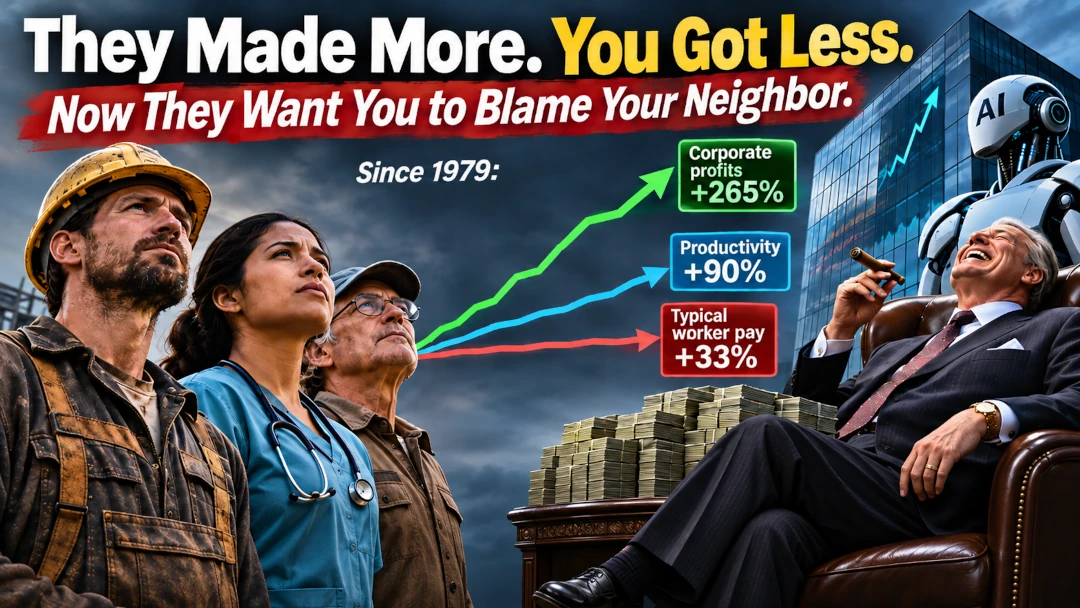
American workers have nearly doubled what they produce in an hour since 1979, yet a typical worker’s pay has grown only a third as much, while inflation-adjusted corporate profits have more than tripled. Artificial intelligence is poised to widen that chasm. And the party funded by the people collecting the difference has spent the year pointing at immigrants and Democrats instead.
Every hour of American work generates far more income today than it did a generation ago. That is not an opinion; it is what the national accounts say. According to the Economic Policy Institute’s analysis of Bureau of Labor Statistics data, net productivity grew 90.2% from 1979 to 2025 while typical worker pay grew by 33.0%. If pay had kept pace, EPI calculates, the typical worker would be earning about $16.40 more per hour. That gap is not a statistical curiosity. It is rent, groceries, a down payment, a retirement, a kid’s tuition — taken from tens of millions of families and routed somewhere else.
This editorial follows that money: where it went, who is guarding it, how the coming wave of AI threatens to accelerate the transfer, and why the loudest voices in American politics would prefer you look anywhere else. It also asks hard questions of the Democratic Party, which voters just handed both chambers of Congress — and which has not always deserved the trust of the workers it claims to represent.
I. The Great Decoupling
For three decades after World War II, the bargain held: as workers produced more, they were paid more. EPI’s index data (1948 = 100) show productivity at 216.8 and typical-worker pay at 190.7 by the end of 1979 — growth of roughly 117% and 91%, respectively, moving close to lockstep. EPI argues this was no accident, and that the fracture after 1979 was driven by policy choices: deregulation, corporate-led globalization, an eroding minimum wage, deunionization, tolerance of excess unemployment, and tax cuts for high earners.
After 1979, the lines split. And a third line — corporate profits — shot past both. Using Bureau of Economic Analysis after-tax corporate profit data via the St. Louis Fed and the BLS consumer price index, we calculate that inflation-adjusted after-tax corporate profits are roughly 3.6 times their 1979 level.
Who got the gains? Cumulative inflation-adjusted growth
Two eras compared. Before 1979, pay tracked productivity. After 1979, profits ran away from both.
View as table
| Period | Productivity | Typical pay | Real after-tax profits |
|---|---|---|---|
| 1948–1979 | ≈ +117% | ≈ +91% | — |
| 1979–2025 | +90.2% | +33.0% | ≈ +265% |
EPI puts the annual cost in plain terms: had production and nonsupervisory pay tracked productivity since 1979, their pay would be 45% higher — about $30,000 more a year. Over the full period, EPI finds typical hourly pay rose just 0.6% a year while productivity rose 1.4% a year.
II. Where the Money Went
The “missing” pay did not vanish. It shows up, quarter after quarter, on corporate balance sheets and in executive compensation. In September the Bureau of Labor Statistics reported that labor’s share of nonfarm business output fell to 52.8% in the second quarter of 2026 — the lowest level ever recorded; for most of the postwar era it sat between 60% and 66%. At the same moment, the Richmond Fed’s John O’Trakoun noted that corporate profits reached a record 13.9% of gross domestic income, the highest since data collection started back to 1947.
Corporate Margins
Nonfinancial profit margins sit just below 20%, a six-decade high, while labor’s share falls, per TD Economics.
CEO Pay
Average S&P 500 CEO-to-worker pay ratio in 2025, as average CEO pay hit a record $22.8 million, per the AFL-CIO.
Stock Buybacks
Spent on buybacks in 2025 by the 100 S&P 500 firms with the lowest median pay, per the Institute for Policy Studies.
Buying Elections
Disclosed corporate spending on the 2026 midterms, a 60% jump over the 2024 record, per Public Citizen.
The Institute for Policy Studies’ Sarah Anderson traced how the machinery works at America’s biggest low-wage employers: between 2019 and 2025 those firms spent $718 billion on stock buybacks, a maneuver that inflates the stock-based pay of the executives who approve it. Walmart’s former CEO Doug McMillon took home $29.2 million in 2025 — 958 times the company’s median pay of $30,520.
III. The AI Accelerant
Artificial intelligence enters this picture not as a neutral force but as an amplifier of whatever power arrangement already exists. Productivity is rising — but in a system where workers have little bargaining power, more output per hour has not meant more pay per hour. The question is not whether AI will make the economy more productive. It is who will own the gains.
The most rigorous forecast to date points in a troubling direction. A large survey of economists, AI experts, and superforecasters by researchers from the Chicago Fed, Yale and elsewhere, published in March 2026 forecasts that labor’s share of output will fall from 55.5% today to 50% by 2050 in the baseline — and to 45% if AI advances rapidly, with the top 10%’s share of national wealth rising from 71.2% to 75%.
(forecast study's measure)
baseline forecast
advances rapidly
The damage may hit paychecks before it hits headcount. MIT’s Daron Acemoglu, a Nobel laureate, told CNBC that because the U.S. labor market is flexible and its safety net thin, he expects AI’s impact on wages to exceed its impact on employment. In a February paper with David Autor and Simon Johnson, Acemoglu argues the path is not predetermined: AI can be built to make human expertise more valuable rather than commodify it, but the market, left alone, will underinvest in that path.
Honesty requires noting the evidence so far is mixed. A European Central Bank study found AI’s aggregate effect on U.S. employment and wages has been muted to date, though employment in high-substitution-risk jobs fell more than 4% between 2019 and 2025. But “not yet” is not a policy. The one institution already writing enforceable AI rules into the workplace is the union contract: the NewsGuild-CWA reports roughly 85 to 90 agreements with AI language, and workers at Microsoft’s ZeniMax won a requirement that management negotiate before deploying new AI systems. Most American workers have no such seat at the table.
Get Involved Today
Contribute to our mission and turn your concerns into action.
IV. The Distraction Machine
If you were a corporation enjoying record margins and a record-low labor share, the last thing you would want is an election about who gets the productivity dividend. And 2026 was the most expensive attempt yet to keep that conversation off the ballot. Public Citizen found that corporate political spending hit $737.3 million by late October, with crypto corporations alone contributing $233 million. Americans for Tax Fairness found that nearly 80% of top billionaire families’ early midterm spending went to Republicans and GOP organizations, with MAGA Inc. receiving $89 million. The Brennan Center reported independent expenditures reached a record $2 billion through September. Both parties take this money — but the flow tilted heavily in one direction.
What did that money buy? A campaign about anything but wages. The Associated Press documented Republicans focusing on public disorder, illegal immigration, and violent crime as voters soured on the party’s handling of the cost of living and the war with Iran. At the State of the Union, as Ed Kilgore observed, President Trump churned through the affordability passages and only came alive savaging immigrants and the Democrats who defended them. In August, CNBC reported that Trump said the word “affordability” was “devised” by Democrats to disparage him, while an RNC fundraising text attributed to Vice President JD Vance said groceries “cost what they cost.” Vance went further, claiming “30 million illegal immigrants” were “taking houses” that belong to citizens.
The evidence says the scapegoat is the wrong target — and that the policy built on it is hurting American-born workers. A National Bureau of Economic Research study by University of Colorado economist Chloe East found that stepped-up deportations produced job losses for immigrant and U.S.-born workers while wages stayed flat; in construction, employment fell 3% for American-born men without a college degree. Separate NBER modeling by Javier Cravino and colleagues finds that removing half of unauthorized immigrants would leave native real wages lower in every state in the long run.
“Heightened ICE activity is harming the labor market overall, and we find no evidence that it is benefiting U.S.-born workers.”
— Chloe East, economist, University of Colorado Boulder, via Allwork.Space
The pattern is old: when the people at the top are taking a larger share, it pays to convince the people in the middle that their real competition is the people at the bottom. Voters, in the end, did not buy it. On November 3, Democrats won full control of Congress in a campaign NPR described as defined by frustration with the cost of living and perceived corruption, flipping Senate seats in states including Ohio, Texas, Kansas, and Iowa.
V. The Trump Record on Workers
Judge a president by what his administration does, not by who stands beside him at rallies. Trump courted Teamsters President Sean O’Brien and signed “no tax on tips and overtime” into law. But the Yale Budget Lab found those populist provisions exclude both low-income and high-income households, and the Congressional Budget Office found the final 2025 law cuts resources for the lowest-income tenth of households by 3.1% of income — largely through Medicaid and food-assistance cuts — while the top gains. Meanwhile, the institutional record against organized labor is long:
Add tariffs to the ledger. Even after the Supreme Court struck down his emergency tariffs in February, the Yale Budget Lab estimated remaining tariffs at about $600 to $800 per household — a consumption tax that falls hardest, as a share of income, on working families. What does this record say about priorities? It says that when a choice arises between the bargaining power of the worker and the discretion of the employer, this administration chooses the employer nearly every time — and pairs that choice with rhetoric aimed at someone else.
Fairness demands acknowledging a real crack in the GOP’s anti-labor wall. In June, 20 House Republicans joined Democrats to pass the Faster Labor Contracts Act, championed in the Senate by Missouri Republican Josh Hawley, which would force employers to begin bargaining with a new union within 10 days. That is genuine progress — and a measure of how far outside the Republican mainstream it sits that it required a discharge petition to reach the floor.
VI. The Democrats’ Unfinished Reckoning
It would be a comforting story if all the blame sat on one side of the aisle. It does not. NAFTA and normalized trade with China were ratified under President Bill Clinton, a Democrat, and former AFL-CIO political director Michael Podhorzer says the party has for decades not focused enough on working-class voters. Les Leopold of the Labor Institute warns that the party faces a credibility problem: it is one thing to promise an anti-corporate agenda and another to persuade voters that a party enmeshed with corporate and financial interests will carry it out.
“It should come as no great surprise that a Democratic Party which has abandoned working class people would find that the working class has abandoned them.”
— Sen. Bernie Sanders (I-Vt.), November 2024, via The Nation
That abandonment is not ancient history. In May 2026, Virginia’s Democratic Gov. Abigail Spanberger vetoed legislation to extend collective bargaining to roughly 500,000 public employees — teachers, firefighters, and paramedics — after earlier expressing support. The Virginia Public Sector Labor Coalition called the move “Orwellian”; Democratic Lt. Gov. Ghazala Hashmi publicly broke with her. The firefighters’ union said Spanberger broke a campaign pledge.
Yet the party’s national legislative record points the other way. When the Richard L. Trumka PRO Act was reintroduced, 44 Senate Democrats joined Sen. Sanders as cosponsors; the bill would levy real penalties on union-busting employers, ban captive-audience meetings, and stop the permanent replacement of strikers. Republicans have consistently blocked it. The lesson is not that Democrats are hopeless — it is that their labor commitments are only as strong as the pressure workers put on them.
And the public is ready. Gallup’s August survey found 71% of Americans approve of unions — tied for the highest since 1959 — including 89% of Democrats, 70% of independents, and 52% of Republicans; a record 47% want unions to have more influence. Union membership, though, sits at just 10.0%, and 5.9% in the private sector. The gap between what Americans want and what labor law lets them have is the single largest untapped political opportunity in the country.
The Law Promised Workers Power. The Courts and the President Are Hollowing It Out.
The National Labor Relations Act of 1935 declares it the policy of the United States to encourage collective bargaining and protect workers’ freedom to organize. Section 7 guarantees the right to form unions and bargain collectively. That promise rests on three pillars now under strain:
- An independent enforcer. Congress built the NLRB with removal protections modeled on the FTC to ensure its independence. In Trump v. Slaughter (June 29, 2026), a 6–3 Court overruled Humphrey’s Executor, and Justice Sotomayor’s dissent warned that the decision “undoes centuries of political practice.” The practical result: a labor board whose members serve at the pleasure of whoever controls the White House.
- Statutory limits on executive carve-outs. The Federal Service Labor-Management Relations Statute (5 U.S.C. Chapter 71) lets a president exclude agencies whose primary function is national security work. EO 14251 stretched that narrow exception into what the Ninth Circuit itself called “the largest single effort to date” to exclude agencies from bargaining. When an exception swallows the rule, Congress — not the courts alone — must restore the rule.
- Meaningful remedies. The NLRA has no civil penalties for employers who illegally fire organizers. The PRO Act and Hawley’s Faster Labor Contracts Act would each fix part of this; the Faster Labor Contracts Act alone would be, as one scholar told Bloomberg Law, the first major change to the NLRA since Taft-Hartley in 1947.
Accountability path: With a Democratic Congress seated in January, the immediate tools are statutory — legislation re-establishing for-cause protections in a form the current Court will accept (for example, structural independence through staggered, bipartisan terms), narrowing Chapter 71’s national-security exclusion by definition, and conditioning appropriations on enforcement of existing labor law. Trump has said he will veto Democratic legislation; that makes every veto a public vote on whose side the president is on.
VII. The Affordability Squeeze
All of this lands on kitchen tables. Over the year to September, consumer prices rose 3.7% while real average hourly earnings fell 0.7% — Americans are working the same hours and buying less. EPI found the median wage grew only 0.8% in 2025, and that a full-time worker at the 10th percentile earns about $30,279 a year — not enough for a modest standard of living in any U.S. county. Layer tariffs, a war-driven spike in energy costs, and Medicaid cuts on top, and the “affordability crisis” Trump calls a Democratic invention is simply arithmetic.
Contrast that with the balance sheets. Corporations did not just weather these pressures; their margins expanded through them. When companies can raise prices faster than their costs while holding wages flat, the gap is not an act of nature. It is a transfer — from customers at the register and workers on the payroll to shareholders and executives — and it persists because workers, outside of a union, have almost no leverage to claw it back. Union members earn a median of $1,404 a week against $1,174 for nonunion workers, per the BLS. That is what leverage looks like.
VIII. What You Can Do
Voting matters, and voters just proved it. But the forces described here are not reversed every two years at the ballot box; they are reversed by organized people applying steady pressure. Here are the five most effective options, with an honest read on each.
Organize your own workplace
Talk to coworkers, then contact a union directly — most have organizing departments that will advise you confidentially. Federal law protects concerted activity even before a union exists.
Honest assessment: the highest-impact step and the hardest. With a politicized NLRB and no penalties for illegal firings, expect resistance. Document everything.Demand the new Congress move labor law first
Call your representative and senators (Capitol switchboard: 202-224-3121) and ask them to bring the PRO Act and the Faster Labor Contracts Act to the floor in the first 100 days — and to say so publicly.
Honest assessment: Trump has vowed vetoes. Passage still forces a recorded vote and makes the 2028 stakes unmistakable.Hold Democrats to their word — in your state
State capitols are where Virginia’s veto happened and where public-sector bargaining, heat standards, and anti-misclassification laws can pass now. Show up at hearings; ask candidates for written commitments.
Honest assessment: often the fastest route to real change — and the place party leaders most expect labor to stay quiet.Back workers in a fight
Honor picket lines and boycotts, donate to strike funds, and show up when local workers go public. Visible community support shortens strikes and changes employer calculations.
Honest assessment: low cost, high morale value; its impact depends on numbers.Push for AI rules with a worker voice
Ask employers, school boards, and city councils to require notice and bargaining before AI systems that affect jobs are deployed — the standard ZeniMax workers won in their contract.
Honest assessment: early days, with few laws in place — which is exactly why the rules written now will last.Editorial Conclusion
American workers produced the wealth of the last half-century, and a narrow class kept it — then spent a record fortune telling working families to blame immigrants and each other. The productivity is real, the profits are real, and the missing paychecks are real. Restoring the freedom to organize is not a partisan wish; it is the promise Congress wrote into law in 1935 and the only mechanism that has ever made a rising tide lift every boat. If AI arrives in an economy where workers have no voice, the decoupling becomes permanent. A democracy in which those who do the work have no power over its rewards cannot long remain a democracy. Rebuild labor’s power now — or watch self-government follow wages down.
Sources & References
- Economic Policy Institute — “How much could I be making?” productivity-pay calculator
- Economic Policy Institute — “Wage suppression in 10 charts”
- Economic Policy Institute — “The widening productivity-pay gap”
- FRED / BEA — Corporate Profits After Tax (CP)
- FRED / BEA — Corporate Profits After Tax, 2025–2026
- CPI-U historical table (BLS data), 1979
- BLS — “Labor share at its lowest level, 52.8 percent”
- Richmond Fed — “Profits Without Peril”
- TD Economics — “U.S. Corporate Profits at a Crossroads”
- BLS — Real hourly earnings down 0.7%, Sept. 2025–Sept. 2026
- BLS — Real Earnings, September 2026
- InvestmentNews — S&P 500 CEO pay hits record $22.8 million (AFL-CIO data)
- Institute for Policy Studies — Executive Excess 2026
- Public Citizen — Corporations pour $737 million into 2026 midterms
- Common Dreams — Americans for Tax Fairness on billionaire midterm spending
- Brennan Center — Big money in the 2026 election
- HCAmag — Karger et al., “Forecasting the Economic Effects of AI”
- Black Enterprise — AI could hit paychecks before jobs
- NBER — Acemoglu, Autor & Johnson, “Building Pro-Worker AI”
- Allwork.Space — ECB study on AI and U.S. jobs
- Allwork.Space — Union contracts as AI protection
- Associated Press — Republicans return to tough-on-crime message
- The Democratic Strategist — Ed Kilgore on MAGA’s immigration message
- Political Wire / CNBC — Republicans dismissing affordability
- Washington Examiner — GOP housing and immigration messaging
- Philadelphia Inquirer — Deportations costing Americans jobs
- Allwork.Space — Crackdown costing U.S.-born workers jobs
- CEPR — Cravino et al., “The Economic Impact of Mass Deportations”
- NPR via OPB — Democrats win full control of Congress
- Yale Budget Lab — Distributional effects of reconciliation tax provisions
- Thomson Reuters — CBO analyzes distributional effects of the 2025 budget act
- Yale Budget Lab — State of U.S. Tariffs, Feb. 20, 2026
- Proskauer — Supreme Court declines Wilcox challenge
- National Law Review — Supreme Court overrules Humphrey’s Executor
- Constangy — Slaughter decision and NLRB’s Wilcox
- HCAmag — Appeals court clears federal bargaining ban
- Federal News Network — Agencies cancel collective bargaining
- The Center Square — Appeals court allows Trump to kick unions out of agencies
- AP via Fox 10 — DOL plans to roll back 60+ workplace rules
- Legis1 — Workplace deregulation debate
- SEJ / New York Times — Trump OSHA undoing heat protections
- Bloomberg Government — House GOP probes union leaders
- House Labor Caucus — House passes Faster Labor Contracts Act
- Bloomberg Law — Bipartisan labor contracts bill roils employers
- The Guardian via Portside — Union leaders’ exit from DNC
- Common Dreams — Les Leopold on Democrats and the working class
- The Nation — Democrats and the working-class message
- Virginia Mercury — Spanberger vetoes collective bargaining bills
- IAFF — Spanberger breaks campaign pledge
- Sen. Brian Schatz — PRO Act reintroduction
- Axios — Record 47% want more powerful unions (Gallup)
- BLS — Union Members, 2025
- Economic Policy Institute — Low-wage workers faced worsening affordability in 2025
Related News