Yalta 2.0: Trump Bargains Over Europe Behind Europe’s Back
After a private White House meeting with Vladimir Putin’s envoy — and none with Ukraine’s — the president promised a “big, beautiful” security deal that “might involve all of Europe.” Europe rejected it within hours. The episode is the clearest sign yet that this administration sees the world as something to be divided among strongmen, not defended alongside allies.
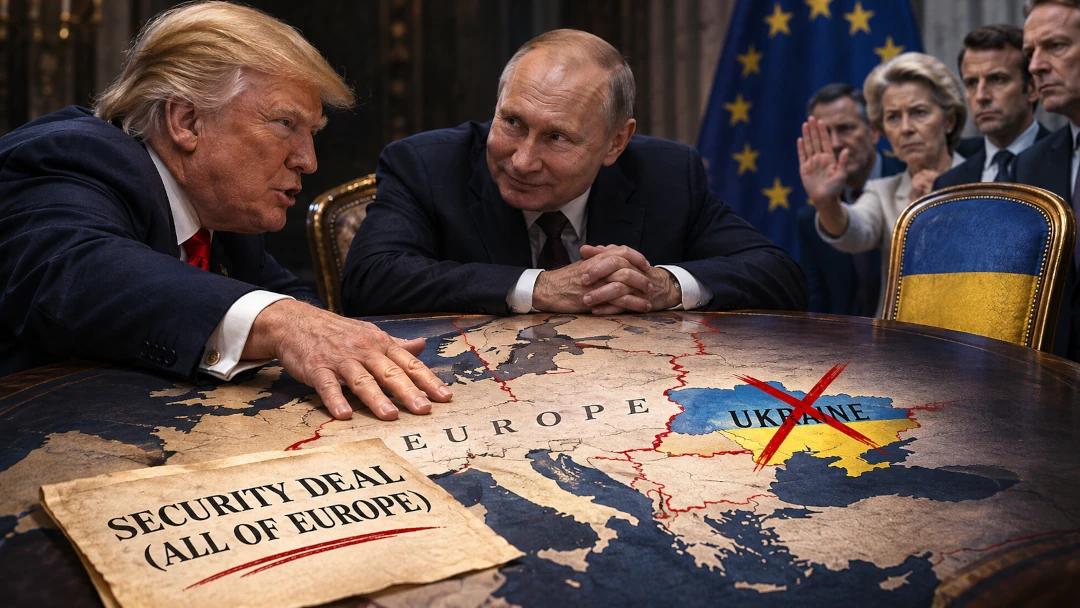
On Thursday, November 5, Donald Trump sat down in the Oval Office with Kirill Dmitriev, Vladimir Putin’s top negotiator. Ukraine’s delegation was in Washington the same day. Trump did not meet them. Afterward, the Washington Post reported, the president announced that Russia and the United States were close to a “big, beautiful agreement” — not merely about Ukraine, but about “all of Europe.”
He offered no text, no terms, no timeline. “I can’t tell you what I discussed,” he told reporters. “It’s going to involve more than Ukraine, and I could even say it might involve all of Europe,” he said, adding that “everyone’s going to be thrilled,” according to CNN. Nobody in Europe was thrilled. Within a day, the European Union’s top diplomat, Poland’s foreign minister, Ukraine’s foreign minister and Ukraine’s president had all publicly rejected the idea that Washington and Moscow could settle the continent’s security over the heads of the people who live there.
This is not a misunderstanding. It is the logical next step in a month-long pattern of concessions to the Kremlin — and in a worldview that treats nations as chips to be traded among great powers. Americans should understand exactly what is being bargained away, and in whose name.
I. The “Deal” With No Details
The only written description of the initiative came from Jared Kushner, the president’s son-in-law and envoy, in a statement posted on X. Kushner wrote that Europe and Russia had struggled for three decades to build a “sustainable security framework,” and proposed five goals: permanent security consultations, reliable crisis communications, greater military transparency, reciprocal measures to reduce escalation risks, and an enduring long-term framework. He insisted that every nation’s sovereignty would be respected and that NATO would remain central to European defense, the Kyiv Post reported.
Those reassurances deserve to be read alongside what the statement left out. As CNN noted, Kushner never mentioned that it was Russia that invaded Ukraine, nor the string of hybrid attacks Europe blames on Moscow. And his call for “reciprocal measures to reduce escalation risks” could alarm European capitals, CNN observed, because Moscow has long argued that NATO’s very presence in Eastern Europe is the escalation. Before launching its full-scale invasion in 2022, Russia sent NATO an ultimatum demanding exactly this kind of rewrite of European security arrangements.
Even the Kremlin would not vouch for the president’s claims. Asked about the deal on Friday, Putin’s spokesman Dmitry Peskov replied simply, “There are no details,” Newsweek reported. Peskov then pivoted to blaming Europe, saying Moscow had received no European proposals on security guarantees. The message from Moscow was unmistakable: the Americans are ready to talk about Europe’s future; it is the Europeans who are the obstacle.
“Russia, frankly, has been fine on Ukraine. They haven’t been doing much.”
— President Donald Trump, October 19, 2026, via The Japan Times
II. Europe Answers: “Not Above Our Heads”
The European response was swift and close to unanimous. Speaking in Warsaw on Friday, the EU’s foreign policy chief Kaja Kallas said, “We already have a European security architecture in place,” and that the real problem is that Russia keeps breaking the treaties that underpin it, Euronews reported. NATO, she noted, posed no threat to Russia in 2021 and poses none today.
Poland’s foreign minister, Radosław Sikorski, was blunter. A deal over the future of Ukraine and Europe struck without Europeans, he said, “would not just be unwise. It is actually impossible.” Ukraine’s foreign minister, Andriy Sybiha, standing beside Kallas, said Russia cannot be the guarantor of Europe’s security, and that the conversation should be about defending against Russia, not haggling with it over spheres of influence.
That firmness marks a change. For nearly two years, European leaders tried to manage this president with flattery — state dinners, royal pageantry, careful praise. NBC News described last week’s response as Europe trading that flattery for firmness.
“Putin does not have a veto over European security.”
— Kaja Kallas, EU High Representative for Foreign Affairs, Warsaw, November 6, 2026
III. Ukraine: “We Don’t Want Yalta 2.0”
Volodymyr Zelensky learned of the “security framework” not from the president but from a phone call with Kushner and special envoy Steve Witkoff. In an interview with CNN’s Jake Tapper, he said he knew few details, and that what he did know worried him: the plan was “not simple, and it can be dangerous.” Russia, he argued, does not want to talk about ending the war it started — it wants to skip ahead to redesigning Europe’s security order, a move he warned would endanger all of Europe, CNN reported.
Then he reached for the most loaded word in European diplomacy. “We don’t want to have Yalta 2.0,” Zelensky said, according to the Kyiv Post. “We don’t want to be divided by Russia.” At Yalta in 1945, Roosevelt, Churchill and Stalin settled the fate of Eastern Europe without the nations concerned at the table, consigning them to four decades behind the Iron Curtain.
Zelensky also rejected territorial concessions and welcomed the Democratic takeover of Congress, expressing hope it would rebuild bipartisan support for Ukraine, the Kyiv Post noted. He has reason to look to Congress. Last month, after Zelensky criticized the administration, Trump responded by suggesting Ukrainians “get a new leader who can make a deal,” NBC News reported — echoing, nearly word for word, the regime-change goal the Kremlin has pursued since 2022.
IV. A Month of Gifts to the Kremlin
The “big, beautiful agreement” did not come out of nowhere. It is the latest in a run of decisions that John Herbst, former U.S. ambassador to Ukraine and senior director of the Atlantic Council’s Eurasia Center, has catalogued as favors to Putin — moves that drew criticism across the political spectrum, including from Republicans and from conservative outlets such as the Wall Street Journal and the New York Post.
The Diesel Deal
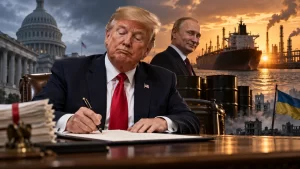
On October 9, Trump announced he would buy Russian diesel and the Treasury eased sanctions on Russian diesel through April 2027. Sen. Richard Blumenthal said the move “makes us complicit in Putin’s war against Ukraine.” AP via OPB
Gutting the Graham Act
Twenty-eight days after signing the bipartisan Graham sanctions law, Trump waived its key Russia sanctions and tariffs by executive order. Dmitriev hailed it as a “truly historic moment.” CNBC
Ignoring His Own Senators
A bipartisan group of twelve senators on the Foreign Relations Committee urged the president to reverse the diesel deal immediately. CFR’s Matthias Matthijs noted the irony of a president who lectured Europe on Russian energy now buying it himself. CFR
Cutting Ukraine’s Eyes
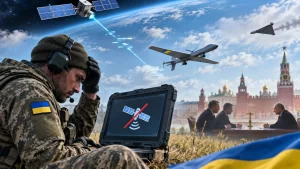
Vital intelligence reaching Ukraine through Starlink and Starshield satellite systems was shut off, with no official accepting responsibility. Service was restored only after criticism from both parties. Atlantic Council
Entertaining a Three-Power Summit
Putin proposed a Trump–Xi–Putin meeting on the sidelines of the APEC summit in Shenzhen this month. Trump said he would do it — and claimed Russia had been “fine on Ukraine.” The Japan Times
Snubbing Kyiv at the White House
On November 5, Trump met Putin’s envoy but not the Ukrainian delegation that had also traveled to Washington, then announced a Europe-wide “agreement.” Washington Post
Each concession was sold as a step toward peace. Not one has produced a Russian concession in return. Moscow pockets each gift and asks for the next one. Zelensky predicted as much in October: after the diesel deal, he warned, more sanctions relief would follow, CNBC reported.
V. The Road to Abu Dhabi
VI. The Three-World Map
Step back from the daily headlines and a shape emerges. The administration’s 2025 National Security Strategy, as the Council on Foreign Relations’ Council of Councils has noted, treats the Western Hemisphere as an American sphere of influence. The military raid that seized Venezuela’s Nicolás Maduro was, in TIME’s assessment, the starkest expression of that intent — and raised the obvious question of whether Russia and China would be granted the same principle in Europe and Asia.
That question is no longer hypothetical. The vision of a planet divided into three blocs — Washington ruling the Americas, Moscow dominating Europe, Beijing commanding Asia — has circulated for years, as historian Anne Applebaum has documented, promoted mostly by Russians eager to inflate their weak economy’s standing. She recalls that Fiona Hill, a National Security Council official in Trump’s first term, testified in 2019 that Russian interlocutors had floated “swapping” Venezuela for Ukraine. Putin, according to reporting summarized by Philadelphia Inquirer columnist Trudy Rubin, sees his three-way summit proposal precisely as a means of carving the world into U.S., Russian and Chinese spheres.
The administration has never announced such a plan, and its defenders insist none exists; National Review argued earlier this year that Trump had shown no willingness to cede East Asia. But policy is what a government does, not what it disclaims. Charles Kupchan of the Council on Foreign Relations warned last month that, given Trump’s attraction to the powerful, he could agree to “some new kind of Yalta” that sells out Ukraine and America’s allies, the Christian Science Monitor reported. And the Atlantic Council’s Jörn Fleck describes the president’s governing instincts as sphere-of-influence arrangements among supposed great powers, personalized leader-to-leader dealmaking, and hard-power realism — instincts Fleck expects to intensify now that Trump no longer faces voters.
What does it say about a president’s priorities when he treats the world’s oldest democratic alliance as a bargaining chip, and the man who launched Europe’s largest war since 1945 as a partner in designing its peace? It says he values the company of autocrats over the counsel of allies. It says he sees sovereignty as something the strong grant to the weak. And it says he is willing to spend American credibility — earned over eighty years and paid for in American lives — to buy a photo opportunity in Shenzhen.
Get Involved Today
Contribute to our mission and turn your concerns into action.
VII. What It Means for Americans
This is not a faraway quarrel. NATO’s collective defense commitment is the reason American troops have not had to fight a major war in Europe since 1945. An arrangement that blesses a Russian sphere over Ukraine and its neighbors invites the next invasion, and the next one could be of a treaty ally the United States is legally bound to defend. A deal that signals borders can be redrawn by force will be read in Beijing as clearly as in Moscow.
The pocketbook argument doesn’t hold either. The diesel deal was justified as relief at the pump, but as Atlantic Council energy expert Landon Derentz points out, restoring Russian energy flows to Europe would undercut America’s own liquefied natural gas exports. The beneficiary is the Kremlin’s war chest. Meanwhile, the American public is not on the president’s side: Herbst notes that more than 80 percent of Americans view Putin negatively, and that Russian military bloggers openly mourned last week’s election results because they believe Trump will now be less able to help Putin.
The president cannot sign away Europe on his own
Article II, § 2 — The Treaty Clause
The president may make treaties only “with the Advice and Consent of the Senate,” with two-thirds of senators concurring. A binding, continent-wide security architecture with Russia is precisely the kind of commitment the Framers reserved for the Senate. Any attempt to impose one by executive agreement or a leader-to-leader handshake should be treated as constitutionally suspect — and a Democratic Senate can say so in hearings and resolutions.
Statutory Guardrails on NATO and Europe
Congress has already fenced in this president. Since 2023, federal law bars a president from withdrawing from NATO without Senate consent or an act of Congress. And, as the Atlantic Council’s Torrey Taussig notes, the Fiscal Year 2026 defense authorization limits troop cuts in Europe and requires the U.S. commander of European Command to remain NATO’s supreme allied commander.
Article I, §§ 8–9 — The Power of the Purse
No money leaves the Treasury without an appropriation. From January, Democrats will chair every committee in both chambers, including appropriations and armed services. Funding conditions in the 2027 defense bill and supplemental Ukraine aid are the strongest lever Congress has over force posture and security assistance.
The Graham Act Waiver
The sanctions law Congress passed allowed a national-interest waiver, and Trump used it. Former NATO ambassador Ivo Daalder has urged a new sanctions bill that “mandates sanctions rather than allows the president to waive them,” Euromaidan Press reported. Mandatory sanctions, passed with a veto-proof majority, would put Russia policy back where the Constitution places lawmaking: with Congress.
VIII. What You Can Do
The midterms changed the math in Washington, but the new Congress is not seated until January, and the president’s foreign-policy powers remain broad. Here is where ordinary citizens can apply real pressure now.
- Demand hearings on the “European security” talksCall your senators at the Capitol switchboard (202-224-3121) and ask them to insist that any security arrangement with Russia be submitted to the Senate under the Treaty Clause — and that Kushner and Witkoff testify about what was promised to Dmitriev.
- Push the lame-duck Congress to act nowThe House passed the Ukraine Support Act 226–195 in June; it has sat on the Senate calendar since July 20, according to Euromaidan Press. Ask your senators to bring it to a vote before the year ends.
- Back mandatory, non-waivable Russia sanctionsTell your incoming representatives that a revised sanctions law — one the president cannot waive by executive order — should be among the first national-security bills of the new Congress.
- Insist on “Nothing about Ukraine without Ukraine”Write to your members and local papers supporting the principle Europe is defending: no deal about a nation’s future without that nation at the table. Letters to the editor are read by congressional staff far more than most people realize.
- Support Ukrainians directlyWhile Washington argues, Ukrainian cities absorb nightly drone and missile attacks on homes and power plants. Reputable humanitarian organizations working in Ukraine need sustained support heading into winter.
No single phone call stops a president from negotiating. Analysts such as Jörn Fleck caution that hard limits on Trump’s foreign-policy powers are unlikely, and overriding a veto requires two-thirds of both chambers. But oversight hearings, conditions on must-pass defense bills, and mandatory sanctions raise the price of every concession — and Herbst argues that cost is already climbing. Public pressure is how that price gets set.
Editorial Conclusion
A president who meets the aggressor’s envoy and snubs the victim’s, who waives sanctions Congress passed and calls it peace, and who promises to settle “all of Europe” without Europe has not misplaced America’s priorities — he has replaced them.
Europe has given its answer: Putin has no veto over its security. Now Americans must give ours. The Constitution does not let one man trade away alliances by handshake, and Congress must enforce that limit — through the Treaty Clause, the power of the purse, and sanctions no president can waive. The question is not whether a deal is “big” or “beautiful.” It is whether free nations still decide their own futures. On that, there can be no compromise.
Sources & References
- The Washington Post — Trump says he and Putin are close to a deal about Ukraine and “all of Europe”
- CNN — Trump teases “big, beautiful” European security deal after meeting Putin envoy
- Kyiv Post — Kushner unveils 5-point European security plan ahead of peace talks
- Euronews — EU rejects Trump’s “big beautiful” security deal with Russia and “all of Europe”
- Newsweek — Kremlin says it has no details of Trump’s “beautiful” deal on Ukraine war
- Kyiv Post — “We Don’t Want Yalta 2.0”: Zelensky warns Trump’s Russia-Europe deal could be “dangerous”
- NBC News — Europe swaps flattery for firmness as Trump teases “big” security deal
- NBC News — Trump claims “energy ceasefire,” but Ukraine says Russia keeps striking
- Atlantic Council — Experts react: Democrats just swept the US midterms
- AP via OPB — Trump strikes deal with Putin to get diesel in sharp reversal of US policy
- CNBC — Trump waives broad new Russia sanctions; Zelenskyy condemns it as “wrong”
- Council on Foreign Relations — Trump’s Russian diesel deal, explained
- The Japan Times — Trump open to trilateral summit with Putin and Xi
- Christian Science Monitor — As midterms near and Putin beckons, Trump embraces big-power diplomacy
- CFR Council of Councils — The world reorders: The complications of a return to spheres of influence
- TIME — Trump and the dangers of spheres of influence
- Anne Applebaum — Spheres of influence: Venezuela and the end of Pax Americana
- National Review — No, America is not adopting a “spheres-of-influence” doctrine
- The Philadelphia Inquirer — Trudy Rubin: Trump’s open alliance with Putin betrays the United States
- Euromaidan Press — What the Democratic midterm win really means for Kyiv
Related News