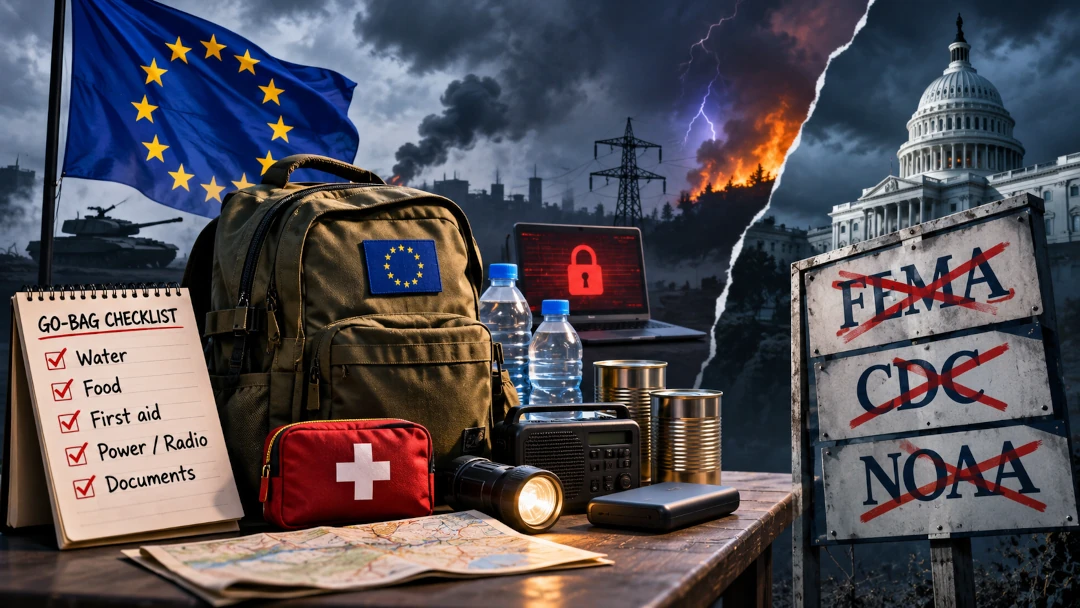
From Stockholm to Dublin to London, governments are mailing tens of millions of households instructions for surviving war, blackouts, cyberattacks and climate disasters. The United States — fighting a war of its own and exposed to every one of those threats — has spent nearly two years hollowing out the agencies built to protect Americans at home.
Somewhere in Ireland this autumn, a booklet landed on a doormat alongside the electricity bill. It explained how much water to store, what food keeps without a refrigerator, why a household should hold some cash, and how to listen for official instructions if the phones go dead. It was one of roughly 2.2 million copies distributed under Dublin’s new Be Emergency Ready campaign — and Ireland was late to the party. Across Europe, the same message has gone out in more than a dozen languages: the next crisis is coming, and governments want their citizens ready for the first 72 hours on their own.
In the United States, the president who would have to lead any response told the country last year that he planned to start “phasing out” the federal agency responsible for disasters. That gap — between a continent bracing itself and a superpower dismantling its shield — is the story of 2026.
I. A Continent Tells Its People to Prepare
This is not a fringe phenomenon or a few nervous Baltic states. In March 2025 the European Commission launched its first-ever Preparedness Union Strategy, a 30-action plan that asks every EU household to be able to sustain itself for at least three days in an emergency. Commissioner for Preparedness and Crisis Management Hadja Lahbib framed it as a new civic habit for the bloc’s 450 million people; in a post reported by Reuters she wrote, “Ready for anything – this must be our new European way of life.” The Commission said it was preparing for natural disasters, cyberattacks and geopolitical crises up to and including armed aggression against member states.
Member governments did not wait to be told twice. As of this week, the European map is crowded with national campaigns:
Nordic States
Sweden began mailing 5.2 million copies of its expanded If Crisis or War Comes booklet in November 2024. Finland moved its guidance online; Norway raised its self-sufficiency target from three days to a full week; Denmark issued three-day guidance.
Baltics & Poland
Estonia sent guides to nearly 600,000 homes, Latvia updated its 72 Hours booklet, and Lithuania’s guide covers what to do if enemy troops enter a town — including how to join resistance efforts, Newsweek reports. Poland issued a national Security Guide in 2025.
Germany, Netherlands, France
Germany revised its national crisis guide in October 2025; the Netherlands mailed booklets to more than 8.5 million households a month later; France’s Tous responsables guide, first published in 2025, was updated in August 2026 to cover cyberattacks, terrorism and armed conflict.
United Kingdom
On October 22, the Cabinet Office launched Be Ready, the first stage of a three-year campaign asking every household to prepare for three days without power, water, phones or internet. More than 500 organizations signed on to distribute it.
Ireland, Belgium, Czechia
Ireland and Belgium issued new guidance in September and October 2026, Snopes confirmed. The Czech Republic distributed 5.2 million 72 Hours guides; Switzerland adopted a new security strategy citing the war in Ukraine.
The EU, This Week
On November 3, Lahbib presented new Commission guidelines at the European Civil Protection Forum — including emergency-bag checklists and preparedness lessons beginning in early childhood education.
II. What Citizens Are Being Told to Do
The advice is strikingly consistent, and strikingly ordinary. Britain’s checklist asks for three liters of water per person per day, food that needs neither cooking nor refrigeration, a battery or wind-up radio, a power bank, cash, medications, baby supplies and pet food. Lahbib’s own demonstration video — a handbag emptied onto a table — showed much the same: food and water, a flashlight, a power bank, a radio, cash and medication.
Beyond the kit, the guides teach citizens how to receive emergency broadcasts when the internet fails, how to keep warm through a winter blackout, where the nearest shelter is, and how to identify disinformation. The more exposed the country, the darker the content. Sweden’s booklet tells its people that the nation will never surrender, and that any message claiming resistance has ceased should be treated as false. Lithuania’s explains what to do under occupation.
The public is listening. After Britain’s launch, the supermarket chain Iceland reported a roughly 40 percent jump in tinned-food sales, and shops reported radios and bottled water selling out.
III. The Threats Behind the Warnings
Europe’s governments are explicit about why. The Commission cites geopolitical conflict, hybrid and cyber threats, foreign disinformation, pandemics and increasingly severe climate disasters. Britain’s Cabinet Office pointed to last winter’s storms and this summer’s wildfires. But one threat has sharpened all the others: Russia’s escalating shadow war against the continent.
On October 1, NATO Secretary General Mark Rutte, standing beside German Chancellor Friedrich Merz, told reporters that Europe must expect sabotage, arson and hybrid attacks to continue, warning: “We see Russia testing us across Europe.” In September, French President Emmanuel Macron said the Russian hybrid threat against France and its neighbors had intensified in recent weeks, citing cyberattacks, information operations and airspace incursions. Czech intelligence chief Michal Koudelka went further, warning that Moscow might attempt a military attack on a NATO member in “months, not years.”
The incidents are no longer hypothetical. According to Al Jazeera’s reporting, the European Commission verified that a failed August plot to blow up cargo planes at Germany’s Leipzig/Halle Airport was a Russian operation; suspected Russian drones have been shot down over Poland, Finland and the Baltics; and in October Ukraine accused Russia of using drones to sink four cargo ships just outside the waters of Bulgaria, an EU and NATO member. Five EU intelligence services told the Financial Times that Russia was seeking to kill European defense executives.
And these threats do not stop at the Atlantic. Since the United States and Israel began striking Iran on February 28, U.S. officials have warned of retaliation on American soil. Pro-Iranian hackers claimed a significant attack on medical-device maker Stryker in March, the Associated Press reported, and analysts have catalogued Iranian-aligned groups targeting American water, energy and financial systems. Climate disasters, meanwhile, have not paused for politics: four tornadoes killed four people in southwest Michigan in March, and floods ravaged Central Texas again in July.
IV. Two Continents, Two Directions
EU launches the Preparedness Union Strategy, urging 72 hours of household self-sufficiency.
FEMA cancels the BRIC disaster-mitigation program, freezing billions for flood walls, tornado shelters and grid hardening.
Trump says he will begin “phasing out” FEMA after hurricane season.
Germany, the Netherlands and France publish new national crisis guides; the Dutch mail 8.5 million booklets.
U.S. and Israel strike Iran; DHS warns of retaliatory cyber and lone-actor attacks at home — as CISA operates with roughly a third fewer staff.
White House budget seeks a $1.3 billion cut to FEMA preparedness grants; the FEMA Review Council recommends shifting disaster responsibility to the states.
After the Leipzig plot, Trump says Putin is “not going to be attacking a NATO territory.”
Ireland mails 2.2 million preparedness booklets; Czech intelligence warns of a possible attack on NATO.
Britain launches its three-year Be Ready campaign.
FEMA stops publishing its list of pending state disaster requests amid evidence of partisan approvals.
EU issues new household guidelines — the same day American voters hand both chambers of Congress to Democrats.
V. Meanwhile in Washington: Dismantling the Shield
Fairness requires one acknowledgment: the United States does have household guidance. FEMA’s Ready.gov still publishes it, and Snopes notes the agency last updated that guidance in July 2026. What America does not have is any national campaign remotely comparable to Europe’s — no mailed booklets, no presidential call to readiness, no new investment. Instead, the administration has spent its energy taking the system apart.
“I’d say after the hurricane season we’ll start phasing it out.”
— President Donald Trump on FEMA, White House briefing, June 10, 2025 (Reuters)
Trump paired that pledge with a philosophy: disasters belong to governors. A state hit by a hurricane should handle the aftermath, he said, adding that if a governor can’t, “maybe they shouldn’t be governor.” Everything since has followed from it.
Preparedness money has been cut or frozen. FEMA canceled the Building Resilient Infrastructure and Communities program — a program Trump himself signed into law in his first term — and resumed it only after a federal judge sided with a coalition of states, PBS NewsHour reported. The president’s fiscal 2027 budget proposes a $1.3 billion reduction to FEMA preparedness grants, which the International Association of Emergency Managers said would “effectively dismantle core programs” that pay for local emergency managers and equipment.
The agency’s leadership has been a revolving door. Trump’s own FEMA Review Council, after missing deadline after deadline, delivered a final report on May 7 calling for responsibility to be shifted to states, localities and tribes, the Congressional Research Service notes. Along the way FEMA’s acting leadership turned over for the third time under Trump, before Cameron Hamilton — removed in May 2025 a day after testifying to Congress — was renominated and returned to the job in August.
Disaster aid has followed the electoral map. An Urban Institute analysis by Andrew Rumbach found that about 84 percent of disaster requests from states Trump won in 2024 were approved in his second term, compared with roughly 42 percent from states he lost, Fortune reported. Michigan’s request after its deadliest tornadoes in decades was denied twice. Texas’s flood request was denied too — until Trump reversed course at a Republican campaign rally in Corpus Christi. Then, late last month, FEMA simply stopped publishing its daily list of pending state requests. Michael Coen, FEMA’s chief of staff under President Biden, told Bloomberg: “They don’t want to be held accountable.”
The cyber shield has been thinned in wartime. The Cybersecurity and Infrastructure Security Agency — the civilian agency that warns water utilities, hospitals and power companies of incoming attacks — has lost roughly one-third of its workforce since early 2025. Sen. Mark Warner of Virginia has pressed CISA on whether the cuts gutted its regional support offices. Those cuts landed just as the administration launched a war with a country whose state-linked and hacktivist groups have made American infrastructure a target.
Get Involved Today
Contribute to our mission and turn your concerns into action.
VI. Why the President Is Looking Away
Why would a president ignore warnings that nearly every major European ally is acting on? The record suggests three answers.
First, ideology. Shrinking FEMA and pushing disaster costs onto states is not an oversight; it is the policy. The Review Council’s own framing, which shifts responsibility and autonomy for disaster management from FEMA onto states, localities and tribes, treats national preparedness as a burden to be shed rather than a duty to be met.
Second, a persistent blind spot on Russia. When Russian drones crossed into Polish airspace in September 2025, Trump suggested it may have been “a mistake.” This August, as European capitals reeled from the Leipzig plot, he said he had held good talks with Putin and assured reporters the Russian leader would not attack NATO territory.
“He’s not going to be attacking a NATO territory.”
— President Trump on Vladimir Putin, August 2026 (Deccan Chronicle / wire report)
Third, priorities. A government that tells its people to prepare is admitting that danger is real and that the state has work to do. That is a hard message for an administration that has made spectacle its governing style. On November 4 — the day after voters repudiated his party — the president was photographed watching the last piece of steel hoisted into place for his new White House ballroom, as Fortune noted in the same report documenting FEMA denying aid to tornado-struck Michigan. Leadership is a choice about where attention goes. This one has gone to the ballroom.
VII. What It Means for the Average American
When a crisis hits — a hurricane, a grid attack, a ransomware strike on the local water utility — the first 72 hours are about what households have on hand and how fast local emergency managers can act. Those managers are paid for, trained and equipped in large part through the very preparedness grants now on the chopping block. Smaller utilities and towns that cannot afford private threat-intelligence services depend on CISA’s warnings, and CISA now has far fewer people to issue them.
In practical terms, an American family in 2026 faces the same categories of risk Europeans are being told to plan for — severe weather, prolonged outages, cyberattacks on essential services, and spillover from a hot war — with less federal help before the disaster, slower and more politicized help after it, and no national leadership telling them what to do in between. And whether aid arrives may depend on how your state voted.
Congress Already Wrote the Rules. The Administration Is Testing Them.
After Hurricane Katrina exposed a hollowed-out FEMA, Congress built guardrails specifically to prevent a future administration from quietly dismantling the agency.
- Post-Katrina Emergency Management Reform Act (6 U.S.C. § 316)
- Requires FEMA to be maintained as a distinct entity and bars the Homeland Security secretary from substantially or significantly reducing FEMA’s authorities, responsibilities, functions or capability to perform its missions, unless later legislation authorizes it. Legal scholars writing at Legal Planet have pointed to this provision in examining the department’s treatment of FEMA, and Rep. Greg Stanton (D-Ariz.) has cited these safeguards in asking the DHS inspector general to investigate FEMA staff being reassigned to immigration enforcement. A presidential “phase-out” has no statutory basis.
- The Stafford Act (42 U.S.C. § 5121 et seq.)
- Establishes the framework by which the president declares disasters and directs federal assistance. Its purpose is national: to aid states overwhelmed by catastrophe. Approval rates that track a state’s presidential vote raise serious questions about whether that discretion is being exercised on the merits.
- Appropriations & the Take Care Clause (Art. II, § 3)
- When Congress funds a program like BRIC, the executive must faithfully execute that law. A federal court ordered the BRIC cancellation reversed after 22 states and the District of Columbia sued — a reminder that the power of the purse belongs to Congress, not to a president’s preferences.
The constitutional stakes are plain: a president may argue for a smaller FEMA, but he may not unilaterally unmake an agency Congress created, funded and fenced off by statute.
VIII. What Congress Has — and Hasn’t — Done
The outgoing Congress produced bipartisan ideas and very little action. The Fixing Emergency Management for Americans (FEMA) Act, written by Transportation Committee Chair Sam Graves (R-Mo.) and Ranking Member Rick Larsen (D-Wash.), would make FEMA an independent, Cabinet-level agency and simplify aid applications. It cleared committee 57–3 in September 2025 — and as of this summer still had not received a floor vote from Republican leadership. In the Senate, Alex Padilla (D-Calif.) and Thom Tillis (R-N.C.) introduced the FEMA Independence Act to the same end; it too stalled.
Oversight fell largely to the minority. House Homeland Security Democrats led by Reps. James Walkinshaw (D-Va.) and Bennie Thompson (D-Miss.) asked the Government Accountability Office in August to independently assess the damage from CISA’s workforce cuts. Republicans on the committee voiced concern too, but in a GOP-controlled Congress, concern rarely became subpoenas.
Congress also inflicted its own wound. During the February–March funding lapse at Homeland Security — a standoff rooted in Democrats’ demands for limits on immigration enforcement — FEMA itself went unfunded. Sens. Adam Schiff and Padilla repeatedly tried to pass a standalone bill to reopen the agency, and Senate Republicans blocked it. Whatever one thinks of that fight, disaster response should never have been a hostage in it.
IX. The Democrats’ Mandate
On Tuesday, voters changed the math. Democrats won control of both chambers in a sweeping rout, PBS NewsHour reported, with at least 54 Senate seats and a House majority far beyond 218. Hakeem Jeffries is in line to become Speaker; Chuck Schumer is expected to return as majority leader.
The incoming chairs have already signaled where homeland security oversight is headed. Thompson, the likely next chair of House Homeland Security, said Democrats are taking power “at a pivotal time for CISA” and vowed to speed its restaffing, rebuild its coordination with critical-infrastructure operators, and renew the lapsed State and Local Cybersecurity Grant Program, with special attention to water systems. Sen. Maggie Hassan of New Hampshire, the likely next chair of Senate Homeland Security, accused the administration of undermining national security by gutting CISA and called for the cuts to be reversed. Sen. Patty Murray’s ascent to the Appropriations gavel puts a longtime CISA supporter in charge of the purse. And Democrats have previewed aggressive investigations of staffing cuts at both CISA and FEMA.
That is a strong start. It is not yet a preparedness agenda. The new majority’s announced 100-day priorities center on lowering costs and reversing cuts to health care. Democrats should add a fourth pillar: pass the bipartisan FEMA reform the GOP leadership sat on, restore preparedness grants in the next appropriations bill, and demand that FEMA publish — not hide — its disaster-approval data.
X. What You Can Do
The federal government’s retreat does not leave citizens powerless. Some of what Europe asks of its households you can do this weekend; the rest requires pressure on the people you just elected.
The new Congress is not sworn in until January 3, and the president retains veto power. A lame-duck session begins November 9, and next year’s spending fights will decide whether preparedness grants survive. Personal readiness is fully in your control; restoring the federal system will take sustained public demand over two years.
- Build a 72-hour household kitUse Europe’s common benchmark: about three liters of water per person per day, food that needs no cooking or refrigeration, a battery or hand-crank radio, a power bank, cash, a first-aid kit, a supply of medications, and copies of key documents. FEMA’s Ready.gov checklist covers the same ground.
- Know your local alert systemSign up for your county or city emergency alerts and learn who your local emergency management office is. With Washington shifting the load to states and counties, those offices matter more than ever.
- Call your representative and senators nowAsk them to force a floor vote on the FEMA Act, to reject the proposed $1.3 billion cut to preparedness grants, and to fund CISA’s restaffing. Calls during the lame-duck session and the January transition carry weight.
- Demand transparency on disaster aidUrge the incoming committee chairs to require FEMA to restore public reporting of pending disaster requests and to investigate whether approvals have been made on partisan grounds.
- Prepare your block, not just your homeKnow which neighbors are elderly, disabled or depend on powered medical equipment. Europe’s campaigns stress that self-sufficient households free up responders for the most vulnerable — that is community, not survivalism.
Editorial Conclusion
Europe has looked at the same world America faces — a revanchist Russia waging sabotage on allied soil, hackers probing water and power systems, a climate producing ever-deadlier storms — and concluded that a responsible government tells its people the truth and helps them prepare. The Trump administration has looked at that same world and chosen to dismantle FEMA’s capacity, starve preparedness grants, gut America’s civilian cyber defense in the middle of a war, and steer disaster aid by political loyalty.
That is not a difference in policy style. It is a failure of the most basic duty of government: to protect the people. Congress wrote that duty into law after Katrina. Voters reaffirmed it on Tuesday. The new majority must now enforce it — restore the agencies, reopen the books, and build an American preparedness effort worthy of a free people who refuse to be caught unready.
Sources & References
- Newsweek — Map Shows Which European Countries Are Preparing Citizens for Crisis (Sept. 22, 2026)
- The Brussels Times — Everyone should have 72 hours’ worth of “war supplies,” EU warns citizens
- Reuters (via Fidelity) — EU tells the public to hold 72 hours of emergency supplies (Mar. 26, 2025)
- EUbusiness — EU issues guidelines on how Europeans can prepare for a crisis (Nov. 3, 2026)
- The Local Sweden / AFP — Sweden releases updated version of “If Crisis or War Comes” booklet
- LADbible — What EU countries are telling citizens to stock up on (Sept. 22, 2026)
- UK Defence Journal — Households asked to prepare for three days of disruption (Oct. 2026)
- Latin Times — What Britain’s “Be Ready” campaign means for your household
- The National — Beans, water and radios sell out after UK’s stockpile warning (Oct. 27, 2026)
- Snopes — Why you shouldn’t panic about governments urging emergency preparedness kits (Nov. 3, 2026)
- Bloomberg — NATO Chief Urges Europe to Brace for More Russian Hybrid Attacks (Oct. 1, 2026)
- Newsweek — Europe on High Alert as Russia Sows Panic With Hybrid Attacks
- Al Jazeera — Russia’s alleged sabotage campaign in Europe raises fears of escalation (Oct. 29, 2026)
- PBS NewsHour / AP — Iran-linked hackers take aim at U.S. and other targets (Mar. 12, 2026)
- RealClearDefense — The Coming War in America: Iranian Threats to the U.S. Homeland (Oct. 13, 2026)
- Reuters (via Marine Technology News) — Trump to Wind Down FEMA After Hurricane Season (June 10, 2025)
- CNN (via KRDO) — Trump says he plans to phase out FEMA after 2025 hurricane season
- PBS NewsHour — FEMA complies with court order to resume major disaster preparedness grant program (Mar. 26, 2026)
- IAEM — Statement on the President’s FY2027 Budget (Apr. 6, 2026)
- Congressional Research Service — FEMA Review Council: Final Report (May 15, 2026)
- Southern Environmental Law Center — Council recommends keeping FEMA but shifting more disaster responsibility to states (May 7, 2026)
- Politico — FEMA’s acting administrator is out, for the third time under Trump (May 12, 2026)
- Associated Press — FEMA’s acting administrator is replaced a day after congressional testimony (May 8, 2025)
- Fortune — Trump approved nearly 90% of disaster aid requests from all-Republican states (Nov. 4, 2026)
- Insurance Journal / Texas Tribune — Trump says more FEMA aid is coming to Texas after 2026 floods (Nov. 3, 2026)
- Bloomberg — FEMA Just Stopped Publishing Key Data on Disaster Aid (Nov. 6, 2026)
- Broadband Breakfast — One Year After DOGE Cuts, Cybersecurity Agency Struggles Over Staffing
- Nextgov/FCW — Warner presses CISA on whether staff cuts weakened regional cyber support
- Ukrainska Pravda / Reuters — Trump’s reaction to Russian drones in Poland raises concern in Europe
- Deccan Chronicle — Trump: Putin Will Not Attack NATO Territory (Aug. 28, 2026)
- GAO — Actions Taken to Implement the Post-Katrina Emergency Management Reform Act
- Legal Planet — Noem’s Disastrous Reign at FEMA (Mar. 12, 2026)
- Office of Rep. Greg Stanton — Letter to DHS Inspector General on FEMA reassignments (Apr. 27, 2026)
- E&E News — Graves, Larsen renew push for FEMA overhaul bill (July 16, 2026)
- Office of Sen. Thom Tillis — Tillis, Padilla introduce FEMA Independence Act
- House Homeland Security Democrats — Walkinshaw, Thompson, Ramirez push for independent review of CISA cuts (Aug. 21, 2026)
- Office of Sen. Adam Schiff — Senate Republicans block Schiff, Padilla bill to reopen FEMA (Mar. 12, 2026)
- PBS NewsHour — Democrats usher in a new era with their sweep of the House and Senate (Nov. 4, 2026)
- Cybersecurity Dive — What to expect from Democrats’ cybersecurity agenda in Congress (Nov. 5, 2026)
- Federal News Network — DHS to face aggressive investigations, oversight in next Congress (Nov. 2026)
Related News