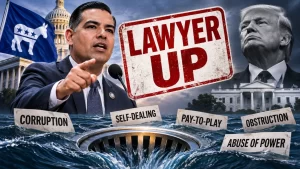
The Real Extinction-Level Event Was Never the Ballot Box
Ron DeSantis says Tuesday’s blue wave nearly wiped Republicans off the map. He has the victim wrong. Voters didn’t destroy the GOP — they rendered a verdict on two years of tariff mania, a war of choice, a gutted government, and a presidency run like a family business. Now the only question that matters is whether the people they just elected have the nerve to act on it.
On Wednesday morning, as Republicans surveyed the wreckage of the worst midterm of their modern history, Florida’s outgoing governor stepped to a podium and reached for apocalypse. Speaking at a Tallahassee press conference, Ron DeSantis told reporters that the results were “close to an extinction-level event for Republicans in many parts of the country” — the kind of rout, he added, the country has rarely seen in a century. He warned it could take years, maybe longer, before his party holds unified control of Washington again.
It is a striking phrase, and DeSantis meant it as a lament. But read it again with clear eyes. What actually went extinct on November 3rd was not a political party. It was the patience of the American people with an administration that spent two years raising their prices, dragging them into a war, hollowing out the services they depend on, alienating the nations that once stood beside them, and enriching the president’s own family at a scale never before recorded. The voters did not cause a catastrophe. They responded to one.
I. What Happened on November 3rd
The numbers are not ambiguous. Networks called the House for Democrats shortly before 10 p.m. Eastern, and CNN projected Senate control at 11:35 p.m., with the party securing at least 51 seats. By Wednesday afternoon, CNBC tallied the damage: Democrats had flipped seven Senate seats, nearly 30 House districts, five governorships and as many as a dozen state legislative chambers. In Texas, Greg Abbott lost the governorship and Democrats won a Senate seat for the first time since 1988.
Look at the map of Senate flips and the scale comes into focus. According to NBC, Democrats took seats in Kansas, Iowa, Texas, Ohio, Maine, North Carolina and South Carolina — Kansas had not sent a Democrat to the Senate in nearly a century. James Talarico won Texas. Sherrod Brown returned in Ohio. Roy Cooper took North Carolina. Troy Jackson unseated Susan Collins in Maine. Abdul El-Sayed held Michigan, becoming, per CBS News, the nation’s first Muslim senator. As of Thursday, Yahoo News reported Democrats holding 54 seats to 44, with Alaska and Mississippi still too close to call and Democrats narrowly leading in both.
In the House, NBC projects the party will open the new Congress with its largest majority in nearly two decades, including districts Trump carried by double digits just two years ago. This was not a correction. It was a repudiation.
“But if we didn’t win, I veto everything.”
— President Donald Trump, on the eve of the election, via the New York Post’s “Pod Force One”
II. The Real Extinction-Level Event
DeSantis, to his partial credit, conceded that voters were rejecting Republicans in Washington rather than embracing Democrats. But he stopped short of naming what Republicans in Washington actually did. So let us name it. The evidence below is drawn from nonpartisan analysts, mainstream reporting and the administration’s own disclosures.
Tariff Mania
The nonpartisan Yale Budget Lab estimated in August that tariffs cost the typical household more than $1,000 a year — after the Supreme Court struck down the president’s biggest levies and he rebuilt them under other statutes.
A War of Choice
Share of voters in the NBC News exit poll who said Trump made the wrong decision in starting the Iran war, a conflict blamed for driving gas prices higher across the country.
A Government Gutted
Federal jobs lost since January 2025, according to Labor Department data — an 11.2% decline that the Center on Budget and Policy Priorities found far exceeded what the administration ever proposed to Congress.
Allies Pushed Away
Trump’s description of Canada’s pivot toward Europe, as Ottawa deepened ties with the EU after tariff threats, attacks on NATO and the push to annex Greenland.
A Family Business
Reuters’ estimate of Trump family profits from crypto ventures; an affiliated entity collects 75% of token-sale revenue while ordinary investors absorbed steep losses.
A Historic Rejection
Trump’s approval in CBS News exit polling — the lowest for any president in a midterm and below his own 2018 mark.
And then there is the question of who has benefited. Elon Musk, who was handed free rein to slash federal programs early in this term, spent close to half a billion dollars this cycle, Axios reported. CNBC’s own voter poll found 69% of voters believe the benefits of this economy flow to the wealthy. Meanwhile, the president’s 2025 financial disclosure showed more than $1.4 billion in cryptocurrency-related income in a single year — an industry his own administration regulates. Eight ethics experts consulted by Reuters called the arrangement an unprecedented conflict of interest.
That is the extinction-level event: not the loss of a congressional majority, but the slow erosion of a government that is supposed to work for the people who pay for it.
III. What the Voters Said
The exit polling reads like an indictment. The AP VoteCast survey found that more than half of voters called government corruption “crucial” to their vote — a slightly larger share than said the same of the cost of living, in a year when roughly six in ten were very worried about grocery prices. CBS found that roughly nine in ten voters called corruption a major factor.
On the economy, the verdict was just as harsh. The Fox News Voter Poll — hardly a progressive instrument — found that about two-thirds of voters said Trump’s tariffs hurt the national economy, with only about two in ten saying they helped. Before Election Day, an AP-NORC poll showed just 17% approving of the president’s handling of the cost of living, with 65% blaming his policies for persistently high costs.
But there is a warning buried in the data that Democrats ignore at their peril. AP’s survey also found that sizable shares of voters said neither party would do better on corruption. Americans did not hand Democrats a blank check. They handed them a job — and a deadline.
IV. Timeline: Seventy-Two Hours That Remade Washington
V. The GOP Blame Game Begins
It took less than a day for Republican unity to curdle into recrimination. Vice President JD Vance, who once defended the Iran operation and scolded its critics, posted a blunt postmortem Wednesday morning. “The reason we lost is the war,” he wrote, according to ABC News, adding that the president himself had said as much. Vance went further, daring war supporters to argue that losing the Senate for six years was a price worth paying, and calling for the party to rethink its relationship with Israel.
Trump, for his part, called Vance’s assessment “largely true” — and then insisted he would change nothing. He told reporters the Iran campaign had to be done and would continue. Elsewhere, he blamed the candidates and the fact that he was not on the ballot, and told Fox News he had “no plans” to change his Cabinet because the loss supposedly had nothing to do with them.
DeSantis, meanwhile, is using the ashes as a launchpad. CNN reports he had already accused the administration of gaslighting voters and failing to tackle corruption in an interview released on the eve of the election. Marco Rubio, according to The Independent, may resign to distance himself from the war as he eyes 2028.
What does this say about the future of the Republican Party? That its leading figures have discovered their consciences only after the voters discovered theirs. Every one of these men stood behind this president while the war was launched, the tariffs were imposed and the agencies were dismantled. Their sudden candor is not courage; it is positioning. A party whose heirs apparent spend the morning after a historic defeat auditioning to replace the man they enabled is not reckoning with its failure. It is simply looking for a new driver for the same vehicle.
Get Involved Today
Contribute to our mission and turn your concerns into action.
VI. Mr. Veto and the Pardon Machine
If the Republican response has been cynical, the president’s has been revealing. On the eve of the election, Trump laid out his plan for the final two years of his term, and it contained nothing about lowering prices or ending the war. It contained two things: vetoes and pardons.
On vetoes, he has been consistent. After the results came in, he told Fox News that Democrats would “send over things that are insane” and he would block them until they came to the table. Think about what that means: a president facing an electorate that just told him, in record numbers, that it cannot afford his economy, announcing in advance that he will reject whatever their representatives send him.
On pardons, the message is even darker. Asked whether he would pardon everyone who worked for him, Trump answered, per AFP, “I would not even think about — I’d do it.” He vowed to protect Elon Musk from any Democratic investigation. And Raw Story reports that corporate allies, fearing pardons will flow only to those Trump personally favors, have begun opening back channels to Democrats — worried less about congressional hearings than about a future Justice Department acting on referrals today’s DOJ will ignore.
Then there is the White House’s own warning. Responding to Democratic plans for oversight, an unnamed official told Fox News that Democrats should remember “we still control the federal government and all of its powers.” That is not the language of a co-equal branch. It is a threat.
A leader focused on the country would have answered Tuesday’s results with a plan to bring down costs. This president answered with a hat, a promise to veto, and a promise to protect the people around him from the law. His priorities could not be clearer — and neither could the case for the oversight he fears.
“We still control the federal government and all of its powers.”
— Unnamed White House official, responding to Democratic oversight plans, via Fox News
VII. Democratic Leadership Is Already Backpedaling
Here is where the story should turn triumphant. Instead, it turns familiar.
On election night, House Democratic Leader Hakeem Jeffries struck the right note. He told ABC that his caucus would bring accountability to those who have visited unprecedented corruption on the country. By Wednesday morning, the tone had shifted. Asked about impeachment at a post-election press conference, Jeffries said no member of his caucus had raised it with him, insisting Democrats remained “relentlessly focused on affordability and accountability.” In a separate television interview, he suggested voters did not want Democrats to “get even,” drawing sharp criticism from progressives who argue that delivering results and pursuing accountability are not mutually exclusive.
He is not alone. A week before the election, former Vice President Kamala Harris told MeidasTouch’s Aaron Parnas that pursuing impeachment was “not a good idea,” pointing out that the Senate votes to convict simply aren’t there. Strategist James Carville has issued similar warnings.
We understand the arithmetic. Conviction requires 67 senators, and Democrats will have at most 56. But the arithmetic of conviction is not the same as the obligation to investigate. “Get even” is a straw man. Nobody serious is asking for revenge. They are asking for the law to be applied to the powerful the same way it is applied to everyone else. Framing accountability as retribution is precisely the framing the White House wants — and Democratic leaders are adopting it within 24 hours of the largest mandate their party has received in a generation.
Voters told every pollster who asked that corruption was crucial to their vote. A party that wins on that message and then hesitates to act on it is not being prudent. It is being deaf.
VIII. The Leadership Battle Ahead
The frustration has a name, and it is Chuck Schumer. On Wednesday, the progressive group Indivisible formally called on Senate Democrats to replace him as leader. The Hill notes that an NBC News poll at the end of October found just 13% of registered voters viewed Schumer’s leadership positively, and that newly elected Democrats in Michigan, Kansas, Illinois and Maine have all said publicly they would not back him.
The incoming class is unusually blunt. On election night, Minnesota Senator-elect Peggy Flanagan declared it was “time for new leadership” in the Senate. Talarico has spoken of the party needing new blood. El-Sayed has openly promoted Maryland’s Chris Van Hollen as the next majority leader. Newsweek lists Van Hollen, Brian Schatz, Chris Murphy and Cory Booker as the leading alternatives.
Schumer’s defenders have a point worth acknowledging: he presided over a Senate majority gained in some of the most hostile territory in the country, and Rhode Island’s Sheldon Whitehouse argued that delivering a Democratic Senate justifies another term. Schumer himself says he expects to be reelected and insists the fight “is not about me.” No senator has yet declared against him.
But the candidates who won those hostile states won them in part by running against the Washington establishment, including him. The base remembers that calls for his departure grew after eight members of his caucus broke ranks to end last fall’s shutdown. The message from Tuesday is that Americans have had enough — not only of Trump, but of a politics that treats every confrontation as a risk to be managed. A leader with 13% approval cannot be the face of the accountability voters just demanded. Democrats should hear that message now, before the caucus vote, not after the next disappointment.
What the Law Actually Allows — and Where Accountability Survives
The Pardon Power — Art. II, § 2, cl. 1
The president may grant pardons for “Offences against the United States, except in Cases of Impeachment.” Two limits matter. First, federal pardons do not reach state crimes — leaving state attorneys general and prosecutors as an independent avenue. Second, a pardon cannot block impeachment, and no court has ever upheld a president pardoning himself; that question remains untested.
The Emoluments Clauses — Art. I, § 9, cl. 8 & Art. II, § 1, cl. 7
The Constitution bars federal officeholders from accepting gifts or payments from foreign states without congressional consent, and bars the president from receiving domestic emoluments beyond his salary. A lawsuit filed in October accuses Trump of profiting from more than $2 billion in foreign-linked crypto deals in violation of these restrictions. A Democratic Congress can now supply the investigative record such claims require.
Congressional Oversight & Subpoena Power
The Supreme Court has long recognized Congress’s investigative power as inherent in its legislative function (McGrain v. Daugherty, 1927), and in Trump v. Mazars (2020) it set a test for subpoenas of a president’s personal records rather than barring them. Committee chairs can compel documents and testimony and refer evidence of crimes to prosecutors.
The Veto — Art. I, § 7
Congress can override a veto with two-thirds of both chambers. Democrats will not have that margin, which means a “veto everything” strategy forces voters to see plainly which bills the president blocked — a record to be built deliberately, bill by bill.
Time Is on the Law’s Side — 18 U.S.C. § 3282
Most federal crimes carry a five-year statute of limitations. Conduct from 2025 and 2026 remains chargeable well into the next administration. Congressional investigations that document wrongdoing now preserve the evidence a future Justice Department will need.
IX. The Road Ahead
What can Americans expect between now and January? A lame-duck president who has already promised obstruction. A Cabinet that may begin to scatter — Dhillon’s exit may be the first of several, and the officials who leave take institutional knowledge, and perhaps documents, with them. A growing pardon queue. And, from our allies, wariness: Politico reported, per Anadolu, that NATO diplomats fear a defeated Trump may withdraw more troops from Europe or cut alliance funding.
After January 3rd, Democrats will hold the gavels. They have promised to restore health subsidies, reverse Medicaid cuts and push to end the Iran war. All of it will likely meet the veto pen. That makes oversight not a distraction from the agenda but the only part of it fully within Congress’s control. Committees do not need the president’s signature to subpoena a bank record or a crypto ledger.
X. What You Can Do
The election was the beginning, not the end. Here, in plain language, are the most effective levers ordinary Americans have between now and the next Congress — and an honest assessment of what each can achieve.
Demand Commitments Before January 3rd
Call and write your incoming senators and representative. Ask specifically: Will you support issuing subpoenas on the Trump family’s foreign and crypto dealings? Will you back document-preservation demands to every agency now, before records disappear? Will you make criminal referrals where evidence warrants? Ask for answers on the record.
Weigh In on the Leadership Votes
Senate Democrats will choose their leader, and House Democrats their Speaker nominee, within weeks. Tell your senator who you want leading — and why accountability matters to you. These are internal votes, but members respond to constituents who call.
Press Your State Attorney General
Federal pardons cannot shield anyone from state law. Contact your state attorney general and legislators and ask whether they are examining conduct by administration figures and affiliated businesses that touches your state — fraud, consumer harm, or securities violations.
Support Watchdogs, Litigants and Whistleblowers
Nonpartisan ethics groups, investigative journalists and pending lawsuits — including the emoluments case over foreign crypto deals — build the factual record. Subscribe, donate, and share their work. If you are a federal employee with knowledge of wrongdoing, learn your legal whistleblower protections before you act.
Stay Organized
Attend town halls. Join local chapters of the organizing groups that delivered this result. Keep friends and family registered. The pressure that won the election is the same pressure that keeps leadership from backing down.
Removal from office through impeachment is not realistic with this Senate, and many federal charges will wait for a future Justice Department. But investigations, public hearings, state-level action and preserved evidence are all achievable now — and they are exactly what determines whether accountability happens later or never.
Editorial Conclusion
Ron DeSantis calls this an extinction-level event. For a party that chose a president over the Constitution, perhaps it should be. But the true catastrophe was the two years that preceded it: the tariffs, the war, the gutting of public service, the abandonment of allies, and the private fortunes built from public office.
Voters have spoken with a clarity American politics rarely sees. The people they elected now owe them more than budget bills destined for a veto. They owe them the truth, established under oath, and consequences under law. A republic in which a president can enrich his family, then pardon everyone who helped him do it, is not a republic. Congress must investigate fully, refer fearlessly, and preserve every record. Americans have had enough — and they will be watching who listens.
Sources & References
- The Hill — DeSantis on GOP pummeling: ‘Close to an extinction-level event for Republicans’
- CNN — Vance, DeSantis make quick moves after disastrous GOP midterms jumpstart 2028 race
- CNBC — Democrats sweep 2026 midterms; Republicans fail to flip a single seat
- NBC Washington — Recap: Vance blames Iran war for GOP losses as Democrats retake Congress
- CBS News — See CBS News exit poll results for the 2026 midterm elections
- PBS NewsHour / AP — How Trump and Republicans lost the 2026 midterm elections, according to AP Voter Poll
- Fox News — Fox News Voter Poll: 2026 midterms usher in a blue wave
- ABC News — Tariffs will cost US households over $1,000 a year, Yale Budget Lab says
- Center on Budget and Policy Priorities — Administration’s Radical Personnel Cuts Bypassed Congress and Lacked Transparency
- TIME — Carney Says Canada and E.U. ‘Are Not Fair Weather Allies’
- Wichita Liberty (summarizing Reuters) — Under the Trump Crypto Playbook, the Family Always Wins
- CNBC — Lawsuit accuses Trump of illegally profiting off foreign crypto deals
- ABC News — Vance blames Iran war for Republicans’ midterms defeat. Trump says he would ‘do it again’
- CTV News / AFP — Trump floats pardons, teases vetoes as he faces possible split government
- Fox News — Trump vows to veto ‘insane’ Democratic bills after midterm losses
- Axios — Trump vows to protect Musk, floats pre-emptive staff pardons
- Newsweek — Trump Sees First Post-Midterm Resignation as Harmeet Dhillon Exits
- Truthout — Jeffries Downplays Trump Accountability Push After Democrats’ Midterm Blowout
- The Hill — Progressive group calls for Senate Dems to replace Schumer as leader
- The New Republic — Calls to Replace Jeffries and Schumer Explode After Democratic Wins
Related News