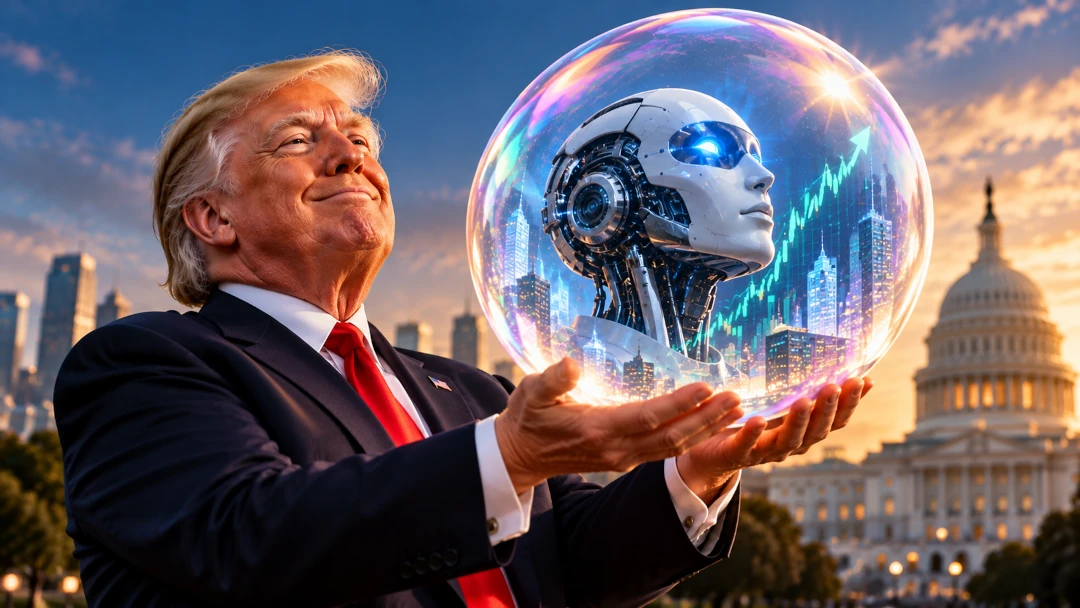
An arms race for artificial intelligence has turned into a trillion-dollar wager financed by borrowed money, circular deals and valuations untethered from profit. The president cheered it on, cleared its path, traded its stocks and let foreign money flow to his family’s businesses along the way. As the cracks spread, ordinary Americans — their jobs, their retirement savings and their power bills — are the ones left holding the risk.
Today, Wall Street got a glimpse of the bill. Alphabet, the parent of Google and YouTube and one of the pillars on which the entire artificial-intelligence boom rests, saw its Class A shares fall 12.6 percent — their worst day since they began trading more than two decades ago, according to the Associated Press. Bloomberg tallied more than $500 billion in market value wiped out in a single session, the largest plunge in the company’s history. The trigger was not a scandal or a lawsuit. It was arithmetic: the company is spending more on AI than its business brings in.
Alphabet reported a second straight quarter of negative free cash flow. Its capital spending for the quarter hit $51.36 billion — more than double the year before and greater than the $42.29 billion in cash its operations generated — and its chief financial officer, Anat Ashkenazi, told analysts that spending would rise “significantly” again in 2027 from this year’s forecast of $195 billion to $205 billion. Meanwhile, search advertising, the cash machine that pays for all of it, grew at its slowest pace in five quarters. Investors finally asked the question that has hung over this boom for three years: who, exactly, is going to pay this back?
That question is not Alphabet’s alone. It belongs to Nvidia, to OpenAI, to Anthropic, to Meta, Microsoft, Oracle and Amazon, to the private-credit funds and pension plans lending them money, to the utilities building power plants for them — and to every American whose 401(k) is loaded with their stock. It also belongs to the man who has spent his second term insisting that the only thing standing between America and AI glory is regulation, while his own brokerage account, his sons’ investment funds and his family’s crypto venture profited from the frenzy.
I. The Anatomy of a Bubble
Every financial bubble has the same skeleton: a genuinely transformative technology, a story about how it will change everything, a flood of capital chasing that story faster than profits can follow, and — eventually — a turn to debt and financial engineering to keep the spending going once the cash runs short. The railroads had it. The dot-com era had it. Housing had it in 2007. Artificial intelligence has every bone.
The technology is real. AI models now write code, draft legal memos, and summarize research at a level few predicted five years ago. But the investment has outrun the income by a staggering margin. Combined capital spending by the largest tech companies is now measured in the hundreds of billions per year, and the industry’s most valuable private companies are losing tens of billions of dollars while being priced at a trillion or more. Billionaire investor Ray Dalio warned this month that AI is a “classic bubble” nearing its bursting point, pointing to the mountain of debt being taken on to fund it just as interest rates climb.
What turned a technology boom into a bubble is the race. Washington and Silicon Valley have framed AI as a winner-take-all contest — against China, and among the labs themselves. The president’s own slogan for the effort is blunt: whoever wins AI, wins. When the prize is framed as total, no price is too high, no deal too circular, no balance sheet too stretched. Companies that would never have tolerated a money-losing product line for a decade now pour tens of billions per quarter into data centers out of fear that a rival will get there first. Funding decisions are no longer made on expected return; they are made on fear of being left behind.
And the bubble’s fingerprints are no longer confined to the United States. In China, where the government urged savers into AI stocks, the STAR 50 index of AI and semiconductor leaders has fallen 40 percent in under four months, erasing some $480 billion, Reuters reported this week. U.S. AI stocks had fallen far less — until today.
II. The Players at the Table
To understand how a stumble at one company can cascade through the whole system, it helps to see how tightly the players are bound together. Many of them are simultaneously each other’s investors, suppliers, landlords, lenders and largest customers.
Who’s who in the AI money machine
Nvidia — The Arms Dealer
Maker of the chips everyone needs, and increasingly the financier of its own customers, including a $105 billion financing structure tied to OpenAI’s Ohio data center.
OpenAI — The Flagship
Valued at $852 billion in March and reportedly raising more at $1.25 trillion; lost $38.5 billion in 2025 on $13.07 billion of revenue.
Anthropic — The IPO
Filed to list on Nasdaq this week. Revenue is soaring, but the filing shows an $80.7 billion net loss for the first half of 2026.
The Hyperscalers
Alphabet, Microsoft, Meta and Amazon — the cash-rich giants now spending beyond their cash flow and turning to bonds, stock sales and off-balance-sheet vehicles to keep building.
The Neoclouds
CoreWeave, Oracle’s cloud arm and others that rent out GPU capacity. CoreWeave carries roughly $50 billion of debt and its bonds now trade at distressed levels.
Private Credit
Blue Owl, PIMCO and their peers — the lightly regulated lenders financing data centers. Carlyle estimates private credit could be asked to fund about $1 trillion of the build-out.
Gulf Capital
Abu Dhabi’s G42 and MGX, controlled by national security adviser Sheikh Tahnoon bin Zayed — chip buyers, AI investors and, it turns out, investors in the Trump family’s crypto venture.
The White House
The industry’s chief promoter: deregulating, fast-tracking data centers, approving chip exports, and — through the president’s own trading account — owning a slice of the action.
III. Nvidia: The Chipmaker That Became AI’s Central Bank
No company has profited from the AI frenzy like Nvidia, whose market value has climbed past $5 trillion. But its role has quietly shifted from supplier to lender of last resort. When customers lose money and run short of cash, Nvidia has increasingly stepped in to finance the purchases of its own chips.
The clearest case is OpenAI. Nvidia, already an OpenAI investor, this summer explored guaranteeing financing for a massive OpenAI data center in Piketon, Ohio. When the Wall Street Journal and Bloomberg reported that Nvidia was weighing a guarantee of up to $250 billion — and separately considering financing OpenAI’s purchase of $350 billion of Nvidia chips — Axios captured the logic in a single line: Nvidia, which is making enormous sums of cash, is using its financial heft to prop up customers who are losing enormous sums. Nvidia’s stock fell and the debt market soured that day. Under investor pressure, the backstop was scaled down, but the chip-financing pipeline survived.
Economists have a name for this: circular financing. A supplier hands money to a customer — through equity, loans or guarantees — and the customer uses that money to buy the supplier’s products. Revenue gets booked. Valuations rise. But the underlying demand is partly manufactured by the supplier’s own balance sheet. Boston College professor Aleksandar Tomic characterized the Ohio arrangement as exactly that. Nvidia CEO Jensen Huang flatly rejected the label, arguing Nvidia is securing scarce infrastructure, that OpenAI will pay the lease, and that the broader buildout could represent some $600 billion in Nvidia compute through 2030.
Huang may be right that demand is real today. The danger is what happens if it softens. In a circular web, a problem at one node becomes a problem at every node. If OpenAI misses its targets, Nvidia’s guarantee is called, Microsoft — which this week disclosed that $10 billion of its $92.3 billion in quarterly revenue came from OpenAI, roughly 11 percent, from a company it partly owns — loses a major customer, and the data center developers who borrowed against OpenAI’s lease face their lenders. That is not a hypothetical chain. It is the structure of the industry.
IV. Built on Borrowed Money
For most of the boom, the tech giants paid for AI with their own enormous profits. That era is ending. Senator Elizabeth Warren (D-Mass.) and three Democratic colleagues warned in January that the companies were increasingly turning to “complex and opaque” debt markets to borrow staggering sums, and asked Treasury Secretary Scott Bessent, as chair of the Financial Stability Oversight Council, to investigate the systemic risk of more than $1 trillion in projected AI-infrastructure debt. Nine months later, their warning reads like a forecast.
CoreWeave: the canary
CoreWeave, the GPU-rental company that became a Wall Street darling, is now the clearest sign of strain. In mid-October, Reuters reported that the cost of insuring its debt against default climbed to about 1,200 basis points and yields on some of its bonds hit 15 to 16 percent — levels that signal investors seriously doubt repayment. Bloomberg reported that junk-bond buyers are increasingly freezing out AI startups seeking financing as a result. CNBC calculated CoreWeave’s debt-to-equity ratio at 702 percent, up from 290 percent a year earlier, with capital spending still projected near $48 billion.
Debt that disappears from the books
The giants have found a way to borrow without looking like they are borrowing. Meta financed its Hyperion megacampus in Louisiana through a joint venture with private-credit firm Blue Owl that issued roughly $27 billion of debt held in a special purpose vehicle — debt that never officially appears on Meta’s balance sheet. Analysts at TS Lombard compared the structure to the dot-com era. In July, Meta confirmed Hyperion would scale to 5 gigawatts with total investment exceeding $50 billion, with Meta’s rent obligations beginning in 2029 regardless of construction delays. When debt is moved off balance sheet, investors, regulators and retirees cannot easily see how much risk is piling up — which is precisely the problem that turned subprime mortgages into a global crisis.
Chips that age faster than the accounting admits
There is a quieter time bomb inside the earnings reports. When a company buys a $40,000 GPU, it spreads the cost over the chip’s “useful life.” The hyperscalers currently assume five to six years. Michael Burry, the investor who famously bet against the 2008 housing market, argues the real economic life of these chips is closer to two or three years because Nvidia now releases a new generation annually. By his estimate, the industry could be understating depreciation — and overstating profits — by about $176 billion from 2026 through 2028. If he is right, the hardware bought at peak prices is depreciating far faster than the books admit, and the write-downs will arrive all at once, not gently over years. The industry’s defense is that older chips get redeployed to lighter work. Both sides agree on one thing: the answer will determine whether today’s profits are real.
The cost of money is rising
All of this borrowing was planned in a world of cheap money. That world is gone. Since the U.S. war on Iran began in late February, oil prices have surged and the 10-year Treasury yield — the benchmark for corporate borrowing and mortgages — climbed to its highest level in over a year by July, making it more expensive for businesses to borrow. Harvard economist Kenneth Rogoff notes that runaway federal deficits have pushed long-term rates higher still, adding pressure on AI firms already loaded with debt. The Federal Reserve held rates steady this week. As AP put it today, future data-center spending is under pressure precisely because it has become so expensive to borrow money to buy more chips.
V. The Data Center Gold Rush
Data centers are where the AI bubble becomes physical — and where its costs land on people who never bought a share of Nvidia. These warehouse-sized facilities, packed with chips and cooling systems, consume electricity on the scale of small cities. The International Energy Agency estimates a typical hyperscale facility uses as much power as 100,000 households.
The administration has treated their construction as a national emergency. A Trump executive order directed fast-tracked permitting and environmental review and offered federal land for data centers. Republicans’ 2025 tax law layered on deductions that, according to letters Senator Warren and Senate Democrats sent in September, coincided with billions in reduced federal tax bills for Microsoft, Amazon and Alphabet. Communities, meanwhile, got the power bills.
The independent market monitor for PJM — the grid that serves all or part of 14 mid-Atlantic and Midwest states — concluded that expected data center demand was a primary reason for $23 billion in customer price increases that will last until at least the end of 2028. Research published by the Centre for Economic Policy Research found that data center growth raises electricity prices particularly for households, many of which capture little of the value; 71 percent of Americans say they would oppose a data center in their area. When Senator Warren said bills near large data centers had risen by as much as 267 percent over five years, PolitiFact noted data centers are not the sole cause of rising prices — but found that regulators in Maryland and D.C. identified data center load as one driver, and Harvard’s Ari Peskoe agreed consumers could be subsidizing the facilities.
Here is the bubble’s cruelest twist: if the AI boom collapses, many of these facilities and the power plants built to serve them could sit underused while their costs remain baked into ratepayers’ bills. Households will have helped finance the build-out and gotten none of the upside.
VI. Valuations From Another Planet
On Monday, Anthropic — the maker of the Claude AI models — publicly filed to go public on Nasdaq under the ticker ANT. The Wall Street Journal has reported a potential valuation of $1.5 trillion to $2 trillion; Reuters reported the company could seek to raise as much as $100 billion, though neither figure appears in the filing. The numbers inside the prospectus tell a remarkable story in both directions. Revenue hit $16.3 billion in the first half of 2026, up from $1.2 billion a year earlier. The net loss for the same six months: $80.7 billion. The company disclosed compute commitments of up to $120.5 billion involving SpaceXAI and Nvidia and up to $114.5 billion with Google through 2033. As Axios summarized, AI giants need fresh investment because even massive revenue isn’t keeping pace with spending.
Fairness requires noting that Anthropic’s filing also showed the company earned $974 million from operations in the second quarter — a rare sign that frontier AI can make money at the operating level. But a $2 trillion price tag on a company that booked $16.3 billion of revenue in six months is a bet on a future of near-total market dominance. University of Florida IPO expert Jay Ritter told CNBC that at a $1.5 trillion starting valuation, the room for outsized gains is limited. That is the polite version of the warning: the early money has already been made, and ordinary investors are being invited in near the top.
OpenAI’s own numbers have proved slippery. In early October, the Financial Times reported OpenAI told investors its annualized revenue was approaching $50 billion — about $20 billion below the widely circulated $68–70 billion figure. Shares of Nvidia, Oracle and CoreWeave fell on the news. OpenAI has since told investors it expects to reach or exceed $70 billion by year-end, driven by enterprise sales. But when an $852 billion company’s revenue can be misread by $20 billion, the market is trading on narrative rather than numbers.
The shares that may not exist
The frenzy has reached retail investors in its most dangerous form. Platforms have sold “pre-IPO” exposure to OpenAI, Anthropic and SpaceX through special purpose vehicles and crypto tokens. Both Anthropic and OpenAI warned in May that many such products are unauthorized; tokens claiming indirect exposure plunged nearly 40 percent afterward. The Wall Street Journal reports the SEC is ramping up enforcement against vehicles that cannot prove they hold the shares they sold. And OpenAI’s decision to push its IPO to 2027 has left buyers of secondary shares holding paper positions with no clear exit. These are the investors who will absorb losses first and recover last.
VII. The Cracks Are Showing
The end of a bubble rarely arrives as a single crash. It arrives as a series of tremors that grow closer together. Here is what the last several weeks have shown.
Eight warning signs
Profits Can’t Fund Spending
Alphabet’s capital spending exceeded its operating cash flow for a second straight quarter, prompting its steepest one-day fall on record.
Debt Markets Balking
CoreWeave’s unsecured bonds fell below 80 cents on the dollar; junk investors are retreating from AI borrowers.
Revenue Questions
OpenAI’s run rate was revealed to be roughly $20 billion below estimates, sending AI stocks lower.
Circular Deals
Nvidia is financing purchases of its own chips; Microsoft counts its part-owned OpenAI as 11% of revenue.
Off-Books Leverage
Tens of billions in data-center debt sits in SPVs that never touch hyperscaler balance sheets.
Rising Rates
War-driven inflation has pushed borrowing costs up just as the industry needs more debt.
Contagion Abroad
China’s AI index lost 40% in under four months; South Korea’s market suffered a historic crash this summer.
Smart Money Exiting
Ray Dalio calls it a classic bubble; Citadel’s Ken Griffin has fanned bubble fears; Burry is betting on write-downs.
How the bubble inflated — and began to leak
VIII. Chips for Adversaries — and for Friends of the Family
The administration’s justification for letting the AI industry run without guardrails is national security: America must beat China. Yet its own chip policy has repeatedly handed advanced American technology to the very rivals it claims to be racing.
Under President Biden, sales of advanced AI chips to China were barred over fears they would accelerate Beijing’s military and surveillance capabilities. Trump reversed course. After months of lobbying by Jensen Huang, the administration formally approved sales of Nvidia’s H200 — its second most powerful AI chip — to approved Chinese customers in January, in a rule critics warned could allow roughly 2 million advanced chips to flow to China. Then–White House AI czar David Sacks argued that selling to China would discourage Chinese rivals like Huawei from catching up. The administration attached an unusual condition: a 25 percent cut for the U.S. government, collected as a tariff on chips routed through the United States for testing before shipment to China.
The policy has not even delivered the sales it promised. Beijing has steered its companies toward domestic chips, and Nvidia’s own quarterly filing with the SEC stated that it had generated no revenue under the H200 licensing program as of that report. So the United States signaled a willingness to trade away its technological edge for a cut of the proceeds, and got neither the revenue nor the leverage. In May, Trump personally phoned Huang to add him to the presidential delegation to Beijing after media coverage noted his absence; U.S. officials later said chip export controls were not discussed in the Trump–Xi talks.
Republicans and Democrats alike have objected. Senators Jim Banks (R-Ind.) and Elizabeth Warren have pressed the Commerce Department over evidence that chips are reaching China through shell companies in Malaysia and Thailand. A bipartisan bill, the SAFE CHIPS Act, would bar the administration from approving advanced chip exports to China for 30 months.
The Abu Dhabi arrangement
The Gulf deal is worse. In May 2025, the administration agreed to let the United Arab Emirates buy hundreds of thousands of Nvidia’s most advanced chips — about 500,000 a year — with a fifth reserved for G42, the AI company controlled by Sheikh Tahnoon bin Zayed Al Nahyan, the UAE’s national security adviser. The Biden administration had blocked such sales amid concern over G42’s past ties to the sanctioned Chinese firm Huawei.
What the public did not know until The Wall Street Journal reported it this February: four days before Trump’s inauguration, a Tahnoon-backed firm called Aryam Investment 1 had signed a deal to buy 49 percent of World Liberty Financial for $500 million, with roughly $187 million of the first installment flowing to Trump family entities and $31 million to the family of Steve Witkoff, now Trump’s Middle East envoy. Trump’s own financial disclosure later put the total to Trump family entities at $263 million. Two senior officers of Tahnoon-backed companies joined World Liberty’s board. And in July of this year, the administration eased limits on how many chips G42 could buy.
A World Liberty spokesman told CNN that neither Trump nor Witkoff had any involvement in the transaction and flatly denied any link to chip policy. But CNN also noted the deal is unprecedented in modern American politics: a foreign government official taking a major ownership stake in a company tied to a sitting president’s family. Senator Chris Murphy (D-Conn.) called the White House “a non-stop corruption machine” on the Senate floor. Whatever the intent, the sequence is undeniable: foreign money in, family profit out, sensitive American technology approved.
“AI taking over the World, destroying Humanity, and all other things bad, is a HOAX.”
— President Donald Trump, Truth Social, September 14, 2026, via ABC News
IX. The President’s Portfolio
Modern presidents of both parties have placed their assets in blind trusts or refrained from trading while in office. Donald Trump does neither. According to a Washington Post analysis of his disclosures, his accounts have executed roughly 30,000 securities transactions since he returned to office, including trades in AI-linked companies such as Dell, Micron, Broadcom and GE Vernova.
The trades track his policies with uncomfortable precision. PBS NewsHour reported that in early January the president’s account purchased between $500,000 and $1 million of Nvidia stock — the same month his Commerce Department formalized Nvidia’s China sales. His May disclosure showed purchases of $1 million to $5 million each in Trane and Eaton, which supply power and cooling for data centers, plus a stake in data center operator Equinix — all while he fast-tracked data center permitting. In July alone his accounts reported more than a thousand trades, including Alphabet, Amazon, Meta, Microsoft, Nvidia and Oracle. Senator Warren put it simply: “it should be illegal for the president to trade individual stocks—period.” Critics also say some trades were reported after the STOCK Act’s 45-day deadline.
The White House and the Trump Organization insist the accounts are fully discretionary, managed by independent institutions, and that the president receives no advance notice of trades. No court or regulator has found that he engaged in insider trading. But the defense misses the point. A president who owns the stocks his decisions move, who can shift markets with a single post, and who refuses the standard safeguard of a blind trust has created a conflict of interest that no disclaimer can cure. Americans cannot know whether a policy was made for the country or for the portfolio. That uncertainty is itself the damage.
The family business
The conflicts extend well beyond the president’s brokerage account. Donald Trump Jr. is a partner at 1789 Capital, which assembled a $1.2 billion fund focused on digital infrastructure including data centers, and Donald Jr. and Eric Trump helped launch American Data Centers — weeks after their father announced a $20 billion data center pledge from Emirati billionaire Hussain Sajwani, a longtime Trump business partner. Eric invests in AI satellite-data firm Space-Eyes. Trump Media, parent of Truth Social, is merging with fusion company TAE Technologies to build power generation for AI data centers. As Moneywise and Yahoo Finance summarized the Post’s reporting, the family is building business interests — and profiting — off the very industry the president refuses to regulate.
What the law says about a president who profits from the policies he sets
The Foreign Emoluments Clause — Art. I, §9, cl. 8
“…no Person holding any Office of Profit or Trust under them, shall, without the Consent of the Congress, accept of any present, Emolument, Office, or Title, of any kind whatever, from any King, Prince, or foreign State.”
The Framers wrote this clause for exactly the scenario now before us: money from a foreign government’s officials flowing to a sitting president’s interests while that government seeks favors from Washington. Sheikh Tahnoon is the UAE’s national security adviser and a member of its ruling family. Payments to Trump family entities from an entity he backs, followed by approval of chip sales his company sought, raise a serious emoluments question that Congress has never consented to. Emoluments lawsuits from Trump’s first term were dismissed as moot when he left office; the question has never been resolved on the merits, and only Congress can supply the consent the Constitution requires.
The Export Clause — Art. I, §9, cl. 5
“No Tax or Duty shall be laid on Articles exported from any State.”
The Constitution forbids taxing exports. The administration’s 25 percent government cut on China-bound H200 chips was structured as an import tariff on chips routed through the U.S. for testing — a workaround that delivers the economic effect of an export levy. Whether that structure survives a constitutional challenge has not been tested, but its design reveals the goal: monetizing access to sensitive technology rather than protecting it.
The Foreign Commerce Power — Art. I, §8, cl. 3
Congress, not the president, holds the power to regulate commerce with foreign nations. The president’s authority over chip exports is delegated by statute through the Export Control Reform Act of 2018, and Congress can reclaim it. The bipartisan AI OVERWATCH Act would treat advanced chip exports like arms sales, requiring congressional approval for sales to China, Iran, Russia and North Korea. Passing it is squarely within Congress’s constitutional role.
The Supremacy Clause — Art. VI, cl. 2
Only federal law can preempt state law. The Senate voted 99–1 to strip a moratorium on state AI regulation from Trump’s 2025 tax bill; Trump’s December 2025 executive order then directed agencies to challenge and preempt state AI laws anyway. An executive order cannot accomplish what Congress refused to enact; states remain free to protect their residents, and the order’s litigation-first design concedes as much.
The STOCK Act of 2012
The STOCK Act requires the president to report securities transactions within 45 days and affirms that federal officials owe a duty of trust regarding nonpublic information. It does not ban a president from trading. That gap is the problem: Congress should extend a trading ban to the president and vice president, require blind trusts, and give the Office of Government Ethics real enforcement teeth.
X. Congress: Is Anyone Watching?
With Republicans in control of both chambers, congressional scrutiny of the AI financial build-out, the UAE chip deal and the president’s trading has come largely from Democrats in the minority — who cannot issue subpoenas or force votes — and from a handful of Republican dissenters such as Senator Josh Hawley.
Senate Democrats’ financial-stability agenda. Senator Warren, ranking member of the Banking Committee, has led the effort. After January’s letter demanding an FSOC investigation, she introduced in June the AI Bubble Transparency Act, co-sponsored by Senator Richard Blumenthal (D-Conn.), which would require banks and other financial institutions to disclose their debt and equity exposure to AI companies, chipmakers and data centers and direct the FSOC to report on how interconnected the financial system has become with the AI industry. In September, Warren and colleagues demanded that Meta, Google, Amazon and Microsoft disclose the AI tax breaks they claimed and their lobbying for them. Blumenthal and Warren also pressed Bessent over what they called the administration’s “asleep-at-the-wheel” approach to testing advanced AI models, writing that voluntary measures and self-policing clearly are not working.
Chip exports. The AI OVERWATCH Act, led in the House by Foreign Affairs Chair Brian Mast (R-Fla.) and in the Senate by Jim Banks with Democrats Warren, Catherine Cortez Masto and Jeanne Shaheen and Republicans Tom Cotton and Pete Ricketts, would require congressional approval for advanced chip sales to adversaries. It advanced from the House Foreign Affairs Committee with bipartisan support but has not become law.
Ratepayer protection. Senators Josh Hawley (R-Mo.) and Blumenthal introduced the GRID Act, which would require large data centers to build their own power rather than pass grid costs to households, and Hawley and Warren have jointly demanded mandatory reporting of data center energy use. Hawley has also proposed ending tax breaks for data centers built on farmland.
The safety question. When the heads of the three leading AI labs called for a slowdown in September, House Democratic Leader Hakeem Jeffries urged Congress to act decisively to slow the pace of development and ensure AI proceeds safely. No federal AI-safety statute has passed.
The pattern is unmistakable. Proposals exist — some bipartisan — but the Republican leadership that controls the calendar has let them sit, while the president attacks the premise of oversight itself. Bloomberg reports that AI companies are now hiring lawyers and lobbyists in anticipation of a congressional gauntlet should control of Congress change. In other words, the industry itself expects that real oversight depends on Tuesday’s election.
Get Involved Today
Contribute to our mission and turn your concerns into action.
XI. What It Means for the Average American
Your retirement
You may not own a share of Nvidia directly, but you almost certainly own it indirectly. About 54 percent of U.S. households have a 401(k), and more than 80 percent of plans default workers into target-date funds that track market indexes weighted by company size. The “Magnificent Seven” tech giants make up roughly 30 percent of the S&P 500; technology and communications together are about 45 percent. When AI stocks fall, the typical American’s retirement account falls with them. Kenneth Rogoff warned in recent days that a 30 percent or larger stock market drop is entirely plausible and, in an economy this dependent on AI, could easily trigger a recession and widespread financial distress.
“Trump could easily run into a financial crisis before his term is up.”
— Kenneth Rogoff, Harvard economist and former IMF chief economist, via Anchorage Daily News
Your job
The fears about AI and jobs are real, but the evidence is more nuanced than the headlines — and the bubble may be the hidden link between them. Major employers have announced AI-linked cuts this year, and researchers find AI has plausibly begun to depress entry-level hiring in the most exposed occupations. Yet overall unemployment has not spiked. Goldman Sachs economist Joseph Briggs offers the crucial insight: AI could eventually displace about one in eleven workers, but companies have historically saved automation layoffs for downturns. Put plainly, a bursting AI bubble could produce the very recession that unleashes AI-driven layoffs. Workers would be hit twice — first by the crash, then by the automation companies use to cut costs coming out of it.
The existential question
Then there is the fear that AI itself could slip beyond human control. It is notable that these warnings come not from activists but from the builders. In September, Anthropic CEO Dario Amodei published an essay arguing the industry must deliberately slow the pace at which it improves AI capabilities, and OpenAI’s Sam Altman and xAI’s Elon Musk publicly agreed. Skeptics such as Diginomica’s Stuart Lauchlan asked why the labs don’t simply slow down on their own if the danger is real. But the response from the White House was not caution; it was ridicule. Responsible policy would neither panic nor dismiss — it would require independent testing, transparency and enforceable standards. The administration has offered only a nonbinding industry pledge.
Your bills
All of this lands on households already squeezed by an affordability crisis. War-driven oil prices have pushed up gasoline, diesel and heating oil, borrowing costs have climbed, and the average household electricity price rose from 13.15 cents to 17.30 cents per kilowatt-hour between 2020 and 2025. Data center demand adds pressure on top. A household that loses value in its 401(k), faces a weaker job market and pays more for power is absorbing the AI bubble’s downside without ever having shared in its gains.
XII. The Case the Boosters Make
Defenders of the build-out make serious arguments. Demand for AI computing has exceeded supply through much of 2026, and capacity prices have risen rather than fallen. Revenue is growing at historic rates: Anthropic's sales grew roughly fourteenfold in a year, and the company now generates more revenue per dollar of compute than it did a year ago. Nvidia finances its customers largely from cash, not borrowed money. Some credit investors, like Janus Henderson's John Lloyd, call the CoreWeave selloff an overreaction. And bubbles can coexist with transformative technology: the dot-com crash destroyed fortunes, but the internet it financed changed the world.
The administration argues that regulation would hand China the lead, and that selling older chips to China slows Huawei's progress. Some economists also caution that data centers are only one of several drivers of higher electricity prices.
These points deserve a hearing. But none of them answers the core problem: valuations and debt are priced for a best-case future, the risk has been spread to retirees and ratepayers, and the official charged with protecting the public is personally invested in the outcome.
XIII. Is Collapse Inevitable?
Honesty requires saying what no one knows: the timing and severity of what comes next. Bubbles can deflate slowly — a long grind of falling valuations and canceled projects — or burst violently when a major borrower defaults and lenders panic. The most likely triggers are visible now: a failed refinancing at a heavily indebted neocloud, a disappointing IPO, a hyperscaler pulling back on spending, a sharp rise in interest rates, or a write-down of aging chips. Some of the AI companies will survive and thrive, as Amazon and Google survived 2000. Many investors in them will not.
What is near-certain is that valuations built on decades of flawless execution, financed by debt at rising rates, will be repriced. The question is whether that happens gradually under the watch of responsible regulators, or suddenly, with retirees, workers and ratepayers left to absorb the losses.
XIV. What You Can Do
Americans cannot stop a bubble on their own, but they can reduce their exposure to its fallout and demand accountability from the people who inflated it. Here are the most important steps, with an honest assessment of each.
Know what you actually own
Log into your 401(k), IRA or brokerage account and look at the top holdings of your funds. An S&P 500 index fund or target-date fund may carry far more AI concentration than its name suggests. You cannot make a sound decision about risk until you know it. Honest assessment: easy, free and the single most useful step.
Rebalance — don’t panic
If your allocation has drifted heavily toward tech because those stocks soared, rebalancing back to your intended mix trims concentration without trying to time the market. Diversification across sectors, international stocks, bonds and equal-weight funds reduces dependence on one theme. If you are near retirement, make sure money you’ll need in the next few years isn’t riding on stocks at all. Honest assessment: nobody can time a crash; selling everything often does more damage than staying diversified.
Build a cushion and lock in your debts
Because a bubble bust could become a recession, an emergency fund covering several months of expenses is your best protection against a layoff. Pay down high-interest variable debt, and avoid margin borrowing to buy AI stocks. Honest assessment: not glamorous, but the households that weathered 2008 best were those with cash and little debt.
Avoid the hype products
Steer clear of “pre-IPO” SPVs, tokenized shares and unsolicited offers to buy into OpenAI, Anthropic or other private AI companies. The companies themselves have warned many such offers are invalid, and the SEC is cracking down. If you buy into an AI IPO, size the position as money you can afford to lose. Honest assessment: newly public mega-companies rarely offer the gains early investors already captured.
Protect your power bill
Check whether your state utility commission is considering a large-load tariff that makes data centers pay for their own grid upgrades, and submit a public comment. Ask your utility about budget billing and assistance programs, and use federal LIHEAP aid if eligible. Honest assessment: public comment really does shape rate cases, which are decided by regulators who rarely hear from households.
Make yourself harder to replace
If you work in an AI-exposed field, learn to use these tools in your work, document what you do that requires judgment and relationships, and keep your network and résumé current. Support unions and professional groups bargaining over how AI is introduced at work. Honest assessment: no individual step guarantees security, but collective bargaining has the strongest track record.
Demand accountability from Congress
Call your senators and representative (Capitol switchboard: 202-224-3121). Ask them to support the AI Bubble Transparency Act, the AI OVERWATCH Act, the GRID Act, a ban on presidential stock trading, and an investigation of the UAE chip deal. Honest assessment: minority-party bills don’t move without public pressure; constituent calls are counted.
Vote on Tuesday
Election Day is November 3. Whether Congress investigates any of this depends on who controls the committees. Confirm your polling place with your state election office and bring a friend. Honest assessment: the AI industry itself is planning for a change in congressional oversight. So should you.
XV. A President’s Priorities
How has the president handled a growing threat to the economy he claims as his greatest achievement? He has called it a hoax. When the leaders of the three most important AI labs asked for time to make their systems safe, Trump declared that the only guardrail AI needs is a strong and smart president — himself — and blamed China and “maybe some politicians” for the push to slow down, insisting America must keep its lead. He phoned Jensen Huang on stage at a tech conference to dismiss existential fears and argue against any pause. He hosted AI executives at a White House luncheon where they signed a nonbinding pledge — voluntary audits and regular meetings — in place of enforceable law.
As his approval ratings fell to record lows and data centers became a political liability, his response was not oversight but a sales pitch: this month he suggested on Truth Social that data center companies should pay communities a “dividend” to make the facilities popular, while still avoiding binding federal limits. He has offered no plan to address the AI-debt risks lawmakers flagged in January, has proposed no rules for off-balance-sheet data center financing, and has not divested from his AI holdings.
What does this say about his priorities? A president who saw the stock market as a public trust would be the first to cool a dangerous mania, to insist on transparency in the debt markets, to protect ratepayers, and to keep advanced chips away from adversaries. Instead, Donald Trump has treated the AI boom as a scoreboard for his presidency and a revenue stream for his family. He has sold access to American technology for a cut of the proceeds, accepted the appearance of foreign money flowing to his family’s businesses, and kept trading the stocks his decisions move. Every one of those choices increased the bubble’s size and shifted its risks onto ordinary Americans. Leadership means telling the public hard truths before a crisis. This president has chosen to profit from the euphoria and call the warnings a hoax.
Editorial Conclusion
The AI revolution is real, but the financial structure built on top of it is not sound. Trillions in valuations rest on profits that do not yet exist, financed by debt hidden off balance sheets and lent at rising rates, while the costs flow to households through their retirement accounts and power bills. A responsible government would have demanded transparency, protected ratepayers and kept America’s most sensitive technology out of rivals’ hands. This one cheered the mania, traded its stocks and let foreign money reach the president’s family.
What is required now is not panic but accountability: full disclosure of AI debt across the financial system, a ban on presidential stock trading, congressional control over chip exports, an investigation of the UAE arrangement, and enforceable safety standards in place of voluntary pledges.
The Constitution gave Congress the power to check a president who profits from his office. When the bubble bursts, Americans will deserve to know who saw it coming, who profited, and who chose to look away. That reckoning begins at the ballot box on November 3.
Sources & References
- Associated Press / The Business Journal — A historic drop for Alphabet’s stock drags the US market lower
- Bloomberg — Google Erases a Record $500 Billion as AI Eats Into Sales
- The Washington Times — Alphabet stock plummets as AI spending turns cash flow negative
- Reuters / The Detroit News — Nasdaq falls as Alphabet set for record loss amid AI spending woes
- Reuters / U.S. News — Analysis: In China, the AI bubble has already burst
- Bloomberg — Dalio says we’re nearing point where AI bubble may burst
- Investing.com / WSJ — Anthropic files for IPO, with revenue surging and potential $2 trillion valuation
- Axios — Anthropic files for its IPO
- Yahoo Finance — Anthropic prepares for potential $2 trillion IPO valuation
- Yahoo Finance — Anthropic IPO live updates: S-1 filing details
- CNBC — Anthropic is going public — what an IPO expert says
- Quartz — OpenAI says its annualized revenue is actually $50 billion, not $68 billion
- Bloomberg / Yahoo Finance — OpenAI expects $70 billion in annualized revenue by end of 2026
- 24/7 Wall St. — OpenAI now makes up 11% of Microsoft’s revenue
- Axios — Nvidia reignites “circular” financing concerns as it weighs OpenAI deal
- Benzinga — Jensen Huang: Nvidia-OpenAI deal isn’t “circular financing”
- The Motley Fool — Nvidia’s $105 billion circular financing structure with OpenAI
- Reuters / Investing.com — CoreWeave’s debt stress tests private credit’s AI financing boom
- Bloomberg — CoreWeave woes risk shutting down AI junk market
- CNBC — Janus Henderson fund manager on CoreWeave debt
- Bisnow — Meta pushes its largest data center project off its books with $27B JV
- Global Data Center Hub — Meta takes Hyperion to 5GW (and off its balance sheet)
- Dave Friedman — The $176 billion accounting question at the heart of the AI boom
- Al Jazeera — Iran war: Look beyond stocks to understand state of economy
- Anchorage Daily News — As vote nears, Trump’s AI gamble fuels economic uncertainty
- Fortune — Data centers have already hiked electricity prices on the public by $23 billion
- CEPR / VoxEU — How data centres affect electricity prices and for whom
- PolitiFact — How much have data centers increased electricity prices?
- NBC News / Reuters — U.S. approves Nvidia H200 chip exports to China with some conditions
- CNBC — Trump administration clears way for Nvidia H200 sales to China with a 25% surcharge
- SEC / Nvidia Form 10-Q — NVIDIA Corp. quarterly report, fiscal 2027 Q1
- Tom’s Hardware — Trump approves Nvidia H200 exports to China, with 25% fee attached
- CNBC — Jensen Huang joins Trump’s China trip after the president called him
- CNBC — UAE “spy sheikh” bought secret stake in Trump crypto company: WSJ
- CNBC — UAE “spy sheikh” backs 49% stake in Trump family’s crypto bank venture
- CNN — UAE-linked firm bought major stake in Trump family crypto company
- Office of Sen. Chris Murphy — Murphy on Trump’s secret deal with the UAE
- Fortune / AP — Trump says Dubai billionaire Hussain Sajwani will invest $20 billion in U.S. data centers
- PBS NewsHour — Trump stock trades fuel accusations of corruption
- DatacenterDynamics — Trump personally invests millions in data center industry firms
- Common Dreams — Trump’s 1,156 July stock trades involved AI, Big Oil, weapons-makers
- Moneywise / Yahoo Finance — Trump dismisses calls to rein in AI as his sons cash in
- Senate Banking Committee (Minority) — Warren, colleagues press FSOC to probe AI debt bubble
- Crypto Briefing — Warren introduces bill for financial institutions to disclose AI exposure
- CNBC — Senate Democrats question Big Tech on AI tax subsidies
- Senate Banking Committee (Minority) — Banks, Warren introduce AI OVERWATCH Act
- Office of Sen. Richard Blumenthal — Blumenthal & Warren demand answers on AI oversight
- St. Louis Public Radio — Hawley wants data centers to build their own power plants
- Greenberg Traurig — Trump administration issues executive order on national AI policy framework
- Bloomberg / Financial Advisor — AI industry’s gamble on Trump crashes into new political reality
- Black Enterprise / Fortune — AI boom could put Americans’ 401(k) savings at risk
- Fortune — AI could displace one in 11 workers, Goldman says
- BrokerChooser / WSJ — Regulators crack down on pre-IPO vehicles lacking proof of holdings
- Crypto Briefing — Retail investors chase Anthropic and OpenAI shares as AI IPO frenzy builds
- ABC News / GMA — Trump calls AI warnings a “HOAX” as AI leaders raise alarms
- Al Jazeera — Trump dismisses calls for AI slowdown from leading tech CEOs
- Fox Business — Trump calls Jensen Huang during summit, dismisses AI fears as “hoax”
- Al Jazeera — Trump says AI data centres should pay “dividends” in pre-midterm shift
- CNBC — Trump’s China visit sparks fresh questions over chip exports
- Senate Banking Committee — Newsroom: Banks-led letter on chip smuggling through shell companies
- Consumer Reports — AI data centers: Big Tech’s impact on electric bills, water and more
- The Economy (economy.ac) — Data centers and electricity bills: who really pays?
- AIMultiple — Predictions and evidence on AI job loss
- Diginomica — If AI leaders are serious about slowing down, what’s stopping them?
- Wikipedia — AI bubble (overview and chronology)
- Yahoo Finance — Nvidia’s circular financing web gets even wider
- Financial News (Korea) / Washington Post — Trump family expands investments in AI and data centers
- Crypto Briefing — CoreWeave’s debt stress tests private credit’s AI financing boom
- TradingKey — Why is Nvidia falling? The $250B OpenAI deal and circular financing fears
- The Jerusalem Post — Trump calls AI warnings a “hoax” in call with Jensen Huang
2547NOW is an independent progressive opinion publication. Analysis and conclusions are those of the Editorial Board. Allegations described above are attributed to their sources; the White House, the Trump Organization and World Liberty Financial deny wrongdoing. Nothing here is investment advice.
Related News