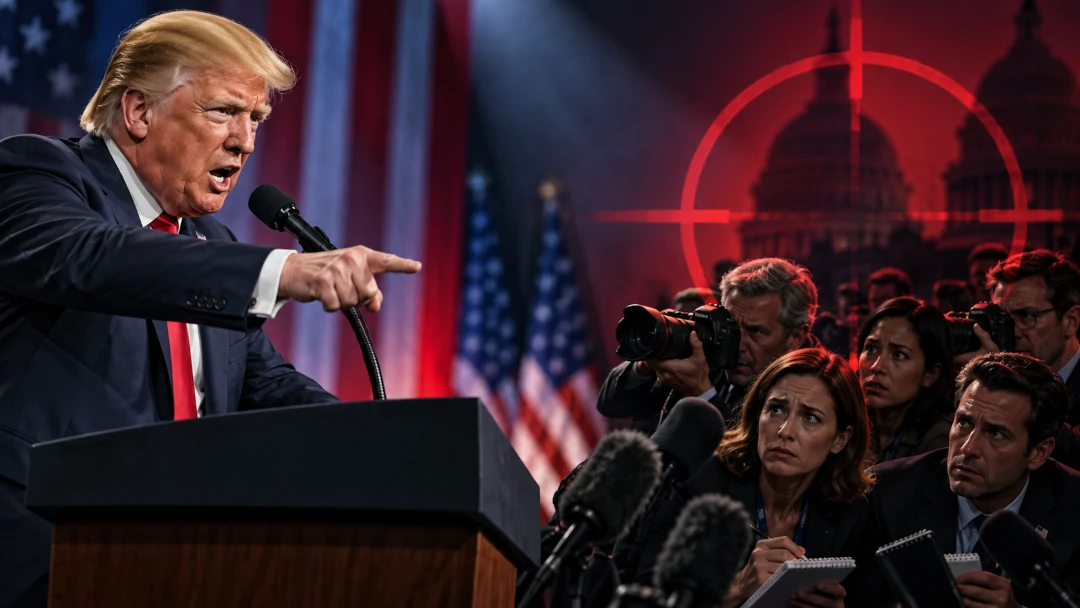
At an Arizona rally, the President of the United States said people who leak to the press deserve to be shot, then turned and pointed at the reporters in the room. It was not a slip. It is the loudest expression yet of a strategy that runs through polygraphs, subpoenas, a home raid, fired watchdogs and a proposed gag agreement for the entire federal workforce, all while the administration faces the most serious corruption questions in modern presidential history.
The words came on Wednesday night at Laughlin/Bullhead International Airport, where President Trump was campaigning for Rep. Andy Biggs. Describing a strike on Iran that he said had to be delayed because its timing reached the press, the president told the crowd that, in his view, leakers deserve the ultimate penalty. As The Hill reported, he went further: They ought to go to jail and be shot.
The Washington Post recorded him calling leakers the scum of the earth.
Then he gestured at the press pen. According to TIME’s Chad de Guzman, the president told the crowd that the journalists covering him were nearly as bad as leakers, because in his telling they spread false information and that makes them leakers too. In a single breath, the commander in chief endorsed killing government employees who talk to reporters and then widened the circle to include the reporters themselves.
“In my opinion, leakers should be shot.”
— President Donald Trump, Bullhead City, Ariz., Oct. 14, 2026 — via TIME
We take seriously that some leaks are genuinely dangerous. Revealing the departure time of an aircraft on a combat mission is not whistleblowing, and the people responsible for operational security have every right to investigate it through lawful means. But a president does not need to call for executions to protect a mission. He needs that rhetoric only if the goal is something else: to make every civil servant who has seen something wrong think twice before telling anyone.
I. A Long Record, Selectively Applied
None of this is new. TIME’s review of Trump’s record shows him floating the death penalty over WikiLeaks’ 2010 release of military documents, calling Edward Snowden a spy who deserved execution, and, in 2019, telling staff at the U.S. mission to the United Nations that whoever gave information to the Ukraine-call whistleblower was close to a spy, adding that the country used to deal with such people differently.
The same reporting documents the other half of the record. In 2016, Trump celebrated WikiLeaks’ publication of stolen Democratic emails at rally after rally and publicly invited Russia to find Hillary Clinton’s missing emails. He even suggested he could warm to Snowden if Snowden produced Barack Obama’s birth records. The principle has never been secrecy. It is control. Leaks that wound his opponents are welcome; leaks that expose him are treason.
II. The Leaks This Administration Is Running From
Look at which disclosures have triggered the most aggressive responses, and a pattern emerges. They are rarely about troop movements. Overwhelmingly, they are stories that embarrassed the administration, contradicted its public claims, or raised questions about competence and self-dealing.
The Iran Damage Assessment
After the June 2025 strikes on Iran’s nuclear sites, a leaked preliminary Defense Intelligence Agency report found the facilities were less damaged than the White House claimed, TIME notes. That leak contradicted the president, not the mission.
The Munitions Shortage
Reporting that the Iran war had drained stockpiles of long-range missiles and Patriot interceptors set off the largest polygraph sweep in the Pentagon’s modern history, The New York Times reported.
Pentagon Leadership Turmoil
Leak probes have repeatedly followed coverage of Defense Secretary Pete Hegseth’s leadership, even as he faced criticism for sharing sensitive strike details in a Signal group chat, the Times reported.
The Federal Workforce Overhaul
The reporter whose home the FBI searched in January had built hundreds of sources among federal workers alarmed by the administration’s overhaul of their agencies, according to The New York Times.
The Crypto Windfall
Trump’s own financial disclosure showed more than $1 billion in family earnings, largely from crypto ventures. Former Bush ethics lawyer Richard Painter told NPR the president stands alone in having such substantial financial conflicts of interest.
“Pay-to-Play” Profits
House Oversight Democrats led by Rep. Robert Garcia estimated $2.25 billion in realized profits from foreign and digital-asset dealings, calling it a new highwater mark for corruption. The White House denies any conflicts.
An administration confident in its own conduct would welcome sunlight. An administration facing this volume of corruption questions has every incentive to make sure the next person who discovers a self-dealing contract, a doctored briefing, or an unlawful order stays quiet. That is what a chilling effect is, and it is precisely what a presidential call to shoot leakers is engineered to produce.
III. Beyond the Rhetoric: The Machinery of Fear
If the rally remark stood alone, it might be dismissed as bluster. It does not stand alone. Over twenty months the administration has built a layered apparatus aimed at the people who might speak and the journalists they might speak to.
- January 24, 2025
Trump fires at least 17 inspectors general, the independent watchdogs who receive whistleblower complaints, CBS News reported. - February 7, 2025
The head of the Office of Special Counsel is fired by email. Hampton Dellinger led the very agency that protects federal whistleblowers from retaliation. He later told 60 Minutes:I don’t think we have watchdog agencies anymore.
- March 21, 2025
The Pentagon opens a leak probe that authorizes polygraphs. Months later, the White House reportedly halted Hegseth’s polygraph effort after a Trump-loyal adviser complained he might be targeted, per The Washington Post’s reporting. - April 25, 2025
Attorney General Pam Bondi rescinds protections for reporters, reopening the door to subpoenas, court orders and search warrants against journalists in leak cases. Her memo, obtained by NPR, declared:This conduct is illegal and wrong, and it must stop.
- October 2025 – March 2026
The Pentagon demands reporters sign a pledge not to publish unauthorized material. Most of the press corps refused, and Judge Paul Friedman struck the policy down as unconstitutional in a case brought by The New York Times, Axios reported. - January 14, 2026
FBI agents search the Virginia home of Washington Post reporter Hannah Natanson and seize her phone, laptops and watch, though the Post was told she was not a target, the Times reported. - May 26, 2026
OPM proposes a government-wide nondisclosure agreement for federal workers, the latest step in the crackdown on leaks to journalists, Bloomberg Law reported. - June 2026
Justice Department subpoenas reporters at the Wall Street Journal and Washington Post over national security stories, then withdraws them after the papers pushed back, per TIME. - August 2026
Mass polygraphs hit the Joint Staff. Members of the military’s top coordinating body were tested over the munitions-shortage stories. The Times reported that mass polygraphing of the military’s top ranks had never happened before. - October 14, 2026
The president says leakers should be shot and lumps the reporters covering him in with them.
The Natanson search deserves particular attention. Even the Obama administration, which pursued leakers aggressively, stopped short of raiding a reporter’s home. Bondi publicly accused Natanson of obtaining illegally leaked information even as the Post was told she was not a target. Press-freedom advocates were unequivocal.
“Searches of newsrooms and journalists are hallmarks of illiberal regimes.”
— Jameel Jaffer, Knight First Amendment Institute — via The New York Times
IV. The NDAs: Then and Now
Trump has used nondisclosure agreements as a weapon against criticism for decades, and he brought the habit into government. During his first term, senior White House staff were reportedly asked to sign NDAs after he grew angry about leaks. The ABA Journal noted that, according to the Times, White House counsel Don McGahn drafted them to placate the president and told signers the terms could not be enforced. Obama-era ethics chief Norm Eisen questioned whether they were constitutional at all.
When former aide Omarosa Manigault Newman published a tell-all book in 2018, the Trump campaign pursued arbitration under her 2016 campaign NDA. Federal-employment lawyer Bradley Moss told NPR at the time that the government does not bind former employees to secrecy about unclassified information, and that letting a campaign contract reach a White House job would sidestep four decades of First Amendment case law. He called the move a warning shot to everyone else in Trump’s orbit.
The courts eventually agreed that Trump’s gag contracts went too far. In 2021, U.S. District Judge Paul Gardephe, a George W. Bush appointee, declared the campaign’s standard NDA invalid and unenforceable in a case brought by former staffer Jessica Denson, finding it vague, unlimited in time, and so broad that no worker could know what speech it covered. Protect Democracy, which represented Denson, said the ruling ended the campaign’s years-long effort to silence her.
Now the idea has gone government-wide. OPM Director Scott Kupor has argued that federal employees should sign confidentiality agreements the way private-sector workers routinely do, and OPM says the form would not override whistleblower rights. Skeptics are not reassured. American Federation of Government Employees president Everett Kelley doubts agencies will truly treat the NDA as optional, Bloomberg Law reported. A related 2025 OPM rule already ties compliance with nondisclosure duties to whether an employee is deemed suitable to keep their job.
Get Involved Today
Contribute to our mission and turn your concerns into action.
V. What the Law Actually Says
The president’s rhetoric collapses a crucial distinction the law draws carefully: the difference between leaking and whistleblowing.
Leaker, Whistleblower, Citizen: Where the Lines Fall
The First Amendment
The Anti-Gag Provision, 5 U.S.C. § 2302(b)(13)
Classified Information
Are the NDAs Enforceable?
Nothing in American law authorizes shooting anyone for talking to a reporter. A whistleblower who reports a crime to an inspector general is doing exactly what Congress asked of them. When the president describes all such people as leakers who deserve death, he is not describing the law. He is trying to overwrite it in the minds of the people it protects.
VI. Congress: Who Is Protecting Whom
Democrats moved early. In February 2025, Senate Democratic Leader Chuck Schumer and Sen. Gary Peters, then ranking member of the Homeland Security Committee, opened a whistleblower portal for federal workers to report wrongdoing and abuse of power, pledging demand letters, records preservation and litigation. Whistleblower Aid CEO Libby Liu welcomed it and warned that the administration had made silencing whistleblowers a top priority. In the House, Rep. Robert Garcia’s Oversight Democrats have built a running public record of the family’s profits.
The most important ally whistleblowers have in the majority is Grassley, who has defended them for nearly four decades. In March he introduced the Whistleblower Anti-Gag Act of 2026, and in June he pressed OPM to fix its draft NDA. That is to his credit. But one senator’s letters are not oversight. The Republican majority has largely let the IG firings, the polygraph sweeps, and the Natanson raid pass without hearings, and has offered no rebuke for a president calling for leakers to be shot. Silence from those with subpoena power is its own form of complicity.
VII. What This Means for the Average American
It is tempting to treat this as a Washington insider fight. It is not. Nearly everything the public has learned about government failure in the past two years, from shortages of the weapons that defend American troops to the gap between official boasts and intelligence findings, reached us because someone inside chose to speak. When those people are polygraphed, threatened, bound by gag contracts and told they deserve to be shot, the stories stop. The waste continues. The self-dealing continues. You just stop hearing about it.
The chilling effect also reaches far beyond Washington. There are millions of federal employees and contractors, and they are veterans’ benefits processors, food inspectors, air traffic staff and Social Security clerks. If they learn that reporting a problem can cost them their job or worse, the safety failures they see go unreported. And when the president casts reporters as nearly as bad as leakers, he is telling every American that the institutions meant to inform them are enemies. A public that cannot learn what its government is doing cannot hold it to account at the ballot box.
VIII. What You Can Do
If you work in or alongside government and believe you have witnessed corruption or illegal activity, the law still offers real protection, but only if you use it carefully. If you are an ordinary citizen, you still have levers. Here are the main options, in plain language.Write it down, then report it through a protected channel
Record dates, names, documents and what you personally observed. Report to your agency’s inspector general, the U.S. Office of Special Counsel, or a member or committee of Congress. These are the channels federal law explicitly protects from retaliation.
Talk to a whistleblower lawyer before you act
Nonprofits such as Whistleblower Aid and the Government Accountability Project advise federal employees, often at no cost. A lawyer can tell you which disclosures are protected, how to preserve evidence lawfully, and how to file a retaliation complaint if you are punished.
Protect yourself digitally
Never use a government phone, laptop or network to contact a lawyer, a congressional portal or a reporter; Whistleblower Aid gives this exact advice. Assume government devices are monitored.
Know the classified line
Never give classified material to the press or paste it into a web portal. Classified concerns go to an inspector general or the intelligence committees, through counsel. Staying on the right side of this line is what keeps you protected.
If you are a private citizen, apply pressure
Call your senators and representative. Ask whether they support the Whistleblower Anti-Gag Act, whether they will demand hearings on the Joint Staff polygraphs and the Natanson raid, and whether they will publicly condemn the call to shoot leakers. Support the independent newsrooms and press-freedom groups fighting subpoenas in court.
An honest assessment: these protections are weaker than they were two years ago. Inspectors general were purged, the Office of Special Counsel’s leadership was replaced, and the OPM agreement is still pending. Retaliation remains illegal, but enforcement depends on watchdogs this administration has hollowed out. That is precisely why documentation, legal counsel and congressional channels matter more now, not less.
IX. What This Says About Trump’s Priorities
A president’s priorities show in where he spends his anger. This one has not called for anyone to be shot over the munitions shortfall itself, over a defense secretary sharing strike details in a group chat, or over billions in crypto profits flowing to his family while his administration rewrote crypto enforcement. His fury is reserved for the people who told the public about those things.
That is the inversion at the heart of this presidency. The wrongdoing is treated as normal and the disclosure is treated as the crime. Leadership in a democracy means accepting that the public is entitled to know when its government fails. Trump’s leadership treats the public’s knowledge as the threat, and loyalty as the only virtue worth protecting.
Editorial Conclusion
A president who says the people who expose government secrets should be shot, and then points at the free press, has told the country exactly what he fears. It is not foreign enemies. It is accountability.
Congress must pass the Whistleblower Anti-Gag Act, hold hearings on the polygraph sweeps and the raid on a reporter’s home, restore independent inspectors general, and put on the record that no American will be threatened with death for telling the truth about their government. The First Amendment and the whistleblower laws exist so that power answers to the people. A government that silences its own witnesses has stopped answering to anyone.
Sources & References
- TIME — Trump Says Leakers ‘Should Be Shot’ and Rails Against Media at Rally
- The Hill — Trump says leakers should be shot: ‘They’re the scum of the earth’
- The Washington Post — Trump says people who leak military plans ‘should be shot’
- The New York Times (via Honolulu Star-Advertiser) — In major leak hunt, Pentagon gives polygraph tests to Joint Staff members
- Anadolu Agency — White House stops defense chief’s polygraph tests on media leakers
- NPR — Justice Department revokes Biden-era protections for reporters in leak investigations
- The New York Times (via West Hawaii Today) — FBI searches Washington Post journalist’s home in national security probe
- Axios — Judge blocks Pentagon’s restrictive press access policy
- Bloomberg Law — Trump Takes Aim at Press Leaks With NDAs for Federal Workers
- Whistleblower Network News — Grassley Warns OPM’s Proposed NDA Could Chill Federal Whistleblowers
- GovInfo — S. 4099, Whistleblower Anti-Gag Act of 2026
- Protect Democracy — Jessica Denson Wins Major Victory Over Trump Campaign
- ABA Journal — Trump says Omarosa had a nondisclosure agreement; would it be enforceable?
- NPR — Trump Campaign Files Complaint Against Omarosa Manigault Newman
- CBS News / 60 Minutes — Fired watchdog Hampton Dellinger on the loss of independent oversight
- Whistleblower Aid — Silencing Whistleblowers a Top Trump Priority
- Cornell Legal Information Institute — Garcetti v. Ceballos, 547 U.S. 410 (2006)
- Senate Democrats — Schumer, Peters Announce New Portal For Whistleblowers
- House Oversight Democrats — Garcia Releases Report on Trump Family Corruption
- NPR (via KMXT) — Former ethics lawyer says Trump’s crypto poses ‘clear conflict of interest’
Related News