A Government of Grievance
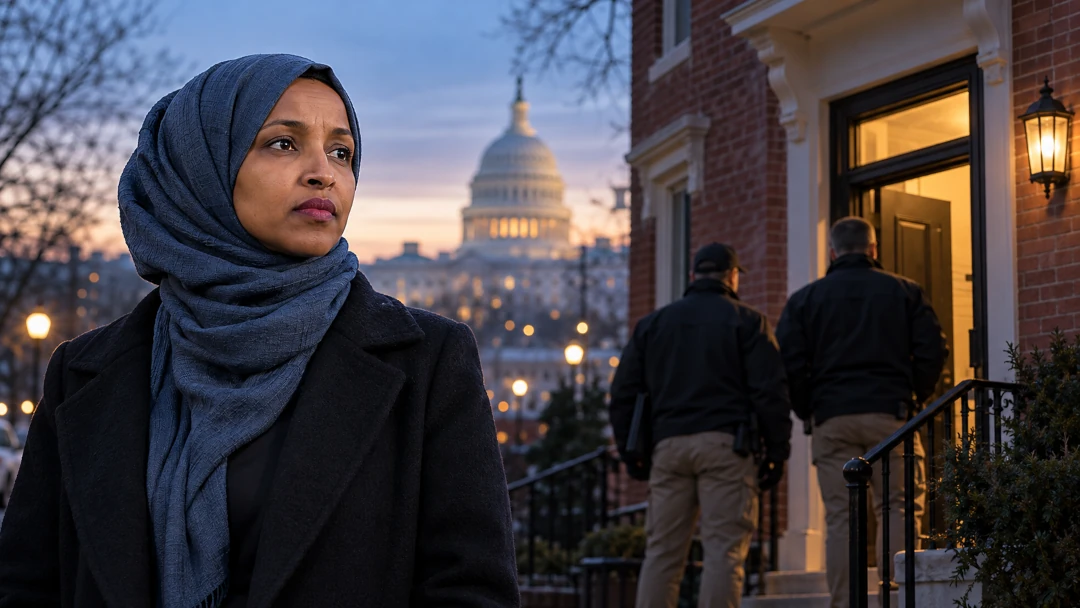
Federal agents have searched Ilhan Omar’s home, bringing the administration’s pursuit of a fierce presidential critic to her doorstep. A court-authorized warrant deserves scrutiny, not dismissal—but it does not erase the surrounding record of political threats. The question reaches far beyond one congresswoman: whether Americans can oppose their president without fearing the machinery of their own government.
The government has an extraordinary advantage over anyone it investigates: it can compel records, enter a home with judicial authorization, and force a person to defend a reputation before any jury hears a case. Those powers exist to enforce the law. When they appear to follow a president’s enemies list, the damage extends beyond the person whose door agents approach.
On October 12, Homeland Security Investigations agents searched Rep. Ilhan Omar’s Washington, D.C., home. The Justice Department said it had secured a judicially authorized warrant in an ongoing federal criminal investigation. NBC Washington’s reporting with the Associated Press confirmed the search and noted that DOJ’s statement itself did not identify Omar.
The progressive case for accountability must begin with accuracy. Omar is entitled to the presumption of innocence. A search establishes neither guilt nor, by itself, political retaliation. But the administration’s public campaign against her makes this an urgent test of whether federal law enforcement is serving the country or servicing Donald Trump’s grievances.
Reporting cutoff: October 12, 2026. The evidence supporting the warrant and the investigation’s full scope were not established in the sources reviewed for this article. Allegations, officials’ explanations, and this editorial board’s conclusions are identified separately.
I. What the warrant does—and does not—tell us
Reuters reported, citing a person familiar with the investigation, that the inquiry concerns alleged immigration fraud, including childhood paperwork completed by Omar’s late father. It also reported consultation with DOJ’s Public Integrity Section and acting Deputy Attorney General Trent McCotter before the search. Those are reported procedural steps, not public proof of the underlying allegations.
Judicial authorization matters. The Fourth Amendment’s probable-cause requirement is a safeguard against arbitrary searches. Yet the standard for searching a place for evidence is different from proof beyond a reasonable doubt. Nor does a judge’s approval of a warrant necessarily resolve whether executive officials selected a target or timing for improper political reasons.
A responsible response demands the lawful basis, the approval process, and an explanation of urgency. It does not demand publication of every sensitive investigative detail. Transparency can accommodate legitimate redactions and confidential congressional review; it cannot mean accepting political insinuation as evidence.
Established
HSI carried out the search, and DOJ described a judicially authorized warrant. That is the confirmed enforcement action. NBC Washington / AP.
Disputed allegations
Administration figures have promoted immigration-fraud allegations that Omar denies. Their assertions must not be converted into findings of fact. MPR News / AP.
Political direction remains unproven
The AP reported that Trump denied involvement. The search’s political context warrants scrutiny, but this article does not establish that he personally ordered it. Associated Press.
II. The target came before the public evidence
The most troubling context is the administration’s own language. AP reporting carried by MPR News describes Vice President JD Vance asserting, without offering evidence, that Omar committed immigration fraud and discussing possible remedies with deputy White House chief of staff Stephen Miller. Omar’s office rejected those accusations. Publicly announcing a conclusion while discussing how to build the case reverses the discipline Americans should expect from government.
“I will not be silenced.”
— Rep. Ilhan Omar · October 12 · Reported by People
The search also arrived 22 days before the November 3 election. DOJ’s Justice Manual, Section 9-85.500, forbids choosing investigative timing to advantage or disadvantage a candidate or party. That prohibition turns on purpose; proximity to an election does not automatically prove a violation. It does, however, make the need for an explanation especially acute.
This is why the defense that nobody is above the law is insufficient. Nobody is beneath its protection, either. Equal justice requires investigating credible evidence through consistent standards—not announcing an adversary’s guilt and then searching for a way to establish it.
III. Democrats have spoken. Accountability needs machinery.
House Democratic Leader Hakeem Jeffries, Whip Katherine Clark, and Caucus Chair Pete Aguilar issued a joint statement condemning the search, questioning the weaponization of government, and promising transparency and accountability. That is a significant leadership response. It is also a promise whose value depends on what follows.
Rep. Jamie Raskin, the ranking Democrat on the House Judiciary Committee, went further in a separate statement: he described the search as political intimidation and said committee Democrats would demand information about who authorized and conducted it. Raskin also alleged a violation of DOJ’s pre-election practice. His assessment is a lawmaker’s accusation, not a judicial determination.
As of this article’s reporting cutoff, those statements do not establish that Congress has compelled documents, held an Omar-specific hearing, or enacted a restraint on the agencies involved. Condemnation is the documented response; effective oversight remains the obligation.
Democrats should seek preservation of relevant communications, a written account of the authorization chain, and testimony addressing election timing and any White House contacts. Those are this editorial board’s recommendations. Appropriate protections for grand-jury material and investigative evidence should accompany oversight rather than become an excuse to abandon it. Republicans should support the same safeguards: powers tolerated against the other party can eventually be used against their own.
IV. A pattern broader than one doorstep
The cases are legally different. Some involve allegations that require serious examination. Their common thread is the collision between public presidential hostility and government pressure on the people who crossed him.
Get Involved Today
Contribute to our mission and turn your concerns into action.
The editorial conclusion is not that every adversary must be innocent. It is that a president’s animosity must never determine whose life the federal government turns upside down. The documented reach—from prosecutors and elected officials to lawyers and an independent central bank—supports concern about a governing style organized around retaliation.
“This is about whether the Fed will be able to continue to set interest rates based on evidence and economic conditions”
— Jerome Powell · January 11, 2026 · Federal Reserve statement
V. The chilling effect reaches ordinary Americans
The practical danger is easy to understand without pretending that every critic faces a search warrant. A public employee may think twice about documenting misconduct. A small nonprofit may wonder whether criticizing immigration enforcement invites scrutiny. A lawyer may calculate whether representing an unpopular client risks government business. These are foreseeable chilling effects of the pattern described above, not findings that each hypothetical person has already been targeted.
A wealthy or prominent defendant may have access to experienced counsel. An ordinary family can face lost work, uncertainty, and legal bills simply trying to respond. The fear can do political work before a prosecution succeeds: keep quiet, stay away, stop organizing.
That is the democratic injury. Constitutional rights become fragile when exercising them feels financially or personally unaffordable. The costs also reach people who never confront an agent: public institutions lose credibility when their decisions appear to reflect loyalty rather than evidence.
VI. America’s standing is part of the damage
Using state power to intimidate opposition is an authoritarian practice. Calling it “third-world” behavior captures the anger but assigns the problem to geography. The meaningful distinction is between accountable government and personal rule. No nation is immune, and no American flag makes retaliation democratic.
The international consequence is a credibility problem. A government that demands respect for dissidents abroad while threatening critics at home weakens the moral force of its own arguments. Partners have reason to question the durability of American commitments when independent institutions appear vulnerable to presidential displeasure. This is an assessment of the likely diplomatic damage—not a claim that the Omar search has already caused a particular ally to break relations.
America separates itself from democratic partners whenever it treats dissent as disloyalty. The country’s standing rests less on declarations of greatness than on whether its government accepts limits when those limits protect someone the president dislikes.
The Constitution / Dissent, equal protection, and limits on executive power
Using federal enforcement to punish a presidential critic strikes at the constitutional protections that make opposition possible. The central issues here are freedom of speech, equal protection, the security of the home, and the independence of Congress. The public record raises serious questions under each; it does not yet establish a court finding that this search violated them.
The First Amendment: political dissent cannot become a criminal target. Criticizing the president is protected speech. As the Supreme Court explained in Hartman v. Moore, government officials generally may not retaliate against people for speaking out, including through criminal prosecution. If officials used this investigation to punish Omar’s criticism, that would implicate the First Amendment’s prohibition on retaliation. Proving a legal claim requires evidence of causation and satisfaction of the applicable legal standards; Hartman also requires absence of probable cause for the retaliatory-prosecution claim it addressed. A search is not itself a prosecution, and its legal analysis must reflect that distinction.
The Fourth Amendment: a home is not a presidential pressure point. The Fourth Amendment requires probable cause and a warrant identifying the place to be searched and things to be seized. DOJ says a judge authorized this search. That is meaningful protection, but it does not preclude a challenge to the warrant’s factual basis, scope, or execution. The available reporting does not establish that any of those requirements was breached. Political hostility alone does not automatically invalidate an otherwise lawful search.
The Fifth Amendment: federal power must not be applied discriminatorily. The Fifth Amendment’s equal-protection component binds the federal government. In United States v. Armstrong, the Supreme Court explained that selective-prosecution claims require discriminatory purpose and discriminatory effect. If enforcement singles someone out because of race, religion, or the exercise of protected rights, constitutional scrutiny is essential. Omar’s identity and the administration’s rhetoric warrant examination; they do not alone establish the required discriminatory treatment.
Article I: Congress must be able to challenge the executive. The Speech or Debate Clause protects legislative acts from executive and judicial interference. It does not give lawmakers blanket immunity for unrelated conduct, including alleged immigration offenses. If investigators seek protected legislative material or use legislative acts against Omar, the privilege becomes a concrete issue. Her status as a member of Congress does not, by itself, make the search unconstitutional.
Article II: presidential authority carries constitutional duties. If evidence establishes that a president directed enforcement to punish lawful opposition, Congress must confront that abuse through oversight and, where warranted, impeachment. The constitutional history of impeachable offenses places abuse of office at the center of that remedy. DOJ’s election-timing policy is a separate institutional safeguard; violating it would not automatically establish a constitutional violation.
A president’s priorities are visible in where power is directed. This pattern suggests an administration too willing to turn public authority toward private grievance. Government should protect the public, administer justice impartially, and solve shared problems. Making critics defend themselves against the state is a profound diversion from that responsibility.
X. What You Can Do
No precaution guarantees protection from abusive enforcement. But preparation, competent legal help, and collective accountability give Americans more options than fear alone.
- Know what to say if agents contact you. The ACLU’s guidance explains the right to remain silent and the importance of consulting counsel. State clearly that you want to remain silent and speak with a lawyer. Do not lie. Identification and immigration-document obligations can vary; get advice appropriate to your circumstances. A subpoena requires prompt legal attention.
- Understand the document at your door. Ask to see a warrant and contact counsel. ACLU guidance on officials entering private areas explains the importance of a judge-signed warrant and exceptions such as emergencies. An immigration administrative warrant generally does not itself authorize entry into a home without consent. Do not physically obstruct agents; state any lack of consent and let counsel contest unlawful conduct.
- Preserve an accurate record. Keep notices, relevant messages, and a contemporaneous account of what happened. Do not destroy evidence or alter records. When lawfully present in public, document agents from a safe distance without interfering. The ACLU recommends recording identifying details and witnesses; local recording rules and personal risks deserve attention.
- Build access to help before a crisis. Identify a lawyer, local legal-aid organization, or civil-rights group that handles the relevant issue. Help support legal-defense capacity and independent reporting. Families and organizations should have an emergency contact plan. Resources vary, and civil or immigration matters do not carry the same appointed-counsel guarantees as criminal prosecutions.
- Demand specific oversight and stay civically present. Ask your representatives whether they will seek authorization records, insist on election-neutral enforcement, and protect independent legal representation. Attend public meetings, organize peacefully, and vote. Measure lawmakers by the records they obtain and safeguards they pursue—not merely by statements expressing concern.
Editorial Conclusion
Federal law enforcement belongs to the American people, not to a president’s grievances. Congress must investigate credible evidence of retaliation, courts must enforce constitutional limits, and citizens must defend the right to dissent. Equal justice requires a government that can investigate wrongdoing without turning opposition into an offense.
Sources & References
- NBC Washington / Associated Press — Federal agents search Omar’s Washington home.
- Reuters — Search, reported immigration inquiry, and DOJ approval process.
- MPR News / AP — Omar’s response and Vance’s prior allegations.
- Associated Press — Omar search, political reaction, and Trump’s denial of involvement.
- People — Omar says she will not be silenced.
- House Democratic Leadership — Joint Jeffries, Clark, and Aguilar statement.
- House Judiciary Democrats — Jamie Raskin’s statement on the search.
- Department of Justice — Justice Manual §9-85.500, election-sensitive actions.
- House Judiciary Republicans — Jim Jordan’s August 2023 Willis inquiry.
- Congress.gov — March 2024 letter concerning the Willis grant-records subpoena.
- Reuters — September 2025 report of DOJ seeking Willis travel records.
- Reuters — September 2026 appeal concerning Comey and Letitia James prosecutions.
- White House — March 2025 executive order targeting Perkins Coie.
- Reuters — Judge strikes down Perkins Coie order.
- Federal Reserve — Jerome Powell’s January 11, 2026 statement.
- Cornell Legal Information Institute / Constitution Annotated — Probable cause.
- Library of Congress — Historical background on impeachable offenses.
- Library of Congress — Twenty-Fifth Amendment overview and text.
- ACLU — Law-enforcement questioning and the right to remain silent. Also: officials at your home or workplace.
- ACLU — Police encounters, documentation, and practical safety.
Related News