Guns at the Ballot Factory: Armed Contractors Move Into America’s Mail Plants
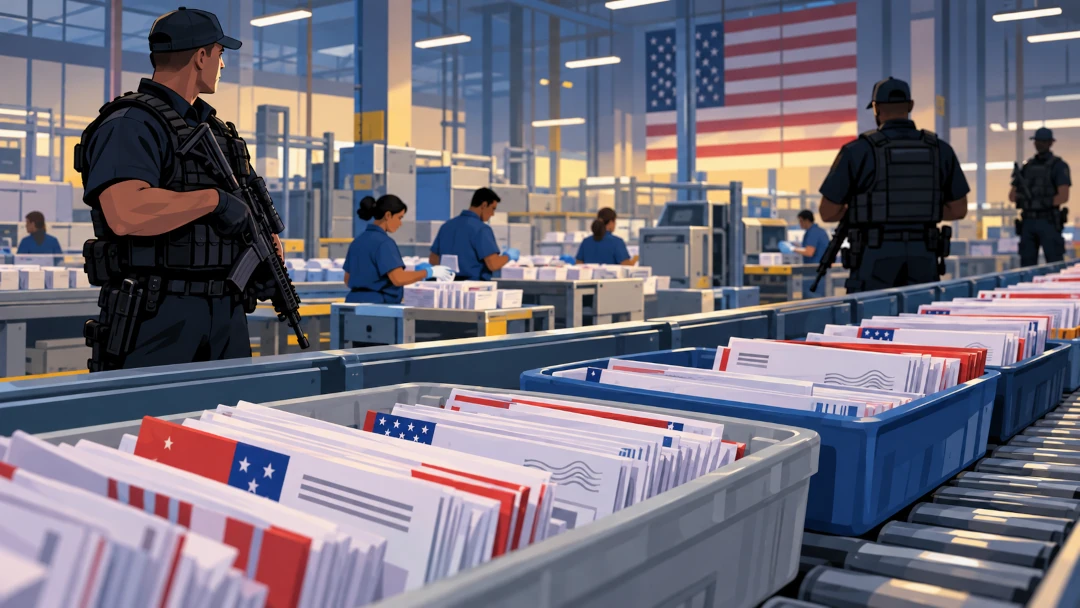
Weeks before the midterms, the Postal Service has quietly stationed nearly 1,000 privately employed armed guards inside the processing centers that will carry tens of millions of ballots. The agency swears it has nothing to do with the election. The timing, the map, the contractor, and the man in the White House say otherwise.
There is a particular kind of building that matters more than almost any other in a vote-by-mail democracy: the regional processing and distribution center, the cavernous plant where outgoing ballots to voters are sorted and returned ballots back to county clerks are sorted. This fall, according to reporting first amplified by The New Republic and built on a Raw Story investigation, nearly 1,000 armed security officers have been deployed to at least 55 of those Postal Service facilities across the country. They do not work for the Postal Service. They work for Prosegur, a Spanish multinational security firm whose record abroad includes allegations of human rights and labor abuses and a price-fixing prosecution in Chile.
The Postal Service’s answer is that this is routine. Its spokesperson told The New Republic the deployments have been underway since last year, are unrelated to elections, and mirror the guard posts at hospitals, schools, and other government buildings. Maybe so. But no democracy should have to take that on faith — not from an administration whose president has spent six years attacking mail voting, whose executive order tried to hand the Postal Service gatekeeping power over ballots, and whose loudest outside allies are now openly urging him to declare martial law around November 3.
I. What Was Deployed — and How Fast
The scale is the first thing to understand. Frank Albergo, who leads the Postal Police Officers Association, told Raw Story in July that his union had been notified of roughly 39,000 weekly work hours approved for 972 full-time armed guards across 54 facilities — 18 of which had never had armed guards before. By October, Raw Story’s count had grown to at least 55 sites. (Reporting has used both figures; the direction of travel is not in dispute.)
The guards replaced nothing that was broken. For six years, the Postal Service has been locked in a fight with its own sworn Postal Police Officers — federal employees with statutory law-enforcement powers inside the Postal Inspection Service chain of command — after the agency confined them to postal property and pulled them off the streets where robberies of letter carriers were surging. Albergo has argued that the agency is now backfilling the officers it benched with lightly trained private contractors, noting that armed-guard training standards vary wildly by state and, per a CNN and Center for Investigative Reporting review he cited, some states require no firearms training at all.
The Contractor
Prosegur, founded in Spain 50 years ago, has faced accusations in Latin America of labor and human-rights violations and threats against union workers; a Norwegian pension-fund ethics review flagged its Brazilian subsidiary in 2024. Prosegur told Raw Story it could find no incidents matching the allegations raised.
The Scale
972 full-time armed guards and about 39,000 weekly hours at 54–55 facilities, concentrated at plants with roughly 1,000 or more employees, according to the postal police union as reported by Raw Story.
The Cost
The expansion adds tens of millions in yearly labor costs at an agency that reported $2.5 billion in net losses in a single quarter this year — which even Albergo concedes could be plain incompetence rather than strategy.
The Official Line
The Postal Inspection Service says the guards deter criminals or employees who might compromise the mailstream, refuses to disclose locations for “operational security,” and calls it a multi-year plan not tied to any threat, per Scripps News.
II. Where They Went: Blue, Swing — and Not Only Those
The Postal Service will not publish its list. What we know comes from internal memos obtained by Raw Story and from local reporting. One postal contractor and researcher, Claire McKean, told Raw Story she grew alarmed watching the guards appear predominantly in what The New Republic quoted her calling “deep blue states or swing states.” The named locations bear her out — with an important caveat honest readers deserve.
| Facility Area | State | 2026 Profile |
|---|---|---|
| Atlanta | Georgia | Battleground |
| Phoenix | Arizona | Battleground |
| Charlotte-area processing center | North Carolina | Battleground |
| Chicago & Carol Stream | Illinois | Blue |
| Denver | Colorado | Blue · all-mail state |
| San Diego | California | Blue · lead plaintiff state |
| Indianapolis | Indiana | Red |
| Tampa | Florida | Red |
Sources: Raw Story internal memos; Scripps/Denver7; APWU Charlotte local. The full list of 55 sites has not been disclosed.
Get Involved Today
Contribute to our mission and turn your concerns into action.
Two of the named sites sit in Republican strongholds, so this is not a clean partisan map. But the pattern still matters: the deployments track the nation’s biggest metropolitan mail plants — the ones processing the ballots of the most Democratic, most diverse electorates — plus the three battleground states where a few thousand ballots can decide a Senate seat. Jim Bjork, a former Postal Police union president, noted to Raw Story that the sworn officers being sidelined are overwhelmingly people of color working in big-city facilities. And in Colorado, which votes almost entirely by mail, the guards arrived less than a week after the Supreme Court blocked the administration’s mail-ballot rule and less than two weeks before ballots hit mailboxes.
III. Their Orders — on Paper and in Practice
According to a memo distributed to American Postal Workers Union members and first reported by Colorado Public Radio, the guards are to watch entrances and parking areas, check IDs, and observe and report anything suspicious. The same memo, as described by Scripps News, says they will not make arrests, handle or process mail, supervise postal employees, or conduct investigations.
That is reassuring until you read the other paperwork. A September memo about the Carol Stream plant outside Chicago, obtained by Raw Story, describes the contract guards as federal law enforcement officers, and a 2024 scope-of-duty document says they carry arrest authority where state law allows. Miriam Bell, president of the Charlotte-area postal workers’ local, told Raw Story the guards who were supposed to patrol parking lots are now stationed inside, and that her local has filed complaints — including one alleging a guard shoved a worker to the ground and punched her. Two sets of rules, one set of guns. Voters are entitled to know which set governs.
“You basically have private contractors in and around ballots without any federal control.”
— Frank Albergo, Executive Director, Postal Police Officers Association, to Raw Story
IV. Who Actually Controls Them
On paper, the chain runs like this: the Postal Inspection Service oversees the Prosegur contract, and postal officials decide where guards go and what they do. Above them sits Postmaster General David Steiner — the former Waste Management CEO whom Colorado Secretary of State Jena Griswold has publicly branded a Trump loyalist, and who told the Senate in June that, under his agency’s proposed rule, the Postal Service would refuse to carry mail ballots for states that declined to hand over voter manifests.
On the ground, the answer is murkier. Albergo’s warning is that no postal employee supervises the guards day to day; they answer to a private company. Bjork offered Raw Story the darker version of the same point: a sworn federal police force has accountability that would make its officers balk at any funny business involving ballots, while a contractor can simply be disavowed afterward. Albergo has even floated the scenario of an executive order requiring American firms to run federal security — leverage, he suggested, that would bend a foreign contractor to the White House’s will. No such order exists. But the fact that the people who guarded these buildings for decades are gaming it out tells you how thin the public’s assurances have become.
The Law Bans “Armed Men” at the Polls. A Mail Plant Is the Loophole.
Article I, § 4 — The Elections Clause
18 U.S.C. § 592 — Troops at Polls
The Gap
V. The Real Reason? What the Reporting Shows
No reporting to date shows the guards have been ordered to touch a ballot. Fairness requires saying so plainly. The Postal Service’s denial is on the record; Albergo himself told Raw Story never to ascribe to malice what incompetence can explain. But he added, in the same breath, that a larger strategy was entirely conceivable — and that the deeper harm is perception: armed contractors in ballot plants hand Trump a ready-made excuse to question the results.
That is the most plausible reading of the evidence: not a plan for armed men to seize ballots, but a plan to make the count look contested. Political scientist Mark Ungar of John Jay College, who studies private security firms like Prosegur, told Raw Story the administration is plainly using every lever to control voting, the Postal Service among them. Put the pieces side by side and the picture sharpens: an executive order to federalize the voter list; a postal rule to withhold ballot delivery from uncooperative states; a Postmaster General willing to defend it; armed, privately controlled personnel inserted at the ballot chokepoint; and a president who, as ABC News documented this week, still insists vote-by-mail is riddled with cheating while voting by mail himself and telling Republicans to do it because “we seem to have no choice.”
Trump signs an executive order directing federal agencies to police mail voting and build a federal list of eligible voters.
Senate Democrats introduce the Protect Our Polls Act after Republicans block two amendments banning troops at the polls.
Postmaster General Steiner tells senators USPS would withhold ballot delivery from states that refuse to provide voter manifests under the proposed rule.
Raw Story reveals 972 armed contract guards approved for 54 facilities; postal workers hold a National Day of Action in Denver.
Courts whipsaw: the Supreme Court first lets the order proceed, then refuses to revive the USPS ballot rule for November.
Armed guards appear at Denver’s largest sorting plant days before Colorado ballots mail; The Atlantic reports Trump allies urging martial law.
Raw Story and The New Republic report at least 55 facilities now hosting nearly 1,000 armed Prosegur guards.
VI. The Martial Law Chorus
This deployment does not land in a vacuum. In late September, reporting from The Atlantic described a circle of Trump’s longtime outside allies pressing him to seize control of the midterms. Lawyer Peter Ticktin, Trump’s classmate from military school, laid out a scenario ending in martial law on or around November 3, and brushed off the prospect of unrest by noting the size of the armed forces. Asked about extraordinary measures, Trump did not rule them out, saying stranger things have happened. His own senior advisers, by the same account, are trying to steer him away.
“Either martial law, or step aside.”
— Peter Ticktin, longtime Trump friend and lawyer, to The Atlantic
The legal footing for any of this is nonexistent. The Brennan Center’s Elizabeth Goitein has warned that some Trump allies wrongly believe an emergency declaration lets a president do whatever he likes, and IBTimes notes the Supreme Court’s longstanding limits on military rule where civilian courts are open, with no precedent at all for using martial law to commandeer a federal election. But authoritarian projects rarely depend on legal footing. They depend on confusion, on facts on the ground, and on a public conditioned to expect a stolen result. Armed guards no one will name, in buildings no one will list, under orders no one will publish, are facts on the ground.
VII. What Congress and Democrats Are Doing
Democrats saw this coming long before the guards arrived. In June, Sen. Elissa Slotkin of Michigan, joined by Sens. Alex Padilla, Mark Kelly, Ruben Gallego, Tammy Baldwin, Amy Klobuchar, Jacky Rosen, and Raphael Warnock, introduced the Protect Our Polls Act, which would require an affirmative vote of Congress before any troops or armed federal personnel could be sent to the polls and would bar military funds from being used to access election records. Kelly called the idea of armed agents at polling places “un-American and illegal.” The bill, as Michigan Advance reported, has virtually no chance in a Republican Congress whose Armed Services members had already blocked similar amendments.
At the June hearing where Steiner defended the ballot rule, Sen. Gary Peters argued the president’s wishes do not make a policy lawful or constitutional, and Slotkin described a president “desperate to federalize our elections.” Once guards appeared in Denver, Sen. Michael Bennet publicly demanded the Postal Service explain them, and Colorado Attorney General Phil Weiser, the Democratic nominee for governor, called the timing suspicious. Meanwhile, California and 22 other states plus D.C. won the court fight that kept the Postal Service’s ballot rule from taking effect this year.
That is real work. It is not enough. Democrats on the Homeland Security and Oversight committees should be demanding, in writing and this week, the Prosegur contract, the complete facility list, the guards’ rules of engagement and arrest authority, and a sworn commitment that no contract guard will enter ballot-handling areas between now and certification. If the Postal Service has nothing to hide, it loses nothing by answering.
VIII. What This Means for Mail Voting on November 3
The most immediate danger is not an armed seizure. It is a slower, quieter chilling: delayed ballots, intimidated workers, and anxious voters who decide the mail is no longer safe. The Postal Service’s own inspector general found it delivered 97.3 percent of more than 59 million ballot pieces on time in 2024, per the Associated Press — a system that works. But this year processing changes have pushed election officials in Michigan and Kansas to urge voters to hand-deliver ballots rather than trust the mail, and the Postal Service still advises mailing at least a week before your state’s deadline.
The second danger is narrative. A president who branded Maricopa County dishonest over a contractor’s harmless early mailing — as he did this week, per ABC News — will not hesitate to point at armed guards in a Phoenix mail plant and claim the ballots inside were compromised. The guards themselves become evidence for whatever story he needs on November 4.
IX. Priorities: Guns for the Mailroom, Nothing for the Real Threats
Here is the tell. There are genuine threats to the midterms — and they are not the ones Trump talks about. U.S. Cyber Command and NSA officials have warned that foreign adversaries are expected to target these elections, Sen. Mark Warner told the Homeland Security Secretary in May, according to MeriTalk. The administration’s response has been to gut the agency built to counter them. It cut roughly 1,000 employees from CISA, slashed election-security programs, and proposed eliminating CISA’s election security program outright in its next budget, per Nextgov. The Brennan Center’s Larry Norden testified that three in four election officials surveyed said their governments had not filled the gap.
When CISA finally released an election security plan, it came just 40 days before the vote, and secretaries of state told the AP that services they once relied on — penetration testing, live tabletop exercises — simply were not available this year. So the record is this: the White House has spent the cycle dismantling protection against real, documented threats from abroad while manufacturing a fraud crisis for which neither it nor its allies have produced evidence. It has found money for nearly 1,000 armed contractors at a postal service hemorrhaging billions, but not for the cyber teams that help counties keep a voter roll from being hacked.
That is not a security strategy. It is a statement of priorities. A president focused on making every vote count invests in the machinery of counting. A president focused on controlling the outcome invests in the machinery of doubt — and in the presence of armed men where the ballots are.
X. What You Can Do to Protect Your Vote
An honest assessment: there is no evidence your individual ballot is in danger, and the worst thing you could do is let this story scare you out of voting. Mail voting remains secure and overwhelmingly on time. The goal here is to shrink the window for delay, confusion, or after-the-fact challenges to near zero — and to make sure armed contractors never become an excuse.
- Skip the mailstream if you can
Return your ballot in person to your county clerk, an early-voting site, or an official drop box. That is exactly what election officials in Michigan and Kansas are now recommending. It takes your ballot out of the processing plants entirely. - If you mail it, mail it early — and get a postmark
The Postal Service says to mail ballots at least one week before your state’s deadline. Hand it to a clerk at the counter and ask for a free postmark rather than dropping it in a collection box late in the day, when it may not move until tomorrow. - Track it until it’s counted
Most states offer online ballot tracking through the secretary of state’s site. Sign up for alerts, confirm your ballot was received and accepted, and if it is flagged for a signature or ID problem, cure it immediately — deadlines are short. - Report intimidation the moment you see it
If you, a postal worker, or an election worker experience harassment or anything resembling interference, document it and report it to your state election office, your state attorney general, and the nonpartisan Election Protection hotline at 866-OUR-VOTE. Postal workers should file grievances through their union, as the Charlotte APWU local has done. - Make Congress demand answers — this month
Call your senators and representative. Ask them to publicly demand the Prosegur contract, the full facility list, and the guards’ written orders, and to cosponsor the Protect Our Polls Act. Oversight letters signed before Election Day are worth far more than hearings held after it.
Editorial Conclusion
A free election does not require armed men in the room where the ballots are sorted. It requires the opposite: transparent counting, accountable public servants, and a government that protects the vote from real threats rather than inventing fake ones.
The Postal Service may sincerely believe its guards are about theft and workplace safety. Then it should prove it — publish the list, publish the orders, and keep every contractor away from every ballot until the last vote is certified. Until it does, Americans are entitled to read this deployment in the context of everything else this administration has done to put its thumb on the mail.
The answer is not fear. It is turnout so large, so early, and so carefully documented that no armed guard, no executive order, and no martial-law fantasy can cast doubt on it. The Constitution gives the states the power to run elections and the people the power to decide them. On November 3, use it.
Sources & References
- The New Republic — USPS Hires Security Service With History of Human Rights Abuse (Oct. 7, 2026)
- Raw Story — Fears swirl as armed guards swarm USPS weeks before midterms (Oct. 7, 2026)
- Raw Story — Shock as USPS gets armed guards from firm accused of human rights abuses
- Raw Story — Armed guards descend on USPS as Trump’s war on mail-in voting ratchets up (July 2026)
- Scripps News / WXYZ — USPS law enforcement arm adds more security guards at postal facilities. Some are armed (Sept. 22, 2026)
- SCOTUSblog — Supreme Court denies Trump administration’s request to implement parts of rule on mail-in voting (Sept. 14, 2026)
- ABC News — Postal Service says it will not deliver ballots if states refuse to turn over voter lists (June 24, 2026)
- ABC News — Trump sows doubt about mail-in voting while encouraging it (Oct. 6, 2026)
- Raw Story — White House desperate to distract Trump as outside allies clamor for “martial law”
- IBTimes UK — Trump Urged to Declare Martial Law as Republicans Face Concerns Over Losing Control of Congress
- Office of Sen. Alex Padilla — Padilla, Slotkin Lead Bill to Block Trump from Deploying Federal Law Enforcement at Polling Places
- Michigan Advance — Slotkin, Senate Democrats seek curb on troop deployments at polling places (June 18, 2026)
- Brennan Center for Justice — Federal prohibitions on troops and armed agents at the polls
- Lawfare — The Insurrection Act Is No Exception to the Troops-at-Polls Ban
- Nextgov/FCW — Federal drawdown of election support “destroyed” ongoing relationships, experts say (April 2026)
- MeriTalk — Warner warns of CISA election security cuts ahead of midterms
- Associated Press via WDBO — 40 days to midterms, election officials say new US cyber plan comes too late
- Associated Press via FOX 5 Atlanta — Mail ballot delays put Postal Service under scrutiny before midterm elections
Related News