Trump’s Red-Dyed Mirage: A Pre-Election Tax Trick That Adds Not One Gallon of Diesel
Signed on a rally stage four weeks before the midterms, the President’s diesel order postpones a 24.4-cent tax, leaves state taxes untouched, and invites truckers to compete with farmers for off-road fuel in the middle of harvest. It does nothing about the war, the refinery squeeze, and the policy chaos that drove diesel to records in the first place.
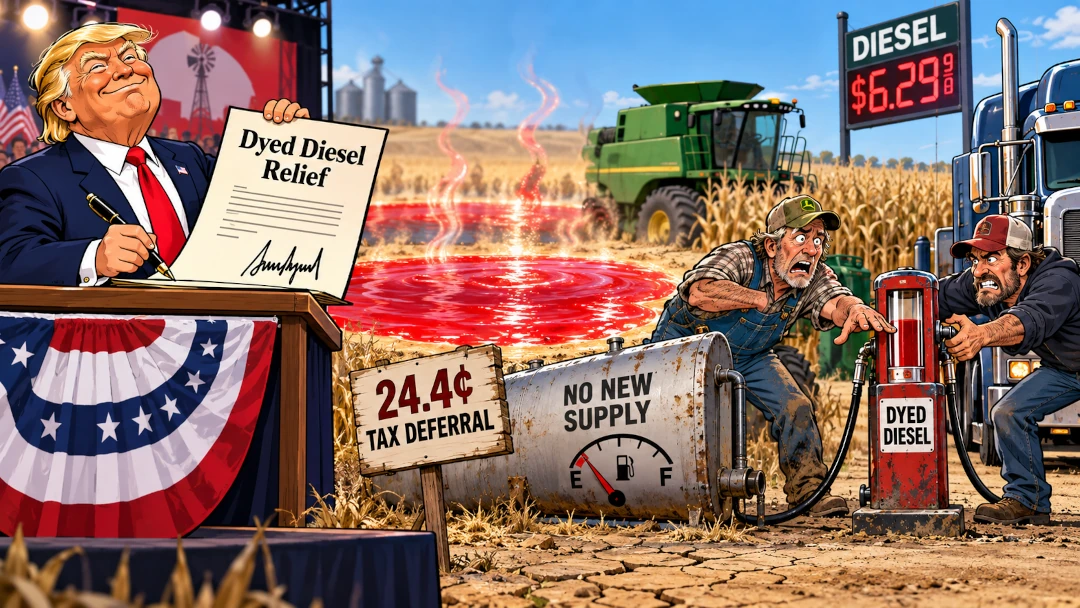
On Monday night in Grand Island, Nebraska, Donald Trump told a campaign crowd he was about to do something historic. He then admitted he had no idea what he was talking about. Moments before signing an executive order on red-dyed diesel, the President conceded he was unfamiliar with the fuel at the center of his own policy. Then he signed it anyway, onstage, at a rally for Sen. Pete Ricketts and Gov. Jim Pillen, and promised that the typical trucker would save more than $100 per fill-up and that grocery prices would fall “very substantially.”
Americans deserve relief from diesel prices that, according to AAA data cited by CNN, rocketed from $3.76 a gallon before the Iran war to a record $6.53 on September 22, and still sat at $6.32 this week. What they got instead was a deferral dressed up as a tax cut, announced as a campaign prop, and resting on legal ground so uncertain that the order itself asks the Treasury to figure out within five days whether it is even allowed.
I. What Trump Actually Signed
Read the text of the order, titled “Emergency Tax Relief on Diesel Fuel,” and the rally rhetoric falls apart. Trump told the crowd he would “allow anyone to purchase tax-free red dye diesel for any reason,” as the White House’s own release quotes him. The document he signed does something much narrower.
Section 2 directs Treasury Secretary Scott Bessent, “in consultation with the Secretary of War,” to determine whether relief is even authorized under 26 U.S.C. § 7508A, a provision for postponing tax deadlines after disasters and military or terroristic actions. Only if he makes that finding does the order defer payment of the federal diesel excise tax incurred from October 5 through December 31, 2026, without interest or penalties. The IRS is told to announce it will not penalize on-road use of dyed fuel in that window. Section 4 is the tell: it instructs the Treasury Secretary to “explore avenues, including legislation,” to eliminate the obligation to pay the deferred amounts. In plain English, the tax is still owed. Only Congress can make it go away.
CNN put it bluntly: the order amounts to a pre-election tax holiday whose obligations are pushed into next year rather than erased. The American Trucking Associations agreed. Its chief advocacy officer, Henry Hanscom, told the Daily Caller News Foundation the order provides “potential tax deferral, not outright tax forgiveness.” When the trucking industry’s own lobby is correcting the President’s sales pitch, the pitch has a problem.
II. What Red-Dyed Diesel Really Is
Red-dyed diesel is not a cheaper or different fuel. It is ordinary diesel with a dye added so inspectors can tell it apart. Federal law taxes diesel by how it is used: fuel burned on public highways pays the 24.4-cent federal excise tax that helps fund roads and bridges, while fuel burned in tractors, combines, bulldozers, generators and furnaces is exempt. Since the 1990s, the tax-exempt fuel has been dyed so that a quick roadside check can catch anyone dodging highway taxes, as a Texas legislative analysis explains.
Same fuel, different label
0
Chemical difference between dyed and clear diesel. The price gap is tax, not refining. Even the White House fact sheet concedes it is dyed so law enforcement can identify it.
The federal saving
24.4¢
Per gallon, roughly $60 on a 250-gallon fill, per the White House’s own math. Against a $1,575 fill-up, that is under 4% — and it is deferred.
The “$100+” claim
State-dependent
The bigger number only applies where states also waive their taxes. IFTA’s executive director told Land Line that no state dyed-diesel order so far has exempted state excise taxes.
Where you can buy it
Farm pumps
Dyed diesel is not sold at most gas stations or truck stops, TIME reports. It moves through co-ops, bulk dealers and rural distributors built to serve farms, not the interstate freight network.
III. Why It Doesn’t Solve the Problem
America does not have a diesel tax problem. It has a diesel supply problem. The national price nearly doubled not because Congress raised the tax — it has been 24.4 cents since 1993 — but because the war with Iran choked off crude flows, Ukrainian strikes knocked Russian refineries offline, and Russia and China restricted fuel exports, as CNN and Fortune have documented.
Nothing in the order produces a single additional barrel. Patrick De Haan, head of petroleum analysis at GasBuddy, summarized it in six words when the plan first surfaced: “Taxes aren’t the problem, supply is.” Tom Kloza, chief oil analyst at Gulf Oil, told The Hill he does not expect the order to make a significant difference in overall prices, because the volumes involved cannot replace what the wars have taken off the market.
Worse, cutting the effective price of fuel in a supply-constrained market tends to raise demand, which pushes prices back up. Economists across the ideological spectrum have long noted that fuel-tax cuts are only partly passed through to consumers. The Penn Wharton Budget Model, analyzing a federal fuel-tax suspension earlier this year, estimated that diesel prices would fall by only about 60% of the tax, with the rest captured elsewhere in the supply chain. Relief that leaks before it reaches the pump is not relief; it is a transfer.
“I don’t know what the hell it is.”
— President Donald Trump, on red-dyed diesel, moments before signing the order · via FOX 9
IV. Farmers Caught in the Crossfire
Here is the cruelest irony. The order is sold as help for farmers, yet farmers already buy dyed diesel tax-free for their tractors and combines. As De Haan pointed out, the policy could save money for on-road users but not for farmers, who were never paying the highway tax on their field fuel in the first place.
What the order does is open that limited, rural, farm-oriented supply to every long-haul trucker, contractor and diesel-pickup owner who wants a discount — during peak harvest, when farm demand is at its annual high. Ohio State University agricultural economist Gabriel Lade warned Brownfield Ag News that with refineries already at capacity, cutting taxes boosts consumption and the off-road diesel price starts climbing, leaving farmers worse off. His verdict: “Knee-jerk reaction policies can backfire.” Even TIME noted warnings that an influx of commercial vehicles could strain dyed-diesel inventories and raise costs for farmers mid-harvest.
The administration seems to know it. Section 7 of its own order tells Agriculture Secretary Brooke Rollins to coordinate with co-ops and rural distributors “to ensure adequate distribution of dyed diesel” in high-demand areas. You do not write a clause protecting farmers’ fuel supply unless you expect your policy to threaten it.
Farm groups are, understandably, taking any relief they can get. The North Dakota Farmers Union told Newsweek it appreciates the order, and Republican governors in North Dakota and Louisiana had already issued narrower, farm-specific waivers in late September. Those state orders were targeted at agricultural haulers. Trump’s version throws the door open to everyone, and that is precisely what turns a narrow harvest fix into a competition for the farmer’s own fuel.
Get Involved Today
Contribute to our mission and turn your concerns into action.
V. How the Industry and Markets Reacted
The people who actually buy diesel by the tanker were unimpressed. The Owner-Operator Independent Drivers Association, which represents small trucking businesses, said through President Todd Spencer that wider use of red-dyed diesel would provide “minimal relief.” Traders shrugged: an analysis from investingLive concluded that because the waiver adds no supply, its effect on diesel futures and refining margins should be limited.
Trucking (OOIDA)
Small carriers’ association calls the benefit minimal; IFTA warns each state must act separately, creating a patchwork for drivers crossing state lines. Land Line
Trucking (ATA)
Large-fleet lobby stresses it is penalty relief and deferral, not forgiveness. Fleets must still plan to owe the tax. Daily Caller
Fuel analysts
GasBuddy’s De Haan: “It’s not really a needle-mover,” though it lets politicians take a victory lap.
Agricultural economists
Ohio State’s Lade warns off-road diesel prices could rise as highway demand migrates to farm supply. Brownfield
VI. What Congress and the Democrats Are Doing
Democrats have been sounding this alarm for months, and they have put actual legislation on the table. Senate Democratic Leader Chuck Schumer took to the Senate floor in September to accuse the President of scapegoating Ukraine for record diesel prices that his own war with Iran set in motion — noting that Trump himself has said prices will plummet once the war ends.
“If gas prices will plunge when the war ends, end it.”
— Senate Democratic Leader Chuck Schumer, Senate floor, Sept. 14, 2026 · Senate Democrats
In July, the Democratic minority on Congress’s Joint Economic Committee documented that American farmers spent $1.4 billion more on diesel during spring planting than the year before, compounding damage already done by Trump’s tariffs. Sen. Mark Kelly (D-Ariz.) and Rep. Chris Pappas (D-N.H.) have introduced the Consumer Fuel Prices Relief Act, which would pause the gas, diesel and aviation fuel taxes through September 2027 — through Congress, as the Constitution requires — while requiring that the savings be passed on to consumers rather than absorbed by corporations. Sen. Sheldon Whitehouse (D-R.I.) and Rep. Ro Khanna (D-Calif.) reintroduced the Big Oil Windfall Profits Tax Act to claw back crisis profits and return them to households as quarterly rebates.
One can debate fuel-tax holidays on the merits — and serious budget analysts do, warning that the Highway Trust Fund depends on that revenue. But there is a world of difference between a lawmaker writing a bill that pays for itself, guarantees pass-through and goes through the democratic process, and a President waving an IOU at a rally and calling it a tax cut.
Who Holds the Power to Tax? Not the President.
Article I, Section 8 of the Constitution gives Congress — not the President — the power “to lay and collect Taxes.” The 24.4-cent diesel excise tax is written into federal statute. No President can repeal it by signing a document on a rally stage, and this order quietly admits as much: Section 4 asks the Treasury to explore “legislation” to forgive the deferred bill.
The legal hook it does reach for, 26 U.S.C. § 7508A, lets Treasury postpone tax deadlines for taxpayers affected by a federally declared disaster or by “a terroristic or military action.” The order’s direction to consult the Secretary of War suggests the administration intends to treat its own war with Iran as the qualifying event — using the consequences of one unilateral decision to justify another. Whether a nationwide, non-geographic deferral for anyone buying a particular fuel fits that disaster-relief statute is a serious open question, which is why the order gives Treasury five days to decide whether relief is authorized at all.
The constitutional stakes are not abstract. Truckers who rely on a President’s promise of “tax-free” fuel may face a bill in 2027 if Congress does not act. And every time an executive treats the taxing power as a campaign accessory, the line between governing and electioneering blurs further. Accountability means Congress should demand that Treasury publish its legal basis under Section 3 of the order, and should write any real relief into law — with pass-through guarantees and a plan to keep the Highway Trust Fund whole.
VII. Marketing Ploy or Real Solution?
To be fair to the administration, its case goes like this: diesel is crushing farmers and haulers at harvest; Washington has few fast levers; about a dozen states were already easing dyed-diesel enforcement, and a federal order brings consistency across state lines; Republican lawmakers including Sen. Ricketts and Rep. Jason Smith have praised it, as the White House’s roundup of endorsements shows. For a farm trucker hauling grain to an elevator on a short trip, a few hundred dollars this season is real money.
But look at the choices that were made. The order was signed onstage at a midterm rally, not in the Oval Office after review. It labels a deferral “tax-free.” It promises savings that depend on state actions that, so far, have not happened. It does nothing about supply. And the President himself told the crowd he hoped the measure wouldn’t be needed long because prices were “plummeting” — a claim at odds with diesel still up roughly 77% this year, as CNN reported.
GasBuddy’s De Haan said the quiet part out loud: the order won’t fix the problem overnight, but it lets politicians take a victory lap. That is the definition of a marketing exercise. A real solution would be measured in barrels and in a shrinking war premium, not in applause lines.
VIII. How Trump Is Making It Worse
The diesel crisis did not fall from the sky. It traces back to decisions this President made and keeps making. Oil prices surged within days of the U.S.-led war on Iran this spring. Congress tried repeatedly to rein it in; a war powers resolution from Sen. Chris Murphy failed 47–53 in March as Republicans blocked it. Sen. Dick Durbin noted that the administration found billions for the war while offering families little help with groceries, mortgages and health care.
Then, as prices peaked in September, the President spent weeks floating a ban on U.S. diesel exports — a move the oil industry, Goldman Sachs and his own Energy Secretary warned would backfire. CNBC reported analysts’ warnings that a ban would offer only brief relief before refiners cut output and pushed gasoline prices higher. After rattling markets for weeks, Trump conceded, as reported by Fortune, that “we were never going to do it.” Policy-by-threat injects volatility into a market that already has too much of it.
Meanwhile, the administration’s own fact sheet blames the Russia-Ukraine war and “Democrat-led States” that closed refineries — while omitting the war it launched. When a leader’s first instinct is to find someone else to blame, and his second is to stage a signing ceremony, the priority is plain: the appearance of action before an election, not the substance of relief after it.
IX. Why This Hits You — Even If You’ve Never Pumped Diesel
Most Americans drive gasoline cars and may assume diesel is someone else’s problem. It isn’t. Diesel moves nearly everything you buy — the trucks that stock grocery shelves, the trains that carry grain, the delivery vans at your door. When it costs $700 more to fill a big rig than it did in January, as TIME calculated, that cost works its way into the price of food, building materials and consumer goods.
And for millions of households, diesel’s twin arrives this month. Heating oil is chemically a close cousin of diesel and is used by nearly 5 million American homes, most of them in the Northeast. The National Energy Assistance Directors Association projects that heating-oil households will spend about $2,297 this winter, up from $1,749 last year — a 31% jump, with its director warning it could go higher as diesel climbs. Nothing in Monday’s order lowers the price of a single gallon of home heating oil.
At the grocery store
Freight costs feed directly into food prices. Farmers paid $1.4B extra for diesel in spring planting alone. JEC Democrats
At home this winter
Heating-oil bills projected up 31% to nearly $2,300 per household. The Hill / NEADA
On the roads
Federal diesel tax raises about $11B a year for highways; unpaid holidays drain that fund. CRFB
X. What We Actually Need to Lower Diesel Prices
The honest answer starts with supply and stability. End the war that created the price shock, as Democrats have demanded since March. Coordinate reserve releases with allies — a step Michael Lynch of the Energy Policy Research Foundation told Fortune could trim U.S. prices by 25 to 50 cents within weeks. Stop market-rattling threats like an export ban the administration never intended to impose. Pass relief through Congress, with enforceable pass-through rules so savings reach drivers and households rather than corporate margins, and with the Highway Trust Fund kept whole. Tax windfall profits earned off the crisis and return them to working families. And over the long run, reduce the economy’s exposure to diesel shocks through freight-rail investment, efficiency standards, and helping Northeast households move off heating oil to heat pumps.
XI. What You Can Do
- Call your senators and representative Ask them to co-sponsor the Kelly–Pappas Consumer Fuel Prices Relief Act and the Whitehouse–Khanna windfall profits tax, and to demand Treasury publish the legal basis for the diesel deferral. The Capitol switchboard is (202) 224-3121.
- Apply for heating assistance now If you heat with oil, contact your state’s LIHEAP (Low Income Home Energy Assistance Program) office before the winter rush. Ask your fuel dealer about budget plans or price caps, and weatherize — sealing drafts is the cheapest gallon you’ll ever save.
- Don’t take “tax-free” at face value If you own a diesel pickup, know that the federal tax is deferred, not forgiven, and that state laws still apply. Check your state’s rules before buying dyed fuel; state penalties for highway use remain in force in many places.
- Support farmers directly Local farmers face higher fuel costs on top of tariffs. Buying from farmers’ markets, CSAs and local co-ops puts money where the harvest squeeze is sharpest.
- Register, vote, and bring others Diesel prices are a direct consequence of decisions about war and economic policy. Confirm your registration and polling place today; the midterms are November 3.
Editorial Conclusion
A President who admits he doesn’t know what red-dyed diesel is has no business selling it as a cure. This order adds no fuel, forgives no tax, protects no farmer, and does nothing for the millions of families about to pay record prices to heat their homes. It is an IOU signed on a campaign stage.
The power to tax belongs to Congress, and the power to end this war belongs, in the end, to the American people. Real relief requires ending the conflict that caused the shock, writing honest relief into law, and holding leaders accountable for choosing applause over answers. America deserves governing, not theater — and on November 3, it can demand it.
Sources & References
- The White House — Executive Order: Emergency Tax Relief on Diesel Fuel
- The White House — President Trump Takes Decisive Action to Lower Diesel Costs
- The White House — Fact Sheet: President Trump Promotes Diesel Affordability
- The White House — What They Are Saying: Diesel Relief
- CNN — Trump signs executive order aimed at lowering diesel prices
- ABC7 / AP — Trump signs order extending tax-free use of red-dyed diesel during midterm stop
- FOX 9 — Trump signs executive order temporarily easing red-dyed diesel limits
- TIME — Trump Expands Access to Tax-Exempt Dyed Diesel
- Newsweek — Trump Allows Dyed Diesel on the Road: How Could It Affect Prices
- Brownfield Ag News — Ag economist warns red dyed diesel policy could raise costs for farmers
- Land Line (OOIDA) — Will red-dyed diesel deliver meaningful relief for truckers?
- Daily Caller News Foundation — Truckers Get Tax-Free Farm Diesel in ‘Unprecedented Step’
- The Hill — Trump announces steps to lower high cost of diesel
- Agweek — Diesel prices increase as harvest begins
- investingLive — Trump opens tax-free red-dyed diesel to all buyers as fuel costs bite
- CNBC — Oil industry warns a diesel export ban will raise fuel prices
- Fortune — After threatening a diesel export ban, Trump admits ‘we were never going to do it’
- Senate Democrats — Schumer floor remarks on Trump’s Iran war and costs
- Joint Economic Committee (Minority) — America’s Farmers Spent $1.4 Billion More on Diesel
- Sen. Mark Kelly — Kelly, Pappas Expand Legislation to Suspend Gas and Diesel Tax
- Senate EPW (Minority) — Whitehouse and Khanna Reintroduce Big Oil Windfall Profits Tax
- Sen. Dick Durbin — Durbin Criticizes President Trump’s War of Choice on Iran
- Penn Wharton Budget Model — Federal Gas Tax Holiday: Revenue and Price Effects
- Committee for a Responsible Federal Budget — A Gas Tax Holiday Would Cost Billions Each Month
- The Hill — Why people in the Northeast will pay higher heating bills this winter
- Sen. Ed Markey — Markey Supports Latest Resolution to Stop Iran War
- Rep. Tom Suozzi (via NYT) — Democrats Seize on Oil Price Surge, as Trump Downplays It
- Office of Gov. Jeff Landry — Landry Takes Action on Dyed Diesel for Farmers
- Texas Legislature — Bill Analysis, H.B. 4296: Dyed Diesel Fuel Use
Related News