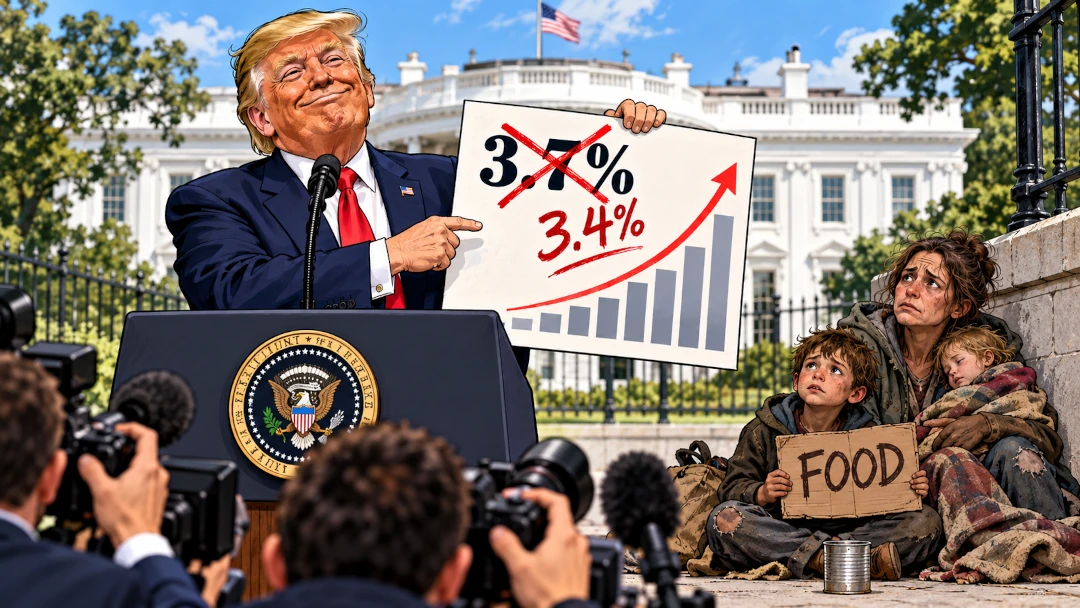
The Inflation Number Got Better. Your Winter Didn’t.
August’s 3.4% PCE reading will be sold as proof that the affordability crisis is easing. It isn’t. Most of the “improvement” came from a statistical overhaul at Trump’s Commerce Department — while bond markets revolt, heating oil soars, millions lose health coverage, and the House has gone home to campaign.
At 8:30 this morning, the Bureau of Economic Analysis delivered what looked, at first glance, like good news. The Personal Consumption Expenditures price index — the Federal Reserve’s preferred gauge of inflation — rose 3.4% over the past year, well below the 3.7% Wall Street expected. Core inflation, which strips out food and energy, printed at 3.0% against a 3.3% forecast, CNBC reported. Stocks rose. Yields eased. Somewhere in the West Wing, a talking point was surely being drafted.
But the number that moved markets this morning is not the number American families are living. Buried in today’s release is the reason inflation “cooled”: the government changed the way it measures it. And every other indicator worth watching — from the bond market to the heating oil truck to the food bank line — is flashing the opposite signal.
I. What the Report Actually Says
Strip away the headline and the BEA’s own release tells a story of households running faster to stand still. Consumer spending jumped 0.9% in August, but personal income rose just 0.2%. The gap came out of savings: the personal saving rate fell to 4.1%. CNN noted that this is a nearly four-year low, and that once adjusted for inflation, disposable income was flat. Americans are not spending because they feel flush. They are spending because the things they must buy cost more, and they are draining their cushions to do it.
Nor did inflation actually slow month to month. Headline prices rose 0.3% from July — a faster pace than the month before. Energy is the engine: according to Wolf Richter’s breakdown of the data, the energy component of PCE was up 16.8% from a year earlier, with gasoline alone up 27.8%. Those categories were not touched by the revisions. They are the war with Iran, arriving at the pump and on the utility bill.
(expected 3.7%)
(expected 3.3%)
year over year
~4-year low
Even analysts who welcomed the softer print were blunt about what it does and doesn’t mean. Sonu Varghese, global macro strategist at Carson Group, told CNBC that “even after major methodological revisions, PCE inflation is still running hot.” Both measures remain far above the Fed’s 2% target — which is why markets still expect the central bank to follow its September rate hike with another before the year is out.
II. The Revision Behind the Headline
Here is what the celebratory headlines leave out. Today’s release incorporated the BEA’s annual update — and, for the first time, a set of methodology changes to three components of the PCE index: portfolio management and investment advice, legal services, and computer software and accessories. The changes were applied retroactively, reaching back to the first quarter of 2021, according to a letter from Sen. Elizabeth Warren, ranking member of the Senate Banking Committee.
The effect was not subtle. July’s headline inflation, originally reported at 3.7%, was revised down to roughly 3.36%. July’s core reading was cut by 37 basis points, from 3.35% to 2.98%. The software subindex, which under the old method showed prices up 21.2% in July, was slashed to 12.3%. In other words, August’s “cooling” is overwhelmingly a product of the new yardstick, not of cheaper living. On a like-for-like basis, headline inflation actually ticked up from July to August.
as first reported
after revision
as first reported
after revision
To be fair, statistical agencies revise their methods regularly, and Axios reported that these particular changes are “entirely defensible on technical grounds.” The problem is not that a technocrat adjusted a computation. The problem is who is presiding over the agency, when the change landed, and how little the public has been told.
This is an administration whose president fired the commissioner of the Bureau of Labor Statistics, Dr. Erika McEntarfer, in August 2025 after a weak jobs report, falsely claiming the data had been “rigged.” It terminated the outside expert advisory committees at BEA and BLS. It banned “noise infusion,” a standard privacy technique, in a move experts warn could wipe out swaths of Census data. Warren’s letter describes the new PCE changes as part of “the Trump Administration’s attacks on the integrity of the nation’s statistical system” and asks BEA to publish its composite weights and release inflation figures under both old and new methods so outside economists can check the math. Employ America’s Vikas Patel, quoted by Axios, likewise urged the bureau to show far more transparency about timing, weights, and historical revisions.
Those are not unreasonable requests. A president demanding lower interest rates, a central bank weighing hikes, and a measurement change that happens to shave several tenths off inflation weeks before a midterm election: when public trust in the data is the only thing standing between democracy and propaganda, the burden of proof belongs to the government.
III. The Bond Market Isn’t Buying It
If the new inflation number truly signaled relief, the world’s most sophisticated investors would be piling back into U.S. debt. They are doing the opposite. Reuters reported on September 24 that the 30-year Treasury yield climbed to 5.48%, its highest since 2004, while the benchmark 10-year reached 5.20% — part of a global selloff driven by worries that energy costs, deficit spending, and a hot economy will keep inflation elevated. Japan’s 10-year yield hit its highest level since 1996. By Tuesday, Bloomberg reported, the 30-year had pushed past 5.61%, a level last seen in 2002.
Treasury Secretary Scott Bessent has resorted to extraordinary measures — expanding buybacks of long-dated bonds and intervening in currency markets — with little to show for it, according to Reuters. Rising long-term yields are not an abstraction: they flow directly into mortgage rates, car loans, business credit, and the interest the federal government pays on its debt. When bond investors demand more to lend to the United States, they are pricing in a judgment about the competence and credibility of its leadership. That judgment, right now, is harsh.
IV. A Winter Squeeze at the Kitchen Table
Macroeconomic numbers can feel distant. What follows is not. As the heating season begins, four pressures are converging on working and middle-class households at once.
Heating
Projected rise in winter costs for households that heat with oil, per the National Energy Assistance Directors Association, which blames the Iran war. Overall heating costs are forecast up 8.7%. In New York, Sen. Kirsten Gillibrand says heating oil has hit $6.14 a gallon — up 66% in a year.
Health Coverage
Drop in paid ACA Marketplace enrollment after enhanced premium tax credits expired, from 22.1 million in 2025 to 19.2 million in February 2026, according to KFF. Many enrollees faced premium payments that doubled or tripled.
Medicaid
Fewer Americans on Medicaid than a year ago — with 400k+ lost in Arizona alone, a 55% plunge, the nation’s steepest, as U.S. News reports. New federal work requirements now reach up to 20 million adults in expansion states, and a strict CMS rule narrows who counts as too sick to work.
Credit
Share of credit card balances 90+ days delinquent in early 2026, up from 7.6% in 2022, per New York Fed research reported by CNBC. Americans owe $1.26 trillion on their cards; roughly 60% of cardholders carry a balance.
Get Involved Today
Contribute to our mission and turn your concerns into action.
The heating crisis is the most immediate. Mark Wolfe, NEADA’s executive director, has warned that families are entering winter with nothing left in their budgets after record summer cooling bills, and his group is pressing Congress to substantially increase funding for the Low Income Home Energy Assistance Program. His message to lawmakers could not be plainer: “Congress cannot wait for the first cold snap.” At current funding, the program is badly outmatched by a war-driven price shock.
Health care costs are compounding the pain. The expiration of the enhanced ACA subsidies at the start of the year pushed millions off the Marketplace, and Medicaid’s new work requirements — enacted in the 2025 Republican budget law and phasing in state by state ahead of a January 2027 national deadline — are now producing precisely the paperwork purges that experts predicted. Losing coverage doesn’t make medical bills disappear; it converts them into debt, deferred care, and emergency-room visits.
At the grocery store, the picture is more complicated than the rhetoric on either side. Food inflation in the PCE data has actually moderated. But prices are not falling, and the safety net beneath them is shrinking. On the health policy podcast Tradeoffs, food bank leaders described a collision of rising food, fuel, and health costs with the downsizing of SNAP: Arizona food banks are now serving more people than SNAP itself, the Greater Cleveland Food Bank reports pandemic-level demand, and roughly a million fewer children receive SNAP than a year ago. Diesel prices driven by the war make every truckload of donated food more expensive to move.
Put it together and you have the portrait of a middle class being squeezed from every side: higher bills, thinner savings, vanishing coverage, and credit cards doing the work that wages no longer can.
“It’s a very inexpensive price to pay for what we’ve done.”
— President Donald Trump, on war-driven gas prices, via PBS NewsHour
V. Congress Went Home
Faced with all of this, what has the House of Representatives done? It left. On September 16, Speaker Mike Johnson canceled the remaining scheduled votes and sent members home until after the November midterms — a recess of more than six weeks, CBS News reported, after he had already scrapped the final two weeks of the September session. Democratic calls to keep the chamber in session were brushed aside.
Not everyone in Washington is idle. Senate Democrats have been doing the work that oversight requires: Warren’s inquiry into the PCE changes, and Gillibrand’s demand that the administration immediately release LIHEAP funds to states before temperatures drop. But letters are not laws. There is no emergency LIHEAP supplemental on the floor, no restoration of the ACA subsidies, no pause in the Medicaid purge, and no serious answer to an energy shock created by a war of the president’s choosing.
Action What You Can Do Right Now
Washington’s paralysis does not leave families powerless. These steps are practical, immediate, and worth sharing with anyone you know who is struggling:
- Apply for LIHEAP early. Contact your state or local energy assistance office now; funds are limited and first-come. If you heat with oil, ask your dealer about budget billing or price-cap plans before winter demand peaks.
- Open every Medicaid notice. States are mailing work-requirement notices this fall. Respond before the deadline, keep copies of pay stubs and exemption documentation, and ask your doctor for paperwork if you have a condition that limits work.
- Re-shop your health coverage. During this fall’s open enrollment, compare plans carefully — some states have added their own subsidies — and contact a free, certified navigator for help.
- Use the food safety net without shame. Call 211 or your regional food bank to find pantries and check SNAP eligibility. If you can give, food banks say cash stretches further than canned goods right now.
- Call your card issuer before you fall behind. Many offer hardship programs with reduced rates or payments. A nonprofit credit counselor can help you build a plan — avoid for-profit “debt settlement” pitches.
- Make your representatives answer for the recess. Members of the House are in their districts campaigning. Show up at their events and ask one question: What have you done about my heating bill? Then vote on November 3.
VI. The President’s Priorities
Every pressure described above has a common thread running back to the Oval Office. The energy shock is the product of a war the president chose. The coverage losses flow from a budget law he championed and from subsidies his party let lapse. The food-aid cuts are his administration’s. And when confronted with the consequences, Donald Trump has offered not a plan but a shrug.
On September 9, CNBC reported, the president acknowledged that energy prices would not fall until “right after” the midterm elections, and predicted the Iran war — then in its seventh month — would end immediately after the vote as well. A week later, campaigning in North Carolina, he called surging gas prices a cheap price for the war, according to PBS NewsHour. Meanwhile, he keeps insisting that things are getting cheaper: a CNN fact check this week found his claim that grocery prices have “come way down” to be false, noting that inflation is higher now than when he returned to office.
These are not the words of a leader managing a crisis. They are the words of a leader managing a news cycle — timing relief to an election, dismissing hardship as a rounding error, and denying what families can read on their own receipts. Pair that with an administration that has fired statisticians, gutted expert advisory panels, and now overseen a methodology change that flatters its inflation record, and a disturbing pattern emerges: when reality is inconvenient, change the reality you report.
When a President Cannot — or Will Not — Discharge the Duties of the Office
The mechanism
Section 4 of the 25th Amendment allows the Vice President, together with a majority of the Cabinet — or of another body Congress creates by law — to declare that the President is “unable to discharge the powers and duties of his office.” The Vice President then becomes Acting President. If the President contests the declaration, Congress decides, and it takes a two-thirds vote of both chambers to keep him sidelined. Section 4 has never been invoked.
Who has called for it
After the president threatened in April that “a whole civilization” in Iran would die, more than 85 House and Senate Democrats called for impeachment or removal under the 25th Amendment, Axios reported. Rep. Jamie Raskin, ranking member of the House Judiciary Committee, introduced legislation creating a 17-member commission under Section 4, arguing that Congress has “a solemn duty to play our defined role under the 25th Amendment.” Rep. Mike Quigley of Illinois tied the president’s conduct directly to the economy, warning in a statement that his threats were driving the country toward another Great Recession.
The argument
The amendment’s framers were concerned with a president’s capacity to govern — not merely with bad policy. The case its proponents make is that the conduct documented here goes beyond disagreement. A president who launches a war of choice, openly accepts the economic devastation it causes as “inexpensive,” publicly times relief for his own electoral benefit, repeats demonstrably false claims about prices, and presides over the politicization of the nation’s economic statistics is exhibiting a sustained detachment from the basic duties of the office: to see the country’s condition accurately and to act in its interest. Economic stewardship is not a side issue of the presidency. It is the core of it.
The honest barriers
We will not pretend the path is easy. Section 4 requires Vice President JD Vance and a Cabinet majority — all chosen by Trump — to act against him. Raskin’s commission bill cannot pass a Republican Congress, and would face a veto if it did. A contested declaration requires two-thirds of both chambers. Many constitutional scholars also caution that Section 4 was designed for physical or mental incapacity, and that policy failure, however grave, is the business of elections and impeachment.
Why the barriers don’t end the argument
Difficulty is not the same as irrelevance. The 25th Amendment exists precisely because the framers of 1967 understood that the gravest threats to a republic can come from within its highest office, and that no one else would be positioned to act. Every official who takes an oath to the Constitution — including every Cabinet secretary watching families choose between heat and food — carries a personal obligation to ask whether this president is capable of discharging his duties. Keeping that question on the public record, backed by evidence, is how accountability survives until the voters can deliver it.
Editorial Conclusion
A lower number is not a lower bill. August’s inflation report was improved by a change in measurement, not a change in American lives — and no revision can hide a 30-year bond at its highest yield in a generation, a heating oil tank that costs a third more to fill, or millions of families stripped of health coverage.
What is required is not complicated: emergency LIHEAP funding before the first freeze, restoration of the ACA subsidies, a halt to the Medicaid paperwork purge, full transparency from the BEA, and a Congress that stays in Washington while the country struggles. And what is at stake is larger than any single winter. A democracy cannot govern itself on numbers it cannot trust, led by a president who treats its people’s suffering as the price of his politics. Americans have had enough — and on November 3, they have the power to say so.
Sources & References
- Bureau of Economic Analysis — Personal Income and Outlays, August 2026
- CNBC — Fed’s preferred gauge showed core inflation at 3.0% in August, much lighter than expected
- CNN — US inflation remained stubborn last month as Iran war continued to lift prices
- Wolf Street — Not Even the Massive Changes of Methodology Can Get PCE Inflation Back into the Bottle
- Axios — Measurement tweaks will make inflation data look better
- U.S. Senate Banking Committee (Sen. Elizabeth Warren) — Letter to Commerce Department and BEA on PCE methodology changes
- Reuters via Yahoo Finance — Global bond selloff rolls on, US 30-year yield at highest since 2004
- Bloomberg — US 30-Year Treasury Yield Rises to Highest Level Since 2002
- NEADA — Winter Heating Report: Winter Heating Prices Projected to Increase by 8.7 Percent
- Office of Sen. Kirsten Gillibrand — Gillibrand demands release of heating assistance funding
- KFF — ACA Marketplace Enrollment Is Down By 3 Million After Big Jump in Premium Payments
- U.S. News & World Report — As Work Requirements Kick in for Medicaid, Some States Are Taking a Tougher Stance
- Tradeoffs — As SNAP Shrinks, What’s the Future of Food Aid in America?
- CNBC — Credit card debt climbs to $1.26 trillion as ‘K-shaped’ divide persists
- CBS News — House cancels votes, cutting week short before adjourning until after midterms
- PBS NewsHour — Rising gas prices frustrate voters. Trump says it’s an ‘inexpensive price to pay’ for the Iran war
- CNBC — Trump says oil and gas prices won’t fall until ‘right after’ midterm election
- CNN — Fact check: Trump lies again that grocery prices ‘have come way down’ this term
- Axios — Dems file long-shot 25th Amendment bill targeting Trump
- Office of Rep. Mike Quigley — Quigley Calls for Trump’s Removal Under 25th Amendment
Related News