Trump’s Washington Puts a Price Tag on Every Calling
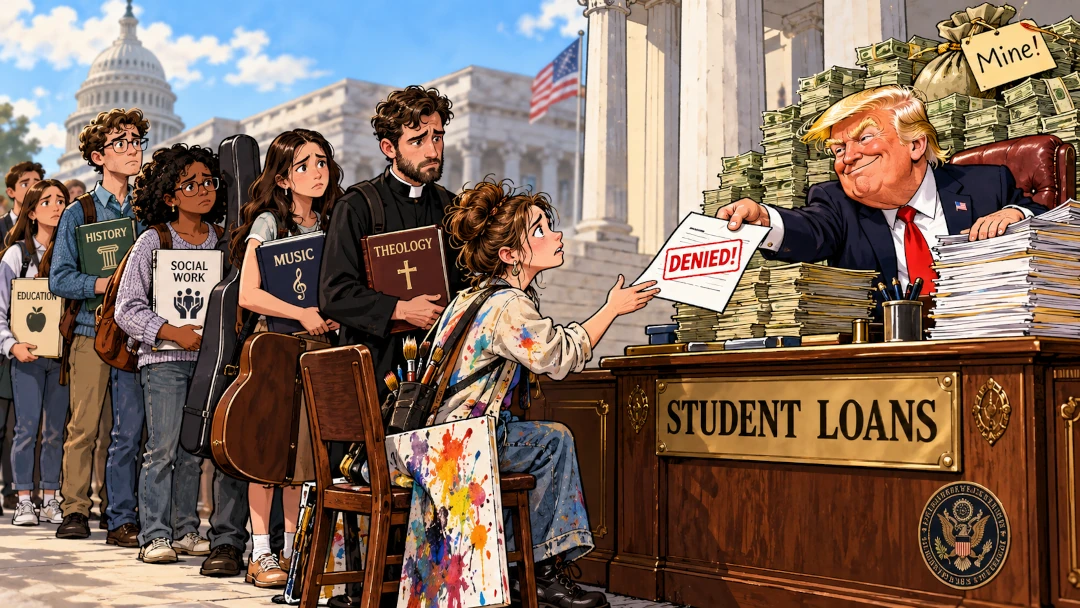
A new federal rule will strip student-loan eligibility from college programs whose graduates don’t out-earn high school graduates four years out. The social worker, the music teacher, the pastor and the painter are first in line — and every American who depends on them will pay the bill.
Somewhere this fall, a nineteen-year-old is sitting in an introductory social work seminar because she watched a caseworker pull her cousin out of a fentanyl spiral. Down the hall, a first-generation student is practicing scales for a music education degree so he can go home and teach band at the high school that saved him. Under a rule the Trump administration has now finalized, the federal government has announced it will soon begin asking a single question about both of them: will their paychecks be big enough?
That question is the heart of what The New Republic described, first in July and again this week, as the administration cutting off student loans for students in degrees that don’t pay enough. Drawing on reporting by the Los Angeles Times, the magazine identified social work, art, religious studies, teaching aides and music as the fields that will be hit hardest.
The Education Department pushed back hard, telling Newsweek that the policy bans no major and no program. On the narrowest reading, the department is right: no student is forbidden from studying anything. But that is cold comfort. The rule does not ban the major — it bans the financing of the major, for the millions of Americans who cannot write a tuition check. For a working family, that is a distinction without a difference.
I. What the Rule Actually Does
The department’s final regulation, published in the Federal Register on July 1, implements an “earnings accountability” framework that limits federal Direct Loan eligibility to programs whose graduates meet earnings benchmarks. Undergraduate programs must show their completers earn more than the typical working adult with only a high school diploma; graduate programs must beat the typical bachelor’s degree holder. The department will use federal tax data measured four years after completion.
According to the National Association of Student Financial Aid Administrators, a program that fails in two of three consecutive years is designated “low-earning” and loses Direct Loan eligibility for two years; the earliest any program could lose eligibility is July 1, 2028. And the rule reaches beyond loans. The department’s own announcement states that after three years of failure, it could terminate all federal Title IV aid — including Pell Grants — for an institution’s low-earning programs.
Fine Arts at Four-Year Colleges
Share of studio and fine arts bachelor’s programs at risk of failing — the largest share of any bachelor’s major, per an American Enterprise Institute analysis reported by CBS News.
Religious Studies
Failure rate among eligible religious studies programs; theater, music and fine arts posted the largest number of failures, per Prof. Robert Kelchen’s analysis in The Chronicle of Higher Education.
Mental & Social Health (Master’s)
Graduate programs training counselors and clinical social workers carry the highest failure rates of any master’s field, according to Education Department data reported by NPR.
For-Profit vs. Public
Roughly a third of for-profit college programs are expected to fail, compared with about 3 percent of degree programs at public and nonprofit schools, per the Times reporting cited by Newsweek.
II. What It Means for Students — and for the Rest of Us
The earnings test measures one thing: a salary, four years out. It cannot see the child protective services worker who keeps a family together, the hospice chaplain, the church musician, or the early-career artist whose income is volatile before it is substantial. The Strategic National Arts Alumni Project’s Lee Ann Scotto Adams told NPR that earnings capture only a small piece of what arts graduates contribute, and objected to judging them in their first few years of work.
Consider social work. The National Association of Social Workers reports that social workers are the nation’s largest providers of behavioral health services, that large swaths of the country live in federally designated mental health shortage areas where only about a quarter of need is met, and that new federal loan limits already threaten the pipeline of future clinicians. Now the government proposes to penalize the very master’s programs that produce them.
“We need social workers.”
— Ted Mitchell, President, American Council on Education, to the Los Angeles Times, via The New Republic
This is where the policy stops being a campus story and becomes a kitchen-table one. The low wages in social work, early childhood education and the arts are not evidence that those jobs are worthless; they are evidence that America underpays the people who do its caring and its culture-making. The rule takes that market failure and turns it into a federal verdict. Fewer credentialed counselors means longer waits for a teenager in crisis. Fewer trained teacher aides means larger, more chaotic classrooms. Fewer church musicians and community artists means poorer civic life in the towns that can least afford to lose it.
Even voices on the right have flinched. Gregory Baylor of the conservative legal group Alliance Defending Freedom told the Los Angeles Times that government should not punish people for pursuing socially valuable callings simply because they don’t earn enough — a concern echoed by Stanford historian Jonathan Gienapp, who noted that a humanities program’s educational success may have little to do with immediate earnings, as The New Republic reported.
III. What It Means for Our Colleges and the Disciplines We Cherish
The deepest damage may come before a single program formally fails. Arts advocates have warned that colleges will preemptively slash music, theater, studio art and design programs rather than risk the penalty, NPR reported. Brian Harlan, dean of the Cornish College of the Arts at Seattle University, argued in Inside Higher Ed that the framework shifts attention away from educational quality and toward subject matter itself — punishing a field for what it is rather than how well it is taught.
The institutional math is unforgiving. The final rule adds an institution-wide “administrative capability” standard: according to NASFAA, at least half of a school’s federal aid recipients and half of its aid dollars must come from programs that pass. Small colleges built around the arts, teacher preparation or ministry — often the only college in a rural county — could see their entire aid structure put at risk. When enrollment falls, departments are merged, faculty are cut, and the literature seminar and the orchestra go first. Once a conservatory or a religious studies department closes, it does not reopen when the political winds change.
There is a cruel irony here. These are the disciplines that teach Americans to read closely, argue honestly, and imagine a different future. A government that decides such things are not worth financing is telling us something about what kind of citizens it wants.
IV. The Hidden Costs Nobody Is Tallying
The administration sells the rule as protection for taxpayers. But the ledger it presents leaves out most of the costs:
Students pushed to private lenders. A student in a disfavored program who still enrolls will turn to private loans, which generally lack the federal system’s income-driven repayment and public-service forgiveness protections. When Republicans first advanced these student aid changes, Rep. Bobby Scott, the top Democrat on the House education committee, warned they would push students toward “predatory private loans.” The loan cutoff stacks on top of the same law’s elimination of Grad PLUS and its new borrowing caps.
Wealth becomes the admission ticket. The only students unaffected are those who don’t need to borrow. The practical result is a two-tier system in which the children of the affluent may still become painters, poets and pastors, while working-class students are steered toward whatever the tax data says pays best.
Workforce shortages get more expensive. Every unfilled counseling position, child-welfare caseworker job, or classroom aide slot has a downstream cost — in emergency rooms, in foster care, in jails, in lost learning. None of that appears in the department’s savings estimate.
Local economies lose anchors. A shrinking college means lost jobs, lost tax base and lost cultural life for the surrounding community.
V. Who Wrote This — and Where the Administration Went Further
Congress holds the power of the purse, and eligibility for federal student aid is set by statute under the Higher Education Act. That is exactly why this fight must be understood accurately: the core earnings test did not come from executive fiat. The Republican Congress wrote it into the One Big Beautiful Bill Act, which Trump signed, and the department’s rule implements it, as the Federal Register notice itself states. That bill cleared the House by a single vote, with every Democrat voting against it. This is a Republican policy, passed on a party-line vote, and it will take an act of Congress to fix it.
But the department did not stop at the statute’s text, and that is where the legal vulnerability lies. In their May 21 letter, Reps. Scott and Alma Adams objected that the department was using the law as cover to dismantle existing gainful-employment protections, including the debt-to-earnings test that policed for-profit programs. The think tank New America argued in its public comment that the proposal “improperly rewrites the statute.”
And there is precedent for courts saying so. When the same department narrowly redefined “professional degree” to limit graduate borrowing for nurses, physician assistants and others, a federal court issued a nationwide stay in June. The pattern is consistent: take a harsh law, then implement it more harshly than Congress wrote it.
Democrats have moved, if not yet boldly enough. Rep. Shomari Figures has introduced the Restoring Opportunity for Advanced Education Act to repeal the graduate borrowing caps, and Sen. Richard Blumenthal’s Restoring College Access and Affordability Act would restore Grad PLUS and repeal the law’s restrictive loan caps. What is still missing is a Democratic accountability standard of their own — one that stops predatory programs cold while weighing public service, licensure, and long-term outcomes rather than a single four-year snapshot of income. Democrats should not merely oppose the earnings test. They should replace it with something better.
Get Involved Today
Contribute to our mission and turn your concerns into action.
VI. A Question of Priorities — and of Leadership
Listen to how this administration talks about the people this rule will affect.
“Federal student loans are not a welfare program for failing college programs.”
— U.S. Department of Education statement, via Newsweek
A graduate program that trains addiction counselors is not a “failing” program because its graduates take modest salaries at community clinics. Calling it “welfare” tells Americans exactly how this administration sees public service: as a cost to be cut rather than a contribution to be honored. Under Secretary Nicholas Kent has called the overhaul a “hard reset” for higher education — yet the same law that constrains student borrowing delivered its largest benefits elsewhere. Families are told to tighten their belts while the priorities of the powerful are protected.
That is the leadership failure at the center of this story. A serious president would ask why America underpays its social workers and teachers, and would fix that. This administration instead asks why anyone would train for those jobs at all — and then makes it harder to do so. It governs by slogan, measures human worth in tax returns, and treats the resulting shortages as someone else’s problem.
Judgment, Fitness, and the Limits of Section 4
The mechanism
Section 4 of the 25th Amendment allows the Vice President, together with a majority of the Cabinet — or of “such other body as Congress may by law provide” — to declare that the President is unable to discharge the powers and duties of the office. If the President contests that declaration, Congress must sustain it by a two-thirds vote in both chambers within 21 days.
Who has called for it
More than 85 House and Senate Democrats called for Trump’s impeachment or removal after his April threat that a “whole civilization will die” in Iran, Axios reported. Rep. Jamie Raskin, ranking member of the House Judiciary Committee, introduced legislation to create the 17-member body Section 4 contemplates, calling it Congress’s “solemn duty.” Rep. Diana DeGette demanded that 25th Amendment proceedings begin immediately, The Hill reported, and Sen. Ed Markey and others joined similar calls.
The argument — and how this issue fits
The case these lawmakers make rests on a pattern: erratic threats, impulsive reversals, and decisions made without regard to their human consequences. The student loan rule adds to the record of judgment that Raskin’s proposed commission would examine — an administration that mischaracterizes its own policy’s burdens, dismisses public servants as “welfare,” and appears indifferent to the workforce shortages its choices will deepen. A president who cannot see the social worker, the teacher and the artist as essential to the country he governs is displaying a failure of the core presidential duty: to govern for all Americans.
The honest barriers
We will not pretend the path is easy, or that this policy alone triggers the amendment. Section 4 addresses inability, not bad policy; a harmful rule enacted through a law Congress passed is a political judgment, and the Constitution’s primary remedies for bad judgment are elections, legislation and the courts. The Vice President and Cabinet serve at the President’s pleasure, Republicans control Congress, and the two-thirds threshold is designed to be nearly insurmountable.
Why the case still matters
None of that relieves Congress of its responsibility. Section 4 expressly invites Congress to create a standing body to assess presidential capacity, and a Congress that refuses even to build that mechanism has abdicated a duty the Constitution assigns it. Every policy that reveals a president detached from the lives of ordinary Americans belongs in the record such a body would weigh. The barriers are real. The obligation to be ready is not optional.
The immediate remedy, though, is closer at hand than any constitutional mechanism. Americans vote on November 3. Every candidate for the House and Senate should be asked a simple question: will you vote to replace an earnings test that treats America’s caregivers, teachers and artists as bad investments?
Editorial Conclusion
A nation that will lend a student money to study finance but not social work has confused price with value. This rule — written by a Republican Congress, signed by President Trump, and implemented by his Education Department with a zeal that exceeds even the statute — will shrink the ranks of the people who heal, teach and inspire us, and it will shut working-class students out of callings that only the wealthy can now afford. Congress must replace the earnings test with a standard that protects students from predatory programs without punishing public service; the courts must hold the department to the letter of the law; and voters must hold accountable those who wrote it. The promise of American higher education has never been that every degree pays the most. It is that every citizen, not just the rich, gets to choose how to serve. That promise is now on the ballot.
Sources & References
- The New Republic — Trump Moves to Cut Off Student Loans for Tons of Degrees
- Los Angeles Times — Low-paying degrees face federal student loan cutoff
- Newsweek — Trump Administration Addresses Plan to Cut Student Loans for Some Degrees
- Federal Register — Final Rule: STATS and Earnings Accountability
- U.S. Department of Education — Final Rule to Hold All Colleges Accountable for Low-Earning Programs
- U.S. Department of Education — Proposed Rule on Low Earning Outcomes
- NASFAA — 2026 STATS/Earnings Accountability
- NPR — New “Do No Harm” Test Targets Low-Earning College Degrees
- CBS News — Colleges With Low-Earning Grads Could Lose Access to Student Loans
- The Chronicle of Higher Education — Colleges Face a New Test on Their Grads’ Earnings
- Inside Higher Ed — Federal Earnings Test Jeopardizes Arts Education (opinion)
- WBIW / NASW — Social Workers Sound Alarm on Workforce Shortage
- Higher Ed Dive — Education Department Proposal Would Erode Student Protections, Critics Warn
- Higher Ed Dive — The Reconciliation Bill Cleared the House. Here’s How It Would Change Higher Ed.
- Higher Ed Dive — House Education Committee Advances Sweeping Higher Ed Bill
- House Education & Workforce Democrats — Scott–Adams Letter to ED on the Proposed Rule
- The EDU Ledger — Federal Court Halts ED’s Narrow “Professional Degree” Loan Limits
- Rep. Shomari Figures — Restoring Opportunity for Advanced Education Act
- Sen. Richard Blumenthal — Restoring College Access and Affordability Act (one-pager)
- Axios — House Democrats File Long-Shot 25th Amendment Bill
- The Hill — Democrats Say Trump’s Iran Threat Cause for 25th Amendment Removal
Related News