From the World’s Podium, a President Weighs Driving a Nation Into Hell
Before 193 nations, Donald Trump openly asked whether to “annihilate” Iran, two days after wondering aloud on Fox News when to “blow the entire nation up.” The threat did not make America stronger. It left Americans abroad more exposed, allies more estranged, and families at home no closer to affording gas, groceries, or a doctor.
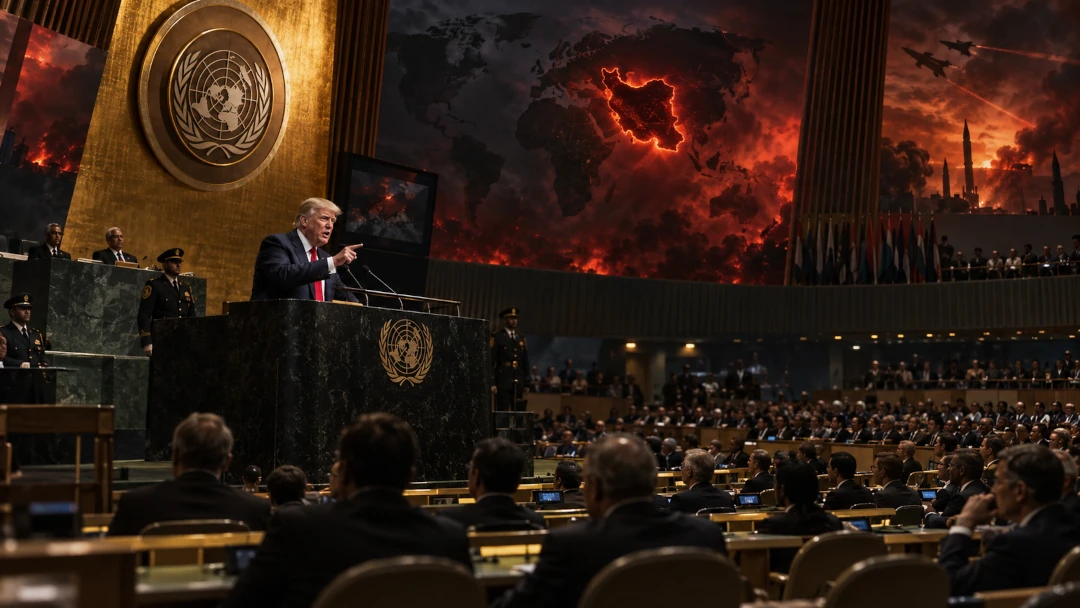
There are words a president of the United States should never say, and rooms where saying them is a special kind of disgrace. On Tuesday, Donald Trump said them in the General Assembly Hall of the United Nations, the chamber the world built from the rubble of the Second World War so that nations would stop plotting one another’s extinction. About eleven minutes into a 40-minute address, The Guardian reported, he told the assembled leaders that he had “a big decision to make.” Either Iran would make a deal and rebuild, or he would do something else.
“Or do I annihilate the Islamic Republic and do it quickly, never giving them a chance to kill and destroy people and countries again? Do I drive them into hell with no chance of survival and no hope of future greatness or generations?”
— President Donald Trump, U.N. General Assembly, Sept. 22, 2026 — via ABC News
This was not a slip of the tongue. It was a script. Two days earlier, on Sunday, Trump told Fox News chief foreign correspondent Trey Yingst that he was in a “deciding mode,” that his options were “wiping Iran out, letting them rot economically or making a deal,” and then added the sentence that should have stopped every newsroom in the country: “My question is if and when do I blow the entire nation up? They better behave,” as Yingst reported it. The “entire nation” in question is home to more than 90 million people, Common Dreams noted, the overwhelming majority of whom have never held a rifle, a centrifuge, or a seat in government.
I. “Hell” at the Lectern
The president did not stop at threats. He then told the world when he expected a resolution, and why. “I believe we’ll make a deal right after the election,” Trump said, claiming Tehran was “waiting to see how I do in the midterm election,” according to Agence France-Presse’s account carried in The Korea Times. The leader of the free world, in other words, stood before the nations of the earth and tied the fate of a war, and perhaps of a country, to the American electoral calendar, while insisting that the election “doesn’t even enter my mind.”
It is worth being clear about the context in which those words landed. The war the president launched against Iran in February is now about to enter its eighth month. Only last week, NBC News reported, the U.N. Human Rights Council found “reasonable grounds to believe” that the United States committed war crimes during indiscriminate attacks on an Iranian school and a residential area in February. Members of the Iranian and Cuban delegations walked out at points during the speech. And it was into that room, with that record, that the president of the United States chose to muse about annihilation.
The administration’s defenders will say this is leverage: that Iran’s theocracy has murdered its own citizens and American service members, that it must never obtain a nuclear weapon, and that only maximal threats move it. Trump made that case himself on Tuesday, and he drew applause when he vowed Iran would never get the bomb. We share the goal. But a threat to erase a nation is not a nonproliferation policy. It is the abandonment of one, because it teaches every regime on earth that the only reliable protection from a hostile superpower is the very weapon we say no one should have.
Nor does this pattern project strength. In April, the president declared on social media that “a whole civilization will die tonight” and then, hours later, announced a two-week ceasefire; Senate Minority Leader Chuck Schumer mocked him as “desperately searching for any sort of exit ramp from his ridiculous bluster.” A leader confident in his strategy does not need to threaten extinction every few weeks. Threats that are never carried out are bluffs, and the world has learned to read them that way. Threats that would be carried out are atrocities. There is no version of this in which the United States looks steady, and every version in which it looks afraid of its own war.
II. The Nuclear Shadow
In fairness, and because this publication does not deal in invented claims, the record should be stated precisely: the president has said he will not use nuclear weapons against Iran. Asked on August 31 whether he had ruled it out, he called it “a stupid question,” and in April he said such weapons “should never be allowed to be used by anybody,” The Jerusalem Post reported.
But words have meaning, and his words describe outcomes that ordinary war does not produce. You do not “blow the entire nation up” with precision strikes on missile launchers. You do not leave a country of 90 million with “no chance of survival” for “generations” by targeting its navy. That is the vocabulary of mass civilian destruction, and it is why, when Trump made his April threat, CNBC observed that it “raised the specter of nuclear war.” The leader of the world’s most powerful nuclear arsenal does not have the luxury of rhetorical ambiguity. Either he means these threats, in which case he is contemplating atrocity, or he does not, in which case he is spending American credibility as if it were counterfeit. The Guardian’s correspondent suggested he may have outdone even Nikita Khrushchev’s infamous theatrics in that same hall by openly contemplating the annihilation of a fellow member state. That is the company this president now keeps in the history books.
III. Allies Spurned, Strongmen Flattered
A traditional president gathers coalitions to meet common threats. This one has spent two years dismantling them. CNN’s analysis of the speech noted that Trump’s tariff wars and threats to other nations’ sovereignty produced what Canadian Prime Minister Mark Carney has called a “rupture” in the alliance system Washington once used to multiply its power, and that transatlantic and Pacific ties have been strained further by a war that has sent oil, gasoline, and diesel prices soaring for allied governments too. In Europe, CNN added, distrust has been deepened by the administration’s support for right-wing populists campaigning against established leaders.
This is the same president who stood at the same podium a year ago and told European leaders their countries were “going to hell,” as CBS News reported. On Tuesday he lectured Europeans that his war protects them too and said he hoped they “realized that,” per ABC News. Even the new security arrangement with Denmark and Greenland slated for signing on Tuesday, giving the U.S. what he called “permanent control over security” there, came only after a long, coercive standoff over a territory belonging to a NATO ally, NBC News noted. That is not partnership. It is extraction.
Contrast the contempt for democratic allies with the warmth reserved for autocrats. The conservative American Enterprise Institute, hardly a progressive outpost, has called the president’s fondness for oppressive strongmen one of his most baffling traits and a disturbing characteristic for the elected leader of a free people, cataloguing his claim that he and North Korea’s Kim Jong Un “fell in love” and his admiring description of Xi Jinping as president “for life.” On Tuesday, Trump touted an oil deal his administration signed in August with what ABC News described as the Rodríguez regime in Venezuela. And in April, as his own party’s lawmakers recoiled at his threats against Iran, Vice President JD Vance was praising Trump from a stage in Budapest while campaigning for Hungary’s Viktor Orbán. The message to the world is unmistakable: under this administration, the surest route to Washington’s favor is to govern like a strongman.
Get Involved Today
Contribute to our mission and turn your concerns into action.
IV. The World Recoils, and Americans Pay the Price Abroad
The verdict of the press, at home and abroad, was swift. The Guardian called the threat “stunning, even for him.” The New Republic labeled the address deranged. AFP’s dispatch, published in Asia by The Korea Times, framed the speech around a single stark choice between a deal and driving Iran into hell. Even mainstream U.S. outlets that rarely editorialize led with the word “annihilate.” The Hill reported that Trump used a large portion of the speech defending a war that is deeply unpopular at home and abroad and that has cost the U.S. tens of billions of dollars.
Americans agree. A CNN/SSRS poll released Tuesday found that 71 percent of voters disapprove of the president’s handling of foreign affairs, the worst mark of either of his presidencies, Axios reported. That is not partisanship. That is a country that can see what its standing in the world has become.
And standing is not an abstraction. It is the difference between an American backpacker being welcomed in a foreign capital and being targeted in one. The State Department’s own Worldwide Caution warns that U.S. diplomatic facilities, including some outside the Middle East, have already been targeted, and that groups supportive of Iran may go after U.S. interests or places associated with Americans “throughout the world.” The department renewed that global alert in July after an Iranian missile and drone strike in Jordan killed two American service members, Newsweek reported. Every American planning a honeymoon, a semester abroad, or a family reunion overseas now travels under that warning. When the president answers his own government’s security alerts by threatening to annihilate a nation from the U.N. podium, he is not protecting those citizens. He is handing every recruiter for every militia a new sermon, and the bill will be paid by Americans who never had a say.
V. Lies at the Lectern
A president who asks the world to trust his judgment on matters of annihilation owes it the truth on matters of fact. Instead, fact-checkers from CNN, PolitiFact, and The Guardian spent Tuesday afternoon cataloguing falsehoods and distortions delivered, for the most part, from a prepared text.
“Eight wars” settled
“It has been my great honor to settle eight wars.”
CNN labeled this a frequent false claim; the list includes situations that were never wars, and one “ended” war was followed by the very Iran war now raging.
Munitions “more than we could ever use”
Critics saying stocks are low are “cowards and traitors.”
PolitiFact rated it misleading: analysts project three to four years to replenish key interceptors and Tomahawks, and NBC News reported the military rationing munitions.
“60% of the oil in the world”
The U.S. and Venezuela together hold “more than 60%.”
PolitiFact found the real figure is about 22 percent of proven reserves and roughly 23 percent of production.
97% of drugs destroyed
Boat strikes destroyed “97% of the drugs” coming by sea.
PolitiFact rated it false; experts say the true volume of trafficked drugs is unknowable.
Basic facts about Iran
A regime in power for “51 years.”
The Guardian noted he said it twice; the revolution was 47 years ago, in 1979. He also cited apparently inflated protest death tolls.
None of these errors is trivial when the speaker is weighing whether to erase a country. A man who cannot get the age of a government right, or the size of an oil market, or the state of his own arsenal, is asking the world, and us, to trust his arithmetic on the survival of 90 million people.
VI. The Bill at the Kitchen Table
Trump opened his speech by calling the U.S. economy “the envy of the world,” NBC News reported. Tell that to the commuter at the pump. He promised the Assembly that if the world stands united, oil prices will come “plummeting down.” Meanwhile, here is what his war and his domestic agenda are costing the people he was elected to serve.
At the pump
Average regular gasoline, about $1.52 more than when the war began; diesel sits at $6.51, driving up the cost of everything trucked to market (ABC News, citing GasBuddy).
Losing coverage
Projected rise in the uninsured this year versus 2025, climbing to 8.7 million by 2028, per CBO figures analyzed by The Century Foundation.
The megabill’s toll
People the CBO projects will become uninsured by 2034 from the Medicaid and marketplace cuts in the president’s signature law (CBPP).
The public’s verdict
Voters who disapprove of Trump’s handling of foreign affairs, his worst rating in either term (Axios, on CNN/SSRS polling).
Precision matters here, too. As FactCheck.org has noted, the harshest Medicaid provisions of the so-called “One Big Beautiful Bill,” including work requirements, take effect mostly in late 2026 and next year, though Nebraska and Montana have implemented them early; much of this year’s coverage loss followed the expiration of enhanced marketplace subsidies, which made premiums more expensive. But that is not an exoneration. Letting those subsidies lapse was a choice, the megabill was a choice, and the Medicaid cuts now bearing down on working families are a choice. They were made by the same president who found time Tuesday to threaten hell on a foreign nation but not a sentence to spare for Americans choosing between a prescription and a tank of gas.
That is the true measure of his priorities. A family in Ohio does not experience the Iran war as a debate about deterrence. It experiences it as a $90 fill-up, a bigger grocery bill, an insurance renewal it can’t afford, and a president on television who seems more interested in whether he looks tough in New York than whether they can see a doctor in Dayton.
Congress, for its part, has heard enough from this president to know exactly what he is. When Trump threatened a “whole civilization” in April, House Minority Leader Hakeem Jeffries said the statement “shocks the conscience” and demanded the House return to vote to end a “reckless war of choice,” while Schumer called Trump “an extremely sick person,” NPR reported. Rep. John Larson of Connecticut filed articles of impeachment as more than 70 lawmakers called for Trump’s removal. Most Republicans, NPR noted, stayed silent. Tuesday’s speech was the president telling them, and the world, that nothing has changed. Your representatives work for you. Call them, and ask a simple question: if threatening to drive a nation “into hell” from the floor of the United Nations is not disqualifying, what is?
“The President’s threat that ‘a whole civilization will die tonight’ cannot be excused away as an attempt to gain leverage in negotiations with Iran.”
— Sen. Lisa Murkowski (R-Alaska), April 2026 — via Common Cause
When the Commander in Chief Threatens Annihilation
How the mechanism works
Section 4 of the 25th Amendment allows the vice president and a majority of the Cabinet to declare in writing that the president is “unable to discharge the powers and duties of his office.” The vice president immediately becomes acting president. If the president disputes the finding, Congress decides, and keeping him sidelined requires a two-thirds vote in both the House and the Senate. As CNBC noted, Section 4 has never been invoked.
Who has called for it
After the April threat, Sen. Ed Markey (D-Mass.) said the Cabinet and vice president “must invoke the 25th Amendment and remove Trump.” Sen. Chris Murphy (D-Conn.) warned that Trump seemed to be leading the nation toward “mass war crimes.” Sen. Ron Wyden (D-Ore.) called him “deranged” and urged impeachment and removal, Common Cause compiled. Former Speaker Nancy Pelosi said that if the Cabinet would not act under the 25th Amendment, Republicans must reconvene Congress to end the war, CNBC reported. Even former Republican Rep. Marjorie Taylor Greene, once among his fiercest allies, posted “25TH AMENDMENT!!!” and called the threat “evil and madness,” CNN reported.
The constitutional argument
The case these lawmakers make does not rest on a medical diagnosis, and we offer none. It rests on function. A president who repeatedly threatens to destroy an entire nation, in terms that would describe grave violations of the laws of war if carried out, and who now makes those threats before the world’s governments while misstating basic facts about the adversary he is fighting, is demonstrating that he cannot be relied upon to discharge the most solemn duty of the office: the lawful, sober command of the armed forces. The amendment’s standard is inability to discharge the office, and the argument is that repeated public threats of annihilation, followed by unexplained reversals, show exactly that.
The honest obstacles
Invocation is extraordinarily unlikely. It requires JD Vance and a Cabinet majority to act, and, as CNBC observed, Cabinet members routinely praise the president publicly and Vance has given no sign of breaking ranks. Republicans control both chambers of Congress, making the two-thirds threshold effectively unreachable today. And a president who survives a Section 4 attempt could emerge politically strengthened.
Why the case still stands
Improbability is not irrelevance. The 25th Amendment exists for the moment when a president’s conduct endangers the nation faster than ordinary politics can respond, and its power lies partly in forcing the people closest to him to answer, on the record, whether they believe he is fit. Every Cabinet secretary who hears a threat to drive 90 million people “into hell” and says nothing is making a constitutional choice. Voters deserve to know who chose silence. Where the Cabinet will not act, the Constitution provides other remedies: impeachment, Congress’s war powers, and the ballot box this November. The moral and constitutional case does not depend on the votes being there today. It depends on the facts, and the facts are on the record.
Editorial Conclusion
A president who stands before the nations of the world and asks aloud whether to drive a country of 90 million “into hell” has told us everything we need to know about his fitness to command the most powerful military on earth. His threats have not ended the war. They have exposed Americans abroad, estranged the democracies that once stood beside us, flattered the autocrats who wish us ill, and left families at home paying more for fuel and losing the health care they were promised.
The vice president and the Cabinet have a constitutional duty to confront what they are seeing. Congress has a constitutional duty to reclaim its war powers and hold this president to account. And if they will not, the American people must, in November and every day until then. No single person should hold the power to threaten the annihilation of a nation in our name. The Constitution was written so that none would. It is time to make that true again.
Sources & References
- Yahoo News — Trump on Iran: ‘My question is, if and when do I blow the entire nation up?’
- Common Dreams — ‘Do I Blow the Entire Nation Up?’: Trump Says He’s in ‘Deciding Mode’ on Iran War
- The Washington Times — Trump warns Iran he will ‘drive them into hell’
- ABC News — Trump in U.N. speech says ‘big decision’ ahead: Make a deal or ‘annihilate’ Iran
- NBC News — Trump tells U.N. he could ‘annihilate’ Iran but expects a deal after the midterm elections
- The Guardian — Trump’s threat to annihilate Iran to UN general assembly is stunning, even for him
- The Korea Times (AFP) — Trump says deciding between deal or driving Iran ‘into hell’
- The New Republic — Trump Casually Mulls Sending Iran ‘Into Hell’ in U.N. Speech
- Axios — Trump says in UN speech he faces a decision whether to ‘annihilate’ Iran
- The Hill — Takeaways from Trump’s UN speech: Iran war, AI and Russia sanctions
- PolitiFact — Fact-check: Trump misleads on Iran war, AI in speech to UN
- CNN — Fact check: Trump’s false claims to the United Nations
- CNN — Analysis: It’s Trump’s world, and he’s accelerating its chaos
- CBS News — Trump criticizes European allies in U.N. speech: ‘Your countries are going to hell’ (2025)
- American Enterprise Institute — Trump’s Fondness for Oppressive Strongmen
- The Jerusalem Post — Donald Trump dismisses possibility of using nuclear weapon against Iran
- CNBC — Trump faces calls for removal over threats to wipe out ‘whole civilization’ in Iran
- CNN — Analysis: An eclectic, bipartisan group suddenly calls for removing Trump using the 25th Amendment
- Common Cause — What Senators Are Saying About Trump’s Iran Comments
- NPR — Congressional Democrats raise alarm over Trump’s comments on Iran
- Office of Rep. John Larson — Trump’s rhetoric on Iran war sparks wave of calls for his removal from office
- U.S. Department of State — Worldwide Caution security alert
- Newsweek — State Department issues worldwide travel warning for Americans amid Iran conflict
- The Century Foundation — CBO reaffirms forecast of a dramatic reduction in health coverage in 2026 and beyond
- Center on Budget and Policy Priorities — By the numbers: Republican megabill will take health coverage away from millions
- FactCheck.org — One Big Beautiful Bill not (yet) driving ACA, Medicaid declines
Related News