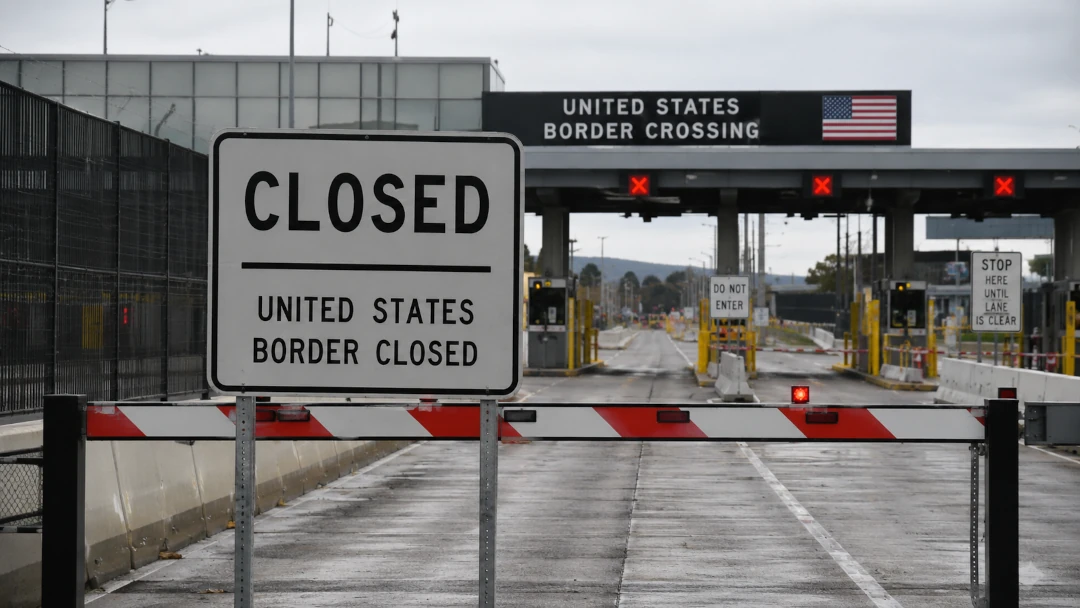
The largest mass visa revocation in U.S. history is arriving at the same moment tourism collapses, weapons stockpiles empty, energy bills climb, and the national debt tips past $38 trillion. What connects these fires is not policy. It is a leadership vacuum — and the Constitution provides a remedy.
On Monday, August 24, the Associated Press reported that the State Department is preparing to revoke up to 200,000 business and tourist visas — the largest single mass revocation in the history of the United States. The targets are B1 and B2 visa holders issued between 2016 and 2026 who have applied for, or are currently seeking, asylum. The action is being coordinated between the State Department and the Department of Homeland Security. It will, in the words of the Associated Press, almost certainly face legal challenges. It should. Because behind the sanitized language of “recategorization” sits a policy that is simultaneously cruel, economically self-destructive, and a window into who this administration considers worthy of American soil.
Deputy Secretary of State Christopher Landau announced the initiative on social media, framing it as a crackdown on people who “come to the United States claiming to be short-term visitors, but then file for asylum.” What Landau did not say — what State Department spokesman Tommy Pigott did not say — is that filing an asylum claim after arriving on a valid visa is a legal act. It is what the 1980 Refugee Act and the 1951 Refugee Convention specifically permit. The government is not punishing lawbreakers. It is punishing 200,000 human beings for using a legal process the United States itself created.
Do the math on what is happening here. On one side of the ledger, the administration is stripping status from 200,000 people who followed the rules and filed for protection. On the other side, President Trump is personally selling a “Gold Card” residency for $5 million and a “Platinum Card” that lets buyers spend most of the year in America without paying U.S. taxes on foreign income. When asked whether Russian oligarchs would qualify, the president said yes, adding that he knows “some Russian oligarchs that are very nice people.” That sentence is not an aside. It is the policy.
I. The Scale of the Revocation
The 200,000 figure is not a ceiling that the administration has definitively committed to; State Department spokesman Tommy Pigott has said the number remains “fluid” because revocations would occur on a rolling basis. But NBC News, citing State Department documents obtained by the AP and two U.S. officials, reports that the plan is drafted and expected to be announced within weeks unless it is challenged. Since President Trump began his second term, his administration has steadily tightened the visa apparatus — demanding social media histories, requiring bonds of up to $15,000 for visitors from about 50 countries, and imposing outright bans on citizens of others.
None of that produced anything resembling a security dividend. It produced, instead, what the tourism industry now openly calls the “Trump slump.”
Cumulative U.S. tourism industry shortfall projected for 2025 and 2026 combined, according to Tourism Economics. Bloomberg
Drop in travel from Canada — the single largest source of U.S. foreign tourists — over the course of 2025. The Conversation
The U.S. is the only one of 184 countries the World Travel & Tourism Council tracks that saw foreign visitor spend fall in 2025. WTTC via Independent
The lowest refugee ceiling in the program’s history — down from 125,000 under Biden. Priority given to white Afrikaners. TIME
Julia Simpson, president of the World Travel and Tourism Council, put it plainly earlier this year: while other nations “roll out the welcome mat,” the U.S. is putting up “the closed sign.” The revocation of 200,000 additional visas will not reverse that trend. It will accelerate it. Every future traveler who reads the words “largest mass visa revocation in U.S. history” will think twice about booking a room in Orlando or Las Vegas. The American Prospect notes that California alone stands to lose meaningfully from a state tourism economy that generates roughly $157 billion in visitor spending. That is real money, real hotel jobs, real restaurant paychecks, real state tax revenue — being deliberately incinerated.
“While other nations are rolling out the welcome mat, the U.S. government is putting up the closed sign.”
— Julia Simpson, President & CEO, World Travel & Tourism Council
II. The Two-Tier Nation: Asylum Seekers Out, Oligarchs In
The most morally clarifying fact in this entire policy landscape is that the Trump administration is not opposed to immigration. It is opposed to a particular kind of immigrant. If you are a Central American asylum seeker, a Venezuelan family, an Afghan interpreter who worked alongside American soldiers, or a Sudanese refugee fleeing a genocide, the door is closed. If you can write a check for $1 million to the Department of Commerce, the door opens. If you can write one for $5 million, it opens wider, and you get a laminated card with Trump’s face on it.
The “Gold Card,” formalized in Executive Order 14351 in September 2025 and rolled out in December, replaces the EB-5 investor visa program that at least nominally required a job-creating investment. The Gold Card requires no such investment. It is a direct payment. As CBS News and NPR have both documented, the president has floated wildly speculative revenue figures — one million cards at $5 million each, he said, would pay down a large share of the national debt. Immigration attorneys interviewed by NPR describe sales expectations “in the low thousands.”
Meanwhile, refugee admissions have not just been curtailed — they have been racialized. Of the 4,999 refugees admitted in the first months after the administration’s new determination, MSNBC reported, 4,496 were white South Africans. The remaining three were Afghans. A separate Daily Maverick analysis found that of 7,730 refugees admitted during a longer window, all but three were from South Africa. The government of South Africa — and top Afrikaner civic organizations themselves — have publicly rejected the president’s claims that white farmers are being systematically persecuted. The International Refugee Assistance Project is now in federal court arguing that the policy is illegal racial discrimination in violation of statute.
These are not separable stories. They are the same story. A president who tells the world that residency is available for $1 million cash, who imports white Afrikaners while shutting out Iraqi allies and Iranian religious minorities, who now moves to strip visas from 200,000 people whose only offense was applying for asylum — that president is not managing an immigration system. He is running a sorting machine, and the sorting criterion is not law. It is race and wealth.
III. The Bill Comes Due: Debt, Prices, and an Empty Arsenal
The visa purge does not arrive in a vacuum. It arrives at a moment when this administration is presiding over a cascade of crises that any first-year economics student could have predicted from the policy mix.
The debt. The Congressional Budget Office now projects that debt held by the public will climb from 101 percent of GDP to 120 percent by 2035, exceeding all historical highs. The 2026 deficit alone is roughly $100 billion larger than pre-legislation projections. The gross national debt has crossed $38 trillion. The immigration crackdown is not incidental to that. Analyses published this year estimate the debt-to-GDP ratio in 2035 could hit 129 percent instead of the pre-crackdown projection of 118 percent, driven in significant part by the labor-force contraction the deportation regime creates.
The affordability crisis. Home electricity bills reached their highest average summer rate in twelve years. Residential electricity rates have risen 18 percent since Trump’s inauguration. On the campaign trail, the president promised a 50 percent cut in eighteen months. That deadline arrived in July. Instead of cutting bills in half, his administration produced the largest rate-hike request quarter in recent memory: $9.2 billion in utility rate hike proposals in Q2 2026 alone, up 26 percent year over year. The clean-energy rollback under the “One Big Beautiful Bill” is projected by Energy Innovation to add roughly $460 per year to household energy costs by 2035.
The empty arsenal. The administration has claimed for years that aid to Ukraine hollowed out U.S. munitions. CBS News reports, citing President Zelenskyy and confirmed by defense experts, that America’s Middle East allies burned through 800 Patriot interceptor missiles in the first week of the war with Iran alone — more than Ukraine used in four years fighting Russia. Reuters reporting cited by defense analysts finds the United States has now depleted virtually all of its ATACMS and PrSM missile stockpiles and consumed nearly half the global stockpile of Tomahawk cruise missiles — largely in a war of the president’s choosing. The White House is now asking Congress for approximately $200 billion in supplemental defense funding, nearly four times what the U.S. supplied to Ukraine over three years.
“To the extent that U.S. stockpiles are being depleted, it has much more to do with what has been going on in the Middle East over the last nine months than what has happened in Ukraine.”
— Thomas Karako, Director, Missile Defense Project, Center for Strategic and International Studies
Every one of these problems compounds the others. Higher electricity bills eat into wages already savaged by tariff-driven inflation. A shrinking labor force from mass deportations forces employers to raise wages in ways economists at the Economic Policy Institute project will still leave the country with millions fewer employed U.S.-born workers over four years, thanks to the ripple effects. The war in Iran, launched without congressional authorization, is draining the very stockpiles the president once claimed to protect. And the visa revocation actively pushes away the foreign spending that could have offset some of the fiscal bleeding.
IV. A Timeline of Escalation
President Trump signs an executive order indefinitely halting refugee admissions through the U.S. Refugee Admissions Program on his first day in office.
Two weeks after halting refugee admissions, Trump announces an exception for white Afrikaners from South Africa, whom he claims face racial persecution — a claim rejected by the South African government.
A chartered flight carrying 59 white South Africans lands at Dulles as the first beneficiaries of the new refugee framework. Sudanese, Afghan, and Iranian applicants remain locked out.
Trump signs Executive Order 14351, formally establishing the Gold Card residency-for-sale program at $1 million per person, $2 million per corporate sponsorship, with a $5 million Platinum tier offering tax exemptions on foreign income.
The White House sets the refugee ceiling at 7,500 per year, the lowest in the program’s history, with slots “primarily allocated among Afrikaners from South Africa.”
Fatal shootings of Renee Good and Alex Pretti by ICE and CBP agents in Minneapolis touch off nationwide protests. Democrats begin campaigning explicitly against the administration’s immigration enforcement.
House Judiciary Ranking Member Jamie Raskin formally demands a comprehensive cognitive evaluation of the president amid what he calls “bipartisan alarm” over Trump’s fitness following the Iran war escalation.
Rep. Raskin introduces legislation to establish a bipartisan independent commission to activate the 25th Amendment process.
A statement signed by 36 neurologists and psychiatrists, citing observable cognitive deterioration and nuclear-command risks, is entered into the Congressional Record urging the president’s removal.
The Associated Press reports the plan to revoke up to 200,000 B1/B2 visas — the largest mass visa revocation in U.S. history.
Get Involved Today
Contribute to our mission and turn your concerns into action.
V. What Democrats Are Doing — and What They Have Promised
The picture in Congress is more active than the national conversation often admits. Democrats are boxed in by a Republican trifecta, but they have not been idle. Senate Democratic Whip Dick Durbin (D-Ill.), Sen. Alex Padilla (D-Calif.), Rep. Jamie Raskin (D-Md.), and Rep. Pramila Jayapal (D-Wash.) — the ranking members with jurisdiction over the Judiciary and Immigration committees — have led coordinated pushback, including a June letter to USCIS Director Joseph Edlow objecting to green-card rule changes that would force noncitizens to apply from abroad and prove their U.S. presence is “in the national interest.”
Padilla and Sen. Adam Schiff earlier this month introduced the Fairness to Freedom Act of 2026, which would guarantee legal representation for anyone facing deportation or immigration proceedings — a right that presently does not exist for non-citizens. Rep. Norma Torres, Rep. Grace Meng, Rep. Pramila Jayapal, and Rep. Robert Garcia are leading the House companion. Padilla has separately re-introduced the Dignity for Detained Immigrants Act to overhaul what he has called a “cruel” detention system, and, with Jayapal, the Access to Counsel Act to ensure U.S. citizens and green card holders can consult attorneys during immigration encounters.
In February, House Minority Leader Hakeem Jeffries and Senate Minority Leader Chuck Schumer submitted ten specific proposals during DHS funding negotiations, including a codification of the “sensitive locations” policy that bars immigration enforcement at hospitals, schools, and churches. The White House’s response, in the words of the two Democratic leaders, was “incomplete and insufficient.” The DHS funding fight remains unresolved.
The larger commitment, articulated by the New Democrat Coalition and echoed by Padilla in his re-introduction of the Renewing Immigration Provisions of the Immigration Act, is this: if Democrats retake the House and Senate in November, they intend to advance a pathway to citizenship for Dreamers, TPS holders, and long-term residents; formalize the sensitive-locations rule; codify the right to counsel in deportation proceedings; and roll back the Gold Card program and the racially discriminatory refugee determination.
They will not, they cannot, do any of that without control of the chambers.
When policy failure becomes evidence of incapacity
Ratified in 1967, the 25th Amendment establishes the mechanism by which a president who is “unable to discharge the powers and duties” of the office may be temporarily or permanently replaced. Section 4 permits the Vice President and a majority of the Cabinet — or a body Congress designates by law — to submit a written declaration of presidential incapacity. If the president contests it, Congress may sustain the removal by a two-thirds vote of both chambers.
The amendment was written in the shadow of the Kennedy assassination. Its drafters worried about physical incapacitation. But the constitutional text says “unable” — not “medically incapacitated.” The framers of the amendment left the standard for Congress and the executive to define through practice.
The lawmakers who have already invoked it
Rep. Jamie Raskin, ranking member of the House Judiciary Committee, formally wrote to the White House physician on April 10, 2026, demanding a full cognitive evaluation of the president. Four days later, he introduced legislation to establish a bipartisan independent commission to activate the 25th Amendment process. Sen. Ed Markey (D-Mass.), Rep. Eric Swalwell (D-Calif.), Rep. Sydney Kamlager-Dove (D-Calif.), and Rep. Yassamin Ansari (D-Ariz.) have all publicly called for invocation. As The Hill has documented, thirty-six neurologists and psychiatrists submitted a statement into the Congressional Record on May 5, 2026, warning of the president’s “rapidly worsening, reality-untethered, increasingly dangerous decline” and urging his removal “with the greatest urgency.”
The constitutional argument
The argument being made by Raskin and his colleagues is not that Trump has bad policies. It is that the pattern of conduct — launching a war without congressional authorization, threatening civilizational annihilation on social media, publishing AI images of himself as a religious figure, insulting a sitting Pope, alienating the country’s oldest allies, presiding over a debt spiral, an energy price spike, and now an immigration policy so racially explicit and economically self-destructive that it defies rational governance — is evidence of an inability to discharge the office responsibly. The 200,000-visa revocation is not the whole case. It is one entry in a ledger.
The practical barriers — and why they don’t end the argument
Honesty compels acknowledgment: the 25th Amendment as written places the trigger with the Vice President and Cabinet, not Congress. Vice President J.D. Vance and this Cabinet will not act. The Raskin commission bill will not pass a Republican-controlled House. Even in a Democratic Congress, sustaining a Section 4 removal against a president’s objection requires two-thirds of both chambers — a threshold not remotely within reach.
But that does not make the argument academic. Constitutional accountability lives in the making of a public record. The neurologists’ letter, the Raskin bill, the demand for a cognitive evaluation — these are the mechanisms by which a self-governing people put on the record that the emperor has no clothes. They are how Congress fulfills its duty to name what is happening even when the votes for removal are not there. They are how a democracy remembers what it saw. The 25th Amendment case is not primarily a path to Vance’s inauguration. It is a demand that leaders on both sides of the aisle stop pretending this is normal.
VII. What This Says About Priorities
Reduce this presidency to its immigration ledger and you learn everything you need to know about who it serves.
Two hundred thousand asylum seekers — people who applied legally, whose only offense was believing the paperwork — are being stripped of status while their tourist dollars, their labor, and their contributions to the tax base evaporate. Meanwhile, the president is personally hawking $5 million residency cards to men whose fortunes were built inside authoritarian regimes, and cheerfully suggesting that Russian oligarchs are welcome buyers. Refugee slots that historically went to interpreters who risked their lives for U.S. soldiers, to religious minorities fleeing execution, to victims of the world’s ongoing atrocities — those slots are now reserved, almost exclusively, for a white ethnic minority in a country whose government has repeatedly denied that persecution is occurring.
The through-line is not policy. It is a worldview. This is a president who believes citizenship is a commodity to be sold to the rich, denied to the desperate, and gifted along racial lines. He believes American power exists to enrich its owners and punish its critics. He believes wars can be launched by tweet, that stockpiles are inexhaustible, that debts do not come due, and that voters will thank him for higher electricity bills as long as he insults the right people while charging them. He is wrong about all of it. The bills are coming due.
Editorial Conclusion
Here is what is at stake. A country that revokes 200,000 visas in a single stroke while selling residency to oligarchs is not conducting immigration policy. It is auctioning citizenship. A country whose president burns through Patriot missiles in a war of choice while asking Congress for $200 billion to replace them, whose electricity prices rise 18 percent instead of falling 50 percent, whose debt-to-GDP ratio is projected to blow past every peacetime record — that country is not being led. It is being liquidated for parts.
The 25th Amendment will not be invoked this month. It may not be invoked at all. But the case for it — the record of a presidency unable to discharge the duties of the office in any coherent, lawful, or morally defensible way — is now written into the Congressional Record and into the ledgers of every family paying more for groceries, power, and rent while their government sells access to the highest foreign bidder.
In November, voters will be asked whether the door of the country is theirs to close, or Trump’s to sell. There is only one right answer. Everything — the Constitution, the economy, the arsenal, the moral standing of the United States — depends on giving it.
Sources & References
- PBS NewsHour / APU.S. set for largest mass visa revocation in history targeting up to 200,000 foreigners
- NBC NewsU.S. preparing for mass visa revocation targeting up to 200,000 people, officials say
- Al JazeeraUS plans to revoke business, tourism visas of 200,000 asylum seekers
- Business StandardUS likely to revoke up to 200,000 tourist, business visas of asylum seekers
- BloombergHow Trump’s Policies Cost US Travel Industry $40 Billion
- The ConversationWill a ‘Trump slump’ continue to hit US tourism in 2026
- ReasonWhy foreign tourism to the U.S. is declining under Trump
- The Independent (WTTC)US is the only country facing tourism decline, WTTC finds
- The American ProspectTrump’s Deportation Crackdown Is Hurting Tourism
- NPRTrump’s $5 million Gold Card offers the rich a fast lane to residency
- CBS NewsTrump proposes $5 million “gold card” to wealthy immigrants: how it works
- TIMETrump Admin Limits Refugees, Prioritizing White South Africans
- MSNBCTrump’s white supremacy refugee policy is in full effect
- Daily MaverickHow Trump’s ‘white preference’ saw 7,727 SA ‘refugees’ enter U.S.
- Al JazeeraCBO: US Federal deficits and debt to worsen over next decade
- CNNTrump promised to cut electric bills in half. His energy policy is doing the opposite
- 24/7 Wall St.Trump Promised He’d Reduce Electricity Prices By 50% In 18 Months. We Ran The Numbers.
- CBS NewsTrump says Ukraine war depleted U.S. weapons stockpiles, but as Iran takes that mantle, Kyiv sees opportunities
- House Judiciary DemocratsRaskin Demands White House Physician Evaluate Trump’s Cognitive Fitness
- The HillConcerns Grow Over Trump’s Mental Fitness for Presidency
- News From The StatesDems push to revert to earlier immigration policy to rein in Trump’s crackdown
- Sen. PadillaPadilla Cosponsors Bill Providing Right to Legal Representation for Individuals Facing Deportation
- Rep. JayapalCongressional Democrats Press Trump Administration on Green Card Application Changes
- Solow Hartnett Immigration LawThe Hidden Economic Cost: How Immigration Policy Is Quietly Reshaping the American Economy
Related News