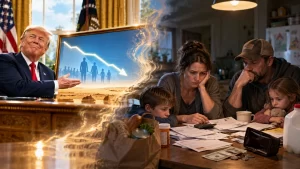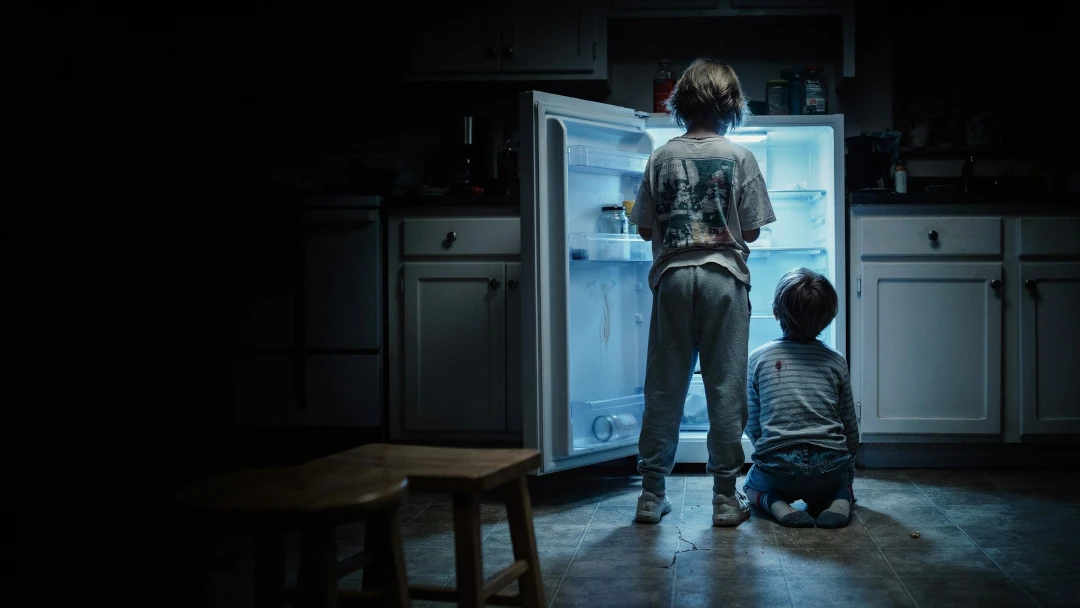
A 6-year-old at the fridge, hoping food would appear. This is what America now does to its children.
More than a million children have been thrown off food assistance since Donald Trump signed the largest cut to SNAP in history — a cut that paid for a $2.3 trillion tax windfall for the richest households in the country. The bill has come due, and children are paying it.
In a modest kitchen in Texas, a six-year-old girl stood in front of her family’s refrigerator, waiting. She had been told there was no food. She stood there anyway, hoping some might appear. In Delaware, an eleven-year-old asked her mother why the family could no longer afford Cinnamon Toast Crunch. In New Jersey, four siblings begged their mother for groceries, and their mother had to tell them, again, that she could not buy any. These are not scenes from a documentary about a distant country. They are scenes from the United States in the summer of 2026, reported by NBC News as part of its investigation into what the Trump administration has done to America’s hungriest children.
The scale is not in dispute. According to the Center on Budget and Policy Priorities, more than 4.5 million people — including at least 1.1 million children in the 22 states that publicly report child-level data — have been cut off the Supplemental Nutrition Assistance Program since Congress passed and the president signed the so-called “One Big Beautiful Bill Act” on July 4, 2025. The Center on Budget and Policy Priorities calls it the steepest short-period decline in the program in nearly thirty years. It is not because Americans have gotten richer. It is not because fewer families need help. Food is more expensive, wages have declined in real terms year-over-year, and food insecurity is climbing. Children are hungry because Washington decided to make them hungry.
I. The Largest Cut to Food Aid in the Nation’s History
The One Big Beautiful Bill Act cut roughly $187 billion from SNAP over ten years — approximately twenty percent of the entire program — and did so by design, not accident. The NAACP Legal Defense Fund characterizes it as the largest cut to SNAP in the program’s sixty-year history. The Congressional Budget Office estimated that the changes would cut off roughly 4 million people in a typical month. That estimate is turning out to be conservative.
The mechanisms are technical, but their effects are not. The law extended punishing work requirements to adults aged 55 to 64, to veterans, to people experiencing homelessness, to young adults recently aged out of the foster system, and — most consequentially for the current numbers — to parents and caregivers of children as young as 14. Previously, households with dependents under 18 were exempt. Now, a single mother of a 14-year-old who cannot document 80 hours of qualifying work each month loses her family’s benefits. The law also shifts, for the first time in the program’s history, a share of both administrative and benefit costs onto the states, according to The Pew Charitable Trusts — a fiscal squeeze designed to force states to tighten eligibility on their own or eliminate the program entirely.
Children Cut Off
Across the 22 states with public data. Actual total is significantly higher. CBPP
Arizona Child Collapse
205,223 Arizona children lost benefits in ten months — the largest drop in the country. ProPublica
II. What Hunger Does to a Child
The debate in Washington sometimes proceeds as if food assistance were a line item, a budget category, a talking point. It is not. It is a biological input to a developing human brain, and its absence causes measurable, permanent damage. Mariana Chilton, a child-hunger researcher at the University of Massachusetts Amherst quoted by ProPublica, described the crisis as a public-health emergency in the making and compared prolonged hunger during early childhood to a brain injury. That is not rhetoric. It is the medical literature.
The peer-reviewed consensus is unambiguous. A Nature study on childhood malnutrition and cognitive development found that undernutrition during early childhood produces “largely irretrievable” damage to brain architecture, with cascading effects on memory, executive function, and academic achievement. Research in Seminars in Pediatric Neurology documents that early-life undernutrition raises the adult risk of schizophrenia, depression, and cognitive decline. Studies of school-age children find that food-insecure kids score meaningfully lower on math assessments and miss more school days than their food-secure peers, according to summaries compiled by public-health researchers tracking the crisis.
“Hunger during early childhood is not a policy inconvenience. It is a wound to a developing brain — one that reshapes what a child will be able to learn, earn, and become for the rest of their life.”
— Peer-reviewed medical consensus
None of this is contested science. It has been the consensus of pediatricians, developmental psychologists, and public-health economists for more than a generation. Every child pushed off SNAP by the One Big Beautiful Bill Act is, in effect, a child whose future cognitive ceiling Congress and the president chose to lower — in exchange for a tax cut that flows overwhelmingly to households the child will never live in.
III. Who Ate the Children’s Lunch: A Tax Windfall for the Top
The trade-off at the heart of the legislation is not a matter of opinion. It is arithmetic. According to an analysis by the Center for American Progress, the One Big Beautiful Bill Act delivers roughly $4.5 trillion in tax cuts, with approximately $2.3 trillion of those cuts flowing to the richest ten percent of Americans. Over the next decade, the top ten percent will gain an average of $14,000 per year in tax breaks. The top one percent will pocket more than $50,000 a year. At the same time, the legislation cuts more than $1 trillion from SNAP, Medicaid, and related health programs. Center for American Progress calls it an upward redistribution of income unprecedented in American history.
The Yale Budget Lab found that when the bill’s tax cuts, its SNAP and Medicaid reductions, and the administration’s tariffs are combined, the bottom eighty percent of American households will see their incomes fall. Analysis from the Penn Wharton Budget Model — associated with the president’s own alma mater — found that the top ten percent of earners will receive roughly 80 percent of the legislation’s benefits, while the bottom forty percent will see their incomes decline. In South Carolina, according to the Institute on Taxation and Economic Policy, the top one percent averages a $68,260 tax cut; the poorest residents will see an average tax increase of $30 alongside deep cuts to Medicaid and SNAP.
These are not, in other words, competing priorities within a scarce budget. They are the same policy. The children in Texas standing in front of empty refrigerators are the offset that pays for the estate-tax cut for the 4,000 wealthiest estates in America. That is the deal that was signed into law on Independence Day, 2025.
IV. What Congress Is Doing — and Refusing to Do
On November 20, 2025, Senate Democrats — led by Agriculture Committee Ranking Member Amy Klobuchar of Minnesota, Senator Ben Ray Luján of New Mexico, Senator Jeff Merkley of Oregon, Democratic Leader Chuck Schumer, and, in the House, Representatives Jahana Hayes of Connecticut and Angie Craig of Minnesota — introduced the Restoring Food Security for American Families and Farmers Act. The bill would fully repeal the SNAP cuts contained in the One Big Beautiful Bill Act and restore the nearly $200 billion the reconciliation law stripped from the program. Every Senate Democrat and Independent — from Cory Booker of New Jersey to Bernie Sanders of Vermont to Elizabeth Warren of Massachusetts to Mazie Hirono of Hawaii — signed on as a cosponsor. Klobuchar accused the administration of taking every opportunity to make it harder for Americans to put food on the table. Hirono, in her own statement, said the administration had made clear it does not care whether millions of Americans go hungry.
“Genuine question: Why is the Trump Administration so hellbent on people going hungry?”
— New York Governor Kathy Hochul, reacting to USDA’s threats to withhold benefits
The bill has not moved. Republicans control both chambers and the White House. There is no Republican co-sponsor. There is no scheduled markup. The public position of House and Senate GOP leadership remains that the underlying law is working as intended — that stripping benefits from more than a million children is not a bug but a feature, a message to America’s poorest families that assistance is being “restored to those who really need it,” to borrow the framing Agriculture Secretary Brooke Rollins has used in defending the cuts and in demanding sensitive personal data from state SNAP recipients as a condition of continued federal cooperation.
During the fall 2025 government shutdown, the crisis sharpened. When Senator Elizabeth Warren was asked by Politico whether it was worth pushing the shutdown past November 1 given the coming SNAP funding cliff, her answer was blunt: worth it to whom — to the people who would lose their health care, or the people who would lose their food? The Republicans, she said, evidently did not care whether Americans had either. The Trump administration, for its part, initially moved to stop SNAP payments altogether during the shutdown, a move ultimately blocked by federal courts.
Get Involved Today
Contribute to our mission and turn your concerns into action.
V. The Map of Cruelty: Red States, Blue States, and Hungry Children
The geography of the crisis has an ugly symmetry. The USDA’s own data, before the administration abruptly ended twenty-seven years of annual food-insecurity reporting, showed that food insecurity is concentrated in the South and Southwest. Louisiana, Oklahoma, and West Virginia see more than fifteen percent of their populations rely on SNAP. Alabama, Kentucky, North Carolina, Florida, Mississippi, Texas, South Carolina, and Missouri all sit above ten percent. Of the ten states with the highest food insecurity rates in the nation, eight voted for Donald Trump in 2024.
The states hemorrhaging children off SNAP fastest are, in general, the states most dependent on it. Arizona has lost 55 percent of its child SNAP enrollment. Louisiana has lost 22 percent of its child caseload. Florida is down 21 percent overall. Oklahoma is down nearly 18 percent. Mississippi is down 12 percent, according to Mississippi Today. These are the constituents of the senators and representatives who voted for the bill. Their children are the hungriest.
“One of the first and most basic priorities of governing is to ensure that families do not go hungry… But no state can fill the enormous gap created by Donald Trump and his administration.”
— Maryland Governor Wes Moore
Blue-state governors have moved, within their capacity, to blunt the damage. During the shutdown alone, according to a Newsweek tally, eight states — Maryland, Delaware, Hawaii, New Mexico, Rhode Island, Vermont, Virginia, and, notably, red-led Louisiana under Governor Jeff Landry, who authorized $150 million in state funds — plus the District of Columbia stepped in with emergency food-assistance appropriations. But as the University of Kentucky’s James Ziliak told Newsweek, these state efforts covered less than five percent of the actual gap in states like Kentucky and Oregon. The math simply does not work. States cannot pay for a federal cut of $187 billion.
And so, in state after state — mostly the states whose voters put the current administration in office — governors and legislatures have chosen a different path: they have let their children go hungry. There are food pantries in Jackson, Mississippi extending their hours, and there are church volunteers in rural Arizona stocking shelves. There is not a state government that can, or in many cases will, substitute itself for the federal program that has fed America’s children for sixty years.
VI. What the Administration Is Doing to Feed Children
The honest answer is: essentially nothing. The One Big Beautiful Bill Act was the administration’s SNAP policy. Since its passage, the administration has taken a series of additional actions that increase, rather than reduce, the number of children who will go hungry.
The administration canceled 84 million pounds of food aid already scheduled for distribution through charitable partners. It abruptly ended, after twenty-seven consecutive years, the annual USDA report on household food security — the primary federal instrument for measuring hunger in America. During the shutdown, USDA moved to halt SNAP payments entirely, backing off only after federal courts intervened. In December 2025, Agriculture Secretary Brooke Rollins announced that USDA would withhold administrative funds from twenty-one Democratic-led states unless they turned over sensitive personal data on SNAP recipients, including immigration status — a demand that a federal judge in San Francisco had already found likely unlawful. Minnesota Attorney General Keith Ellison described the maneuver as an attempt to punish political rivals. A spokesperson for California Governor Gavin Newsom called cutting programs that feed American children morally repugnant.
There is no administration initiative to reduce child hunger. There is no White House task force. There is no comprehensive plan. There is, instead, a president who signed a bill that produced the largest food-aid cut in American history, and who has spent the year since defending it, extending it, and weaponizing it against political opponents.
VII. A Timeline of Deliberate Harm
VIII. What This Does to America’s Future
There is a version of this story told entirely in the register of moral outrage, and it is warranted. There is another version told entirely in the register of national competitiveness, and it is equally warranted. As Feeding America concluded in a landmark study, the effect of child hunger in the United States is a contributing factor to the nation’s economic decline and a source of long-term competitive disadvantage. A hungry child becomes a diminished adult. A cohort of diminished adults becomes a diminished workforce. A diminished workforce loses to nations that fed their children.
Every serious analysis of long-term American economic performance treats human capital formation — the health, nutrition, and education of children from birth through adolescence — as foundational. The countries that outcompete the United States in the coming decades will be, in significant part, the countries that did not permit a million-plus of their children to be pushed into food insecurity in a single year in order to fund an estate-tax cut. The consequences of the choices made in July 2025 will be showing up in remedial-education budgets, in prison populations, in workforce-productivity statistics, in mental-health caseloads, and in national output figures for the next forty years. This is the bill for a Big Beautiful Bill. The president will not be around to pay it. The children standing at the refrigerator will.
IX. The Question of Fitness
All of this occurs against a backdrop that this publication and many others have been reporting for months: an escalating national conversation about whether the current president is fit to hold the office. That conversation did not begin with SNAP. But SNAP belongs in it.
The 25th Amendment, and the case that governance itself has become the evidence
Section 4 of the 25th Amendment provides that the Vice President and a majority of the Cabinet — or another body Congress designates — may declare a president “unable to discharge the powers and duties of his office,” transferring authority to the Vice President. The mechanism was designed for physical or mental incapacity, not policy disagreement. That distinction is legally real, and honesty about it matters.
But the calls for its invocation have already been made, and they are not fringe. On April 7, 2026, Congressman Raja Krishnamoorthi of Illinois publicly called on Vice President JD Vance and the Cabinet to invoke the amendment. Congressman Shri Thanedar of Michigan wrote the same day to all sixteen Cabinet members. On April 14, House Judiciary Ranking Member Jamie Raskin of Maryland introduced legislation, with fifty Democratic co-sponsors, to establish a bipartisan Commission on Presidential Capacity — the body the 25th Amendment itself contemplates. On April 30, Senators Sheldon Whitehouse and Jack Reed of Rhode Island entered into the Congressional Record a statement by 36 physicians — neurologists, psychiatrists, and cognitive specialists from Harvard, Tufts, Columbia, and George Washington — warning of the president’s “rapidly worsening, reality-untethered, increasingly dangerous decline” and urging removal under the 25th Amendment “with the greatest urgency.”
The proponents of invocation have grounded their arguments in the president’s rhetoric on Iran, his social-media conduct, and observed behavioral patterns — not in SNAP policy. The constitutional and legal question of “incapacity” is technically distinct from the political question of “bad policy.” A president may sign a cruel law and remain, in the narrow legal sense, capable of discharging the duties of office. This publication will not pretend otherwise.
What we will say is this: the pattern of governance the SNAP crisis reveals — the deliberate design of hunger as policy, the weaponization of federal food payments against states that decline to hand over sensitive personal data, the elimination of the very statistical instrument used to measure the harm, the abandonment of a sixty-year bipartisan consensus that children should not go hungry in America — is not the pattern of a functional presidency. It is the pattern of a presidency in which the moral guardrails have been removed. Whether that meets the legal threshold of the 25th Amendment is a question for the Cabinet, the Vice President, and the courts. Whether it meets the moral threshold is a question the country can answer for itself.
X. What Greatness Actually Requires
The country that permits this — that lets its own children stand in front of empty refrigerators so that estates worth $30 million can pass to their heirs tax-free — is not a great country. It is a country in the process of forfeiting its greatness. Greatness is not a slogan on a hat. Greatness is measured in the health and dignity of the smallest and least powerful citizens. By that measure, and by no serious other, the United States in August 2026 is failing.
Editorial Conclusion
A country that engineers hunger in a million of its own children in order to enrich the households of billionaires is not merely governed badly. It is governed against itself. The Restoring Food Security for American Families and Farmers Act must be brought to a vote in both chambers, and every senator and representative who blocks it must be made to explain — on the record, by name — what a six-year-old in Texas standing in front of an empty refrigerator did to deserve the policy they voted to preserve.
Feeding one’s own children is not a partisan priority. It is the minimum condition of a functioning nation. The refusal to do it is the fact from which every other judgment about this administration follows.
Sources & References
- NBC NewsOver 1 million fewer children get food stamps under Trump’s “big, beautiful bill” (Aug. 19, 2026)
- Center on Budget and Policy PrioritiesSNAP Tracker: People Are Losing Food Assistance as the 2025 Republican Reconciliation Law Is Implemented
- CBPPSharp Drop in Number of Children Receiving SNAP Food Assistance Under New Federal Law
- NAACP Legal Defense FundPresident Trump’s “One Big Beautiful Bill Act,” Explained
- Center for American Progress7 Ways Trump’s “Big Beautiful Bill” Hands $2 Trillion to the Rich
- CNBC / Yale Budget Lab“Big Beautiful Bill” mostly benefits the rich, while low earners would suffer, Yale report finds
- ProPublicaMore Than 770,000 Children Are No Longer Receiving SNAP Benefits After Trump Changes Federal Food Program
- Mississippi TodayMississippi sees drop in SNAP after federal cuts
- Sen. Amy Klobuchar / Senate Ag CommitteeDemocrats Introduce Legislation to Reverse SNAP Cuts and Restore Food Security
- Sen. Mazie HironoHirono, Senate Democratic Caucus Introduce Legislation to Reverse SNAP Cuts
- MS NOW / PoliticoHungry kids are about to become the new face of the shutdown
- NBC NewsTrump administration threatens to withhold SNAP benefits from blue states over immigration data
- PBS NewsHourTrump administration says it will withhold SNAP from states led by Democrats if they don’t provide recipient data
- NewsweekMap shows states covering SNAP benefits amid funding lapse
- The Pew Charitable TrustsAs SNAP Changes Shift Food Assistance Costs, States Face New Choices
- ForbesWhy American Hunger And Food Insecurity Is Not A Game
- Rep. Jamie Raskin / House Judiciary DemocratsRaskin Demands Cognitive Fitness Evaluation; Calls to Invoke 25th Amendment
- The HillRep. Jamie Raskin introduces bill to assess president’s fitness under 25th Amendment
- Rep. Raja KrishnamoorthiKrishnamoorthi Calls for President Trump’s Removal Under 25th Amendment
- Nature (Scientific Reports)Effect of nutrition intervention on cognitive development among malnourished preschool children
- Feeding AmericaReport: The Economic Impact of Child Hunger on Our Nation
- NPRThe agriculture secretary says SNAP changes are coming. Here’s what we know
Related News