The Shredder in the Treasury: Trump Deletes the Database That Follows the Money
On August 11, the administration permanently ended beneficial-ownership reporting for U.S. companies — and ordered federal officials to erase what shell-company owners had already disclosed. It is the clearest signal yet that the machinery of financial accountability is being dismantled to protect the class that has always feared it most.
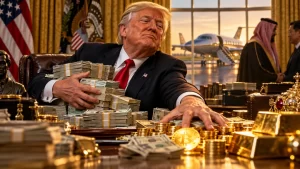
On a warm Tuesday in August, with almost no fanfare and a five-paragraph press release, the United States Department of the Treasury did something that anti-corruption prosecutors, banking regulators, and career federal agents had spent fifteen years warning against. It issued a final rule permanently exempting American companies and American citizens from disclosing to the government who actually owns them. Then it went further. It announced that the beneficial-ownership records already collected under the bipartisan Corporate Transparency Act — records reflecting the true human owners of anonymous shell companies — would be deleted.
The change was signed off by Treasury Secretary Scott Bessent, who called it “a victory for common sense and American small businesses.” What it actually is, on the plainest possible reading of the record, is the deliberate destruction of the single most important anti-money-laundering tool the federal government has built in a generation — assembled with rare bipartisan agreement, championed in the Senate by Republican Marco Rubio, enacted over a first-term Trump veto by a Congress that recognized the national-security stakes, and now dismantled by the same man whose veto Congress once overrode.
To understand what has been taken away, it helps to understand what the Financial Crimes Enforcement Network — FinCEN — actually does. It is the Treasury bureau charged with tracing illicit finance: the money laundered by drug cartels, the sanctions-evading capital of hostile foreign regimes, the anonymous cash that flows through American shell corporations on its way to buying luxury Manhattan condominiums nobody ever seems to live in. The beneficial-ownership database was designed to give authorized law-enforcement agencies a single, searchable answer to the most basic investigative question in white-collar crime: who really owns this company?
That question is the one Donald Trump’s Treasury no longer wants answered.
I. What the Rule Actually Does
The final rule, published in the Federal Register this week, does three things in sequence, each one worse than the last. First, it permanently exempts virtually all domestic U.S. entities from any obligation to file beneficial-ownership information with FinCEN — reversing a reporting regime that Congress enacted in 2021 as part of the National Defense Authorization Act, and that FATF, the global anti-money-laundering standard-setter, considered a long-overdue American catch-up to the transparency norms of every other major democracy. Second, per American Banker’s reporting, it releases anyone who already obtained a FinCEN identifier from any duty to update or correct it. And third — the truly extraordinary step — it directs FinCEN to affirmatively delete previously submitted information the agency “reasonably believes” belongs to U.S. persons.
That last provision is not deregulation. It is not the removal of a “burden.” It is the government affirmatively purging its own evidence.
The Corporate Transparency Act was not a Biden-era progressive experiment. It was a bipartisan measure hammered out over years of hearings, jointly authored in the Senate by Republican Marco Rubio and Democrats Ron Wyden and Sheldon Whitehouse. As The Hill noted this week, Rubio — now Trump’s Secretary of State — once wrote publicly that the CTA was “the most significant anti-corruption & money-laundering law in decades,” a bill that “forces anonymous shell companies to disclose their true owners.” He was right about that then. His government now says he was wrong.
“This is a gift to cartels, criminals, and U.S. adversaries that exploit shell companies to move millions through our financial system.”
— SEN. ELIZABETH WARREN · Ranking Member, Senate Banking Committee · August 12, 2026
II. Who, Exactly, Benefits
Every rollback of this kind has beneficiaries. Small business owners filling out a ten-minute form is the official story the White House would like Americans to keep in mind. The real beneficiaries — the people who genuinely fear a searchable federal database of true corporate ownership — are somewhat different. They are the operators of the anonymous shell entities that former FinCEN investigators have told Congress are used, in the words of one recent witness, by “kleptocrats, foreign officials, and cartels to launder illicit funds and purchase luxury assets in this country.”
Consider the concrete evidence federal officials have themselves put on the record.
Fentanyl & the Cartels
Treasury and DOJ documents cite one case alone in which more than 100 shell companies were used by Chinese money-laundering networks to wash at least $77 million in narcotics proceeds for cartels moving fentanyl into the United States. Warren cites this case as central to the ownership-reporting fight.
Federal Program Fraud
A Government Accountability Office report cited by Sen. Warren and Rep. Waters concluded that beneficial-ownership data would materially assist the fight against procurement, grant, and eligibility fraud across federal programs — a direct hit on taxpayer dollars. Read the September 2025 oversight letter.
National-Security Exposure
Retired Air Force Lt. Col. Jodi Vittori of Georgetown’s School of Foreign Service has testified that anonymous shell companies have been used by backers of the Taliban and Hizbullah to fund operations against U.S. forces. Full FACT Coalition testimony here.
Ten Minutes of “Burden”
Rep. Stephen Lynch, Democrat of Massachusetts, told the House Financial Services Committee earlier this year that the beneficial-ownership form the administration calls “onerous” is a document that takes about ten minutes to complete. Coverage from Thomson Reuters Tax News.
Rep. Maxine Waters, the ranking Democrat on the House Financial Services Committee, put it more bluntly at the April committee vote to gut the same law legislatively: creating a carve-out that exempts Americans from reporting who truly owns their companies would, in her words, “protect terrorists, drug traffickers, gun smugglers.” That is not editorial hyperbole from a partisan outlet. That is the sitting ranking member describing what her Republican colleagues on the committee — and now the Trump Treasury — have voted to protect.
Get Involved Today
Contribute to our mission and turn your concerns into action.
III. The Pattern, Not the Incident
If this were a single administrative decision, one might argue about the balance between compliance costs and enforcement gains. It is not a single decision. It is one entry in a chronology that has become impossible to explain except as a coordinated retreat of the federal government from its own laws.
FinCEN issues an interim rule suspending beneficial-ownership enforcement against domestic companies after a wave of industry lawsuits — the first signal that the Trump Treasury intended to unwind the CTA administratively.
The Justice Department and the IRS reach a $1.776 billion “Anti-Weaponization Fund” settlement that, as later disclosed, extends broad tax amnesty to the president, his family, and his businesses, blocking future audits. Sen. Wyden calls it “self-dealing.”
Sen. Warren releases analysis concluding that the Trump-Vought overhaul of the Consumer Financial Protection Bureau has already cost American consumers roughly $26.5 billion in halted or dismissed enforcement. CNBC report.
After campaigning on releasing the Epstein files, the administration reverses course. Rep. Marjorie Taylor Greene, then a Trump ally, publicly recounts a call in which the president told her, in her own words, “Marjorie, my friends will get hurt.” Full account here.
Treasury issues the final beneficial-ownership rule and announces the deletion of previously reported U.S. person data from the FinCEN database — the subject of this editorial.
Read as isolated events, each of these has an official rationale. Read together, they describe a single project. The tools built to see wealthy people clearly — their money, their audits, their corporate ownership, their proximity to sex trafficking, their consumer-facing misconduct — are being disabled one by one. And the ledger of who is helped is, at this point, not seriously in dispute.
“Donald Trump has turned the federal government into his personal protection racket.”
— SEN. RON WYDEN · Senate Finance Committee · May 2026, on the Trump-IRS tax-amnesty settlement
IV. What This Means for the Average American
The temptation, when writing about beneficial-ownership rules and interim final rulemakings, is to treat this as a technical story. It is not. When federal law enforcement loses the ability to identify who really owns an American shell company, five very concrete things happen to ordinary Americans, and none of them are abstract.
The fentanyl that reaches an ordinary American town becomes marginally easier to finance. The federal grant fraud that inflates every taxpayer’s bill becomes marginally harder to unwind. The foreign kleptocrat parking laundered money in an anonymously owned condominium down the block from a working-class family becomes harder to identify. The sanctioned Russian or Iranian principal seeking to route funds through a Delaware LLC has one fewer American obstacle. And the wealthy domestic tax cheat — the one whose behavior IRS enforcement budgets used to police, before those budgets were cut by an estimated $40 billion over ten years — is now working in an environment engineered for his convenience.
What the average American loses, in other words, is not a form nobody wanted to fill out. What the average American loses is one of the last remaining federal answers to a question every citizen has an interest in: who is moving the money, and are they above the law?
V. What Law Enforcement Is Saying
The reaction from career law-enforcement voices has been unusually plainspoken. Chris LaPrevotte, a former FinCEN investigator, told a House committee earlier this year that “gutting the Corporate Transparency Act would eliminate a key tool needed by law enforcement to follow the money and stop the United States from being a safe haven for criminal proceeds.” Himamauli Das, FinCEN’s own former acting director, told American Banker this week that Treasury and law-enforcement agencies have “repeatedly emphasized the importance of beneficial-ownership information in investigating financial crimes.”
Erica Hanichak of the FACT Coalition — a bipartisan anti-corruption group — was, if anything, sharper: “There could be no greater gift to the fentanyl traffickers, fraudsters, and U.S. adversaries that rely on the anonymity that shell companies provide than gutting the Corporate Transparency Act.” These are not partisan flacks. These are the people whose job it is, or was, to trace illicit finance. They are telling Americans, on the record, that the tool they need has been taken away from them on purpose.
VI. The Refusal to Enforce the Law
There is a specific constitutional obligation, spelled out in Article II, that every president swears to uphold: to “take Care that the Laws be faithfully executed.” Not the laws the president likes. Not the laws that leave his donors alone. The laws. Duly enacted by Congress, signed or overridden by veto, on the books.
The Corporate Transparency Act is on the books. It was passed by a Republican-led Congress, overriding a first-term Trump veto, and reaffirmed by every intervening Congress. What the Treasury has done this week is not repeal it — no rule can repeal a statute — but functionally nullify it, on the theory that the executive branch simply will not collect the information the law demands, and will erase what it has already collected. That is the same executive-branch posture that the CFPB has taken toward dozens of pending consumer-protection enforcement actions, letting more than 40 lawbreakers off the hook in eight months. It is the same posture that the DOJ has taken toward the president’s own tax exposure. It is the same posture that has withheld the Epstein files from the American public until forced by veto-proof majorities in both chambers to release them.
A president who refuses to enforce the laws that duly elected representatives have passed is not merely making policy Americans may disagree with. He is asserting a right to override Congress unilaterally, and to selectively immunize a chosen class — himself, his family, his friends, his donors — from the rules that apply to everyone else. There is a word for that arrangement, and it is not democracy.
The 25th Amendment and the Failure to Faithfully Execute the Laws
The 25th Amendment, ratified in 1967, provides two distinct mechanisms for transferring presidential power when the officeholder is “unable to discharge the powers and duties of his office.” Section 4 authorizes the Vice President, together with a majority of the Cabinet — or with “such other body as Congress may by law provide” — to declare the president unable to serve, at which point the Vice President immediately assumes the office in an acting capacity.
In April 2026, Rep. Jamie Raskin of Maryland, joined by fifty Democratic co-sponsors, formally introduced legislation to establish exactly such a body: a bipartisan “Commission on Presidential Capacity to Discharge the Powers and Duties of the Office” composed of physicians, psychiatrists, and former high-ranking executive-branch officials. Reps. Raja Krishnamoorthi, Eric Swalwell, Sydney Kamlager-Dove, and Yassamin Ansari, and Sen. Ed Markey, have separately called for the amendment to be invoked directly by the Vice President and Cabinet.
The traditional case for Section 4 has focused on cognitive fitness. There is a broader case that deserves to be made honestly. The 25th Amendment does not define “unable to discharge” solely as medical incapacity. An officeholder who systematically refuses to execute laws he is constitutionally sworn to enforce — who deletes evidence, who grants himself audit amnesty, who withholds files that would implicate his associates, who dismantles anti-money-laundering infrastructure while accepting foreign business dealings — is not exercising the office. He is defeating it from within.
The practical barriers are real. Section 4 requires the Vice President to move first, and Vice President Vance has shown no inclination to do so. Any commission Congress establishes must survive presidential veto and Republican control of both chambers. These are structural realities.
But barriers to invocation do not extinguish the constitutional case. The Framers wrote Section 4 into the Constitution precisely because they anticipated an officeholder who might no longer be exercising the office in any recognizable sense. When the president himself has instructed the government to destroy the records used to enforce the law against his friends, the question the amendment was designed to ask has arrived. Whether the political system is willing to ask it is a separate question. The moral and constitutional case is not.
VII. Priorities, and What They Reveal
Every administration has priorities, and every set of priorities eventually becomes a portrait. The portrait now emerging is unambiguous. It shows a presidency that has cut IRS enforcement by tens of billions of dollars while delivering $117 billion in 2026 alone to the top one percent. That has dismissed dozens of pending consumer-protection cases with no public explanation. That has, according to Marjorie Taylor Greene’s own account, personally intervened against the release of the Epstein files because “my friends will get hurt.” That has extracted, via a lawsuit the executive branch effectively brought against itself, a sweeping tax amnesty for the president’s family. And that has now, this week, ordered the deletion of the federal database that would let law enforcement identify who actually owns anonymous American companies.
A leader whose consistent priority is the protection of the class of people around him — himself, his family, his donors, his social circle — from the rules that apply to ordinary Americans is not a leader of the country. He is a leader of a faction, using the machinery of the country to shelter it. That is what the public trust exists to prevent. That is what the public trust has, at this point, been visibly violated to enable.
Editorial Conclusion
The deletion of the beneficial-ownership database is not a technocratic footnote. It is the physical erasure, from federal systems, of the evidence Americans would need to hold powerful people accountable. It is the natural culmination of a presidency that has, methodically and unmistakably, disabled the mechanisms by which the wealthy and connected are made to answer for what they do.
The oath of office is to faithfully execute the laws — not to grant amnesty to friends, not to withhold files that implicate them, not to shred the ledgers that would identify them. A government that will not enforce the laws its own Congress has passed has, in the plainest constitutional sense, ceased to govern. The stakes are not partisan. They are whether the United States remains a country in which the same rules apply to the president as apply to a small-business owner in Beacon or Buffalo or Bakersfield.
That is the question the 25th Amendment was written to make possible to ask. It is time to ask it — and to keep asking it, in every legal and political forum available, until an answer is given.
Sources & References
- U.S. Department of the Treasury — “FinCEN Permanently Ends Beneficial Ownership Reporting Requirements for Millions of Small Business Owners” (Aug. 11, 2026)
- American Banker — “Beneficial ownership regime’s demise removes tool for banks”
- The Hill — “Treasury Department repeals Biden-era FinCEN beneficial ownership reporting requirement”
- Accounting Today — “FinCEN ends beneficial ownership reporting”
- AML Intelligence — “FinCEN ends beneficial ownership reporting for millions of US businesses”
- UPI — “Treasury Department repeals reporting rule for businesses”
- OCCRP — “US Congressional Committee Chips Away at Corporate Transparency Act”
- FACT Coalition — “House Committee Advances Disastrous Bill Gutting Corporate Transparency Act”
- Thomson Reuters Tax News — “House Committee Votes to ‘Gut’ Corporate Transparency Act”
- U.S. Senate Banking Committee — Warren & Waters oversight letter to Secretary Bessent
- Traders Union — “Warren attacks Treasury move weakening shell company transparency law”
- The Daily Beast — “Trump Given Sweeping Tax Amnesty in Secret Deal”
- Forbes — “Can Trump Sue Himself Into Tax Amnesty?”
- Sen. Sheldon Whitehouse — Probe into Trump family tax-fraud amnesty deal
- Institute on Taxation and Economic Policy — “Year One of Trump-Republican Tax Policy: The Consequences”
- Protect Borrowers & CFA — “Trump’s CFPB Has Let More Than 40 Lawbreakers Off the Hook”
- CNBC — “Sen. Warren says Trump’s CFPB overhaul has cost Americans $26.5 billion”
- OK Magazine / AOL — Rep. Marjorie Taylor Greene on Trump call: “My friends will get hurt”
- The Hill — “Rep. Jamie Raskin introduces bill to assess president’s fitness under 25th Amendment”
- Rep. Raja Krishnamoorthi — Statement calling for 25th Amendment invocation
Related News