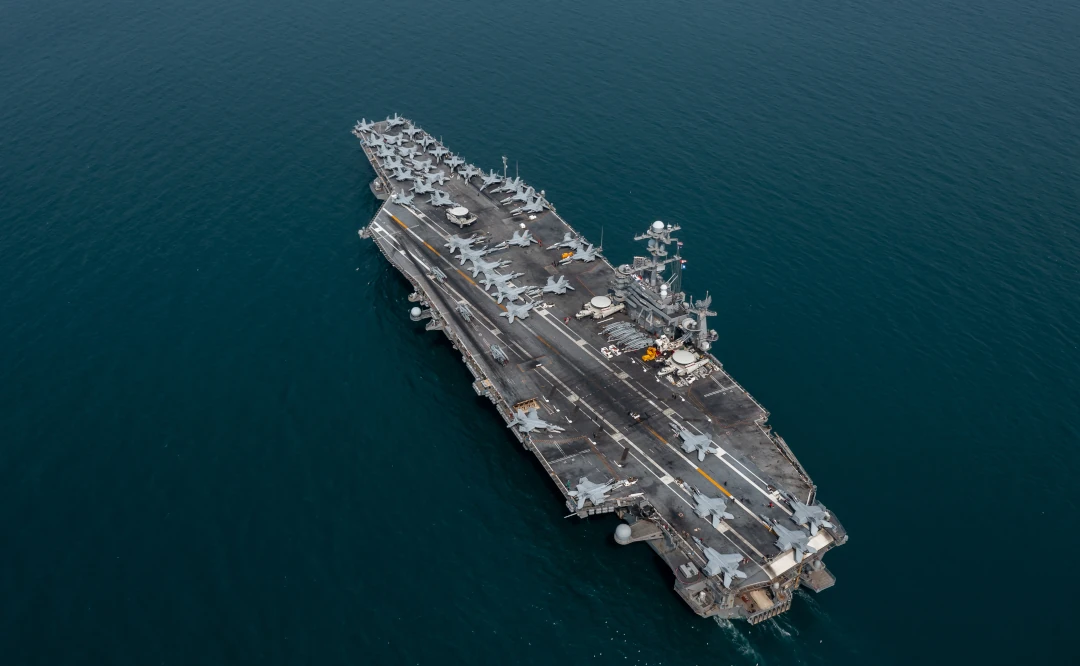
For more than 250 straight days at sea, the 5,000 sailors and Marines aboard the USS Abraham Lincoln have been living on rationed meals, moldy showers, and 16-hour shifts — while the president who ordered this open-ended war refuses to tell them when, or whether, they are coming home.
The USS Abraham Lincoln left Naval Base San Diego on November 21, 2025, bound for a routine Pacific deployment. Its 5,000 sailors and Marines were told they would be home by May. Nine months later, they are still at sea — rerouted to the Persian Gulf, stripped of port calls, working through combat operations against Iran that Congress has never authorized, and, according to reporting this week by Military Times and Stars and Stripes, so ground down by the conditions that multiple crew members have tried to throw themselves into the ocean.
The Navy has quietly confirmed at least one incident to CNN: a sailor went overboard in July, was recovered alive in a life vest, and was classified as a mental health episode. Family members and shipmates describe others who were pulled back from the railing before they jumped. This is what the modern-day record for consecutive days at sea looks like from the inside.
What is happening aboard the Lincoln is not a story about one carrier’s misfortune. It is a direct, human consequence of an undeclared war being run by a commander-in-chief who does not appear to know — or care — that the sailors he keeps ordering to stay at station are collapsing under him.
I. A Ship at the Breaking Point
The physical conditions aboard the Lincoln, as documented by multiple named lawmakers, family members, and the sailors themselves in text messages obtained by reporters, are staggering for a first-tier U.S. warship in 2026. In a formal letter to Defense Secretary Pete Hegseth and acting Navy Secretary Hung Cao, Sen. Richard Blumenthal (D-CT) — a Marine Corps Reserve veteran and Senate Armed Services Committee member — catalogued the failures aboard the ship: shortages of basic supplies, contaminated water, plumbing collapses, deteriorating mental health, deck safety concerns, and a broken mail system that has left care packages from families lost in transit for months.
Days at Sea
Consecutive days without a port call — a modern-era U.S. Navy record, per Sen. Blumenthal’s letter to the Pentagon.
Crew Trapped Aboard
Sailors and Marines deployed in what was supposed to be a seven-month rotation, now stretching past nine, per CNN reporting.
Daily Ration
Rice plus two tortillas — the meal one family described to Rep. Mike Levin, per his public statements to Newsweek.
Shift Length
Working days with no days off, per Sen. Ruben Gallego’s account of what families are reporting from onboard, cited in wire coverage.
Democratic Rep. Mike Levin of California, whose district borders the Lincoln’s home port, met with a dozen families last week and relayed what he was told: moldy showers, broken toilets, weeks without hot water, meager rations. According to his account, one family member said the ship’s own doctor warned crew needed to reach port soon or people would begin losing their minds. That is not a rhetorical flourish from a politician — that is Levin passing along what a Navy physician allegedly told sailors in the middle of a war zone.
Text messages from a Lincoln crew member obtained by the outlet MeidasTouch and reported by Mediaite describe supply ships arriving too infrequently to keep fresh food onboard, and a growing sense among the crew that the Navy chain of command has stopped caring what happens to them. The Washington Examiner — not exactly a progressive outlet — reported that the initial complaints on social media were treated as normal griping until it became clear that self-harm incidents were real and that shipmates had physically pulled crew away from the edge of the deck.
II. The Families Who Will Not Stay Silent
The families of the sailors are the reason this story broke at all. In two town halls with Navy leadership over the past two weeks, Lincoln families reportedly clashed openly with senior officers, demanding a return date and challenging the official denials about conditions onboard.
Annabelle Loma of San Diego told Military Times that her husband, a 13-year Navy veteran, tried to go overboard from the Lincoln during this deployment and is now on medical hold. She has spoken with him only a handful of times since. Her account is one that ought to shake anyone still able to be shaken.
“He’s scared. He thinks he’ll get a dishonorable discharge, and just because he was burnt out, his 13-year career is ruined.”
— Annabelle Loma, wife of a Lincoln sailor, to Military Times
A second wife, Maria Rodriguez, told the same paper that her husband — on watch — spotted a shipmate preparing to go over the side of the ship, ran to him, and physically pulled him back onto the deck before three other sailors arrived to help. He described the adrenaline as unlike anything he had ever felt. This is what “supporting the troops” looks like when it has been outsourced from the president and the Pentagon to a burned-out enlisted man on the graveyard shift.
III. The Pentagon’s “Fake News” Defense
Defense Secretary Pete Hegseth’s public response has been to dismiss the reporting. He told reporters during a trip to Panama on Thursday that accounts of poor conditions aboard the Lincoln had been “completely misrepresented,” and insisted the Navy provides every ship with everything it can. This is the same secretary who initially dismissed the first round of complaints about the Lincoln in April as “fake news”, and who now, four months later, is confronted with named senators, named family members, on-the-record text messages, and a Navy that has itself confirmed a sailor went overboard.
The Navy’s own spokespeople have been more cautious, telling CBS News that the Lincoln is operating in what it called a highly contested environment where traditional supply hubs in the Middle East have been disrupted by combat. That is a significant admission. It is a concession that the ship is not just late for a routine rotation — it is trapped in a war zone whose logistics the administration cannot sustain.
None of this is an isolated malfunction. It is what happens when a Navy already operating with only three or four ready-to-deploy carriers out of an authorized eleven is ordered to indefinitely maintain a carrier strike group in a live war zone with no political off-ramp.
Get Involved Today
Contribute to our mission and turn your concerns into action.
IV. The Commander-in-Chief’s Priorities
President Trump, who ordered the strikes that opened Operation Epic Fury on February 28, has not publicly addressed the sailors of the Lincoln at any length in the days since the reporting broke. He has not visited the ship, has not announced a return date, has not named a replacement carrier’s arrival timeline for the crew still onboard, and has not, in any forum accessible to the public, acknowledged that the men and women he ordered into an open-ended blockade of the Strait of Hormuz are trying to jump into the sea.
He has, however, found time to escalate. In April, Trump publicly threatened that “a whole civilization will die tonight” if Iran did not accept his terms — a threat that prompted more than 70 members of Congress to publicly call for his removal via impeachment or the 25th Amendment. He has ordered strikes on Iranian civilian infrastructure that legal scholars have described as potential war crimes. He has extended the Lincoln’s deployment multiple times without congressional consultation. And through it all, the burden of his rhetoric has been carried by the crews forward-deployed to enforce his ultimatums.
Sen. Gallego, an Iraq combat veteran, put it plainly this week in a public statement on X. Unlike the president, he noted, he has personally seen active-duty service — and what Trump is doing to the sailors and Marines aboard the Lincoln, he wrote, is not merely disgusting but dangerous.
“These sailors are owed a sense of when they will go home.”
— Sen. Ruben Gallego (D-AZ), Marine combat veteran
V. Congress: The Democratic Response, the Republican Silence
The Democratic response has been substantive, if constrained. Blumenthal’s letter to Hegseth and Cao demands answers by August 27 on how many times the deployment has been extended, who authorized each extension, what military objective the continued presence serves, and what metrics the Navy is using to assess fatigue and mental health onboard. Gallego is pressing for a bipartisan congressional delegation to inspect the ship in person. Sen. Mark Kelly (D-AZ), a former Navy combat pilot, called the reports disturbing and noted that long deployments become far more damaging when the mission is undefined and the end date unknown. Rep. Ro Khanna and Rep. Pramila Jayapal have led repeated War Powers Resolution votes in the House to force an end to the war itself.
The record on those War Powers votes tells its own story. On June 3, the House passed a resolution directing Trump to end hostilities with Iran, 215 to 208 — with just four Republicans crossing over: Thomas Massie of Kentucky, Brian Fitzpatrick of Pennsylvania, Tom Barrett of Michigan, and Warren Davidson of Ohio. A second House resolution passed in July with the same four Republicans. Both were blocked in the Senate. The overwhelming majority of Republican lawmakers, in control of both chambers, have chosen to let this war continue — and with it, the deployment that is breaking the Lincoln’s crew.
That is the political geometry sailors are trapped inside: the party of the president will not stop him, and the party out of power cannot. The Senate has not even reached the floor with a binding resolution to end the war. Meanwhile the sailors keep counting days.
VI. What Breaks on This Ship Does Not Stay on This Ship
The long-term outlook for the crew, if this deployment is not urgently ended, is grim. Studies published in the peer-reviewed journal Military Medicine — cited in Newsweek’s coverage — have consistently found that extended underway periods produce elevated stress, degraded access to mental health care, and higher suicide risk. What happens to a 22-year-old machinist’s mate today happens to his marriage, his career, and his mental health for the rest of his life.
The long-term outlook for U.S. military readiness is not much better. The Navy officially maintains eleven aircraft carriers. In practice, as multiple defense analysts have documented in The War Zone and elsewhere, the maintenance backlog, an aging fleet, and simultaneous global demand mean that only a handful are actually deployable at any moment. Every additional month the Lincoln is held at sea past its planned return accelerates equipment wear, cascades scheduled maintenance for follow-on carriers, and — as the USS Dwight D. Eisenhower’s overrun after its 2024 combat cruise proved — postpones the availability of the carrier meant to replace it. The Trump administration is, quite literally, burning through the Navy’s readiness to sustain a war it never asked Congress to declare.
And the impact on the average American is not abstract, even for those with no family in uniform. A prolonged, unauthorized war in the Persian Gulf keeps energy prices elevated, drags on economic confidence, and consumes federal resources — the same resources that could have gone to housing, health care, or veterans’ services back home. Every dollar spent extending the Lincoln’s mission is a dollar not spent on the crumbling VA capacity these same sailors will need when they finally come home. The Iran war has already killed at least eighteen U.S. service members and injured nearly 500, per Pentagon figures cited by NPR. Those numbers grow every week the war continues.
The 25th Amendment Was Written for Exactly This Failure of Duty
Section 4 of the 25th Amendment provides that when the vice president and a majority of the cabinet — or another body designated by Congress — declare in writing that the president “is unable to discharge the powers and duties of his office,” the vice president immediately assumes those powers as acting president. Two-thirds of both chambers of Congress must then ratify the removal if the president contests it. The section has never been invoked. It was drafted in the aftermath of the Kennedy assassination for the express purpose of protecting the country when a president can no longer perform the office’s most basic duties. Command of the armed forces is the most basic duty of all.
What the Lincoln crisis demonstrates is not merely a policy failure. It is a failure of command judgment so pronounced that named lawmakers — Rep. John Larson of Connecticut has already filed articles of impeachment; Reps. Ro Khanna, Mike Quigley, and Shri Thanedar and Sens. Ed Markey, Chris Murphy, and Andy Kim have all publicly called for the cabinet to invoke Section 4 — argue the president can no longer discharge his duties as commander-in-chief in a manner consistent with the safety of the force. A president who cannot tell his own sailors when they are coming home, who dismisses their suffering as fake news through his war secretary, and who publicly threatens the extermination of entire civilizations has, in the plain reading of the amendment’s text, become unable to safely exercise the powers of his office.
The Practical Barriers
The path is genuinely hard. Section 4 requires Vice President JD Vance and a cabinet majority to act, and there is no public indication that any of them intend to. If Trump contests removal, two-thirds of both the House and the Senate must ratify — with Republicans in control of both chambers. As CNN’s analysis in April noted, party loyalty on Capitol Hill has effectively neutralized the amendment’s short-term utility.
Why the Barriers Do Not Negate the Case
The political impossibility of removing a sitting president does not erase the constitutional case that removal is warranted. The framers of the 25th Amendment did not condition its moral force on the party in power. When named senators who served in combat are publicly stating that the president is treating American service members in ways that are “dangerous,” when the Pentagon’s own supply lines cannot sustain the mission the president has ordered, when sailors are trying to jump into the sea rather than continue serving under him — the constitutional record must reflect that the mechanism designed for this moment exists, that it has been formally invoked in public by members of Congress, and that history will remember which officeholders had the option to act and chose not to.
VII. What This Says About the Presidency
Every presidency reveals its priorities in a crisis. Trump’s second-term priority list, as revealed by the Lincoln, is clear: prosecuting an undeclared war against Iran ranks above the physical and mental welfare of the sailors ordered to fight it; the political optics of a “peace through strength” posture rank above bringing 5,000 Americans home; the defense of Hegseth’s competence ranks above the honest acknowledgment that the Navy’s logistics have collapsed. A president who cared about the troops in any operational sense would already have named a return date. He has not.
Leadership of the American military is not a ceremonial title. It is a fiduciary duty to the men and women who wear the uniform. That duty includes not deploying them into open-ended combat without congressional authorization; not extending their tours past the physical and psychological limits documented in the military’s own medical literature; not letting their food, water, and mail systems fail; and not, when confronted with reports that they are trying to jump overboard, dismissing those reports through subordinates as if they were a public relations problem to be managed.
The sailors of the USS Abraham Lincoln did not fail their commander-in-chief. Their commander-in-chief has failed them.
Editorial Conclusion
A president who orders American sailors into an undeclared war, extends them past every limit the Navy’s own doctrine permits, refuses to name a date they can come home, and dismisses their suffering as “fake news” has forfeited the trust that command requires.
Congress must end this war under the War Powers Act — over a veto if necessary. The cabinet must confront, in writing, whether the president is still able to discharge the duties of commander-in-chief. The Lincoln must come home. And the country must remember that a Constitution is only as strong as the officeholders who are willing to invoke it when the moment demands.
Sources & References
- Military TimesMultiple USS Abraham Lincoln sailors have tried to go overboard amid extended deployment, families say (Aug. 11, 2026)
- CNN PoliticsSailor went overboard from the USS Abraham Lincoln last month as conditions on the ship prompt lawmakers’ demand for answers
- CBS NewsDemocratic senators demand answers about conditions aboard USS Abraham Lincoln
- NewsweekNavy responds to reports USS Lincoln sailors are trying to jump overboard
- MS NOWDemocratic senator presses Pentagon over ‘broken toilets’ and ‘mental health’ aboard USS Lincoln
- Rolling StoneUSS Abraham Lincoln sailors try to go overboard: Report
- Military TimesSenator presses Navy for answers on USS Abraham Lincoln deployment
- The New RepublicSailors are trying to jump overboard as Trump’s Iran war drags on
- MediaiteDesperate texts from USS Abraham Lincoln sailors reveal they’re served rotten food
- Al JazeeraReports of US sailors in Middle East trying to jump ship spark outcry
- Jerusalem PostUSS Abraham Lincoln conditions under scrutiny after reports sailors attempted to jump overboard
- Washington ExaminerSpartan conditions amid long deployment take toll on USS Lincoln crew
- NPRHouse passes war powers resolution directing Trump to end hostilities with Iran (June 4, 2026)
- NPRFor a 2nd time, House approves resolution to end the war in Iran in a rebuke to Trump
- TIMEThe Republicans who have voted to limit Trump’s Iran war powers
- NBC NewsDozens of Democrats call for Trump’s removal after his Iran threats
- CNN PoliticsAnalysis: An eclectic, bipartisan group suddenly calls for removing Trump using the 25th Amendment
- Rep. John Larson (D-CT)Larson files articles of impeachment, calls for 25th Amendment
- The War ZoneNavy juggles its aircraft carrier plans to stay afloat
Related News