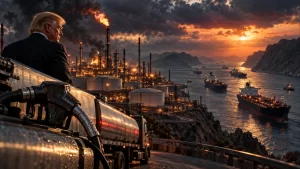
Donald Trump has invoked a Cold War weapons statute to build coal plants nobody wants, killed clean-energy projects in states that voted against him, and handed the industries of the future to China and Europe. This isn’t nostalgia. It’s national self-harm — and the constitutional emergency it represents is no longer theoretical.
On June 4, 2026, standing in the Oval Office beside Energy Secretary Chris Wright, Donald Trump did something no American president had ever done: he invoked a wartime industrial-mobilization statute — the 1950 Defense Production Act, a law written to arm the country against the Soviet Union — to prop up a fuel that the free market has already retired. In the same announcement, the White House committed roughly $700 million in federal money to refurbish 13 coal plants, build two new ones in Alaska and West Virginia, restart a defunct Maryland plant, and construct a West Coast coal export terminal. Trump called it “beautiful clean coal.” What he did not mention is that global coal demand is collapsing, that no serious buyer wants a new American export terminal, and that every other advanced economy on Earth is running as fast as it can in the opposite direction.
To understand how strange this moment is, it helps to remember what the Defense Production Act was designed for. Congress passed it in June 1950, three days before the outbreak of the Korean War, to give the president authority to compel private industry to serve national defense — to build tanks, planes, and ammunition when America was being outbuilt. In April 2026, Trump issued a Presidential Determination declaring — on his own signature — that coal mining, coal transportation, and coal power generation are “essential to national defense”, and used that finding to waive the statute’s ordinary financing safeguards. In February, he had already directed the Department of War (as he now insists on calling the Pentagon) to sign long-term power-purchase agreements with coal plants — a taxpayer-funded floor for an industry the market has otherwise abandoned.
Coal now supplies just 8 percent of America’s primary energy. Wind and solar together produced a record 17 percent of U.S. electricity in 2025 — and in the first months of 2026, according to clean-energy think tank Ember, solar outpaced coal in the American power mix for the first time in history, 12.8 percent to 12.2 percent. Coal is not a national-security industry. It is a fuel in visible retreat, being forcibly resuscitated by federal fiat because a handful of donors wish it so.
I. The Numbers Don’t Lie — Coal Is Not Cheap
The core lie the administration tells about coal is that it is “affordable.” It is not. Lazard, the investment bank whose Levelized Cost of Energy report is the industry’s gold-standard benchmark, released its 2026 edition in July. Its findings are unambiguous: unsubsidized renewables remain the most cost-competitive form of new-build generation in America, for the tenth consecutive year.
Utility-Scale Solar
Per megawatt-hour, unsubsidized, according to Lazard’s 2026 LCOE+ report. With the production tax credit, the low end drops to $16/MWh.
New-Build Coal
Per megawatt-hour — roughly twice the ceiling of solar, according to Lazard’s own analysis of new-build coal in the same 2026 report.
Kept-Open Coal Plants
The cost of keeping Michigan’s J.H. Campbell plant open past its retirement date under Wright’s DPA order, $80 million so far in ratepayer costs, per Consumers Energy filings.
Household Bills
The rise in national electricity prices since Trump took office — on the same day he had promised to cut them in half. Utilities filed $9.2 billion in rate hikes in Q2 2026 alone.
The Union of Concerned Scientists’ Julie McNamara has been blunt about what is happening: the administration has intervened repeatedly in the market to force coal plants slated for retirement to stay online — even though utilities, regulators, and grid operators all want them closed, and even though the forced life-extensions are costing individual states tens to hundreds of millions of dollars each. Michael Goggin, a grid analyst quoted by CNN, put the point still more sharply: “It is impossible to claim that retaining an uneconomic resource will benefit ratepayers.”
Coal, in short, is now one of the most expensive ways to generate electricity in the United States. The Trump plan is not to lower bills. It is to raise them so that specific companies get paid.
II. The War on the Industries That Actually Work
The taxpayer coal transfusion is only half the picture. The other half is the systematic destruction, using federal power, of the American clean-energy sector that was booming when Trump took office.
The scale is now documented and undisputed. According to a July 2026 report from the business-focused advocacy group E2 and BW Research, 468,000 American jobs have been lost or foreclosed since January 2025 — 343,000 permanent positions and 125,000 construction jobs — from the cancellation, closure, or downsizing of more than 200 major clean-energy manufacturing and generation projects. The economic damage: $91 billion in lost GDP from cancelled construction, $55 billion in lost annual GDP from foregone operations, $31 billion in lost annual wages, and $33 billion in lost federal, state, and local tax revenue. It is one of the largest self-inflicted industrial wounds in modern American history.
The mechanism has been almost cartoonishly direct. In court filings this July, the Department of Justice acknowledged that the administration cancelled $7.6 billion in clean-energy grants “based solely on the political identity of the grant recipient’s state” — a list of the 16 states that voted for Kamala Harris in 2024. In August, the administration reached its fifth taxpayer-funded deal with an energy company to abandon offshore wind development, this time a $1.2 billion payoff to German utility RWE to walk away from wind leases off New York, California, and Louisiana and redirect nearly a billion of it into a Louisiana LNG project. The total taxpayer bill for killing green energy has now reached roughly $4 billion.
“Yes, you heard that right: they are PAYING to keep more energy off the grid and your bills higher. The latest is $1.2 billion of your money to cancel offshore wind and pump it into fossil fuels.”
— Rep. Mike Levin (D-CA), August 7, 2026
Meanwhile, Chris Wright’s Department of Energy has rebranded its Loan Programs Office as the “Office of Energy Dominance Financing” and cancelled roughly $30 billion in clean-energy loan obligations, including $4.9 billion for the Grain Belt Express transmission line that would have carried Great Plains wind power to Midwest and East Coast cities. Sen. Elizabeth Warren and Sen. Ed Markey documented in a January 2026 report that Massachusetts alone — a state that under Biden hosted 115,000 clean-energy workers — has been the second-hardest-hit state in the country after Texas.
III. The World Isn’t Waiting
All of this is happening while the rest of the industrialized world is moving in the opposite direction with startling speed. On July 17, 2026, the European Commission unveiled its Electrification Action Plan — an explicit strategy to make Europe the world’s first “electro-powered continent”, doubling electricity’s share of final energy consumption from 23% today to an indicative target of 46% by 2040. The Commission estimates the plan will cut Europe’s fossil-fuel import bill by €260 billion per year by 2040 and save the average European household up to 60% on heating bills.
Among America’s G7 peers, only one country is actively trying to build new coal capacity in 2026 — the United States. The others are dismantling theirs.
G7 Coal Phase-Out Status · 2026
The UK’s transformation should be humiliating for American conservatives who invoke national greatness. The country that invented coal power in 1882 walked away from it in 12 years — from 40% of its electricity mix in 2012 to zero in September 2024, without collapsing its grid, without hyperinflation, and without a Cold War statute. “This will be the first time since 1882 that coal has not powered Great Britain,” said Uniper CEO Michael Lewis on the day of Ratcliffe-on-Soar’s closure. Britain simply decided the future was elsewhere and went there.
IV. Who Will Buy the Coal?
The West Coast coal export terminal Trump announced on June 4 was pitched as a way to sell American coal to Asia. But Asia isn’t buying. According to the International Energy Agency’s mid-2025 update, global coal trade contracted in 2025 for the first time since the COVID downturn — and it is projected to contract again in 2026, marking the first back-to-back decline of the century. Chinese coal imports fell 10% year-over-year in February 2026. Chinese domestic coal output is projected to fall in 2026 for the first time since 2016.
The Trump administration is proposing to build coal export infrastructure for a market that is closing. This is the trade equivalent of opening a Blockbuster in 2026. There is no scenario — no geopolitical shock, no imagined Asian coal renaissance — that makes an American West Coast coal terminal a rational investment in the 2030s. It is a monument to a president who cannot read a spreadsheet.
Get Involved Today
Contribute to our mission and turn your concerns into action.
V. The Race We’re Now Certain to Lose
While the American president spends nine-figure sums to kill wind projects and pay Peabody Energy’s electric bills, China is running away with the future. According to the International Renewable Energy Agency, China added 315 gigawatts of solar capacity in 2025 — more than nine times the 34 gigawatts added in the United States. China now controls roughly 85% of global solar-manufacturing capacity and 80% of the lithium-ion battery supply chain. An Atlas Public Policy report released in May found that Chinese firms accounted for 55% of nearly $1.1 trillion in clean-energy manufacturing investments announced globally between 2019 and 2025, while U.S. clean-tech manufacturing investment has fallen for six consecutive quarters.
What we are watching is the deliberate manufacture of American dependence. If the U.S. is not building solar panels, batteries, wind turbines, heat pumps, and grid-scale storage, the U.S. will be buying them — from China, from Germany, from South Korea, from India. There is no third door. Trump’s “energy dominance” slogan does not describe an energy-dominant America. It describes an America that will be a customer.
VI. Follow the Money
The question that keeps arising is: why? Why would a president spend political capital and hundreds of millions of federal dollars on an industry that produces less of America’s energy each year, employs a shrinking workforce, and has no serious export market? The answers are not mysterious.
Fossil-fuel donors gave $96 million to support the Trump 2024 campaign and allied groups, plus $11.8 million to his second inauguration, according to Public Citizen. Energy Secretary Chris Wright is the former CEO of Liberty Energy, a Denver-based fracking-services company; he was, per the Associated Press, tapped for the job by oil tycoon Harold Hamm, who reportedly organized a Mar-a-Lago dinner in April 2024 at which Trump asked industry executives to donate $1 billion to his campaign in return for the curtailment of environmental regulations. Inside Climate News reports that 25 of 37 Senate-confirmable nominees to the Energy Department, EPA, and Interior had ties to polluting industries.
The pattern of behavior is what a good-faith prosecutor would call a quid pro quo. Industry money in; industry-favoring policy out. The May 2026 DOE order forcing the Michigan Campbell coal plant to stay open was signed just eight days before the plant was to shut, over the objections of Michigan’s top utility regulator. An internal DOE memo acknowledging that Consumers Energy had already ended its coal-procurement, coal-delivery, and staffing contracts — meaning the order would cost ratepayers dearly for no operational reason — was quietly removed from the Department’s website.
None of this happens in an ethics vacuum. It happens because the guardrails were dismantled and the donors were placed in charge of the regulators. That is not policymaking. That is capture.
VII. The Legal Terrain — And What It Says
The Defense Production Act gives the president broad emergency authority to direct industry. That breadth is precisely why using it here is so troubling. Congress wrote the DPA to answer real, identifiable defense needs — not to underwrite a president’s political preferences about which fuel he’d like to see burned. And the courts are already saying so.
California Attorney General Rob Bonta has sued the administration over its DPA-invoking order to restart the Las Flores oil pipeline. “No matter how much President Trump may claim there’s a so-called national energy emergency — it’s just not true,” Bonta told reporters, arguing the order “invented an energy emergency to justify forcing the restart of a shuttered offshore oil operation”. In April, a federal judge in the District of Columbia issued a preliminary injunction against the administration’s separate campaign to slow-walk wind and solar permitting, finding the Interior Department’s actions likely violated federal law and had created “second-class status” for renewables. In June, a federal court in D.C. tossed a Treasury rule that had made it harder for wind and solar projects to qualify for tax credits.
The Environmental Defense Fund reports that where cases against the administration’s clean-energy blockade have received decisions, the administration has lost every single one. That is not a legal strategy. It is a stalling tactic — running out the clock while pipelines get relit and wind leases get bought out, then leaving the courts to sort it out later.
VIII. The Grandchildren Test
Strip away the political theater and there is a simple test any American can apply. Ask: will the country I hand to my grandchildren be more energy-independent, healthier, wealthier, and more competitive because of what Donald Trump is doing to the American power grid in 2026? By every metric anyone can measure — the answer is no.
Energy Innovation modeled the health costs of the administration’s forced coal build-out through 2040 and found $43 billion in additional direct healthcare costs, driven overwhelmingly by worsened childhood asthma from smokestack particulate matter. The grandchildren pay the medical bills.
They also pay the industrial bill. Every solar panel, every battery cell, every heat pump, every EV motor the U.S. does not build in the next decade is one it will import — at whatever price the exporting country decides to charge. Meanwhile, the manufacturing jobs, the R&D spillovers, and the patent portfolios go somewhere else. This is the industrial policy equivalent of dropping out of high school and expecting a promotion.
What Americans Can Actually Do
- Contact your senators and representative and demand co-sponsorship of Rep. Jamie Raskin’s presidential-capacity commission bill and legislation restricting DPA use to genuine defense purposes.
- Push your state attorney general — through your state legislators — to join or file suit against the DPA coal orders and the discriminatory grant cancellations already reversed in federal court.
- Support your state’s public utility commission process. Coal-plant life-extension costs must be approved by state regulators. Show up. File comments. These proceedings are winnable.
- Invest in what the federal government won’t. Rooftop solar, home electrification, EVs where practical — every kilowatt-hour of electricity you make or displace is one less that funds the political economy of coal.
- Vote in 2026, and vote down-ballot. Governors, state legislators, and public service commissioners set electricity policy in a hundred quiet ways the White House cannot override.
Why coal policy is now a 25th Amendment question — even if invoking it remains politically impossible
Section 4 of the 25th Amendment, ratified in 1967, provides that when the vice president together with a majority of the Cabinet or “such other body as Congress may by law provide” determines that the president “is unable to discharge the powers and duties of his office,” the vice president assumes those duties. It was written after the Kennedy assassination and the Eisenhower strokes for a reason: the Framers of the amendment understood that a president in visible cognitive or judgmental collapse is not a partisan problem. It is a constitutional problem.
On April 14, 2026, Rep. Jamie Raskin (D-MD), the ranking Democrat on the House Judiciary Committee, formally introduced legislation to create the Commission on Presidential Capacity to Discharge the Powers and Duties of Office, the very “other body” the 25th Amendment contemplates. The bill has 50 Democratic co-sponsors and would empower a 17-member bipartisan panel — including former vice presidents, cabinet secretaries, attorneys general, and physicians — to conduct medical assessments of the president when Congress requests one. “Public trust in Donald Trump’s ability to meet the duties of his office,” Raskin said in a statement, “has dropped to unprecedented lows.”
Sen. Bernie Sanders called Trump’s Easter 2026 threats against Iranian civilian infrastructure “the ravings of a dangerous and mentally unbalanced individual.” Sen. Chris Van Hollen has publicly connected the administration’s energy policies to what he called “simple supply and demand” incoherence. This is not partisan grumbling. It is a coordinated congressional record.
The coal policy is now part of that record. A president who invokes a wartime industrial-mobilization statute to build coal plants nobody wants, in a market that is contracting globally, at prices that exceed every alternative, while spending billions of taxpayer dollars to pay companies to not build the cheaper energy source — while also cancelling grants explicitly on the basis of which states voted against him — is not exercising judgment recognizable as coherent executive decision-making. It is either serious cognitive impairment, serious corruption, or both.
The practical barriers to invoking Section 4 are enormous. Both houses of Congress are Republican-controlled. The Vice President and Cabinet have shown no willingness to act. Raskin’s commission bill will not pass. All of this is true. But the constitutional case is separate from the political path. The Framers of the 25th Amendment did not condition its moral force on partisan arithmetic. They wrote a mechanism for a country facing exactly this situation — a president visibly disconnected from the country’s interests, empowered by a Cabinet unwilling to check him — and they wrote it precisely because they knew such moments would come.
The barriers do not negate the case. They describe the emergency.
IX. A Failure of Leadership, Named Plainly
Leadership, at its most basic, means seeing the country as it is and steering it toward what it needs to become. Every advanced economy Trump claims to want to compete with is electrifying. Every serious market signal — LCOE, capital allocation, private investment, consumer demand — points the same direction. Every scientific body, every insurer, every Pentagon climate assessment says the same thing: fossil fuels are a shrinking asset and a growing liability. A president who cannot see this is not conservative. He is not skeptical. He is not “asking questions.” He is refusing to look at the world.
The coal package is the clearest evidence yet that this presidency is not a governing project. It is a settlement of scores — with wind developers, with blue states, with the Biden administration, with modernity itself — dressed up in the vocabulary of national defense. It is being paid for with taxpayer money, and it will be paid for again, for decades, in higher utility bills, worse air, and industries America no longer builds.
Editorial Conclusion
A president who invokes wartime powers to prop up an industry the free market has retired — while paying companies to kill the industries of the future and cancelling grants based on how states voted — is not making policy. He is enacting a political revenge fantasy at the country’s expense.
The Defense Production Act was written to arm America against real enemies. It was not written to hand $700 million to coal donors. Every G7 peer of the United States has walked away from coal. Every serious economic analysis says renewables are cheaper. Every court that has ruled on the administration’s clean-energy blockade has ruled against it. The evidence is not close. It is not contested. It is not partisan.
What is at stake is not one energy policy or one industry. It is whether the United States remains a country capable of recognizing the future — and whether the constitutional mechanisms designed for exactly this moment can still be invoked when they are needed. The 25th Amendment exists for presidents who can no longer see the country in front of them. Donald Trump’s coal delusion is the proof. The remedy remains available. The only question is whether America will use it.
Sources & References
- Scientific American — Trump invokes Defense Production Act to keep U.S. coal plants running (June 5, 2026)
- CBS News — Trump announces $700 million investment in coal plants and California export terminal (June 4, 2026)
- The White House — Presidential Determination on Coal Supply Chains under Section 303 of the DPA (April 20, 2026)
- Columbia Climate Law — EO 14387: Department of War purchase of coal power (February 11, 2026)
- European Commission — A plan to make Europe the first electro-continent (July 17, 2026)
- EU Commission — Energy Directorate — Electrification Action Plan · 46% target by 2040 (July 2026)
- Utility Dive — Renewables remain cheapest, but their LCOE is rising: Lazard 2026 (July 2026)
- Independent Women / Lazard — Lazard 2026 LCOE breakdown for new-build coal, gas, and nuclear
- E2 / BW Research — One Year Since the OBBB: Economic Impact Analysis of America’s Clean Economy (July 2026)
- Climate Power — Energy Crisis Snapshot: 143,775 Clean Energy Jobs Lost (June 2026)
- Fortune / AP — Administration admits it cancelled $7.6B in clean energy grants “based solely on political identity” (July 2026)
- Engadget — Administration spends another $1.2 billion to kill offshore wind farm projects (August 7, 2026)
- Canary Media — Federal judge halts Trump admin’s blockade on wind and solar (April 22, 2026)
- Environmental Defense Fund — How the Trump administration is obstructing clean energy — and raising costs (July 30, 2026)
- CNN — Trump promised to cut electric bills in half. His energy policy is doing the opposite (July 7, 2026)
- CNN — Trump is using emergency powers to keep aging coal plants open. It could increase your bill (February 2026)
- Reason — Trump’s 18-month deadline to cut electricity prices in half arrives — rates up 18% (July 2026)
- Energy and Policy Institute — Michigan coal bailout memo disappears from DOE website (June 2025)
- Public Citizen — Trump’s Polluter Playground: Fossil Fuel Insiders in Government (October 2025)
- Inside Climate News — 25 of 37 Trump energy nominees had fossil-fuel industry ties (October 2025)
- PBS NewsHour / AP — Trump names Chris Wright, fossil-fuel CEO and campaign donor, as Energy Secretary
- Ms.Now / NBC — Raskin introduces 25th Amendment Commission on Presidential Capacity bill (April 14, 2026)
- Texas Public Radio — U.S. risks losing ground in the global clean-energy race (June 2026)
- Warren / Markey Senate Report — Higher Energy Bills, Lost Jobs, and Growing Uncertainty (Massachusetts report) (January 2026)
- International Energy Agency — Global coal demand on a plateau · trade volumes contracting (July 2025)
- CalMatters — California AG Bonta sues Trump over DPA-invoked pipeline restart (March 2026)
- E3G — UK becomes first G7 nation to end coal power (Ratcliffe-on-Soar) (September 30, 2024)
Related News