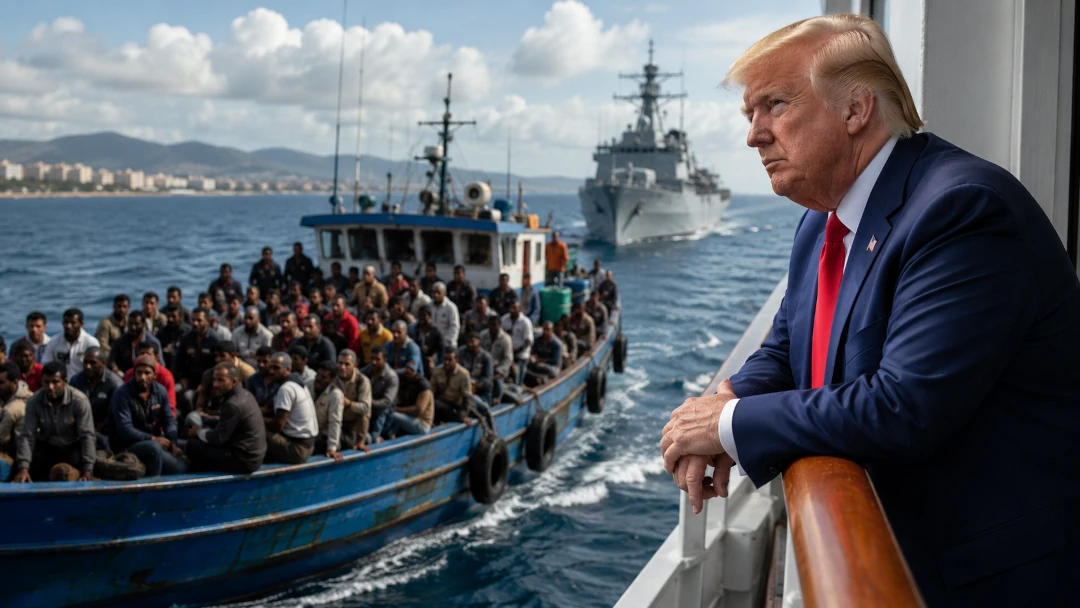
Manufactured at Sea: The Ceuta Gambit and a Presidency Off the Rails
Sixty thousand people were funneled toward a Spanish enclave in a single day. At least 43 drowned. Within hours, the Trump White House was recycling the footage as a midterm ad — and named commentators from Lisbon to Al Jazeera were asking a harder question: was Washington, alongside Rabat and Tel Aviv, the choreographer rather than the spectator?
On the night of July 30, the Moroccan border force at Fnideq did something border forces do not do without an order: it disappeared. Within twenty-four hours, roughly 60,000 people had crossed by land and by sea into Ceuta, a Spanish city of 85,000 clinging to the North African coast. By Friday morning, at least 43 bodies had been recovered from the water at Tarajal; by the weekend, Spain’s interior ministry put the toll higher still. Prime Minister Pedro Sánchez flew to the enclave and called what had happened “an attack” and “a violation of Spain’s territorial integrity.” He was not being rhetorical. He was describing what a growing chorus of European analysts, former officials, and Middle Eastern outlets have since named plainly: a hybrid warfare operation against a European ally, aligned with the interests — and, they argue, the coordination — of Washington, Tel Aviv, and Rabat.
The White House response arrived before the Spanish coroners had finished counting. President Donald Trump, at a Camp David cabinet meeting on Friday, called the scenes “a catastrophe” and instructed Americans to “remember that picture. That’s going to be us in three years if the wrong side gets in.” Vice President JD Vance posted the footage on X and blamed “radical left-wing globalist policies” for “the Invasion of the West.” Deputy Chief of Staff Stephen Miller, in the most telling tell of all, wrote: “Democrats will see your home trampled and stolen by invaders and they will rejoice.” The State Department, without evidence, blamed Spain’s “deliberate efforts to enable and facilitate mass illegal migration.” Not a single one of them condemned Morocco, the government whose border force had stepped aside.
That silence is the story.
“Whether or not the US and Israel were involved before the fact, they were deeply involved and intensely active after the fact, especially trying to use it against the current Spanish government.”
— Bruno Macaes, former Portuguese Europe Minister, quoted in Middle East Eye
I. What Actually Happened at Ceuta
Ceuta is roughly eight square miles of Spanish territory pressed against the Moroccan coast. It has been Spanish since 1668, was reaffirmed as Spanish soil by every Moroccan king of the modern era, and remains — under both Spanish and international law — sovereign EU territory. On Thursday, July 30, that sovereignty was overrun. CNN’s on-the-ground reporting and NPR’s dispatch from Ceuta both confirmed the same core facts: an estimated 50,000 to 60,000 migrants — including some 8,000 unaccompanied children — swam, waded, or walked past Moroccan border posts that had, for a critical window of hours, ceased to function. Spanish soldiers responded with tear gas, water cannons, and warning shots. Bodies washed up on the Tarajal breakwater for two days.
By Friday evening, per Euronews, roughly half of those who had crossed had turned around and returned to Morocco — many of them, per Reuters, because Ceuta’s authorities announced they would not provide food or shelter. The EU confirmed no crossings from Ceuta to mainland Europe took place. The “invasion” the White House sold to Fox News was, in operational terms, contained within 72 hours. What it did not contain was the political fallout, which was the point.
II. The Motive: Palestine, Iran, and the Punishment of Pedro Sánchez
To understand why Ceuta happened when it did, one has to understand what Sánchez has done. Since 2024, Spain has recognized the State of Palestine, become the first major EU government to formally accuse Israel of genocide in Gaza, canceled arms contracts with the Netanyahu government, closed Spanish ports and airspace to weapons bound for Israel, joined the Hague Group, and rejected Trump’s Gaza “Board of Peace” for sidelining the UN. In March 2026, Spain permanently withdrew its ambassador from Israel, downgrading diplomatic relations to a chargé d’affaires. When the US and Israel launched their war on Iran, Sánchez said “no to war” — refused base access at Rota and Morón, closed Spanish airspace to US strike aircraft, and denied a White House claim that Madrid had ever agreed to cooperate. At the July NATO summit, Trump called Spain “a wasted cause” and threatened trade retaliation.
Sánchez, in other words, had done what no other major NATO leader dared: he had demonstrated that a Western government could recognize Palestine, denounce a US war, and refuse to be conscripted into an Israeli one — and survive politically. Spain’s persistence, more than any single policy, was the threat. As the Media Review Network’s analysis put it: Madrid had “turned solidarity into a state practice,” and the challenge extended to Washington.
III. The Evidence of Coordination
No smoking-gun cable has surfaced. Spanish authorities have not formally accused Washington or Tel Aviv of orchestration, and the Jerusalem Post has dismissed the theory as conspiracy. But the pattern — which reporting from Al Jazeera, Middle East Eye, Naked Capitalism, Foreign Policy in Focus, and Zeteo have all documented — is too dense to dismiss.
The Highway With Trump’s Name
Four days before the Ceuta crossings began, Trump announced that Morocco’s 1,055-kilometer Tiznit–Dakhla expressway through Western Sahara would bear his name. The US embassy in Rabat promoted it heavily. Two days later, King Mohammed VI celebrated Throne Day — congratulated by both Rubio and Israel’s Sa’ar. Source
The Rubin Blueprint
In March 2026, former Pentagon official Michael Rubin publicly urged Morocco to launch a new “Green March” of unarmed civilians into Ceuta and Melilla, and called on Rubio and Trump to “right another historical wrong” by recognizing them as “occupied.” Four months later, that is nearly the operation that unfolded. Source
The $40 Million and the “Moroccan Territory” Language
In April 2026, the US House Appropriations Committee approved $20M in National Security Investment and $20M in Foreign Military Financing to Morocco — while describing Ceuta and Melilla in report language as “located in Moroccan territory.” Rep. Thomas Massie (R-KY) publicly called out his own party’s hypocrisy last weekend. Source
The Netanyahu Family Tweet
A 2019 post by Yair Netanyahu, the Israeli prime minister’s son, urging “Arabs and Muslims” who wished to “free occupied lands” to “begin with Ceuta and Melilla,” was recirculated aggressively in the days before the crossings. Israel’s UN ambassador Danny Danon publicly demanded Spain justify its “colonial enclaves in Africa” while migrants were still drowning. Source
Rehearsed Talking Points
Within hours of the first crossings, Trump, Vance, Miller, Cheung, Cruz, Cotton, and the State Department all deployed nearly identical language — “invasion,” “radical left globalist,” “look at Spain” — accompanied by identical clip packages on Fox and X. Foreign Policy in Focus called it “manufactured outrage over a crisis it helped create.” Source
The Absence of a Rebuke of Rabat
An American administration that just funneled $40M to Morocco, named a highway after Trump there, and congratulated its king on the day the border force stood down — did not utter one word of criticism of Morocco. It aimed its fury exclusively at the ally receiving the migrants. That silence, more than any evidence, is the argument. Source
IV. Timeline: How the Pressure Was Built
Trump publicly orders Treasury Secretary Bessent to cut off trade dealings with Spain after Sánchez denies use of Rota and Morón for Iran strikes. Sánchez responds in a televised address: “No to war.”
Spain permanently withdraws its ambassador from Israel, downgrading the mission to a chargé d’affaires.
Former Pentagon official Michael Rubin publicly calls for a new Moroccan “Green March” into Ceuta and Melilla and urges Rubio and Trump to recognize the enclaves as “occupied.”
House Appropriations Committee report describes Ceuta and Melilla as “located in Moroccan territory” and approves $40M in security financing to Morocco. Most Democrats vote against.
Rep. Jamie Raskin introduces legislation to establish an independent commission on presidential capacity under the 25th Amendment, citing Trump’s Iran conduct.
At the NATO summit, Trump calls Spain a “wasted cause” for refusing the 5% GDP defense target and threatens further trade retaliation.
Trump announces Morocco’s Tiznit–Dakhla expressway through Western Sahara will bear his name. The US embassy in Rabat amplifies the announcement.
Moroccan border enforcement at Fnideq ceases to function. Approximately 60,000 crossings into Ceuta follow in under 24 hours.
Trump, Vance, Miller, and the State Department all deploy coordinated “invasion” talking points, within hours of the first crossings, using it as midterm messaging.
Death toll rises to at least 67. Israel’s UN ambassador Danny Danon publicly demands Spain justify its “colonial enclaves in Africa.”
V. The Global Backlash — and What It Says About American Credibility
Sánchez did not, as the White House hoped, collapse. Instead, in a letter widely circulated across European media, he denounced what he called the “selfish, polarising and unlawful reaction” of other EU member states — a direct rebuke to Italy, which had temporarily suspended Schengen with Spain, and to France, which had ordered extra border checks. Spain summoned the Italian ambassador. Iran’s foreign ministry publicly blamed Washington and Tel Aviv. Al Jazeera ran a full opinion analysis under the headline “Is Spain being punished?” Even the Hungarian Conservative — a paper reliably hostile to Sánchez — catalogued the coordination pattern as a legitimate line of inquiry.
The damage to American standing is more corrosive than any single episode. The United States is the world’s oldest continuous constitutional democracy. Its credibility as a security partner rests entirely on the belief that it does not weaponize migration against its own NATO allies. That belief, in Madrid, in Brussels, in Paris — is now gone. As Forbes noted, Trump’s approval on immigration itself has already collapsed: an eight-point swing to Democrats since April in the Fox News poll. He is losing at home. The Ceuta gambit is the flailing of a president who cannot govern and has resorted to producing footage.
“Democrats will see your home trampled and stolen by invaders and they will rejoice.”
— Stephen Miller, White House Deputy Chief of Staff for Policy, X, July 31, 2026
VI. The Democratic Response — and What Is Missing
Congressional Democrats have not yet named the Ceuta operation for what named commentators outside government are calling it. That is a failure of nerve — not a failure of evidence. The framework already exists: on April 10, Ranking Member Jamie Raskin demanded a comprehensive cognitive evaluation of the president. Four days later, he introduced the Independent Commission on Presidential Capacity Act — the statutory body the 25th Amendment has been waiting for since 1967. Rep. Raja Krishnamoorthi has already called on Vice President Vance and the Cabinet to invoke it. On April 30, Senators Sheldon Whitehouse and Jack Reed entered into the Congressional Record a statement signed by 36 physicians — from Harvard, Tufts, Columbia, and George Washington — describing “rapidly worsening, reality-untethered, increasingly dangerous decline” and calling for removal “with the greatest urgency.”
Ceuta is the next entry on that record. It should be presented as such. Congress can convene emergency hearings under the Foreign Affairs and Intelligence Committees on the coordination between Trump administration officials, Moroccan security services, and the Netanyahu government. It can subpoena the Ambassador to Rabat, the State Department officials who blamed Sánchez within hours, and the drafters of the House Appropriations report language on “Moroccan territory.” It can — and, per Raskin’s framework, should — treat the operational conduct itself as evidence of the presidential incapacity his commission was designed to assess.
Get Involved Today
Contribute to our mission and turn your concerns into action.
VII. The Question of Criminality — Domestic and International
The legal exposure runs in two directions. Domestically, if it is established that Trump administration officials — including at the White House, State, or DoD — coordinated with a foreign government to engineer a mass border crisis inside the sovereign territory of a NATO ally, the statutes potentially implicated are serious: 18 U.S.C. § 371 (conspiracy against the United States, insofar as it damages foreign relations and undermines treaty obligations), the Logan Act as a floor rather than a ceiling, and — if any of the 43 to 67 dead can be traced to affirmative operational planning — depraved-indifference exposure that no immunity framework has ever tested.
Internationally, the exposure is graver. Weaponized migration against a state is treated by NATO doctrine itself as a form of hybrid attack. The 2021 Belarus–Poland border episode produced formal EU sanctions on Minsk on exactly that theory. If a US administration has done what Alexander Lukashenko was sanctioned for, the credibility of every American treaty obligation is in question. The International Criminal Court, which the Trump administration has spent 2026 sanctioning individual judges of, would have jurisdiction over any resulting deaths on Spanish soil.
The Twenty-Fifth Amendment Was Written for This Week
Section 4 of the 25th Amendment provides that whenever the Vice President and a majority of the Cabinet — or “such other body as Congress may by law provide” — declare in writing that the President is “unable to discharge the powers and duties of his office,” the Vice President immediately assumes those powers. It was ratified in 1967 in the specific wake of Kennedy’s assassination and Wilson’s stroke, to answer a question the original Constitution left open: what happens when the president is present in body but incapable of governing responsibly.
That is the question this week has produced. A president who orchestrates — or, at absolute minimum, celebrates and instantly monetizes — a foreign-directed operation that kills dozens of people inside the sovereign territory of a NATO ally, in retaliation for that ally’s exercise of independent foreign policy, is not exercising judgment. He is discharging grievance. That is what the amendment’s authors, Senator Birch Bayh chief among them, meant by inability.
Two Democratic lawmakers have already laid the constitutional groundwork. Rep. Jamie Raskin’s Independent Commission on Presidential Capacity Act would create the “such other body” the amendment contemplates. Rep. Raja Krishnamoorthi has called explicitly on Vice President Vance and the Cabinet to invoke Section 4. Thirty-six physicians of national standing have declared him “mentally unfit” and called for removal “with the greatest urgency.”
The Practical Barrier — and Why It Doesn’t Negate the Case
The honest reckoning: Vice President Vance will not invoke Section 4. This Cabinet will not sign the letter. The Republican Senate will not vote to sustain. That is the political fact. But the constitutional argument does not require political success to require presentation. Every episode of unfitness — Iran, Easter Sunday, and now Ceuta — must be entered into the record because the record is the mechanism by which future accountability, whether through the ballot, the impeachment power, or the historical judgment of the courts, becomes possible. To not make the argument because it will not immediately succeed is to concede that the presidency is no longer constrained by law. It is.
VIII. What This Means for the Average American
It is tempting, and wrong, to file Ceuta under “foreign news.” The average American — the one who does not read Middle East Eye or Politico Europe — has three concrete stakes in this. First: every alliance the United States relies on to secure its Pacific and European interests depends on the assumption that Washington does not use migration as a weapon against friendly capitals. If Sánchez’s Spain can be punished this way, so can Merz’s Germany, so can Meloni’s Italy the next time she strays. That erosion is measured in decades, and Americans pay for it in trade access, in defense costs, and eventually in blood.
Second: the same tactical toolkit — border weaponization as political theater — is being rehearsed for use at home. Miller’s line, that Democrats “will see your home trampled and stolen by invaders,” is not immigration policy. It is a template. What was done to Sánchez can be, and per multiple statements from Miller and Cheung, is intended to be, done to any American governor or attorney general who defies the administration on immigration. The Ceuta footage is the demo reel.
Third: a president who spends his working hours coordinating with foreign monarchs on midterm B-roll is not a president governing the country he was elected to lead. He is not repairing the economy, not addressing housing costs, not managing the water in the Colorado River basin, not negotiating drug prices, not doing any of the things ordinary Americans actually need the office to do. He is producing television. The opportunity cost of that television — the collapse of governance itself — is what the average American is paying for.
Editorial Conclusion
What happened at Ceuta was not an invasion of Spain. It was a signal from an American president to any ally who would dare to remain a democracy on its own terms. Sixty thousand people were used, at least 43 killed, and an EU border overrun so that a failing administration could produce a midterm advertisement. That is not foreign policy. That is not statecraft. It is the operational conduct of a presidency that has stopped being a presidency and become an ongoing crime against the constitutional order it was elected to uphold.
The Twenty-Fifth Amendment exists for the moment the office is being used against the country. That moment is not coming. It has arrived. Congress — every senator and every representative who took the oath — is required to enter this episode into the record, subpoena its architects, and make the constitutional case for removal on the merits. The path is hard. The obligation is not conditional on the path.
Sources & References
- Al JazeeraWhy did Ceuta migrant mayhem chill already frosty Israel–Spain relations?
- Middle East EyeSpanish commentators accuse Israel and US of involvement in Ceuta crisis
- Naked CapitalismDid the US and Israel Just Commit Their First Act of Hybrid War Against Spain?
- ZeteoThe Fake ‘Invasion’ of Spain: What You Need to Know
- Foreign Policy in FocusCeuta: How Washington Manufactured Outrage Over a Crisis It Helped Create
- Media Review NetworkMorocco, Israel and the United States Punished Spain for Palestine
- CNNSpanish leader slams ‘selfish’ EU response as death toll from Ceuta crossings climbs
- NPRSpain’s Pedro Sánchez was a hero of migrants. After Ceuta, he faces his biggest challenge
- The HillMigrant crisis in Ceuta spurs Trump, Stephen Miller warnings
- France 24Trump blames Spain for migrant chaos despite return of tens of thousands to Morocco
- EuronewsTrump calls Ceuta crisis ‘terrible’ as White House blames far left
- NewsweekThomas Massie Accuses GOP of Hypocrisy Over Ceuta Migrant Crisis
- ForbesTrump Alleges Ceuta Migration Crisis Would Happen In U.S. Under Democrats — Here’s Why That’s Unlikely
- Al Jazeera OpinionsIs Spain being punished?
- Hungarian ConservativeCeuta Migrant Invasion: Payback for Sánchez Defying Trump and Israel?
- House Judiciary DemocratsRaskin Demands White House Physician Evaluate Trump’s Cognitive Fitness
- House Judiciary DemocratsRaskin Introduces Legislation Establishing Independent Commission on Presidential Capacity
- Rep. KrishnamoorthiKrishnamoorthi Calls for President Trump’s Removal Under 25th Amendment
- The Hill OpinionConcerns Grow Over Trump’s Mental Fitness for Presidency
- Wikipedia2026 Morocco–Spain Border Incident (running compilation)
Related News