The president will address the nation Thursday night. He has confirmed the topic — elections. What his advisers are telegraphing, and what his existing executive order has already tried, describe a country whose chief executive is preparing to declare himself the arbiter of who counts as an American voter, which senators are legitimate, and which elections were real. This is not a policy dispute. It is the vocabulary of authoritarian reversal.
On Monday evening, from his Truth Social account and in the third person, President Donald Trump informed the country that he would deliver a “Speech to the Nation” on Thursday, July 16, at 9 P.M. Eastern. He offered no subject. He offered no reason. By Tuesday afternoon, in the Oval Office, he told reporters the address would concern “free and fair elections,” that the country “has to shape up,” and that it would carry “really big news.” The reporting since — from Reuters, from MS NOW, from CNBC — has begun to fill in what he intends that news to be. It is worse than any single sentence can carry.
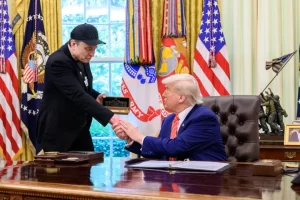
Two senior White House officials told MS NOW the president will use the primetime slot to unveil what the administration is calling newly declassified intelligence purporting to show that a foreign nation planned to interfere in the 2020 election he lost to Joe Biden. He will be flanked by CIA Director John Ratcliffe, acting Director of National Intelligence Bill Pulte, FBI Director Kash Patel, and Homeland Security Secretary Markwayne Mullin — the full ceremonial apparatus of the intelligence and law-enforcement state, arranged behind a president who has spent five and a half years insisting, against every court, every audit, and his own first-term Justice Department, that he did not lose.
Reuters, citing an administration official, has separately reported that Trump will use the address to assert vulnerabilities in American voting machines — the same claim his first-term cybersecurity officials called “the most secure in American history,” and the same claim that cost Fox News nearly $800 million in a defamation settlement with Dominion Voting Systems. On Monday, in a phone interview with Newsmax, the president previewed the mood: “Our elections are crooked and we’ve got to straighten them out.”
I. What Is Reported, and What Is Only Rumored
A serious accounting requires distinguishing what has been confirmed from what has been floated. The address itself, the elections framing, the four cabinet officials, and the declassified-intelligence conceit are all reported by multiple mainstream outlets citing named or administration-anonymized sources. The far more explosive claim — that the president intends to declare the elections of Georgia Senators Jon Ossoff and Raphael Warnock illegitimate — was first reported Monday by the conservative Washington Reporter, citing a single “well-placed source in Georgia.” The same outlet later updated its reporting to note that the White House says the speech “will not focus on Georgia’s 2020 elections.”
That partial walk-back should not comfort anyone. It is not a denial. It is a negotiation over which version of the same insurrection story will play in primetime. And the trial balloon itself — floated to a friendly outlet, allowed to trend for eighteen hours, then softened without being retracted — is a familiar pattern for this White House. It measures the country’s tolerance for a claim before the claim is made from a podium.
Senator Ossoff answered the same night. “Donald Trump’s spiral continues,” he wrote on X. “The failed president, pocketing billions as he drives up prices, is afraid to lose the midterms. So he will reheat debunked election conspiracy theories and tell bizarre new lies to deny his 2020 defeat and attack voting rights.” Senator Warnock’s answer was shorter and older, the language of a movement.
“Donald Trump is at war with our democracy and Georgia is ground zero. But this is John Lewis’s Georgia. We are not intimidated. We are not moved.”
— Sen. Raphael Warnock, D-Ga., July 14, 2026
II. The Executive Order That Already Exists
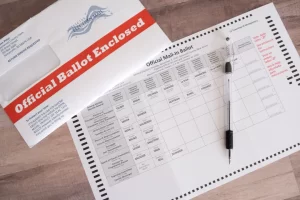
To understand what Thursday is really for, the country must first understand what has already been done, and what has already been struck down. On March 31, 2026, the president signed an executive order titled Ensuring Citizenship Verification and Integrity in Federal Elections. Its plain-language purpose, explained here by Issue One, is to federalize the machinery of American elections: to have the Department of Homeland Security build lists of “eligible” voters state by state from federal databases known to be riddled with errors; to force the U.S. Postal Service to refuse to deliver mail-in ballots to any American whose name does not appear on those federal lists; and to instruct the Justice Department to prioritize the criminal prosecution of state and local election officials who dare to give a ballot to someone the federal government has decided is not entitled to one.
The Brennan Center’s analysis is stark: the order “flatly violates the Constitution and federal law.” The Elections Clause — Article I, Section 4 — reserves the setting of federal election rules to state legislatures and to Congress. Not to the president. Never to the president. Three federal judges have already said so.
Kollar-Kotelly, January 2026
Blocked provisions of Trump’s earlier March 2025 elections order requiring proof-of-citizenship for federal voter registration. “Our Constitution does not allow the President to impose unilateral changes to federal election procedures.” Brookings analysis.
Talwani, June 2026
Declared Sections 2 and 3 of the March 2026 order legally void. Ruled the directive that USPS refuse ballots to voters not on federal lists was an impermissible infringement on state election authority. Filed by 23 states and D.C. Case coverage.
Sullivan, July 2026
Ruled nationwide that the executive order breached a 2021 NAACP settlement requiring the Postal Service to prioritize mail-ballot delivery. Application: every state, no exceptions. Votebeat coverage.
Appeal Filed, July 2026
The Justice Department has appealed Talwani’s ruling to the First Circuit, arguing the Postal Service is “running out of time” before the midterms. The plaintiffs — including California, New York, Pennsylvania, Michigan — argue the appeal itself is the point: to introduce enough chaos to depress turnout. Details.
This is the context Thursday’s speech is meant to reframe. When an administration has lost three times in federal court over an order that a Trump-appointed judge himself called constitutionally suspect, the political move is not to comply. It is to escalate — to produce, on primetime television, with the intelligence community lined up in uniform behind the president, a manufactured pretext for saying that the courts have gotten it wrong because the elections themselves were the crime.
III. The Timeline of an Escalation
IV. What “Federalizing Elections” Means for the Voter
Strip away the euphemisms and the phrase describes a straightforward transfer of power. The Constitution assigns the administration of federal elections to the states, subject to override by Congress. What the president has attempted, and what Thursday’s speech may attempt to legitimize retroactively, is to move that authority into the executive branch — into agencies whose leaders serve at his pleasure and can be fired for insufficient loyalty.
The concrete effect on the average American, in the words of the ACLU brief in the Massachusetts case, would be to “threaten the ability of millions of eligible citizens to cast their ballots, particularly military members, overseas citizens, the elderly, recently naturalized citizens, and voters with disabilities who rely on mail voting.” Danielle Lang, a lawyer at the nonpartisan Campaign Legal Center, put it plainly in her argument before Judge Nichols: the order’s timing, with primary elections already underway, “will cause chaos.”
Consider the mechanics. The federal government would send each state a list of who it has decided is eligible. Those lists, drawn from Social Security and DHS databases never designed for that purpose, would inevitably contain errors — misspelled names, outdated addresses, naturalized citizens whose paperwork has not yet caught up, women who changed their names at marriage, service members deployed abroad. The Postal Service, under the order, would then refuse to deliver a mail-in ballot to anyone not on the list. And any local election official who sent a ballot to a voter the federal government had excluded — for any reason, mistake or judgment — would face criminal referral by the Attorney General. As the Brennan Center notes, this sweeps in postal workers and civic volunteers too. Neighbors helping neighbors could be prosecuted.
The disenfranchisement is not accidental. It is architectural. Elderly voters, disabled voters, rural voters, working-class voters who cannot leave their shift to stand in a five-hour line, service members overseas, students, the recently naturalized — every category of voter who has historically leaned toward the party the president opposes is exactly the category most dependent on the mail-in system he is trying to seize. This is why Brookings scholars and Lawfare’s legal analysts arrived at the same conclusion from different premises: the order is not designed to make elections more secure. It is designed to make certain elections harder to win.
Get Involved Today
Contribute to our mission and turn your concerns into action.
V. The Constitutional Case, and What the Court Will Face
The Elections Clause is not ambiguous. Article I, Section 4 of the Constitution vests the authority to prescribe “the Times, Places and Manner of holding Elections for Senators and Representatives” in the state legislatures, subject only to alteration by Congress. Not by executive order. Not by presidential declaration. Not by primetime television address, no matter how many intelligence directors are arranged behind the podium.
Judge Colleen Kollar-Kotelly’s language, in striking down the earlier 2025 order, is the sentence the country should memorize: “Our Constitution does not allow the President to impose unilateral changes to federal election procedures.” The current Supreme Court, whatever else one may think of it, has been consistent on the reading of the Elections Clause. The Moore v. Harper decision in 2023, written by Chief Justice John Roberts and joined by six justices including some of the Court’s most conservative members, rejected the “independent state legislature” theory that would have loosened judicial constraints on state legislatures — but it did so by reaffirming that the constitutional text places election authority in state legislatures and Congress, not in any single actor claiming special power over the process. The president is not on the list. He has never been on the list. He cannot put himself on the list by decree.
If Trump on Thursday declares two duly elected United States Senators “illegitimate” and directs any federal agency to treat them as such — refusing to seat them, refusing to accept their votes, refusing to recognize their offices — he will have crossed a line the Constitution does not permit any president to cross. The Constitution provides exactly one method for removing a sitting senator: expulsion by a two-thirds vote of that senator’s own chamber, under Article I, Section 5. Not presidential fiat. As the policy analyst Adam Cochran observed in response to the Georgia trial balloon, “the constitution has no way to nullify a swearing-in. Only peer expulsion.”
What the Supreme Court will do, if Thursday’s speech is followed by actual executive action, is the question every constitutional lawyer in Washington has been quietly modeling for a week. The predictable answer is that they will strike it down, and quickly — but the more sober answer is that the damage will not wait for the ruling. Litigation takes months. Elections happen on days. The chaos itself is the payload.
“Put simply, our Constitution does not allow the President to impose unilateral changes to federal election procedures.”
— U.S. District Judge Colleen Kollar-Kotelly, January 2026
VI. The Oath, and What It Names
The presidential oath, prescribed by Article II, Section 1 of the Constitution, contains twenty-seven words and one operative promise: to “preserve, protect and defend the Constitution of the United States.” Not the president’s own election prospects. Not his party’s midterm strategy. Not the theory of the case his lawyers have been rehearsing since November 2020. The Constitution.
To use the office of the presidency to attack the legitimacy of a legally certified election he lost, five and a half years after losing it, is not preservation. To marshal the Postal Service against a category of voters known to lean against him is not protection. To command the Justice Department to prosecute state election officials for the offense of counting ballots the president would prefer had not been cast is not defense. It is the oath inverted, made to serve the office-holder rather than the office itself.
What Thursday’s speech puts before the country is not a policy debate. It is a question about whether the man administering that oath understands what it means, and whether he is still capable of executing it.
What the Drafters Meant by “Unable”
The Twenty-Fifth Amendment, ratified in 1967 in the shadow of the Kennedy assassination, contains one sentence that is doing an enormous amount of work in the current moment. Section 4 permits the vice president, together with a majority of the cabinet, to declare in writing that the president “is unable to discharge the powers and duties of his office.” It does not define unable. It does not define inability. The drafters left both terms open on purpose.
As PBS reported in its April analysis, legal experts confirm the drafters “used intentionally vague and open-ended language…because they recognized they couldn’t predict every scenario in which a president could be deemed disabled.” The framers of the amendment — chiefly Senator Birch Bayh — knew what they were doing. They understood that inability in 1967 might mean a stroke; that in some future decade it might mean something the country had not yet been forced to name.
Section four was not intended as a means of removing the president simply because he or she makes an unpopular decision. But nor was it intended to require a coma before it could be used.
Since April, a growing list of members of Congress has publicly called for Section 4’s invocation — a list that, per NBC’s tally, now exceeds seventy lawmakers. Representative Yassamin Ansari of Arizona wrote after the Iran ultimatum that “the 25th Amendment exists for a reason.” Representative Melanie Stansbury of New Mexico posted the amendment’s number alongside “the emperor has no clothes.” Senator Chris Murphy of Connecticut wrote that if he were in the cabinet he “would spend Easter calling constitutional lawyers.” They are joined, remarkably, by former Republican Representative Adam Kinzinger, by former Trump communications director Anthony Scaramucci, and by former Trump allies including Alex Jones and Marjorie Taylor Greene. It is a coalition that does not exist on any other subject in American life.
The constitutional argument for the amendment’s application is not exotic. It is textual. If a president uses primetime television, the intelligence community, and a series of unconstitutional executive orders to declare that duly elected senators are not senators and that duly cast ballots are not ballots, he is not exercising the powers of his office. He is subverting them. That is the definition of unable the drafters, in their prudent silence, permitted the country to reach when it needed to.
The practical barriers are real. Vice President J.D. Vance was hand-picked for loyalty; the cabinet was selected on the same principle. Section 4 requires the vice president’s initiation, then either the cabinet majority or a body Congress may designate. A president can contest the finding, at which point Congress must sustain the removal by a two-thirds vote in both chambers within twenty-one days. The math today is prohibitive. The Common Cause statement is right to concede this.
The barriers do not negate the case. Constitutional mechanisms exist even when they are politically dormant. Their availability is itself a check — a signal to every cabinet member and every senator that the country is watching, and that history will note who acted and who did not. The 25th Amendment does not lose its meaning because the current cabinet lacks the courage to invoke it. It gains meaning by remaining unused only because the country continues to believe that the office-holder, in the end, will not force the question. Thursday’s speech may be the moment the country stops being able to believe that.
VII. What This Says About Priorities
Consider what the president of the United States has chosen to do with the primetime attention of the country he leads. Inflation remains stubborn. Housing costs are cratering household budgets. The war he inherited with Iran has reignited and is unraveling. A U.S. Marshal was killed serving a warrant on Monday. A parasite outbreak has crossed 2,800 cases across the American Midwest. Sen. Lindsey Graham, one of his closest congressional allies, died last week and was replaced Monday by his sister as a placeholder senator from South Carolina.
These are the crises a sitting president might address the nation about. Instead, on Thursday at 9 P.M. Eastern, this president will discuss an election he lost in November 2020 — sixty-eight months ago. That is the choice. That is the priority. Everything the country needs a leader for is on hold while the man in the leader’s chair processes, one more time, in front of the intelligence directors of the United States, a grievance he has not been able to let go of for five and a half years.
This is not the behavior of a president. It is the behavior of a man who has confused the presidency with therapy, and who has confused therapy with revenge.
Editorial Conclusion
The Constitution does not permit what Thursday’s speech appears designed to justify. The Elections Clause reserves election administration to the states and to Congress — not to the president, not to executive order, not to primetime declaration. Three federal courts have already said so. The Supreme Court, under any faithful reading of Moore v. Harper, will say so again.
But the harm the country should fear is not the eventual ruling. It is the eighteen months of engineered chaos between the speech and the ruling — the ballots not delivered, the officials threatened with prosecution, the senators whose legitimacy the president of the United States has declared open for renegotiation. That is the payload. That is what democracies collapse into when their leaders decide the last election they lost was the only one that counted.
The 25th Amendment was written for exactly this — for a moment when the office-holder can no longer discharge the office’s duties without inverting them. The drafters left the word unable open on purpose. Thursday is the country’s chance to see what they meant. And the cabinet that watches this speech from the front row will have to answer, for the rest of their lives, whether they saw it too.
Sources & References
- Washington Times — “Trump to deliver major address to the nation on Thursday” (July 13, 2026)
- CNN Politics — “Trump says Thursday address will focus on ‘free and fair elections’” (July 14, 2026)
- CNBC — “Trump to claim declassified intel reveals 2020 election interference” (July 13, 2026)
- Reuters via U.S. News — “Trump to assert voting machine vulnerabilities in Thursday speech” (July 13, 2026)
- TIME — “Trump to Give Primetime Speech on Thursday: What to Expect” (July 14, 2026)
- Raw Story — “’This is insane!’ Eyes widen over teased Trump stunt during upcoming national address” (July 14, 2026)
- Mediaite via Yahoo — “Ossoff, Warnock Fire Back at Report Trump Will Announce Georgia Wins Were ‘Illegitimate’” (July 14, 2026)
- Joe.My.God — “Right Wing Outlet Says Trump Will Claim Ossoff And Warnock Were Illegally Elected” (July 14, 2026)
- Issue One — Explainer: Executive Order on Mail-in Ballot Rules and Federal Voter Eligibility Lists (April 2026)
- Brennan Center for Justice — Analyzing the President’s Executive Order on Mail Voting
- Ballotpedia — Trump signs absentee/mail-in voting executive order (April 6, 2026)
- ACLU — Voting Rights Groups Applaud Ruling Declaring 2026 Executive Order Unconstitutional
- Votebeat — Federal judge refuses to block Trump executive order on elections — for now (May 28, 2026)
- Votebeat — Trump administration asks federal judge to allow mail voting restrictions for 2026 election (July 2, 2026)
- Lawfare — What’s up with Trump’s Mail-In Voting Executive Order?
- Brookings — Trump’s new elections executive order and what it would mean for voters (June 2026)
- PBS NewsHour — Could the 25th Amendment be invoked against Trump? Here’s how it works
- TIME — What to Know About the 25th Amendment as Lawmakers Call for Trump’s Removal (April 2026)
- NBC Washington — What is the 25th Amendment? Calls grow for it to be invoked against Trump
- Common Cause — Common Cause Calls on the Cabinet to Invoke the 25th Amendment
- National Constitution Center — 25th Amendment — Presidential Disability and Succession (full text)
Related News