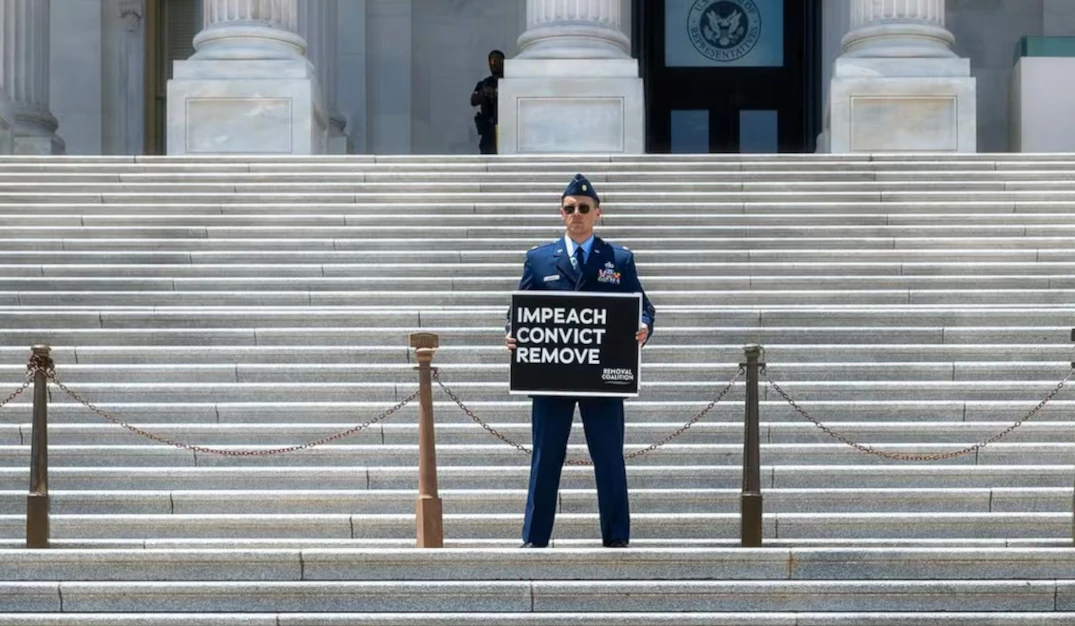
Air Force Major Jason Watson stood on the Capitol stairs holding a piece of cardboard that read three words: Impeach. Convict. Remove. He was arrested inside of ninety seconds. What he said before the cuffs went on is what this administration cannot allow the country to hear — and what it plans to punish him for saying, uniform and all.
Three days before the United States marked its 250th birthday, an active-duty officer of the United States Air Force walked halfway up the House steps in dress uniform, raised a cardboard sign, and was arrested for it. Maj. Jason Watson — a logistics readiness officer on leave from a NATO posting in Poland, three years shy of a full pension, twenty-one years into a career he began at the Air Force Academy in 2005 — knew exactly what he was doing. He had been planning it since February, when he reached out to the grassroots Removal Coalition and asked them to organize the event so his sacrifice would not be, in his own word, in vain. The Military Times reported he was cuffed at approximately 1:15 p.m. on July 1. He is believed to be the first active-duty commissioned officer to publicly call, in uniform, for the impeachment and removal of a sitting president and vice president.
The mechanics of the arrest are being used, deliberately, to obscure the meaning of it. U.S. Capitol Police told The Hill that Watson was charged under D.C. Code 22-1307 — “Crowding, Obstructing, and Incommoding” — because Rep. Al Green (D-Texas), the member of Congress who had escorted him to the steps, walked away, leaving Watson technically unaccompanied on ground where public demonstration is not permitted. Officers gave him lawful orders. He refused them. He was taken away. On the surface: a paperwork arrest for a rule about foot-traffic, dismissed the following day when the D.C. Superior Court, CNN confirmed, declined to file a case.
Beneath the surface: a serving officer used the Constitution’s most sacred words — the oath — to accuse the Commander-in-Chief of violating it, and the machinery of state responded within a minute and a half. That is the story. The charge is the disguise.
I. What He Actually Said
Watson’s speech, delivered at a Removal Coalition press conference before he ever set foot on the steps, was not a partisan tirade. It was, in structure and cadence, a legal indictment. He opened by reciting the officer’s oath he first swore in 2005, then laid out a bill of particulars: unconstitutional military strikes on Iran, Venezuela, and Cuba without congressional authorization, in violation of the War Powers Clause; the deaths of 13 U.S. service members in the resulting Iran conflict; the delegation of executive authority to Elon Musk to shut down federal agencies and access citizens’ private data; the mass firings of federal civil servants; the killings by immigration officers of U.S. citizens Alex Pretti and Renee Good; the blinding of a legal observer by a nonlethal projectile fired by an ICE officer.
After each violation, Watson delivered the same refrain, the Washington Times documented: the president and vice president must be impeached, convicted, and removed. He was careful, almost lawyerly, in the language. He was not asking Congress to consider it. He was telling Congress that its oath, like his, required it.
He also told the country something important about himself. He is not a Democrat, he said. He knows nothing about Rep. Green’s policy positions. He stood next to Green only because Green is the only member of Congress who has actually forced an impeachment vote during this term. Watson called himself, in the speech, “just a nobody” — a rhetorical construction whose purpose was to make his listeners understand that if a nobody could risk his career and freedom for the Constitution, they could risk considerably less.
“I am calling on average Americans everywhere to peacefully exercise your First Amendment rights en masse every day until this administration is removed and our democratic republic is restored.”
— Maj. Jason Watson, U.S. Air Force, July 1, 2026
II. The Charge Is the Cover Story
Let us be clear about what the “crowding and obstructing” charge is meant to accomplish. It transforms an act of constitutional witness into a procedural infraction. It allows the administration and its media allies to say — accurately, but misleadingly — that Watson was not arrested for speech. He was arrested, they insist, for standing in the wrong ten square feet of granite.
This is technically true and morally hollow. The rule Watson violated exists to control the choreography of Capitol protest; it is not a rule against speech in the abstract. But the follow-up is not a citation and a fine. It is the machinery of military justice. The Air Force, under Secretary Troy Meink, has already announced a “thorough investigation” under the Uniform Code of Military Justice. The provision most frequently cited in those discussions is Article 88, which makes it a court-martial offense for a commissioned officer to use “contemptuous words” against the president, vice president, Congress, or the secretaries of the military departments. That is not a traffic ticket. That is a career, a pension, and potentially a prison term.
Article 88 is a Cold War-era relic of civil-military discipline. It was written when the concern was open sedition inside the officer corps. It has almost never been enforced. Applying it against Watson — a man who quoted the Constitution and cited documented facts, whose “contempt” consists entirely of accurate description of impeachable conduct — would announce a new doctrine: that the uniform strips its wearer of the First Amendment, and that the president may punish those who serve him for the sin of noticing when he breaks the law.
III. Silence From the White House. Silence From the GOP.
The most telling response to Watson’s arrest has been the near-total silence from congressional Republicans. Not a single GOP member of the House or Senate has publicly called for the Air Force to drop its investigation. Not one has invoked the obvious First Amendment interest of a service member speaking as a citizen. Not one has said, as their party spent four years saying under the previous administration, that the concern here is presidential fitness.
Instead, the House has continued its pattern of enforcement. When Rep. Green filed articles of impeachment in December 2025, charging Trump with abuse of power, the House voted 237–140 to table the resolution without an up-or-down vote. Every Republican in the chamber voted to bury it. Twenty-three Democrats joined them. That vote is the political context of Watson’s arrest. He was not standing on the Capitol steps because he thought the system was working. He was standing there because the system had refused, at every prior turn, to work.
The White House response has been characteristically petty. Air Force Secretary Meink’s statement on X did not defend the First Amendment. It emphasized “good order and discipline” and promised the investigation would “proceed unimpeded” — bureaucratic language for a foregone conclusion. The president himself, at the time of writing, has issued no public statement about the arrest. He was at the grand opening of the Theodore Roosevelt Presidential Library in Medora, North Dakota. He rode in on a train.
Get Involved Today
Contribute to our mission and turn your concerns into action.
IV. The Democrats’ Half-Measures
Establishment Democrats — the leadership class that determines what the party will fight for and what it will merely tut-tut over — have offered exactly the response the moment does not require. Rep. Chrissy Houlahan (D-Pa.), an Air Force veteran, praised Watson’s bravery in a statement to Newsweek and said she was “enormously frustrated” with her Republican colleagues. Frustration is not a strategy. It is a press release.
Where is the demand from the House Democratic leadership that the Air Force be prohibited from prosecuting Watson? Where is the Senate hearing on Article 88 as an unconstitutional restraint on core political speech? Where is the caucus-wide push, following the lead of Rep. Jamie Raskin and Sen. Chris Murphy, to force the 25th Amendment question to the floor? Rep. Green has been the sole reliable voice, and the party’s response to his one impeachment resolution was to let 23 of their own members vote to kill it — and 47 more to hide behind “present.” That is not opposition. That is complicity dressed as caution.
The Democrats who understand the stakes are speaking. Sen. Murphy has said publicly that if he were in Trump’s Cabinet he would be calling constitutional lawyers about the 25th Amendment. Sen. Bernie Sanders has called the president’s recent statements the ravings of a mentally unbalanced individual. Rep. Raskin, joined by fifty House Democratic co-sponsors, has already introduced legislation to establish a commission on presidential capacity. But the party’s official posture — from leadership, from committee ranking members, from the presidential-hopeful class — remains that of concerned bystander. A major just went to jail wearing their uniform. Concern is not enough.
V. What This Does to the Military
The consequences of prosecuting Watson under Article 88 would not be confined to one officer. The signal sent through every wardroom, ready room, and squadron in the United States military would be unmistakable: the oath you swore to the Constitution is subordinate to loyalty to the sitting president. If you notice a violation and say so, you will be punished. If you notice and stay silent, you will be safe.
That is precisely the opposite of what the officer’s oath was drafted to require. The oath binds officers to the Constitution — not to the individual holding executive office. It was written that way for exactly this scenario: a president who violates the document, and an officer corps that must choose between the man and the law. Watson’s calculation, as he explained to the Removal Coalition’s Jessica Denson in a recorded interview before the arrest, was straightforward. Every violation he cited had been documented. Every one had a constitutional or statutory tie-in. He was risking his career because the country’s officers had a duty he believed the officer class as a whole was failing.
An ICE officer shot a legal observer at a protest in January, causing him to lose his left eye. The observer’s job is to document constitutional violations. Watson cited the incident by name.
Activists who protested an ICE detention facility in Prairieland, Texas have been convicted on terrorism charges, with prosecutors introducing “black clothing” and “radical zines” as evidence.
The State Department is now screening green card applicants for political viewpoints, per Defending Rights & Dissent — a de facto ideological test at the border.
The administration has deployed roughly 3,000 ICE and Border Patrol agents to Minnesota and threatened the Insurrection Act in response to peaceful protests over Renee Good’s killing.
VI. The Chill Was the Point
The First Amendment doctrine that most matters here is one the Trump administration understands perfectly: the chilling effect. When the government makes an example of one person, the effect is not one prosecution — it is the thousand acts of speech and dissent that never occur because the possibility of prosecution has become vivid and personal. The scholarship on this is exhaustive and unambiguous. When protesters see the president deploy the military against demonstrators, some who would have marched stay home. When a service member sees an officer arrested for a sign, some who would have spoken out do not.
Watson’s arrest, and the promised military investigation to follow, are not an isolated incident. They are one item in a pattern the Center for American Progress has already documented at length: activists targeted for deportation based on their political views; peaceful protesters labeled domestic terrorists; the military deployed on American streets to restore what the president calls “public order”; law firms, universities, and newsrooms hit with shakedown lawsuits; a secret federal police force that has killed U.S. citizens without accountability. This is not the disorganized cruelty of an impulsive administration. It is the operating system.
VII. A Timeline of Legal Speech, Treated as a Threat
“Unable to Discharge the Powers and Duties of His Office”
Section 4 of the 25th Amendment, ratified in 1967, permits the vice president together with a majority of the Cabinet — or “such other body as Congress may by law provide” — to declare a president “unable to discharge the powers and duties of his office.” The words “unable” and “inability” are not defined in the amendment. That was not an oversight. It was a design choice.
“Whenever the Vice President and a majority of… the principal officers of the executive departments or of such other body as Congress may by law provide, transmit to the President pro tempore of the Senate and the Speaker of the House… their written declaration that the President is unable to discharge the powers and duties of his office…”
The framers of the amendment — Sen. Birch Bayh chief among them — deliberately declined to enumerate the conditions that would qualify. They understood that presidential incapacity would take forms they could not anticipate: strokes, comas, dementia, but also delusion, paranoia, and the sort of judgment collapse that a rigid definition would fail to capture. The undefined term was the point. Congress and the Cabinet were meant to make the determination in the moment, based on the evidence in front of them.
The evidence in front of us is now considerable. In April, Rep. Jamie Raskin — top Democrat on the House Judiciary Committee — wrote to the White House physician demanding a comprehensive cognitive evaluation, citing “incoherent, volatile, profane, deranged, and threatening” public statements consistent with cognitive decline. On April 14, he introduced the Presidential Capacity Commission Act with fifty House co-sponsors. On April 30, thirty-six physicians — neurologists, psychiatrists, and cognitive disorder specialists from Harvard, Tufts, Columbia, and George Washington — entered a statement into the Congressional Record calling the president mentally unfit and urging removal with the greatest urgency. Sen. Chris Murphy has said publicly he would be calling constitutional lawyers from inside the Cabinet. Sen. Bernie Sanders has called the president’s recent conduct dangerous. Even a February 2026 Reuters-Ipsos poll found a majority of Americans — including 30 percent of Republicans — saying the president has become erratic with age.
Watson’s arrest bears directly on the 25th Amendment question. It is not, on its own, evidence of incapacity — many presidents have crushed dissenters and been fully compos mentis. But the pattern it fits is the pattern the framers had in mind: a chief executive whose judgment is so degraded that he cannot distinguish between a citizen exercising his First Amendment rights and a threat to be neutralized; who orders military strikes without authorization; who threatens civilian populations on social media; who responds to peaceful protest with troop deployments; who cannot tolerate the smallest expression of dissent from a serving officer of the armed forces. The “inability” contemplated by the amendment includes the inability to exercise the sound judgment the office requires. The judgment on display is, by any honest reckoning, not sound.
The practical barriers are real and should not be sugarcoated. Section 4 requires Vice President Vance and a majority of the Cabinet — a Cabinet Trump personally chose for its loyalty. Not one of them will act. Raskin’s commission bill would, if enacted, allow Congress to designate the “other body” the amendment contemplates; a Republican-controlled House will not pass it. These obstacles are not arguments against the constitutional case. They are arguments about the political case. The Constitution does not become inoperative because the officeholders sworn to it are unwilling to enforce it. The mechanism exists. The threshold has been reached. The record is being built — one physicians’ letter, one arrest, one silenced officer at a time — for the moment the political conditions catch up with the constitutional facts.
VIII. What This Says About the Man in the Chair
A president secure in his authority does not need to arrest majors. A president confident in his conduct does not need Article 88 investigations against officers who cite documented facts. A president whose priorities are the country’s does not spend the eve of the 250th anniversary of American independence at a library grand opening while a serving officer of the Air Force sits in a holding cell for holding up a sign.
The Watson arrest is not, in the grand ledger of this administration’s abuses, the largest. Thirteen U.S. service members died in the Iran conflict Watson was speaking about. Renee Good and Alex Pretti were shot dead by federal officers. Hundreds of thousands of impoverished people abroad have died from the abrupt termination of American aid. Tens of thousands of federal civil servants were fired to hand their functions to an unelected billionaire. Against that catalogue, one arrest for “crowding and obstructing” is a footnote.
But it is a revealing footnote. It shows what the administration will do when a member of the armed services publicly names the pattern. It shows what the party of “back the blue” and “support the troops” will do when the troop in question inconveniences the president. It shows what the party of the loyal opposition will do — which, mostly, is issue statements. And it shows what the framers of the 25th Amendment understood: that the moment would come when a president’s judgment, temperament, and priorities would be so misaligned with the duties of the office that ordinary politics would not be enough. That moment has come. The question is whether the people sworn to act on it will.
Editorial Conclusion
A commissioned officer of the United States Air Force stood on the Capitol steps in dress uniform and told his country that its president had violated the Constitution. He was cuffed inside of ninety seconds. His government is now preparing to punish him for the specific sin of saying so.
This is what the 25th Amendment was written for. Not because Maj. Watson’s arrest, alone, proves incapacity — but because a president who orders unauthorized wars, deploys the military against peaceful protesters, ignores Congress, and cannot tolerate a single serving officer’s dissent is a president unable to discharge the duties of his office as the framers understood them. The word “unable” was left undefined on purpose. The purpose was this moment.
Every member of the Cabinet who has not resigned. Every senator who has not called for hearings. Every House member who voted to table Rep. Green’s resolution. Every general officer who has not spoken. History is keeping the list. The Constitution does not enforce itself. The oath is not decorative. If a major in Poland can stack twenty-one years of service on the table and push, so can they. So can we.
Sources & References
- CNN PoliticsUS service member arrested at Capitol after calling for Trump’s impeachment
- NBC NewsAir Force officer arrested at Capitol after calling for Trump’s impeachment
- Military TimesAir Force major arrested on Capitol steps during protest calling for Trump impeachment
- The HillAir Force major arrested after calling for Trump impeachment on Capitol steps
- NewsweekWho is Jason Watson? Air Force Major’s Arrest After Trump Protest Sparks Investigation
- SnopesUS Air Force Maj. Jason Watson arrested after calling for Trump’s impeachment on Capitol steps
- The Washington TimesU.S. Air Force major arrested at Capitol while demonstrating for Trump’s impeachment
- Free Speech For PeopleStatement in Support of Active US Air Force Officer Arrested at Capitol
- House Judiciary DemocratsRaskin Demands White House Physician Evaluate Trump’s Cognitive Fitness, Calls to Invoke 25th Amendment
- MS NOWRaskin offers bill setting up 25th Amendment process to remove Trump from office
- MediaiteDemocrats Question Trump’s Mental Fitness and Ramp Up 25th Amendment Push
- The Hill (Opinion)Concerns Grow Over Trump’s Mental Fitness for Presidency
- MS NOW (Opinion)War with Iran would put Trump’s crackdown on dissent into overdrive
- Center for American ProgressProtecting Constitutional Freedoms of Speech and Assembly During the Second Trump Administration
- American Civil Liberties UnionTrump’s Threat to Invoke the Insurrection Act, Explained
- Just SecurityThe Military Parade and Protections of the First Amendment
- Amnesty International USAMilitarization and Suppression of Protests in the Age of Trump
- Defending Rights & DissentNewsletter: May 2026 — Prairieland terrorism convictions and green card ideological screening
Related News