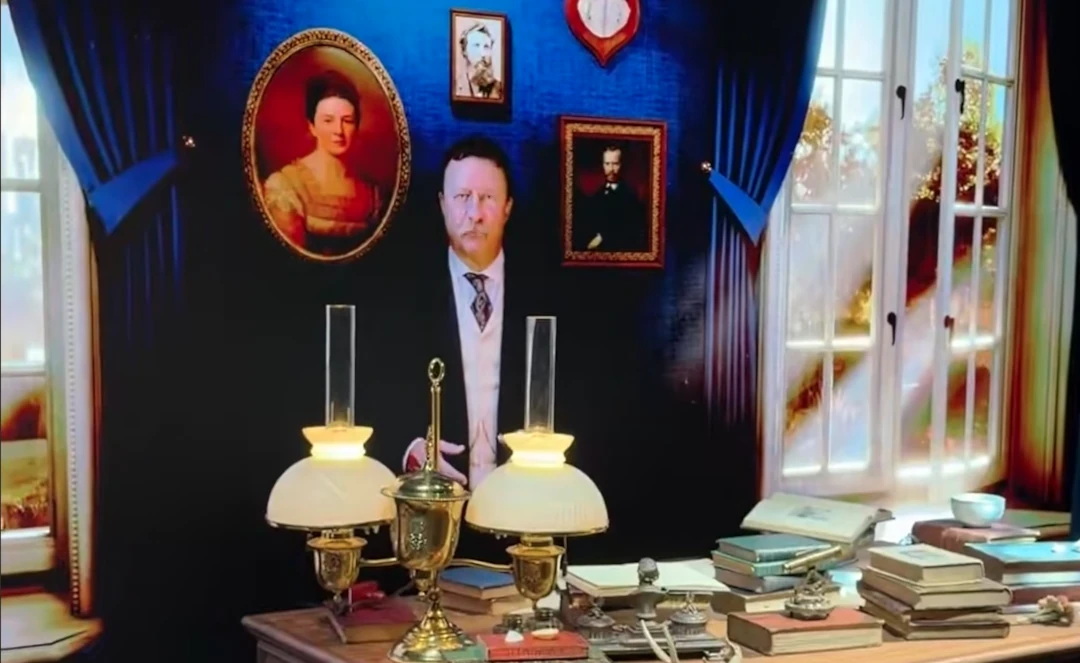
The AI Teddy Roosevelt was not a hallucination. It was a museum exhibit. The problem is what happened after the tour — when a sitting president climbed onto a stage and, in his own words, told the country he had just spoken with a man who died in 1919.
On the first day of July, in the buttes and dry grass of the Badlands, President Donald Trump toured a brand-new limestone building that had been quietly built into a hillside near Medora, North Dakota. The Theodore Roosevelt Presidential Library — designed to open to the public on America’s 250th birthday, July 4 — features an unusual centerpiece: an AI-driven exhibit called Campfire, developed with Microsoft’s AI for Good Lab and the Theodore Roosevelt Center at Dickinson State University, that lets visitors have simulated conversations with an avatar assembled from Roosevelt’s real letters, speeches, and photographs. This is a matter of public record, described in some detail by Snopes, The Washington Post, and the library itself. It is important to say clearly what this piece is not: the argument that the president “hallucinated” Roosevelt into being is not accurate, and we are not going to make it.
We are going to make a different argument, and it is one that we think matters more.
The problem is not that the AI was fake. The problem is what the president did with it after he walked out of the building. He climbed onto a stage at the Burning Hills Amphitheatre, in front of an audience and cameras, and, according to a widely circulated video captured by journalist Aaron Rupar and later verified by multiple outlets, told the country: “I even had a conversation with Theodore Roosevelt. I said, ‘What did you think about the Panama Canal? Do you consider that your greatest achievement? How do you feel about the fact that the Democrats gave the Panama Canal away to Panama for $1?'” No qualifier. No clarifying phrase. No “at the museum’s AI exhibit.” He offered it to the country as fact. As The New Republic reported, it fell to reporters, fact-checkers, and eventually the White House itself to explain that what the president had described as a conversation with a former president was, in fact, a chat with a hologram.
That is the sentence that ought to stop us in the middle of a national birthday. It fell to others to explain what the president had said.
I. The Encounter, Precisely as It Happened
On the tour itself, according to video shared by Trump’s own communications advisor Margo Martin, the AI Roosevelt spoke first. Trained on Roosevelt’s writings, it addressed the current occupant of the office in the voice of the 26th president. “Every day a president faces storms most people never see,” the AI said, “but if you keep your nerve and remember the nation comes first, you get through. I know you know that feeling yourself.”
The line about “the nation comes first” was not, one imagines, chosen at random from Roosevelt’s archive by accident. It is exactly what Roosevelt believed and exactly what he wrote about again and again. It is also — and one need not be uncharitable to notice this — exactly the kind of counsel that has been notably absent from the current administration’s decisions, arriving in the same week that The Daily Beast reported the president has personally earned roughly $1.4 billion from his family’s crypto ventures since taking office.
Trump’s response, on camera, was: “Well, I appreciate those words, those words are fantastic, and I just want to say it’s an honor to be with you today, and we are making a little bit of a tour, some of the fantastic things you’ve done.” The tone was conversational. Deferential, even. He addressed the machine as “you.” As The New Republic put it, it had “a similar effect to watching your elderly grandfather chat with a young, hot single on an online forum.”
Charitable readings are available and we should acknowledge them. The exhibit is designed to be conversational; a museum visitor being polite to a machine is not, by itself, a symptom of anything. Snopes, careful as ever, noted that the president did mention in his speech that Roosevelt died 107 years ago. He knew, in some frame of reference, that this was not a séance.
But the follow-up — the boasting to a rally crowd about a “conversation” with a man dead since 1919, described in the language one uses to describe an interview — is a different thing. And it is not a detail we can shrug at. It is the president of the United States describing an interaction with a chatbot to the American public, in the register of factual reportage, on the eve of the country’s 250th birthday.
II. What the Medical Establishment Actually Said
The reaction from clinicians was not from a fringe. It arrived on top of a warning that has been in the Congressional Record for two months.
On the specific North Dakota incident, IBTimes UK reported that a neurologist reviewing the footage described the president’s subsequent framing of the interaction as consistent with concerns about a possible “degenerative brain problem” — a term that would ordinarily be filed under professional over-caution but which here joins a much larger paper trail.
That paper trail is the point. On April 30, 2026, Senators Sheldon Whitehouse and Jack Reed, both Democrats of Rhode Island, entered into the Congressional Record a statement signed by 36 physicians — neurologists, psychiatrists, and specialists in cognitive disorders drawn from Harvard, Tufts, Columbia, and George Washington University. According to The Hill, the statement warned of a “rapidly worsening, reality-untethered, increasingly dangerous decline,” described the president as “mentally unfit,” and called for his removal “with the greatest urgency,” citing “grandiose and delusional beliefs,” “reckless threats of violence,” and “seemingly compulsive, manic-like late-night communications.” Because he holds the nuclear codes, the physicians invoked the 25th Amendment by name.
Raskin Demands Cognitive Evaluation
Rep. Jamie Raskin, ranking member of House Judiciary, formally wrote to White House Physician Capt. Sean Barbabella demanding a “comprehensive cognitive and neurological evaluation” of the president, and full public disclosure of the findings. The letter remains unanswered.
Section 4 Commission Bill Filed
Raskin, joined by 50 House Democrats, filed legislation to establish the Commission on Presidential Capacity to Discharge the Powers and Duties of Office — the standing body Section 4 of the 25th Amendment explicitly authorizes Congress to create, and which Congress has never established.
36 Physicians Enter the Record
Senators Sheldon Whitehouse and Jack Reed formally entered a statement by three dozen physicians from Harvard, Tufts, Columbia, and GWU into the Congressional Record, calling for the 25th Amendment. The Hill covered the statement in full.
The Roosevelt Library Speech
The president publicly describes his interaction with a museum AI as “a conversation with Theodore Roosevelt,” and — separately — brags on camera about “ripping” 90 acres of protected land “away from the federal government,” saying, “They don’t know it’s missing.”
The Roosevelt Library speech, in other words, did not arrive in a vacuum. It arrived on top of a Congressional Record entry from three dozen credentialed physicians, a formal Judiciary Committee demand for a cognitive assessment that has been simply ignored, and pending legislation to create the very body the Constitution says Congress may create for exactly this situation. It arrived on top of a February Reuters-Ipsos poll — cited in the same Hill essay — showing that a majority of Americans, including 30 percent of Republicans, believe the president has become erratic with age.
III. The White House’s Answer, and What It Wasn’t
Asked to respond, the White House did not offer a medical rebuttal. It did not release neurological findings. It did not make the White House physician available. It made jokes.
White House spokesperson Davis Ingle, responding to Raskin’s demand for a cognitive evaluation, said: “Lightweight Jamie Raskin is a stupid person’s idea of a smart person. President Trump’s sharpness, unmatched energy, and historic accessibility stand in stark contrast to what we saw during the past four years.” That is the exact quote, and it is the substance of the administration’s reply. Insult. Deflection. Comparison to Biden.
When The Daily Beast asked the White House to address the obvious contradiction between the president opening Roosevelt’s library while dismantling Roosevelt’s conservation legacy, the White House “didn’t see any contradiction” and simply referred the reporter to Trump’s remarks. Not a defense. A refusal to engage. The pattern is uniform: any request to substantiate the president’s fitness or explain the president’s conduct is met with a taunt about someone else. This is what “unable to discharge the powers and duties of his office” looks like when the office itself will not answer for it.
Get Involved Today
Contribute to our mission and turn your concerns into action.
IV. The Priorities the Speech Actually Revealed
Set the medical question aside for one moment — set aside every question about what a neurologist would or would not conclude from a five-second video clip — and look only at what the president chose to say and do on the day he opened a library honoring Theodore Roosevelt.
He bragged, on camera, about the acquisition of the library’s site. “We ripped it away from the federal government,” he said of the 90 acres of protected land the Theodore Roosevelt Presidential Library Foundation had purchased from the U.S. Forest Service. “They don’t know it’s missing. They still haven’t figured out what the hell happened.” This is on camera, from the man who then, in the same speech, praised the president who founded the Forest Service.
He praised Roosevelt for the Panama Canal — which was, on Roosevelt’s own record, a moral compromise Roosevelt spent decades defending. He barely mentioned the parks. He did not linger on the Antiquities Act. He said nothing meaningful about the Square Deal, the trust-busting, the food and drug safety regime — the actual pillars of the Roosevelt legacy that Democrats and progressives have spent a century honoring.
Meanwhile, according to reporting from The New Republic, this same administration has “significantly rolled back environmental protections that Roosevelt championed,” weakening the Endangered Species Act and exposing 86 million previously protected acres to drilling and development. Eighty-six million acres. That is the number that ought to have been in the president’s speech at Roosevelt’s library. It was not.
Interior Secretary Doug Burgum, the former governor of North Dakota who traveled with the president, told reporters ahead of the trip that “the parallels between Theodore Roosevelt and President Trump just keep adding up and up and up,” describing both as “transformative people who really shaped not just the U.S., but shaped the world and the world order.” Burgum was quoted by The Daily Beast. What Roosevelt shaped was a system of public trusts and conservation and antitrust law that Trump is systematically disassembling. To describe those two projects as parallels is not analysis. It is inversion.
“We ripped it away from the federal government. They don’t know it’s missing. They still haven’t figured out what the hell happened.”
— President Donald J. Trump — Medora, North Dakota, July 1, 2026
V. The Pattern, on a Timeline
None of the Roosevelt Library concerns can be evaluated by themselves. They are meaningful because they extend a pattern already documented by lawmakers, by the medical community, and by the president’s own recorded statements.
Ranking Judiciary Democrat Rep. Jamie Raskin writes to the White House physician, calling out “increasingly volatile, incoherent, and alarming public statements,” specifically citing threats to “extinguish a civilization” on social media and rants “about combat missions with children at the Easter Egg Roll.”
Raskin, joined by 50 House Democrats, files legislation establishing the Section 4 Commission on Presidential Capacity — the standing body the 25th Amendment authorizes Congress to create and has never created.
Sens. Sheldon Whitehouse and Jack Reed enter into the Congressional Record a statement by 36 physicians from Harvard, Tufts, Columbia, and GWU calling the president “mentally unfit” and demanding invocation of the 25th Amendment.
Reports emerge of a “Leon” slip in which the president addresses Elon Musk by the wrong name aboard the newly gifted $400 million Qatari 747; IBTimes UK aggregates a running list of clinician commentary on gait, speech, and cognition.
At the Theodore Roosevelt Presidential Library, the president describes a museum AI as “a conversation with Theodore Roosevelt” — and openly boasts about hiding 90 federal acres from the U.S. government.
The Undefined Word: Inability
The 25th Amendment, ratified in 1967 after the Kennedy assassination made presidential incapacity an urgent unresolved problem, uses a phrase that appears in Sections 3 and 4 and nowhere else in the Constitution: the president is unable to “discharge the powers and duties of his office.”
It does not define unable. It does not define inability. This was not sloppy drafting. This was — as the amendment’s principal author, Senator Birch Bayh, and the ratification-era commentary both make plain — deliberate. The framers of the amendment understood that human incapacity does not arrive on a schedule that lawyers can anticipate. It comes as strokes, dementia, addiction, psychiatric collapse, physical injury, cognitive decline, and every combination thereof. To define inability in the text was to invite every future crisis to be litigated over whether it fit the definition. Better, the drafters concluded, to leave the word plain and place the decision in political hands: the Vice President, the Cabinet, or a “body” that Congress may itself establish under Section 4.
Who has already invoked it
Rep. Jamie Raskin (D-MD), ranking member of House Judiciary, is the lead sponsor of legislation to establish the Section 4 Commission. Sens. Sheldon Whitehouse (D-RI) and Jack Reed (D-RI) entered the physicians’ statement into the record. 36 clinicians, working out of Harvard, Tufts, Columbia, and George Washington University, have signed a public medical judgment calling for the amendment’s use. This is not a fringe position. It is a documented, on-record request from a sitting congressional caucus and a working coalition of American physicians.
The constitutional argument, at its core
If the president describes a chatbot as a conversation with a dead statesman to a rally crowd, if the president brags on camera about concealing federal land seizures from the federal government, if the president’s own doctors will not appear before Congress to certify his fitness — then the amendment’s plain word does not require us to guess. Unable means what a reasonable citizen, watching the president discharge his duties, sees. The framers left the word undefined precisely so we could look, honestly, at what is in front of us.
The practical barrier
Section 4 requires the Vice President plus a majority of the Cabinet, or the Vice President plus a majority of a Section 4 body Congress has never created. Vice President Vance will not initiate this. The Cabinet, populated by loyalists, will not initiate this. That is why Raskin’s legislation matters: the amendment gives Congress the express power to create the alternative body, and Congress has, for fifty-nine years, refused to do it.
“The Constitution explicitly vests Congress with the authority to create a body that will guarantee the successful continuity of government by responding to presidential incapacity.” — Rep. Jamie Raskin, April 14, 2026
Why the barrier does not extinguish the case
That the political path is blocked does not mean the constitutional question is answered. The 25th Amendment does not require that a president consent to being unfit. It does not require that his party concede he is unfit. It requires a determination — and the drafters left the determination undefined so that reality could not be legislated away. The medical evidence, the physician letters, the congressional record, the video clips of the president himself: all of it is public. The barrier is political will, not constitutional clarity. And the barrier of political will is precisely the barrier a democracy is supposed to overcome, not indulge.
VI. What This Says About the Presidency
A serious president touring Theodore Roosevelt’s library on the country’s 250th birthday would have talked about Yosemite, the Antiquities Act, the 230 million acres of public land Roosevelt placed under federal protection. A serious president would have used the moment to argue for something: a conservation policy, an anti-corruption agenda, an industrial policy. A serious president, having just interacted with a museum AI, would have described it to the country as what it was — a museum AI — and used it as an occasion to talk about American history, or American technology, or both.
The president did none of those things. He talked to a hologram, and then told the country he had talked to Theodore Roosevelt. He talked about the Panama Canal, because it is the piece of the Roosevelt legacy he wants to imitate by threat of annexation. He bragged about acquiring federal land by stealth. He announced a $750,000 grant of taxpayer money to a library operated outside the National Archives system, on the same day that a separate congressional investigation, according to House Democrats, found that the administration diverted $75 million in taxpayer funds intended for the nonpartisan America250 commission to his own Freedom 250 project. Priorities are choices. These are the choices.
The Roosevelt Library was, in one sense, an incidental event. In another, it was diagnostic — not medically, but constitutionally. It showed a presidency that describes a chatbot as a person, describes a land grab as a triumph, describes a legacy of public conservation as a personal parallel, and cannot explain any of it when asked. That is what “unable to discharge the powers and duties of his office” looks like when the office itself will not answer for it.
Editorial Conclusion
The president did not hallucinate Theodore Roosevelt. But he described an AI as if it were a man, described a stolen forest as if it were a joke, and described a legacy of public conservation as if it were his own — and the White House will neither substantiate his fitness nor explain his conduct. The 25th Amendment left the word “inability” undefined for exactly this moment. Congress has a Section 4 body it is constitutionally authorized to create and has never created. That is no longer a theoretical failure. It is a live, ongoing dereliction — and every day it is delayed, the drafters’ foresight becomes another day’s warning ignored.
Sources & References
- The Hill — President Trump chats with AI Teddy Roosevelt at presidential library opening (July 2, 2026).
- Snopes — Posts claim Trump hallucinated conversation with Teddy Roosevelt. Here’s what happened (July 2, 2026).
- The New Republic — People Think Trump Hallucinated Teddy Roosevelt. The Truth Is Weirder (July 1, 2026).
- The Daily Beast (via Yahoo) — Trump, 80, Gets Roasted by a Hologram in Pep Talk Gone Wrong (July 1, 2026).
- Washington Post — Trump honors a president he sees as a peer — Theodore Roosevelt (July 1, 2026).
- IBTimes UK — ‘Degenerative Brain Problem’: Neurologist Says Trump’s AI Teddy Roosevelt Chat Raises Dementia Concerns (July 2026).
- AOL / Wonderwall — Donald Trump sparks ‘hallucination’ claims after saying he spoke with Theodore Roosevelt (July 2026).
- House Judiciary Democrats — Ranking Member Raskin Demands White House Physician Immediately Evaluate Donald Trump’s Cognitive Fitness (April 10, 2026).
- House Judiciary Democrats — Ranking Member Raskin Introduces Legislation Establishing Independent Commission on Presidential Capacity (April 14, 2026).
- The Hill (opinion) — Concerns Grow Over Trump’s Mental Fitness for Presidency (April/May 2026).
- Mediaite — House Democrats File Bill to Form 25th Amendment Commission (April 14, 2026).
- Yahoo News — Trump talks to AI Teddy Roosevelt about his ‘greatest achievement’ (July 2026).
- The New Republic — How Trump Lied to People Trying to Donate to America250 (July 1, 2026).
- The New Republic — Trump Posts Weird AI Video of Him Treating Celebrities Who Hate Him (July 1, 2026).
- Theodore Roosevelt Presidential Library — Official site, including the Campfire AI exhibit description.
- AP News — Trump Visits Newly Built Theodore Roosevelt Presidential Library in North Dakota’s Badlands (July 1, 2026).
- PBS NewsHour — Watch Live: Trump Attends Theodore Roosevelt Presidential Library Dedication (July 1, 2026).
Related News