Four Hundred Fifty Years to Silence Dissent
Eight protesters. A combined 450 years in federal prison. A “terrorism” designation invented by executive fiat. The Prairieland sentencings are the first major harvest of a presidential machinery built to criminalize opposition itself — and the country must reckon with what comes next.
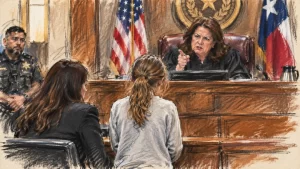
The federal courtroom in Fort Worth on Tuesday morning was the venue for what the Trump Justice Department openly celebrated as the first major harvest of a year-long executive project. Eight people connected to a July 2025 protest outside the Prairieland Detention Center in Alvarado, Texas, were sentenced to a combined four hundred and fifty years in federal prison, according to the Justice Department’s own announcement. The longest term — one hundred years — went to Benjamin Song, a former Marine Corps reservist convicted of firing on a police officer who responded to the demonstration. The shortest, thirty years, went to Daniel Sanchez-Estrada, who was not present at the protest at all. His crime was moving a box of antifascist zines belonging to his wife after the fact.
The Justice Department did not bury this lede. In its press release, it described the proceeding as “the first sentencing of defendants affiliated with Antifa” following President Trump’s September 2025 executive order designating that loose movement as a domestic terrorist organization. FBI Director Kash Patel, in a statement accompanying the sentences, framed the day as evidence the Bureau remained committed to identifying, locating, and dismantling antifascist networks across the United States. Acting Attorney General Todd Blanche struck a similar note. The defendants, in this telling, are not protesters who made a catastrophic choice in proximity to a violent act by one of their number. They are terrorists. They are the proof of concept for a new prosecutorial doctrine.
The trouble is that the doctrine has no foundation in law, the designation has no foundation in fact, and the sentences have no precedent in proportion. By every measure that matters to a constitutional republic, what happened on Tuesday is not the closure of a case. It is the opening of a campaign.
1. The Sentences That Sent a Message
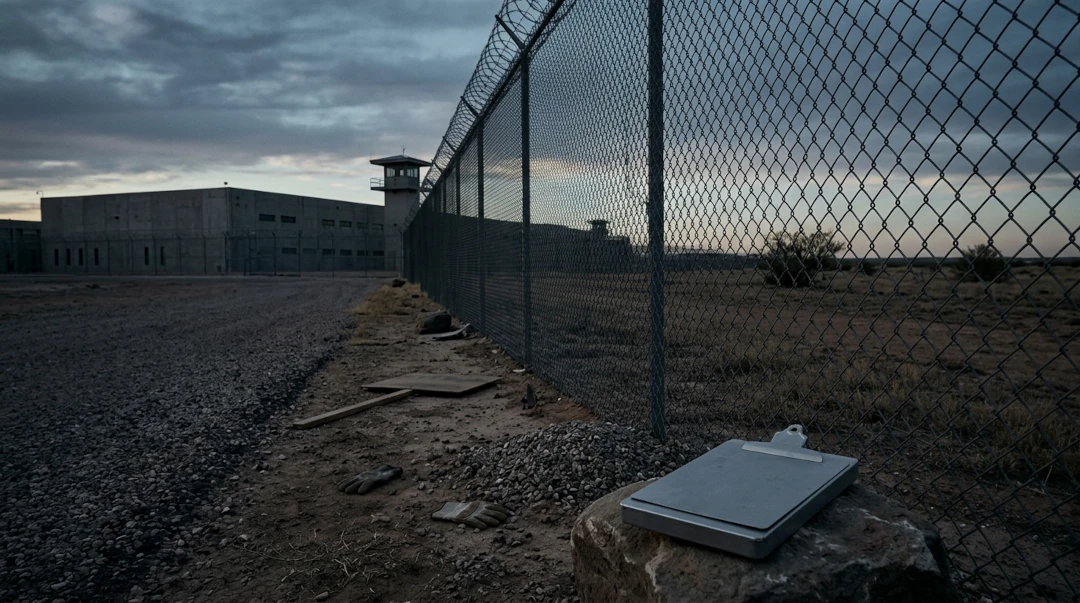
To understand what is genuinely new about the Prairieland verdicts, the sentences must be set against the conduct charged. On the night of July 4, 2025, a group of roughly eleven people gathered outside the Prairieland Detention Center, an ICE lockup operated by the for-profit contractor LaSalle Corrections. They set off fireworks. Some among them spray-painted slogans on government vehicles, slashed tires, and damaged a security camera and guard structure. When local police responded, Benjamin Song — by every account the only person to fire a weapon that night — shot Alvarado Police Lt. Thomas Gross in the neck from a wooded area. Gross was airlifted to a hospital. He survived. He has, according to the Alvarado police chief, fully recovered.
That set of facts produced these sentences: Song received 100 years. Maricela Rueda, 70 years. Cameron Arnold, Savanna Batten, Zachary Evetts, Bradford Morris, and Elizabeth Soto each received 50 years. Sanchez-Estrada, who was not at the demonstration, received 30 years for moving a box. A ninth defendant, Ines Soto, awaits sentencing on July 1. These prison terms are longer than any handed down to any of the more than 1,500 defendants convicted in connection with the January 6, 2021 assault on the United States Capitol — an attack on a coordinate branch of government in session, an attack that produced multiple deaths.
Prosecutors persuaded the jury that the defendants’ material support for terrorism could be inferred from the fact that they wore black clothing and used the Signal encrypted messaging application. That, in 2026, is what the federal government is prepared to call evidence of a terrorist conspiracy. Defense attorneys, in arguing for sentences proportionate to conduct rather than rhetoric, found themselves outflanked by a courtroom in which the government’s framing — that this was not a protest but a coordinated assault on the rule of law — had already been written into the indictment, accepted by the jury, and endorsed by judges who declared from the bench that the defendants’ actions were an assault on democracy itself.
Song’s attorney, Phillip Hayes, told reporters outside the courthouse that his client — a former Marine, by every account a young man of previously unremarkable conduct — would appeal. Hayes described the defendants as young people who had wanted their voices heard and who, save for one terrible decision in one terrible moment, never intended for anyone to be hurt. Christopher Weinbel, who represented Sanchez-Estrada, made the more searing argument in his own client’s hearing.
“The punishment must fit the crimes — not the headlines, not the politics, not the fears that have been mongered about the case.”
— Christopher Weinbel, defense attorney for Daniel Sanchez-Estrada
Judge Reed O’Connor gave Sanchez-Estrada thirty years anyway, for moving a box that contained nothing illegal. The headlines, the politics, the manufactured fear — these are now sentencing factors in a federal courtroom.
2. Manufacturing an Enemy: The Antifa Fiction
The legal scaffolding that produced these sentences is not, in the conventional sense, law. It is a presidential memorandum and an executive order, neither of which is grounded in any statute that authorizes the president of the United States to designate a domestic political tendency as a terrorist organization. Antifa, as has been observed by nearly every credible scholar to address the subject, is not an organization. It is an ideological orientation — a loose family of anti-fascist commitments that, like feminism or environmentalism, has no membership rolls, no leadership structure, no incorporation papers, no bank account.
Three days after President Trump signed his September 22, 2025 executive order purporting to designate this non-entity as a domestic terrorist organization, the administration issued National Security Presidential Memorandum 7 (NSPM-7), titled “Countering Domestic Terrorism and Organized Political Violence.” The memorandum is the master document of the campaign. It directs federal law enforcement, the Treasury, and the IRS to investigate, prosecute, and financially disrupt networks engaged in what it characterizes as politically motivated violence. Its enumerated indicia of such networks — the ideological markers federal investigators are now instructed to treat as predicates for terrorism inquiry — include anti-Americanism, anti-capitalism, anti-Christianity, support for migration, and what the memo calls “hostility towards those who hold traditional American views on family, religion, and morality.”
The Brennan Center for Justice’s analysis concluded that both the executive order and the memorandum are ungrounded in fact and law, that the president possesses no statutory authority to declare domestic terrorist organizations, and that the documents conflate constitutionally protected speech with criminal conspiracy in a manner the Supreme Court has previously warned against. The American Civil Liberties Union reached the same conclusion in starker terms, describing NSPM-7 as a deliberate effort to intimidate and silence opposition to the administration’s abuses.
Inside Congress, the response from progressive lawmakers was immediate. Representatives Mark Pocan of Wisconsin, Jared Huffman of California, and Pramila Jayapal of Washington led a House letter demanding the executive order and the memorandum be rescinded immediately. They warned that the inclusion of “anti-capitalism” as a hallmark of violent behavior could permit federal officials to treat ordinary Americans as domestic terrorists for organizing a local boycott. They warned that the memo’s framing of “anti-Christianity” as a concern conflicted with the First Amendment’s prohibition on government favoritism toward any faith. They warned, in short, of precisely the prosecutorial pattern that culminated in a Fort Worth courtroom on Tuesday.
Sept. 22, 2025 — Executive Order
Trump signed an order purporting to designate “Antifa” as a Domestic Terrorist Organization. No federal statute authorizes such a designation. Coverage via Time.
Sept. 25, 2025 — NSPM-7
Presidential memorandum directs Justice, Treasury, and IRS to investigate organizations and donors based on broad ideological markers. Full text at White House.
Dec. 4, 2025 — Bondi Memo
Attorney General Bondi orders agencies to scour five years of files for “Antifa-related intelligence” and establishes informant bounty programs. Reported by The Intercept.
2026 — Joint Mission Center
FBI’s NSPM-7 Joint Mission Center, drawing personnel from ten agencies, dedicated to identifying and prosecuting targets of the memorandum. Coverage via Truthout.
3. From Prairieland to Minneapolis: A Strategy Emerges
If the executive order and NSPM-7 are the doctrine, Prairieland is the prototype. And the prototype is replicating. Earlier this month, federal prosecutors in Minnesota indicted fifteen activists in connection with efforts to resist Operation Metro Surge, the administration’s immigration crackdown that flooded 2,700 federal agents into the Twin Cities to target Somali communities. Eleven of the fifteen face charges of conspiring to impede or injure federal officers. The Justice Department has identified this prosecution, too, as part of the NSPM-7 initiative. In Georgia, prosecutors have reanimated cases against Stop Cop City protesters that had been dismissed on procedural grounds in 2025, securing federal indictments after years of state-level dormancy.
What is emerging is a national prosecutorial template. It works as follows. A demonstration occurs. Some among the demonstrators commit acts of vandalism. A separate, possibly unrelated, act of violence occurs at or near the scene. The federal government then treats the entirety of the gathering — the planning, the attendance, the protective clothing, the encrypted communication, the political literature later moved or stored — as material support for terrorism. The conduct of the individual is collapsed into the conduct of the most violent person present. The political beliefs of the individual become predicates for the prosecution itself. And the sentence is determined not by the discrete act the defendant committed but by the ideological category to which the prosecution has assigned them.
Suzanne Adely, the interim president of the National Lawyers Guild, made the point precisely. The Prairieland case, she said, helps the government see how far it can go in criminalizing constitutionally protected protest, and helps it intimidate activists elsewhere into thinking twice before showing up. That is the function of these sentences. They are pedagogical. They are meant to teach.
4. What This Means for the Ordinary American
It is tempting, for Americans who do not consider themselves activists, to read about the Prairieland case as a story about other people — about a Marine reservist with a rifle, about a wooded perimeter outside an ICE facility, about choices most readers will never face. This would be a mistake. The legal architecture being built does not stop at the perimeter of any particular protest. It is designed not to.
Consider the Treasury and IRS provisions of NSPM-7. The memorandum directs the Treasury Secretary to disrupt the financial networks that allegedly fund what the administration calls domestic terror. It directs the IRS Commissioner to ensure that no tax-exempt entity directly or indirectly finances such activity. Federal law already makes it a felony — under a provision titled “Prohibition on Executive Branch Influence over Taxpayer Audits and Investigations” — for senior officials, including the president, to use the IRS for politically motivated retaliatory investigations. NSPM-7 instructs the executive branch to do exactly this. The targets are nonprofits whose missions touch immigrant aid, racial justice, environmental advocacy, and reproductive rights. The targets are foundations that fund civil society. The targets, ultimately, are the institutional supports that allow ordinary citizens to organize at all.
Consider, also, the question that The Intercept’s Nick Turse posed to the White House in December 2025: whether Americans deemed by the federal government to be members of domestic terrorist organizations are subject to the same extrajudicial killings the administration has authorized against alleged foreign terrorist suspects. The administration declined to answer the question. It answered other questions in the same exchange. It declined to answer that one. The space the administration has opened, by refusing to answer, is the space in which every American who has ever attended a protest, signed a petition, or donated to an immigrant aid group is now invited to live.
This is the meaning, for the ordinary American, of a 100-year sentence handed down to a young man who fired a shot at a protest, and a 30-year sentence handed down to a young man who moved a box. The space between the two — the radius of the strike zone — encompasses everyone.
Get Involved Today
Contribute to our mission and turn your concerns into action.
5. A President’s Priorities, Made Plain
It is fair to ask what kind of leadership this represents. A presidency must be judged not only by what it does but by what it prioritizes — by where it directs the immense machinery of federal power, and on whose behalf, and against whom. The pattern of this administration, made unmistakable by Tuesday’s sentencings, is a presidency that has decided its principal adversary is not a foreign power, not an economic crisis, not a public health threat, but the political opposition at home.
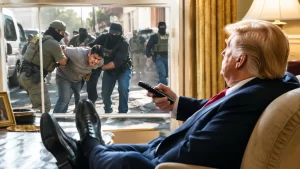
This is a president who, in the same season he was directing the Justice Department to construct century-long prison sentences for protesters at an immigration facility, was posting on Truth Social that “a whole civilization” could die if Iran did not meet a deadline he had imposed. This is a president who in a March 2026 Cabinet meeting acknowledged, on camera, that the path he was on could prompt invocation of the 25th Amendment — “which they didn’t do with Biden, which is shocking”, he added. This is a president whose Justice Department has refused to clarify whether American citizens on a secret domestic terrorism list are subject to extrajudicial killing.
The Prairieland sentences are not an isolated episode in the moral biography of this presidency. They are continuous with it. They are what happens when a chief executive who experiences criticism as threat is given a federal law enforcement apparatus willing to encode that experience into prosecution. They are what happens when “loyalty” replaces “law” as the operating principle of the executive branch. They are, in the literal sense of the term, an emergency — a moment in which the ordinary checks have proven insufficient and the extraordinary mechanisms of constitutional self-defense must be at minimum considered, even when the political path to invoking them appears closed.
The 25th Amendment Was Written for Moments Like This One
The Twenty-fifth Amendment, ratified in 1967, exists precisely because the framers of the modern presidency understood that the office could, in foreseeable circumstances, exceed the capacity of the person holding it. Section 4 provides that the Vice President, joined by a majority of the Cabinet — or, by the amendment’s own text, “such other body as Congress may by law provide” — may transmit to Congress a written declaration that the president is unable to discharge the powers and duties of the office. Power then passes, immediately, to the Vice President.
The case for considering Section 4 here does not rest on policy disagreement. It rests on a documented pattern: an executive who has openly directed federal prosecutors to construct century-long sentences for political dissidents on the basis of a domestic terrorist designation no statute authorizes; an executive who has threatened the mass killing of civilians abroad in profane late-night posts; an executive whose Justice Department has declined to rule out the summary execution of American citizens it places on a secret list. These are not partisan complaints. They are descriptions.
The named voices urging this constitutional reckoning are not marginal. Representative Jamie Raskin of Maryland, ranking member of the House Judiciary Committee, introduced legislation in April 2026 to establish the 17-member commission Section 4 explicitly contemplates. Representatives Ro Khanna of California and Yassamin Ansari of Arizona, alongside Senator Ed Markey of Massachusetts, have repeatedly called for invocation. More than 85 House and Senate Democrats joined the call after Trump’s April threats. Even prominent figures from the anti-Trump right, including Anthony Scaramucci and former Congressman Joe Walsh, have publicly endorsed it.
The Practical Barriers
Vice President Vance is a Trump loyalist. The Cabinet is a Trump Cabinet. Republican majorities in Congress are unlikely to provide the two-thirds vote that Section 4 ultimately requires. Trump himself has mocked the amendment’s invocation.
Why That Does Not End the Argument
The constitutional duty to identify presidential incapacity is owed to the country, not to its political calculus. A historical record matters. A congressional commission, even one a president can ignore, places on the public record the assessment of his fitness — and binds successors.
The Twenty-fifth Amendment is not a partisan instrument. It is a constitutional one. It was written, in the literal language of its drafters, to address situations in which the person holding the most consequential office in the federal government can no longer be trusted with its powers — whether for reasons of physical illness, mental deterioration, or, in a phrase the framers chose with deliberate breadth, any “inability to discharge the powers and duties of his office.” Building a prosecutorial machine to imprison political opponents on the basis of an ideology the Justice Department itself cannot define is exactly such an inability. The country owes itself the conversation, even if it does not yet have the votes for the result.
Editorial Conclusion
When a republic begins handing down century-long prison sentences for protests, treats ideologies as criminal conspiracies, and applies the machinery of federal counterterrorism to the work of silencing its own citizens, the constitutional question is no longer rhetorical.
The Twenty-fifth Amendment was not written for emergencies of weather or wartime alone. It was written for moments precisely like this one — when a president’s judgment, character, and reverence for democracy can no longer be trusted with the powers the office confers.
The Prairieland sentences are not the end of a case. They are the opening of a campaign — against dissent, against the First Amendment, and against the constitutional order itself. The country’s response must be commensurate with what is being lost.
Sources & References
- U.S. Department of JusticeLeader of Antifa Cell Members in North Texas Sentenced to 100 Years in Prison for Terrorist Attack on ICE Facility — official press release listing sentences and statements by Acting AG Blanche and FBI Director Patel.
- The InterceptPrairieland Defendant Sentenced to 30 Years in Prison for Moving a Box of Antifascist Zines — Matt Sledge’s reporting from the Fort Worth courthouse, including defense statements and historical context.
- CBS TexasLeader of group convicted in antifa-inspired attack on Texas ICE facility handed 100-year prison sentence — local coverage with judges’ statements and Alvarado police chief’s reaction.
- NBC 5 Dallas-Fort WorthAlvarado ICE shootout sentences include 100 years for Song — includes statement from National Lawyers Guild interim president Suzanne Adely.
- Al JazeeraProtesters sentenced to decades in US prison over alleged antifa ties — international coverage emphasizing civil liberties alarm.
- PBS NewsHour8 convicted of terrorism charges in Texas immigration center shooting sentenced to decades in prison — defense attorney Phillip Hayes’s statement on appeal.
- The New RepublicAnti-ICE Protesters Sentenced to Decades in Prison for “Terrorism” — case framed as test of Trump’s crackdown on immigration dissent.
- Common Dreams‘New Red Scare’: ICE Protester Gets 30 Years for Leftist Zines Under Trump Antifa Decree — includes Georgetown Law professor Arjun Sethi and DSA Fort Worth statements.
- The White HouseNational Security Presidential Memorandum-7: Countering Domestic Terrorism and Organized Political Violence — primary source for the memorandum’s text and enumerated ideological indicia.
- Brennan Center for JusticeTrump’s Orders Targeting Anti-Fascism Aim to Criminalize Opposition — analysis concluding the order and memo are ungrounded in fact and law.
- American Civil Liberties UnionHow NSPM-7 Seeks to Use “Domestic Terrorism” to Target Nonprofits and Activists — legal analysis of NSPM-7’s chilling implications.
- Time MagazineWhite House Anti-Terror Order Targets ‘Anti-American’ Views — Brennan Center expert commentary on conflation of dissent with terrorism.
- The InterceptWhite House Refuses to Rule Out Summary Executions of People on Its Secret Domestic Terrorist List — Nick Turse’s reporting on the administration’s evasion.
- TruthoutTrump Designated Antifa “Domestic Terrorists” — New Prosecutions Follow His Lead — coverage of the Minneapolis indictments and the NSPM-7 Joint Mission Center.
- Just SecurityThe Domestic Terrorist Label Endangers Rights and Drives Extremist Violence — prepared Senate testimony on the dangers of executive terrorism designations.
- Rep. Mark PocanPocan, Huffman, Jayapal to Lead Letter to Trump Slamming Executive Order Targeting Protected Speech — congressional letter demanding rescission of the EO and NSPM-7.
- AxiosHouse Democrats file long-shot 25th Amendment bill targeting Trump — Rep. Raskin’s commission legislation and the post-Iran momentum.
- NBC NewsDozens of Democrats call for Trump’s removal after his Iran threats — comprehensive list of lawmakers calling for the 25th Amendment, including Khanna, Ansari, Markey.
- PBS NewsHourCould the 25th Amendment be invoked against Trump? Here’s how it works — PolitiFact analysis including Trump’s own March 2026 Cabinet statement.
- Wikipedia (Reference)2025 Prairieland ICE detention center incident — consolidated factual chronology and references.
Related News