The Cleveland Raid: When the FBI Comes for Voter Registration
More than one hundred federal agents fanned across Ohio this week to question canvassers and seize laptops from a nonprofit whose offense is helping Black, urban, and incarcerated Americans register to vote. This is not a criminal investigation. It is an intimidation campaign — and it is exactly what the framers built the First and Fourteenth Amendments to prevent.
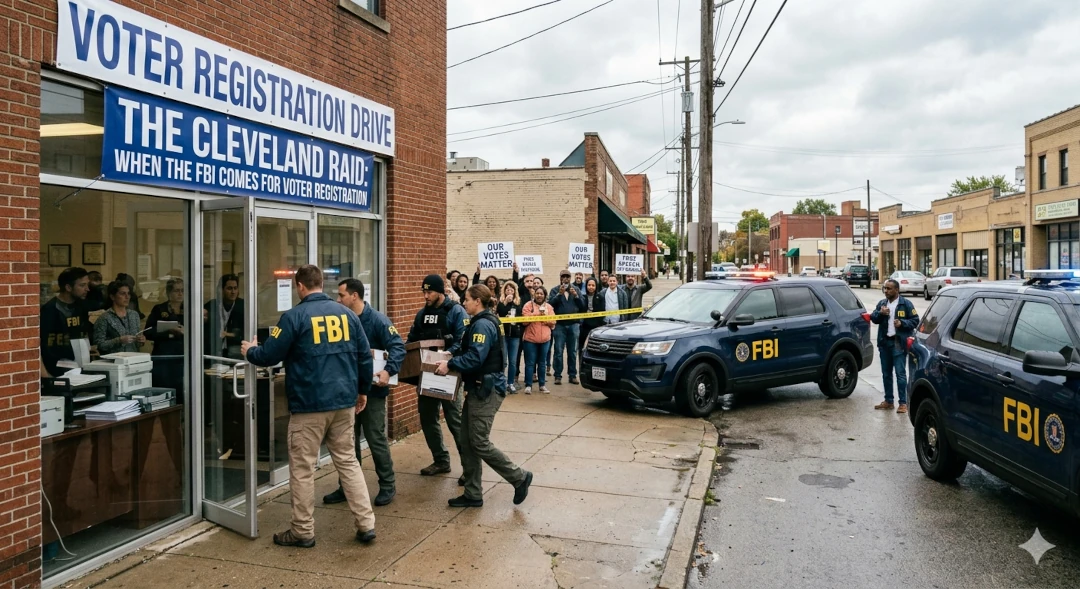
On Thursday morning in Cleveland, federal agents walked into the offices of the Ohio Organizing Collaborative — a nineteen-year-old grassroots nonprofit best known for registering voters in Black churches, on college campuses, and inside Ohio’s prisons — and began seizing laptops, files, and electronic devices. According to board member Prentiss Haney, agents spent hours questioning staff. Then they fanned out. They appeared at the homes of organizers in Columbus, Dayton, and Cincinnati. They knocked on the doors of volunteers who had done little more than help neighbors fill out registration forms. Some, Haney told MS NOW, arrived without warrants. They demanded that people step outside their homes to be questioned about alleged voter fraud — in front of their children, in their driveways, on their way to work.
By Haney’s estimate, more than one hundred FBI agents were involved. “It was a full onslaught,” he said. The Justice Department has declined to comment. The FBI’s Cleveland field office has not responded to reporters. The U.S. Attorney’s Office for the Northern District of Ohio has gone silent. Americans are simply expected to accept that the most powerful law enforcement agency on the planet has descended on a voter registration nonprofit five months before a midterm election in which Ohio will host two of the most consequential races in the country — and trust, without evidence, that this is normal.
It is not normal. It has never been normal. And the silence of the men who ordered it is the loudest part.
1. What Actually Happened
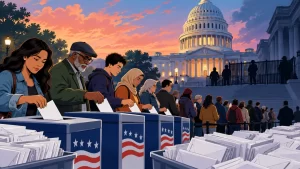
The Ohio Organizing Collaborative was founded in 2007. Its stated mission, available on its public-facing website and in its publicly filed tax returns, is to build “transformative relational power” with everyday Ohioans for racial, social, and economic justice. Its Democracy Builders initiative runs voter registration drives in Cleveland, Columbus, and Cincinnati. It works with Black congregations, with formerly incarcerated Ohioans, with college students. In other words: it does the constitutionally protected, statutorily encouraged, civically essential work of helping eligible American citizens exercise their right to vote.
According to reporting by the Washington Post, the Associated Press, and MS NOW, which broke the story, agents seized computers and materials from the Cleveland office on Thursday. Subpoenas were served at the homes of staffers and people described as having only “performed basic canvassing.” A person familiar with the matter, speaking anonymously to the AP, said investigators are examining “potential fraud violations” — a phrase notable for its vagueness. The organization itself has never been charged with anything. The only documented incident in its history is a single 2017 case in which one paid canvasser pleaded guilty to falsifying signatures and was prosecuted — by the existing legal system, working as designed, without a paramilitary raid.
“They had agents all across the state going to civil rights leaders’ and community leaders’ doors intimidating them … just straight-up intimidation tactics.”
— Prentiss Haney, OOC Board Member, to MS NOW
2. The Pattern Is the Point
To understand the Cleveland raid, you have to look at it as the eleventh, twelfth, or thirteenth entry in a list — not the first. Since January, the Trump administration has launched federal interventions into the election machinery of states that voted against the president, every single one of them dressed in the language of “election integrity”:
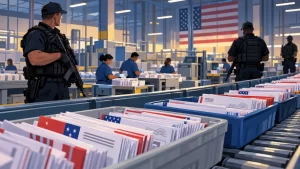
In January, a dozen FBI agents seized 2020 ballots from Fulton County. The operation was personally overseen by then-DNI Tulsi Gabbard, who arranged for President Trump to speak with agents by cell phone during the raid.
In March, a federal grand jury subpoenaed 2.1 million ballots from Maricopa County. Arizona Attorney General Kris Mayes noted the results had already been certified, litigated, and audited — an audit that actually gained votes for Biden.
In April, DOJ demanded all 865,000 ballots and envelopes from Wayne County’s 2024 election — the election Trump won. The targeted county is home to Detroit. Wayne County has said it does not have custody of the records.
In March, Trump signed an executive order requiring federal agencies to compile and transmit “State Citizenship Lists” — a federal mechanism with no constitutional basis. The Constitution gives election authority to the states.
The common thread is unmistakable. Every jurisdiction targeted is one Trump lost or where Democrats are competitive. The legal pretext is always the same — phantom “fraud” that no audit, no court, no bipartisan review has ever substantiated. And the tactics are escalating: from seizing old ballots in a county elections warehouse to deploying agents at the front doors of unpaid volunteers in Ohio.
3. The First Amendment Is Not a Suggestion
Voter registration is core, protected political activity under the First Amendment. The Supreme Court has held repeatedly — in NAACP v. Button (1963), in Buckley v. Valeo (1976), in case after case — that the right to advocate for the franchise and to associate with others doing the same is constitutionally protected to the highest degree. When federal agents knock on the doors of canvassers in their pajamas and demand information without warrants, they are not investigating crime. They are chilling speech. That is the textbook definition of an unconstitutional prior restraint exercised through intimidation.
The Fourteenth Amendment matters here too. The communities the Ohio Organizing Collaborative serves — Black congregations, urban voters, the formerly incarcerated — are precisely the populations the Equal Protection Clause was ratified, in 1868, to shield. As Rep. Shontel Brown of Cleveland put the matter plainly: voter registration is not voter fraud. Black Americans voting is not voter fraud. Urban communities voting is not voter fraud. The deployment of federal force against the people doing this work — and only against the people doing this work for one of the two major parties — is exactly the “color of law” violation that federal civil rights statutes were enacted to punish.
Get Involved Today
Contribute to our mission and turn your concerns into action.
4. A Timeline of Escalation
5. What This Means for the Average American
If you are reading this and you have never registered a voter, helped a neighbor request an absentee ballot, or signed your name to a petition, you may be tempted to believe the Cleveland raid does not touch your life. It does. It touches it directly. The question raised by the Ohio Organizing Collaborative is not whether progressive nonprofits will continue to register voters in 2026. The question is whether any ordinary American — a retired schoolteacher in Akron, a church deacon in Cincinnati, a college student in Columbus — can volunteer for a civic cause without the realistic fear that federal agents will arrive at their door demanding answers about “fraud” they never committed and cannot define.
The chilling effect is the goal. When Cleveland Mayor Justin Bibb said he was “deeply troubled” by the raid, he was identifying precisely this dynamic. A volunteer who fears the FBI will not knock on her neighbor’s door tomorrow. A nonprofit board member who has been awakened at home will think twice before authorizing the next registration drive. A donor will hesitate before writing the next check. Multiply that by every state where the administration has signaled it might intervene, and you have functionally suppressed civic participation across half the country without passing a single new law. This is suppression by atmosphere — and it is far more efficient than passing voter ID laws one statehouse at a time.
It is also, in the most literal sense, taxation without representation in reverse: the federal government has been seized by a faction and is now being weaponized against the very citizens whose taxes pay its salaries — for the offense of trying to vote.
“Any attempt to intimidate Ohio voters is wrong, and will not work.”
— Dr. Amy Acton, Democratic Nominee for Ohio Governor
6. The Constitutional Duties He Swore To Uphold
Article II, Section 3 of the Constitution requires the president to “take care that the laws be faithfully executed.” That is not decorative language. It is the spine of the office. The laws being faithfully executed include the Voting Rights Act of 1965, the National Voter Registration Act of 1993, and the First, Fourth, and Fourteenth Amendments to the Constitution. A president who deploys federal law enforcement to intimidate the very citizens those laws were enacted to protect is not “taking care” of anything. He is, by the plainest reading, in violation of his oath.
And he has been escorted to this place by enablers. FBI Director Kash Patel — whose own writings and public statements before his confirmation made his hostility toward perceived enemies of the president explicit — now signs off on operations against voter registration groups while declining to explain a single one of them publicly. Attorney General Pam Bondi’s Justice Department has issued no statement justifying the Cleveland raid on its merits. Harmeet Dhillon, the assistant attorney general for Civil Rights, has openly described these investigations as “accountability for the outrageous weaponization of the deep state” — language that confirms what the targets already know: this is not law enforcement. This is reprisal.
When a President Cannot — or Will Not — Faithfully Execute the Laws
The Twenty-Fifth Amendment, ratified in 1967, was drafted in the aftermath of the Kennedy assassination to answer a question the Constitution had left unresolved: what happens when a president is unable to discharge the powers and duties of his office? Section 4 provides the answer. By a written declaration of the Vice President and a majority of the Cabinet (or such other body as Congress may by law provide), a president may be transferred to inactive status. If contested, Congress must convene within 48 hours and, by a two-thirds vote of both chambers, can confirm the determination.
The legal mechanism is not in dispute. The question has always been the political will to invoke it. That question is now being asked in earnest. On April 10, 2026, Rep. Jamie Raskin (D-MD), ranking member of the House Judiciary Committee, demanded that White House physician Capt. Sean Barbabella conduct a comprehensive cognitive and neuropsychological assessment of the president and release the results publicly. Days later, Raskin introduced legislation to establish an independent bipartisan commission empowered to activate the Section 4 process. More than fifty Democratic lawmakers, including Sen. Andy Kim (D-NJ), have publicly called the president “unfit for office.”
Raskin’s case rested on a documented pattern of erratic, volatile, and incoherent public statements — including threats to “destroy entire civilizations” over the Strait of Hormuz, social-media posts likening himself to Jesus Christ, and increasingly disjointed press appearances. To that established record we now add a new and specifically constitutional dimension: a president who deploys the federal investigative apparatus against citizens exercising their First Amendment rights is not merely behaving badly. He is failing the threshold test of Article II — the duty to faithfully execute the laws of the United States. The Twenty-Fifth Amendment was written for incapacity. It is fair to argue that a sustained, knowing refusal to discharge the core duty of the office — preserving the constitutional order — is a form of incapacity Madison himself would have recognized.
The honest assessment of practical barriers must be made. Vice President JD Vance will not initiate a Section 4 proceeding against the president he serves. A Republican Cabinet, selected for loyalty above all, will not vote against him. A Republican-controlled Congress will not reach the two-thirds threshold. The path is, in the short term, politically closed.
That does not negate the constitutional case. The case must be made anyway — in committee hearings, in scholarly analysis, in the public record — because the work of building consensus around presidential incapacity is the work of preserving the Republic itself. The Cleveland raid is exhibit Z in a brief that grows longer by the week. History will record who refused to read it.
7. The Voices on the Record
This is not manufactured outrage. Every elected official with standing to speak has already spoken. Rep. Emilia Sykes (D-OH) called the raid an “egregious federal overreach” and an “unprecedented attack on our democracy.” Rep. Shontel Brown, who represents the Cleveland district where the raid occurred, identified it as part of a “systematic effort by Trump and Kash Patel’s FBI to attack our elections.” Former U.S. Sen. Sherrod Brown, the Democratic nominee challenging Sen. Jon Husted, called the raid a “transparent attempt at silencing Ohioans” in free and fair elections. Cleveland Mayor Justin Bibb demanded transparency on every aspect of the operation.
What is striking is not the unity of the Democratic response. What is striking is the absolute silence — and active facilitation — from elected Republicans whose constituents include the same voters now being intimidated. Ohio Secretary of State Frank LaRose, a Republican who oversees the state’s elections, issued a statement thanking federal law enforcement and offering further assistance. He did not ask for a single piece of evidence. He did not demand to see a warrant. He did not call to defend the franchise of the Ohioans who elected him. He saluted.
Editorial Conclusion
The Cleveland raid is not an investigation. It is a message. The message is that in Donald Trump’s second term, the cost of helping an American citizen register to vote — if that citizen is the wrong color, in the wrong neighborhood, or expected to vote the wrong way — is a federal agent at your door, without a warrant, in front of your children.
This is not a partisan grievance. It is a constitutional emergency. The First Amendment does not survive a regime that punishes association. The Fourteenth Amendment does not survive a regime that targets enfranchisement by race and geography. The presidency itself does not survive a man who treats Article II’s “take care” clause as optional.
The Twenty-Fifth Amendment exists because the framers, and their successors in 1967, understood that the Republic must have a remedy for a president who cannot or will not do the job. We are past the point at which serious people may pretend the remedy is unnecessary. What is required now is the political courage to name what is happening, to record it, and to act — in Congress, in the courts, in every statehouse, and on every doorstep where a volunteer was told this week that voting is a crime. America has had Enough. The franchise belongs to the people. So does the country.
Sources & References
- Common Dreams — “Straight-Up Intimidation Tactics: Kash Patel’s FBI Raids Ohio Voting Rights Organization” (June 12, 2026)
- MS NOW — “Ohio voting rights organization raided by FBI” (initial breaking report)
- The Washington Post — “FBI searches offices of Ohio voter registration group, seizing computers”
- PBS NewsHour / AP — “FBI searches office of Ohio group that supports voter registration efforts”
- WKYC Cleveland — “Ohio political leaders react to report of FBI raid”
- News 5 Cleveland — “FBI searches Cleveland office of Ohio group” (statements from Bibb, Brown, Sykes)
- U.S. Rep. Emilia Sykes — Official statement on the FBI raid
- Statehouse News Bureau — “Ohio voting rights group says it was raided by the FBI”
- Democracy Docket — “Trump FBI raids Ohio voter registration group in latest bid to suppress voting”
- Signal Akron — “What to know about the Ohio Organizing Collaborative after FBI searches”
- Ohio Capital Journal — “FBI searches offices of Ohio voting-rights group”
- Dayton Daily News — “FBI searches offices of Ohio voting-rights group”
- USA Today / Yahoo News — “FBI raids Ohio voting rights group, questions members across state”
- Votebeat — “Trump administration’s investigations into 2020 voter fraud may be more about the 2026 election”
- The Hill — “Trump’s election fraud claims and efforts to override state control”
- Congressional Research Service — “Federal Investigations and Seizures of Voting Records”
- House Judiciary Democrats — Rep. Jamie Raskin’s letter demanding cognitive evaluation of the President
- The Hill — “Concerns Grow Over Trump’s Mental Fitness for Presidency”
- Axios — “Raskin demands Trump cognitive test in 25th Amendment push”
Related News