A new Yale Budget Lab analysis finds that the president’s IRS–ICE data-sharing regime and broader enforcement push could cost the Treasury up to $479 billion in lost tax revenue over the next decade — at the very moment the deficit is racing toward $3 trillion and Social Security toward insolvency. This is not strength. It is self-sabotage dressed in red, white, and blue.
The numbers were never supposed to be the headline. President Donald Trump has spent the better part of two years selling his mass deportation campaign as a matter of sovereignty, security, and moral clarity — never as a fiscal question. But the fiscal question has now arrived, and it is staggering. The Yale Budget Lab, a nonpartisan research center at Yale University, projects that the administration’s signature agreement between the Internal Revenue Service and Immigration and Customs Enforcement will cost the federal government between $147 billion and $479 billion in lost tax revenue over fiscal years 2026 through 2035, with a midpoint estimate of roughly $313 billion. That is real money. It is money the United States cannot afford to lose. And it is money the president is choosing to forgo, deliberately, in the service of a policy that economists across the political spectrum warn will hollow out the labor force, accelerate inflation, and bring the entitlement programs of millions of American retirees closer to collapse.
The mechanism is straightforward. Undocumented immigrants currently contribute approximately $66 billion every year in federal payroll and income taxes, often using Individual Taxpayer Identification Numbers in the long-standing — and, until last year, ironclad — belief that the IRS would never hand their information to immigration enforcement. In April 2025, the Treasury Department broke that promise. Under a memorandum of understanding first reported by the press and later analyzed by the Yale researchers, the IRS agreed to share names and addresses with ICE for individuals with final removal orders. The federal courts have since intervened, ruling that the disclosure of nearly 50,000 addresses likely violated taxpayer confidentiality law. But the damage to compliance behavior, the Yale analysts warn, may already be done.
Filing rates are falling. Employers are shifting workers off the books. And every dollar that no longer flows into the Treasury is a dollar that must either be borrowed, taxed elsewhere, or cut from a federal program. There is no fourth option. There has never been a fourth option. A president who promised to balance the budget is now actively chasing tens of billions of dollars in annual revenue out of the country.
1. What the Yale Budget Lab Actually Found
The Yale Budget Lab analysis, originally released in April 2025 and updated in May 2026, models the federal revenue impact of the IRS-ICE data-sharing arrangement under a range of behavioral assumptions. In its central scenario, the agreement reduces federal income and payroll tax collections by an average of 0.5 percent — roughly $25 billion in fiscal year 2026 alone. Over the decade, the midpoint loss is $313 billion. At the high end — if nearly all undocumented workers and their employers shift to informal arrangements — the figure climbs to $479 billion. At the low end, which assumes minimal behavioral change, it still costs $147 billion.
The Conference Board’s Committee for Economic Development, in its own review of the data, characterized the projection as a credible accounting of “between $150 billion and $500 billion in lost Federal tax revenue over the next decade.” The estimate is, the Yale team is careful to note, highly uncertain. That uncertainty cuts both ways. It could be less. It could also, plausibly, be more.
2. The Workers He Is Hunting Are the Workers Who Pay the Bills
There is a fact about undocumented immigration in America that does not appear in any campaign speech delivered from the South Lawn. The roughly eight to ten million unauthorized workers in the U.S. labor force are, by any honest accounting, net fiscal contributors. They pay into Social Security and Medicare through payroll withholding. Most will never collect a dollar in return. The Center on Budget and Policy Priorities, citing the chief actuary of the Social Security Administration, has documented that this population contributes a net positive sum to the trust fund — roughly $12 billion in 2010, and substantially more today. The Institute on Taxation and Economic Policy reached a parallel conclusion in its analysis of 2022 returns.
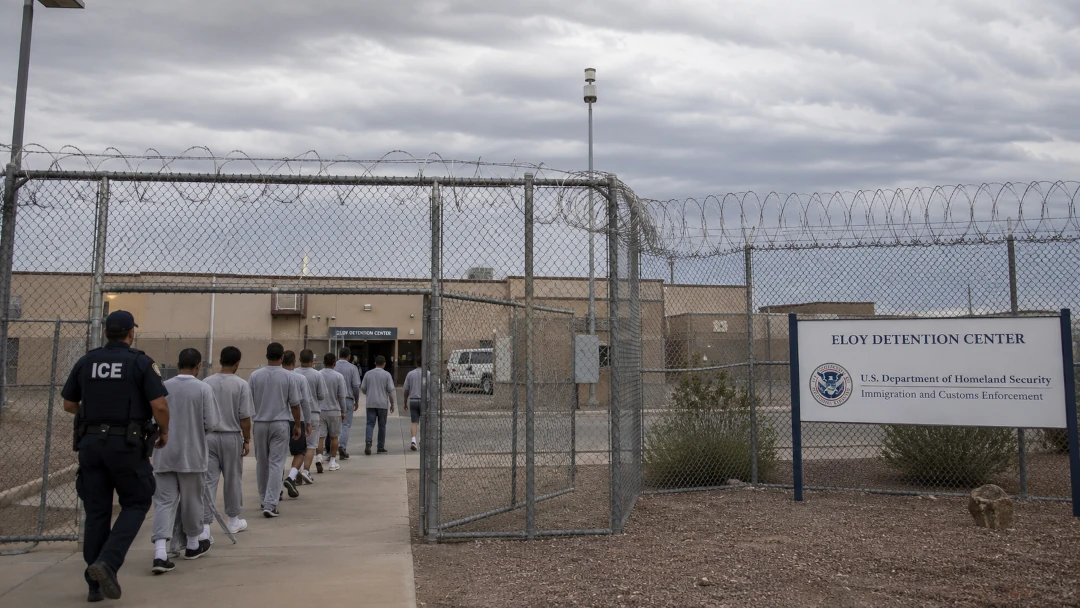
This is the population the administration has spent more than $113 billion of taxpayer money — already, in just the first seven months of fiscal 2026 — trying to find, detain, and remove. According to apportionment data tracked by the Cato Institute, the Department of Homeland Security has now released $113.9 billion in funds from the One Big Beautiful Bill Act, leaving roughly $77 billion still queued for fiscal 2027 and beyond. ICE alone, as NPR has documented, has become the highest-funded federal law enforcement agency in the United States — a budget of roughly $85 billion at its disposal, larger than the entire annual appropriation of the federal prison system that houses 155,000 inmates.
“Here what we have is just a massive shoveling of cash to an agency with few if any strings. I can’t think of an example that’s anywhere close to that.”
— Sam Bagenstos, former OMB general counsel, to NPR (April 2026)
Set the moral case aside, if you must, and look only at the ledger. The president is spending $170 billion in enforcement money — borrowed money, since the federal government is running a $1.9 trillion deficit this year — to chase out a workforce that pays $66 billion a year in federal taxes. He will lose, by the Yale researchers’ central estimate, another $313 billion in revenue over the next decade because of the compliance collapse his enforcement regime has triggered. The math is not difficult. The math is, in fact, devastating.
3. The Economic Damage Beyond the Treasury
Lost tax revenue is only the most direct fiscal consequence. The broader macroeconomic effects are larger and, by most credible estimates, worse. The Penn Wharton Budget Model, in its mass deportation analysis, finds that a sustained ten-year deportation policy reduces real GDP by 3.3 percent by 2034, with cumulative output losses growing to 4.9 percent by 2054. The model also projects an additional $900 billion in fiscal cost over the first decade, on top of the $170 billion already allocated. Wages for high-skilled workers — 63 percent of the workforce — would fall as well.
Brookings economists Wendy Edelberg and Tara Watson, in their January 2026 update, conclude that the U.S. experienced negative net migration in 2025 for the first time in decades, with the dampening effect on consumer spending alone estimated at between $60 billion and $110 billion across 2025 and 2026. The Joint Economic Committee minority staff has warned that for every 500,000 immigrants removed from the labor force, 44,000 U.S.-born workers lose their jobs through the cascading effect on industries that depend on immigrant labor. Construction would shed up to 1.5 million workers. Agriculture, 225,000. Hospitality, a million. These are not abstractions. These are the jobs that feed American families and build American homes.
The Dallas Federal Reserve, hardly an outpost of progressive thought, has reached parallel conclusions about the drag on growth, noting that the labor force impact alone will weigh on GDP for years to come without any offsetting deflationary benefit. The Baker Institute at Rice University projects total GDP losses of 2.6 to 6.2 percent over the next decade under full enforcement.
Get Involved Today
Contribute to our mission and turn your concerns into action.
4. The Deficit He Promised to Cut
This is where the absurdity sharpens into something closer to indictment. The Congressional Budget Office’s February 2026 baseline projects a federal deficit of $1.9 trillion for fiscal year 2026, rising to $3.1 trillion by 2036. Federal debt held by the public will surpass its post–World War II record, climbing from 101 percent of GDP this year to 120 percent by 2036. The CBO is unsparing about the causes: the One Big Beautiful Bill Act of 2025 increased projected deficits by $4.7 trillion over the decade, and the administration’s immigration enforcement actions added another half-trillion dollars on top of that, even before tariff revenue effects are netted out.
“Our budget projections continue to indicate that the fiscal trajectory is not sustainable,” CBO Director Phillip Swagel said upon the report’s release. Maya MacGuineas, president of the Committee for a Responsible Federal Budget, was blunter: the country has borrowed $1 trillion in just the first five months of fiscal year 2026. Interest payments on the national debt now exceed $1 trillion annually and are on track to surpass $2 trillion by 2036.
Let that settle. The country is borrowing seven billion dollars a day. The president is simultaneously waging an enforcement campaign that, by the Yale Budget Lab’s reckoning, will deprive the Treasury of as much as half a trillion more dollars. And his answer to all of this is to push Congress for another $72 billion in ICE and CBP reconciliation funding. There is no plausible accounting in which this is fiscal responsibility. It is, on its plain face, a deliberate choice to make the deficit worse in pursuit of a political symbol.
5. Social Security on the Clock
The cruelest irony is the one that lands on retirees. The Social Security Trust Fund is, on its current trajectory, projected to be depleted in 2034, at which point benefits would be cut by roughly 23 percent across the board. The Penn Wharton Budget Model finds that Trump’s deportation policies move that depletion date forward by six months in every scenario it modeled — and, under the most aggressive deportation assumptions, drain the trust fund of an additional $133 billion to $884 billion over the next thirty years.
Tara Watson, who directs the Center for Economic Security and Opportunity at Brookings, captured the demographic logic precisely: immigration drives nearly all of U.S. population and labor force growth, and the deportation regime is shutting off that engine just as the country needs it most. The president has spent years claiming, falsely, that undocumented immigrants are draining Social Security. The opposite is true. The Center for American Progress documents the lie at length. And now, in the act of pursuing his fiction, he is making the truth materially worse.
“We are at a dangerous precipice, and it is now a matter of national security for Congress to fulfill its responsibilities under the 25th Amendment.”
— Rep. Jamie Raskin (D-MD), Ranking Member, House Judiciary Committee (April 14, 2026)
6. A Timeline of Self-Inflicted Damage
When Self-Sabotage Becomes a Question of Capacity
The 25th Amendment, ratified in 1967 in the wake of the Kennedy assassination, was designed to answer a narrow but vital question: what happens when a president is medically or cognitively unable to discharge the powers and duties of office. Section 4 empowers the vice president, acting with a majority of the Cabinet — or with a majority of “such other body as Congress may by law provide” — to transfer presidential authority to the vice president on a finding of incapacity. In nearly six decades, the section has never been invoked. The “other body” Congress was authorized to create has never been created.
That changed, at least on paper, on April 14, 2026, when Rep. Jamie Raskin (D-MD), the ranking member of the House Judiciary Committee, introduced legislation establishing a Commission on Presidential Capacity to Discharge the Powers and Duties of Office. Fifty House Democrats co-sponsored the bill within hours. Rep. Alexandria Ocasio-Cortez (D-NY) and more than 70 additional lawmakers had, days earlier, publicly called for the president’s removal following his social-media threat that “a whole civilization will die tonight” if Iran did not accept his ceasefire terms.
The standard 25th Amendment objection — that policy disagreement, however severe, is not the same as incapacity — is well-taken and must be acknowledged honestly. The Amendment was not written for an administration whose policies one happens to find ruinous. It was written for a president who cannot perform the job.
But the case Raskin and his colleagues are making is not that the president disagrees with them on tax policy. It is that the president is making decisions — on Iran, on the office of the presidency itself, and yes, on the federal fisc — that no rational actor charged with the duty of faithful execution would make. To borrow $7 billion a day while deliberately driving half a trillion dollars in tax revenue out of the country, to spend $170 billion hunting workers who contribute $66 billion annually to the very entitlement programs his own base depends on, to compound a $1.9 trillion deficit in pursuit of a symbol — these are not the choices of a leader exercising contested judgment. They are choices that, taken together with the broader pattern, raise legitimate questions about whether the duties of the office are being faithfully discharged at all.
The Practical Barriers
The Raskin bill faces brutal arithmetic. Republicans control both chambers. The president would veto any bill that reached his desk. And even if the Commission were established, Section 4 still requires the concurrence of the vice president — and Vice President J.D. Vance is, by every available indication, a Trump loyalist. The constitutional path runs through people who will not walk it.
That is not a reason to abandon the case. It is a reason to make the case more clearly. The 25th Amendment exists precisely because the Framers — and the post-Kennedy Congress that drafted Section 4 — understood that some failures of presidential capacity cannot wait for the next election. Whether the country has reached that threshold is a question Americans will have to answer in the voting booth, in their state legislatures, and in their daily acts of civic engagement. But the question itself is no longer fringe. It is on the floor of the House of Representatives, carried by fifty members, and it deserves a serious hearing.
7. What Leadership Is, and What This Is Not
A serious president, presented with a Yale Budget Lab analysis projecting a half-trillion-dollar revenue loss over the decade, would convene Treasury, the Office of Management and Budget, and the Council of Economic Advisers. He would ask whether the policy is worth the price. He would weigh the macroeconomic evidence — from the Dallas Fed, from Brookings, from Penn Wharton, from the Joint Economic Committee — and adjust. He would not, having seen the numbers, push Congress for another $72 billion in enforcement funding through a reconciliation process that bypasses the normal appropriations safeguards. He would not, with the deficit running at 5.8 percent of GDP, allow the largest law enforcement spending surge in American history to proceed with what the former White House OMB general counsel describes as virtually no oversight.
A serious president would, in short, govern. What the country is getting instead is a campaign rally extended into a second term — symbolism elevated above arithmetic, grievance prioritized over governance, and a fiscal house being burned for the warmth of the fire. The cost is being charged to American workers, to American retirees, to American children who will inherit the debt, and to the millions of undocumented workers whose labor has, for decades, quietly subsidized a country that now hunts them with the very money they helped to provide.
Editorial Conclusion
The Yale Budget Lab’s half-trillion-dollar estimate is not a partisan claim. It is a forecast produced by nonpartisan economists, corroborated by the Congressional Budget Office, the Penn Wharton Budget Model, and the Federal Reserve Bank of Dallas. It tells us, in numbers no honest reader can dismiss, that the president of the United States is conducting an enforcement campaign that will deepen the deficit, accelerate Social Security’s insolvency, shrink real GDP, raise consumer prices, and cost American-born workers their jobs — all in the service of a political symbol. That is not strength. That is not leadership. That is a presidency choosing to harm the country it is sworn to defend. The 25th Amendment will not arrive to rescue us, and impeachment cannot pass a Republican Congress. The remedy, if there is to be one, must come from the voters — from the midterms now seven months away, from the state legislatures, and from every citizen who can read a budget projection and recognize what is being done in their name. The Republic has weathered worse. It has not often weathered worse with the numbers in such plain view.
Sources & References
- Yale Budget Lab — The Potential Impact of IRS-ICE Data Sharing on Tax Compliance
- Yale Budget Lab — Trump’s immigration crackdown could cost nearly $500B in lost taxes over 10 years (May 18, 2026)
- Fortune — IRS to lose billions in revenue if migrants stop filing taxes
- Associated Press / AOL — Trump’s immigration crackdown could cost nearly $500B in lost taxes
- Congressional Budget Office — The Budget and Economic Outlook: 2026 to 2036
- The Hill — CBO projects worsening federal deficits, debt
- Committee for a Responsible Federal Budget — CBO Estimates $1 Trillion Deficit for First Five Months of FY 2026
- Penn Wharton Budget Model — Mass Deportation of Unauthorized Immigrants: Fiscal and Economic Effects
- Brookings Institution — Macroeconomic implications of immigration flows: January 2026 update
- Federal Reserve Bank of Dallas — Declining immigration weighs on GDP growth, with little impact on inflation
- Joint Economic Committee (Minority) — Mass Deportations Would Deliver a Catastrophic Blow to the U.S. Economy
- NPR — How a $75 billion windfall from Congress has insulated ICE
- NPR — How ICE became the highest-funded U.S. law enforcement agency
- Brennan Center for Justice — Big Budget Act Creates a “Deportation-Industrial Complex”
- American Immigration Council — What’s in the Big Beautiful Bill? Immigration & Border Security Unpacked
- American Immigration Council — Social Security Is in Trouble. Deporting Undocumented Immigrants Will Make It Worse.
- Center on Budget and Policy Priorities — Immigrants Contribute Greatly to the Social Security Trust Fund’s Solvency
- Marketplace — How Trump’s immigration policies could threaten Social Security
- Cato Institute — How the Administration Plans to Spend the Largest Immigration Enforcement Funding Surge in History
- House Judiciary Committee Democrats — Raskin Introduces Legislation Establishing Independent Commission on Presidential Capacity
- The Hill — Rep. Jamie Raskin introduces bill to assess president’s fitness under 25th Amendment
- Axios — House Democrats file long-shot 25th Amendment bill targeting Trump
Related News