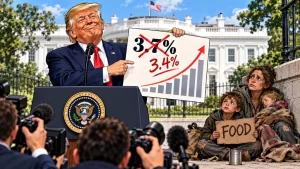
Consumer prices rose 3.8 percent in April — the steepest year-over-year jump since 2023 — while real hourly wages fell. The cause is not a mystery, and the man responsible is not paying attention.
The numbers released this morning by the Bureau of Labor Statistics describe an economy in which the ordinary American is steadily, methodically, losing ground. The Consumer Price Index rose 0.6 percent in April and 3.8 percent over the past twelve months — the highest annual reading since May 2023, and a full half point above March. Core inflation, the measure the Federal Reserve watches most closely, climbed to 2.8 percent, well above the central bank’s 2 percent target. Gasoline is up 28.4 percent year over year. Food at home posted its largest monthly gain since August 2022. Airline fares are up nearly 21 percent from a year ago. And buried in the same report, all but unmentioned by the White House, is the line that matters most for the family standing in a grocery checkout: real average hourly wages fell 0.5 percent in April and are now down 0.3 percent over the year.
That last figure is the entire story. Every raise the American worker has fought for in the past twelve months has been eaten — not by impersonal market forces, not by some unforeseen shock from the far side of the world, but by the deliberate policy choices of a single man and the political party that has surrendered to him. The bill is now coming due, and it is being paid at the pump, at the supermarket, and in the line item on every paycheck that no longer goes as far as it did last spring.
“Donald Trump promised to lower costs ‘on day one.’ Instead, he keeps raising them. First, his chaotic tariffs drove prices higher. Now, his war with Iran is pushing them up even more. Trump’s failed economic policies aren’t just raising costs — they’re shrinking families’ paychecks.”
— Sen. Elizabeth Warren, Statement on April CPI · May 12, 2026
1. The Receipts: What April’s Report Actually Says
The headline number — 3.8 percent — does not capture what is happening to working households. The composition of the inflation matters as much as the total, and on that score the report from the Bureau of Labor Statistics is brutal. Energy alone accounted for more than 40 percent of April’s price gain. The energy index has now risen 17.9 percent over twelve months, its steepest annual increase since September 2022. Fuel oil is up an extraordinary 54.3 percent. Shelter, which had been moderating, accelerated again to a 0.6 percent monthly gain. Apparel, a tariff-exposed category, rose 0.6 percent for the month. Household furnishings rose 0.7 percent. These are not luxury items.
What makes the report so damning politically is not merely the level of prices but the loss of purchasing power they have inflicted. CNBC reports that real average hourly wages slipped 0.5 percent for the month and have fallen 0.3 percent annually. For the first time in three years, American inflation is outpacing American wage growth. Stock futures fell on the news. Bond yields rose. Traders raised the odds of a Federal Reserve rate hike before year-end to roughly 30 percent — the opposite of what the administration has been demanding.
Annual inflation in April — the highest reading since May 2023, up half a point in a single month. BLS via Trading Economics
Real average hourly earnings fell for the month; down 0.3 percent for the year. Purchasing power is shrinking. CNBC
Gas prices have risen 65 percent in six months. The national average is above $4.50 a gallon. Axios
The Tax Foundation estimates Trump’s tariffs amount to an average household tax increase of $1,300 in 2026, up from $1,000 last year. Tax Foundation
The largest monthly increase in grocery prices since August 2022 — the peak of pandemic-era inflation. Senate Democrats
A tariff- and energy-sensitive category that has surged as carriers pass along fuel and supply-chain costs. CNBC
2. Who Did This — And When
The inflation now bleeding through to consumer prices is not accidental. It is the predictable, cumulative result of a series of policy choices made in the Oval Office over the past sixteen months. The Tax Foundation, hardly a left-leaning institution, calculates that the Trump tariffs amount to the largest U.S. tax increase as a share of GDP since 1993, raising the average effective tariff rate from 2.4 percent in 2024 to 7.7 percent in 2025 — the highest level since 1947. Mark Zandi, chief economist of Moody’s Analytics, has warned in recent public analysis that the trend lines on jobs and prices since “Liberation Day” “don’t look good, especially as the economic fallout from the Iran War hits with full force.”
Get Involved Today
Contribute to our mission and turn your concerns into action.
3. The Wages of Tariff: How a “One-Time Tax” Became a Permanent Pay Cut
The administration’s defenders, when pressed, fall back on a familiar technical argument: tariffs are a one-time price increase, not an ongoing inflationary force. This is true in the narrow econometric sense. It is irrelevant in the only sense that matters to a family on a fixed budget. As Emma Hussey, a policy advisor to Senator Warren on the Banking Committee, put it earlier this year: “Policymakers at the Fed can debate whether to ‘look through’ inflation, but families don’t get to choose to look through higher costs… they’re permanent for families already stretched thin.”
Research published by the New York Fed’s Liberty Street economists, summarized in analysis by the Competitive Enterprise Institute, found that roughly 86 percent of tariff costs have fallen on U.S. importers, not foreign exporters. The Kiel Institute puts the share absorbed by American consumers even higher, at roughly 96 percent. “The claim that foreign countries pay these tariffs is a myth,” Julian Hinz, the institute’s research director, told The Washington Times. “The data show the opposite: Americans are footing the bill.”
The Senate Banking Committee minority, in its statement issued this morning, calculates that Americans have paid $25 billion more for gas alone since the start of the war with Iran. That is not a forecast. That is money that has already left American checking accounts and gone into the global oil price.
4. Ballrooms While Bread Bills Rise
Nothing illustrates the gulf between the president’s stated concerns and the country’s actual ones more clearly than the project taking shape on the south lawn. As consumer prices were ticking higher, Trump demolished the East Wing of the White House to make way for a 90,000-square-foot ballroom that he repeatedly assured the country would cost taxpayers nothing. “Not one penny is being used from the federal government,” he told reporters in November. “I’m paying for it; the country’s not,” he said in September.
Last week, as NBC News reported, Senate Judiciary Chairman Chuck Grassley introduced legislation seeking $1 billion in taxpayer money for “security enhancements” tied to the project — more than double the ballroom’s official $400 million construction price tag, itself already double the original $200 million estimate. NPR reported the funding was quietly tucked inside a broader Immigration and Customs Enforcement reconciliation bill.
The morning the April CPI report dropped, Rep. Brendan Boyle of Pennsylvania, the ranking Democrat on the House Budget Committee, made the connection explicit. “Today’s inflation data confirms what everyone can see: costs are out of control, and President Trump is responsible,” Boyle said. “Instead of helping Americans struggling to make ends meet, Washington Republicans are busy trying to steal $1 billion from taxpayers to build a ballroom for Trump’s billionaire donors.”
“In December 2025, he called affordability a ‘hoax’ and a ‘con job by the Democrats.’ The president and his cronies have served us lie after lie and signaled that they are completely out of touch with the lives of everyday people.”
— Food & Water Watch, on Trump Administration Statements on Cost of Living
5. Leadership in Name Only
Leadership in a moment like this is not complicated. It looks like a Secretary of the Treasury working the phones with grocery chain executives to identify where supply-chain costs can be absorbed. It looks like a Federal Reserve given the political space to do its job without daily presidential threats. It looks like a tariff policy reviewed honestly against its effect on the household budget. It looks, above all, like a president capable of acknowledging the figure on the front page of the morning’s economic report.
What the country received instead, on the day the worst inflation reading in three years was published, was a hastily announced 18-cent gas-tax holiday — a roughly 4 percent reduction in pump prices against a 28 percent annual increase — and a continued public insistence that the affordability crisis is a Democratic invention. Meanwhile, Trump’s pick to lead the Federal Reserve, former governor Kevin Warsh, has been campaigning for rate cuts even as outgoing Chair Jerome Powell has confirmed, under questioning from Senator Warren, that the Fed’s elevated inflation projections are being driven by the administration’s own tariff regime. The president is demanding that the central bank rescue him from the consequences of his own choices.
This is not the conduct of a leader engaged with the lives of the people he serves. It is the conduct of a man who, in his own words, considers their suffering a “hoax.”
When Policy Failure Becomes a Question of Capacity
The Twenty-Fifth Amendment, ratified in 1967, provides in Section 4 a constitutional remedy when a president becomes “unable to discharge the powers and duties of his office.” The mechanism is deliberately narrow: it requires the Vice President and a majority of the Cabinet — or such other body as Congress may by law provide — to declare the president unfit, with Congress empowered to resolve any subsequent dispute by a two-thirds vote in both chambers.
On April 14, 2026, House Judiciary Committee ranking member Rep. Jamie Raskin of Maryland, joined by fifty House Democratic co-sponsors, introduced legislation to establish exactly such a body: a 17-member independent Commission on Presidential Capacity composed of physicians, psychiatrists, and former high-ranking executive officials appointed by leaders of both parties. Raskin had previously written to the president’s physician, Capt. Sean P. Barbabella, formally requesting a “comprehensive neuropsychological assessment.” He cited a pattern of conduct his letter described as “incoherent, volatile, profane, deranged, and threatening.” Among those who have publicly called for Trump’s removal under the Amendment is Rep. Alexandria Ocasio-Cortez, who joined that call after the president’s Truth Social post warning that “a whole civilization will die tonight” if Iranian leadership did not meet his terms.
The constitutional argument is this: a president whose tariff policy has imposed a $1,300 annual tax on the average household, whose foreign policy has spiked gasoline by 65 percent in six months, who responds to a record inflation reading by announcing a gas-tax gesture and dismissing affordability as a “hoax,” and who diverts a billion dollars in public money toward the construction of a ballroom while wage-earners lose ground — that president is exhibiting a sustained inability to perceive the duties of his office. The amendment does not require dementia. It requires inability. Policy detachment of this magnitude, sustained over time and in the face of repeated correction, is itself evidence.
The practical barriers are real and must be named honestly. Section 4 requires the assent of Vice President JD Vance and a majority of the Cabinet, every member of which serves at Trump’s pleasure. The Republican-controlled Congress is unlikely to advance the Raskin commission, and Trump retains a veto. Even sympathetic legal observers have called the path “long-shot.”
None of that changes the constitutional case. Difficulty is not the same as impropriety. The framers of the Twenty-Fifth Amendment did not condition its application on the political convenience of invoking it. When fifty members of the House formally name a problem of presidential capacity, and the country’s economic data confirm the consequences of that incapacity in every grocery aisle and gas station, the obligation falls on Congress to convene the inquiry the Constitution provides for — whether or not the votes are presently there to act on its findings.
6. What the Numbers Demand
An economy is not a Truth Social post. It cannot be remade by repetition. The April CPI report is, in this sense, the most stubborn possible rebuke to a presidency built on assertion: every claim that inflation has been “defeated,” every promise that costs would fall “on day one,” every dismissal of affordability as a Democratic con — all of it has been falsified, in cold numerical detail, by the agency the federal government itself maintains to measure such things.
What is required now is not another rally, another executive order suspending a small fraction of the gas tax, another investigation of “foreign price-fixing.” What is required is the recognition that the policies producing this inflation — the tariff regime, the war in Iran, the assault on the independence of the Federal Reserve — are choices, and that they can be reversed. They will not be reversed by the man who made them. That much, at least, the April numbers make plain.
Editorial Conclusion
Inflation at 3.8 percent. Real wages falling. Gasoline up 28 percent. Tariffs costing the average household $1,300 a year. A billion taxpayer dollars proposed for a ballroom while families ration groceries. And a president who calls the resulting hardship a hoax.
This is not a policy dispute. It is a question of capacity — and of whether the constitutional system retains the will to recognize incapacity when the evidence is printed every month by the Bureau of Labor Statistics.
The Raskin commission deserves a hearing. The tariffs deserve repeal. The Federal Reserve deserves independence. The American worker, whose paycheck was the casualty of April, deserves a government that can read its own data — and a president who does not consider their suffering an inconvenience to be denied.
Sources & References
- BLS — Consumer Price Index Summary, April 2026
- CNBC — CPI inflation April 2026: Prices rose 3.8% annually
- Axios — Inflation hits three-year high in April as Iran war impacts prices
- Trading Economics — United States Inflation Rate, April 2026
- Sen. Warren — Statement on April 2026 CPI
- House Budget Dems — Rep. Boyle Statement on April CPI Data
- Tax Foundation — Tariff Tracker: 2026 Trump Tariffs & Trade War by the Numbers
- CNN — US inflation tripled last month on record spike in gas prices
- CEI — Tariffs and inflation: Response to latest CPI release
- Fortune — Warren report: Households paid extra $2,120 last year
- Moneywise — Moody’s Mark Zandi warns Trump tariff fallout has pushed inflation to 3.8%
- Sen. Banking Cmte — Powell Confirms Trump Tariffs Driving Higher Inflation Projection
- Mediaite — House Democrats File Bill to Form 25th Amendment Commission
- Deseret News — Democrats Introduce 25th Amendment Commission Bill
- Fox News — Raskin Introduces Bill to Assess Trump’s Fitness for Office
- NBC News — Republicans propose $1 billion in taxpayer dollars to secure Trump ballroom
- NPR — Republicans add $1 billion for Trump’s ballroom security to ICE bill
- Food & Water Watch — The 5 Worst Things Trump Officials Have Said on Affordability
- Senate Dems — The True State of the Union Under Trump
- Washington Times — Trump did not bring down grocery costs (Kiel Institute data)
Related News