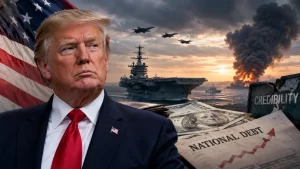
Epic Fury, Epic Failure:
How Trump’s War on Iran Broke His Every Promise — and Americans’ Wallets
The White House declared Operation Epic Fury “complete” on May 5, 2026. Iran’s nuclear program survives. The Strait of Hormuz remains closed. Gas prices are the highest since 2022. And a president who bypassed Congress now claims a ceasefire “pauses” the Constitution. The reckoning is overdue.
On the morning of May 1, 2026 — the exact day the 60-day War Powers Resolution clock was set to expire — President Donald Trump sent letters to House Speaker Mike Johnson and Senate President Pro Tempore Chuck Grassley informing them that, as far as the White House was concerned, hostilities with Iran had already “terminated.” That same week, Secretary of Defense Pete Hegseth told the Senate that a ceasefire “pauses or stops” the War Powers clock. On May 5, Secretary of State Marco Rubio stood at the White House podium and declared Operation Epic Fury formally “over.” The war, they insisted, was a victory. The mission was accomplished.
The facts tell a different story. The Strait of Hormuz — the narrow waterway through which one-fifth of the world’s oil supply flows, and which the administration promised to reopen — remains effectively closed to commercial shipping, with Iran’s Islamic Revolutionary Guard Corps warning that any vessels attempting passage will face “decisive action.” The nuclear enrichment program the war was launched to destroy has been assessed by independent analysts to be capable of recovering within six months. American families are paying $4.45 per gallon at the pump — the highest since late 2022 — up from $2.98 the day before the bombs fell. And a president who swore his operation would be swift, decisive, and complete is now reshuffling the nameplates and calling the failure “Project Freedom.”
What Operation Epic Fury actually achieved is a tableau of strategic confusion, constitutional contempt, and callous indifference to the material suffering of millions of ordinary Americans who cannot afford the “temporary disruptions” the White House cheerfully prescribed.
1. The Promises They Made — and the Record They Left
The stated objectives of Operation Epic Fury were not vague or hedged. They were proclaimed, repeatedly and in public, with a specificity that now reads as an indictment. White House Press Secretary Karoline Leavitt enumerated them on March 30: destroy Iran’s navy, destroy their ballistic missiles, dismantle their defense industrial infrastructure, and “of course, preventing Iran from ever obtaining a nuclear weapon.” Secretary Hegseth declared on March 13 that he “answers only” to those objectives — as though reciting a catechism. Secretary Rubio said on March 26 that “every single objective the president clearly laid out on the first night of this operation is being effectuated.”
On April 7, Trump ordered a ceasefire. The administration immediately declared victory. On May 5, Rubio declared the operation “over.” But when ABC News asked Rubio directly whether the administration was any closer to removing Iran’s nuclear material, the answer was a maze of qualifications — touting “tactical achievements” while sidestepping the original promise entirely. “Their ability to build a shield behind which they could hide their nuclear program was wiped out,” he offered. What he did not say: the nuclear material itself, the enriched uranium that was the entire predicate for the war, remains in Iran.
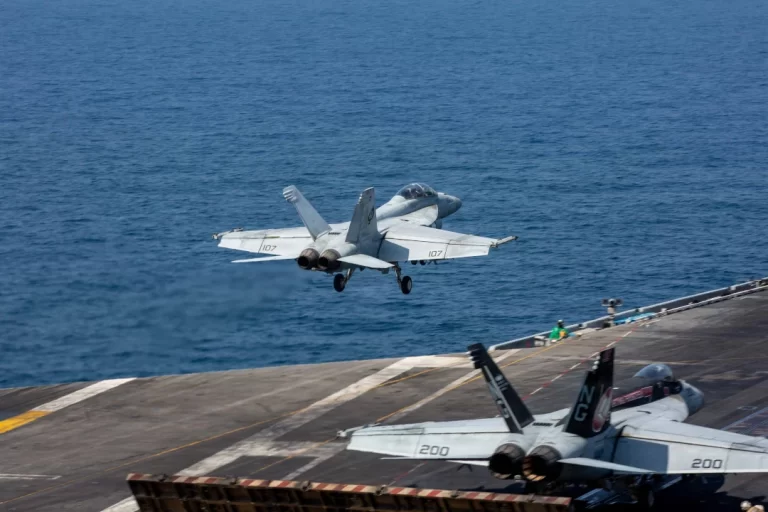
The White House claims 150 warships destroyed and all submarines sunk. The IRGC Navy, however, continues to threaten commercial shipping in the Strait. CSIS and CFR analysts note Iran’s drone-based attrition model proved sustainable.
2. The War Powers Shell Game
On May 1, 2026, Trump wrote to Johnson and Grassley — not to seek authorization under the 1973 War Powers Resolution, but to declare the war over, sidestepping the 60-day congressional approval requirement entirely. PBS NewsHour reported that Trump’s letter asserted the hostilities had “terminated” on April 7 — conveniently ignoring the fact that the U.S. fired on an Iranian tanker on April 19, and that the U.S. Navy was still maintaining a blockade of Iranian ports. The maneuver was intellectually dishonest and, according to leading constitutional scholars, legally indefensible. Sen. Tim Kaine of Virginia said plainly: “The military operations haven’t stopped. We’re still using the U.S. military to blockade all Iranian ports, which is an act of war.” Rep. Sara Jacobs of California, a member of the House Armed Services Committee, was equally direct: the administration’s argument “has no basis in law.” Historian Heather Cox Richardson noted that the letter explicitly ignored the April 19 tanker strike while simultaneously acknowledging that Iranian threats remained “significant” — a contradiction so naked it functioned as a dare.“There’s no pause button in the Constitution, or the War Powers Act.”
— Sen. Richard Blumenthal (D-CT), May 1, 2026
The timeline of this legal contortion deserves to be seen in full:
3. The Price at the Pump — and the Grocery Store
While the administration managed its messaging around military milestones, ordinary Americans have been living in a different world. CBS News reported that the average cost of a gallon of gasoline hit $4.06 as of late April — up from $2.98 the day before the war began, a jump of more than $1 per gallon. NPR’s data from AAA showed that by early May, that average had climbed to $4.45 per gallon, rising over 30 cents in a single week. In California, GasBuddy recorded prices as high as $5.87 per gallon.
Get Involved Today
Contribute to our mission and turn your concerns into action.
As Time magazine reported in March, American families have been paying nearly 80 cents more per gallon every time they fill up — representing more than $300 million in additional costs every single day across the country. But the pump is only where the pain begins. Diesel prices surged 49%, reaching $5.62 per gallon — devastating the trucking and agricultural sectors that move food across the country. The American Farm Bureau Federation warned Trump directly in a letter that disrupted fertilizer supply chains, with one-third of global fertilizer supplies normally transiting the Strait of Hormuz, could produce a shortfall in U.S. crops.
Mark Zandi, chief economist at Moody’s Analytics, told CBS News: “I think the damage has already been done, in part because there’s no going back on oil prices, at least not any time in the near future.” Lydia Boussour, senior economist at EY-Parthenon, warned of “lingering impacts” on supply chains and energy capacity even after the Strait reopens. Scott Lincicome of the Cato Institute projected the Personal Consumption Expenditures price index could hit 4% by year’s end — double the Federal Reserve’s target.
“Trump has launched a war without a playbook for managing the economic fallout, and the cost-of-living crisis isn’t going away anytime soon.”
— Time Magazine, March 2026
Trump’s response to all of this? At the outset of the war, when gas prices began their steep climb, he said it was “a very small price to pay for U.S.A., and World, Safety and Peace.” A month later, he offered this: “If they rise, they rise.” These are not the words of a president managing a cost-of-living crisis. They are the words of a man who has decided that what other people pay to heat their homes, fill their tanks, and feed their children is someone else’s problem.
4. Hegseth Before Congress: Defiance as Strategy
When Pete Hegseth finally appeared before the House Armed Services Committee on April 29 — his first congressional testimony since the war began — the result was a six-hour confrontation that laid bare the administration’s contempt not only for oversight, but for basic accountability. Time reported that Democrats used the hearing to level a central charge: that tactical military activities had been substituted for a coherent strategy, and that the American public had been misled from the beginning.
Rep. John Garamendi of California was unsparing: “Secretary Hegseth, you have been lying to the American public about this war from day one, and so has the President.” He called the conflict “a geopolitical calamity,” “a strategic blunder,” and “a self-inflicted wound to America.” Rep. Adam Smith of Washington pressed Hegseth on a glaring logical contradiction: if Iran’s nuclear facilities had been “obliterated” in the 2025 Operation Midnight Hammer strikes, as Hegseth himself had said, why did the administration tell Congress 60 days ago that the nuclear threat was so imminent it justified a new war? NPR reported Smith’s conclusion: the war “left us at exactly the same place we were before.”
Hegseth’s response was to attack the questioners. He called congressional critics “the biggest adversary” the Pentagon faces — a remark so offensive in its contempt for democratic oversight that it should have ended his tenure on the spot. He demanded to know who lawmakers were “cheering for.” Rep. Chrissy Houlahan of Pennsylvania asked why Hegseth had fired Army Chief of Staff Gen. Randy George — described as one of the most decorated officers in the service — and Hegseth’s only answer, repeated twice, was: “We needed new leadership.” Fortune reported that even Republican Rep. Don Bacon of Nebraska acknowledged “bipartisan concern” about Hegseth’s purge of senior military leaders.
5. The Constitutional Question: What the 25th Amendment Asks of This Moment
The pattern of behavior that has characterized Operation Epic Fury — the impulsive launch of a war without congressional authorization, the serial shifting of stated objectives, the dismissal of expert military leadership, the breezy indifference to the economic suffering of ordinary Americans, and the baroque legal maneuvering to evade constitutional accountability — raises questions that go beyond policy failure. They raise questions about fitness for office.
When “Unable to Discharge the Powers and Duties” Is Not a Hypothetical
The 25th Amendment to the Constitution, Section 4, provides a mechanism for removing a president from power when the Vice President and a majority of Cabinet members — or another body designated by Congress — determine that the president is “unable to discharge the powers and duties of his office.” The mechanism does not require incapacity in the medical sense; it requires only that the principal officers of the executive branch make a collective judgment that the president cannot or will not fulfill the responsibilities of the office. Congress then acts.
The plain-language case is not difficult to make. Operation Epic Fury was initiated without congressional approval, prosecuted without an exit strategy, declared “victorious” while all of its principal objectives remained unmet, and used as a pretext to circumvent the War Powers Resolution through a legal argument — the “ceasefire pauses the clock” theory — that Rep. Sara Jacobs (D-CA) said has “no basis in law,” and that Sen. Tim Kaine (D-VA) called constitutionally groundless. A president who simultaneously calls the War Powers Act “totally unconstitutional” while sending letters that purport to comply with it is not exercising constitutional fidelity — he is performing it as a costume.
Lawmakers who have addressed the 25th Amendment in this context include Sen. Richard Blumenthal (D-CT), who flatly stated there is “no pause button in the Constitution,” and Rep. Adam Smith (D-WA), the ranking Democrat on the House Armed Services Committee, who argued that Trump has plunged the country into “the very kind of open-ended Middle East conflict Trump once condemned.” Rep. Garamendi went further, calling the war conduct not merely incompetent but dishonest — “a strategic blunder” and a “self-inflicted wound.”
The honest constitutional assessment must acknowledge the practical barriers: the 25th Amendment’s Section 4 requires a two-thirds majority in both chambers of Congress to override a presidential objection, a threshold that effectively requires significant Republican support. In the current political climate, that remains remote. But the existence of a difficult path does not negate the moral and constitutional argument. A president who fires his most experienced military generals, launches a war without authorization, tells the public the war is over while the blockade continues, and shrugs at $4.45 gasoline as a “small price to pay” is not demonstrating the capacity to govern. He is demonstrating its opposite.
The 25th Amendment exists precisely for moments when the machinery of presidential power runs far ahead of the judgment required to wield it wisely. The question is not whether its activation is politically easy. The question is whether the republic can afford to wait for someone in the Cabinet to act as though it mattered.
6. A Nation That Cannot Afford Its Gasoline — or Its Wars
Step outside the briefing rooms and the constitutional debates, and the reality of Operation Epic Fury is simpler and harsher. The Center for American Progress reported that in just the first week after the strikes, gas prices jumped 48 cents per gallon — the fastest sustained spike in recent memory. The administration had neglected to refill the Strategic Petroleum Reserve before the war began, leaving the country exposed to exactly the supply shock that every energy analyst predicted.
Brent crude surged past $120 per barrel at its peak — the largest oil supply disruption in history, according to the International Energy Agency, which confirmed that by March 12, more than 10 million barrels per day had been removed from global markets due to the Strait closure. Airlines began hiking ticket prices and introducing new bag fees to offset surging jet fuel costs. The American Farm Bureau warned of crop shortfalls as fertilizer costs — one-third of whose global supply transits through the Strait — spiked. Mortgage rates climbed as inflation expectations reset. Stock markets fell.
The economic devastation is not incidental to Operation Epic Fury. It is the clearest measure of what a failure of leadership actually costs. This is a president who spent months boasting about cheap gas, who stood at the State of the Union podium bragging about energy prices, and who then launched a war — without a plan for managing its foreseeable economic consequences, without authorization from Congress, without a diplomatic off-ramp — that sent every price in the American economy into an upward spiral from which families are still trying to recover. Economists at Moody’s, EY-Parthenon, and the Cato Institute all agree: the damage will linger well beyond the war’s end.
The Quwa Defence Research Centre, drawing on assessments from CSIS, CFR, the ISW/AEI Critical Threats Project, and the Soufan Centre, summarized the strategic picture with unusual precision: the United States achieved significant tactical damage to Iran’s visible military infrastructure but “could not reach underground infrastructure, eliminate the Strait of Hormuz threat, suppress proxy networks, drain reconstitution capacity, or produce the political outcome it sought.” The estimated global GDP losses range from $590 billion to $3.5 trillion. The direct cost of the war has hit $25 billion with the budget proposed at $1.5 trillion. And the Strait — the one thing that had to be reopened for any of this to have mattered — is still closed.
Editorial Conclusion
Operation Epic Fury did not fail because war is inherently unwinnable. It failed because it was launched impulsively, without constitutional authorization, without a coherent exit strategy, and without any plan for the economic suffering it would impose on the American families Trump claimed to be protecting. Every objective the administration publicly promised has gone unmet: Iran’s nuclear program survives; the Strait of Hormuz remains closed; gas prices are the highest since 2022; and the administration is now calling the same unfinished war by a new name. The letters sent to Mike Johnson and Chuck Grassley on May 1 were not a report of victory — they were a legal escape hatch dressed in the language of triumph. A president who cannot tell the difference between declaring a war over and actually ending one, who dismisses $4.45 gasoline as a “small price to pay,” who fires his most experienced generals and calls Congress his biggest adversary, is not governing. He is performing, playing at the idea of governing while the country pays the bill. The 25th Amendment exists not as a partisan weapon, but as a constitutional safeguard for precisely this kind of failure: when the powers of the presidency are exercised without the judgment, honesty, or fitness the office demands. The question now is whether anyone in a position to act will find the courage to say so.
Sources & References
- White House — “Peace Through Strength: President Trump Launches Operation Epic Fury”
- White House — “President Trump’s Clear and Unchanging Objectives” (April 1, 2026)
- White House — “Operation Epic Fury Crushes Iranian Threat as Ceasefire Takes Hold”
- PBS NewsHour — “Trump says deadline for Congress to approve Iran war doesn’t apply”
- Heather Cox Richardson — “May 1, 2026” (War Powers Analysis)
- MS Now — “White House tells Congress Iran war has been ‘terminated,’ skirting 60-day clock”
- Daily Wire — “Trump Signals Legal Path to Restart Iran Fight in Letter to Congress”
- Mining Awareness+ — Full text of Trump’s May 1, 2026 War Powers letter
- Time — “Rubio Says ‘Epic Fury’ Is Over, as Flare-Ups in Strait of Hormuz Test Fragile Ceasefire”
- ABC News — “Rubio says operation in Iran is ‘over,’ nuclear material ‘has to be addressed'”
- CNN — Iran War Live Updates: Rubio says Operation Epic Fury is over (May 5, 2026)
- Quwa Defence Research — “Operation Epic Fury and the Limits of American Air Power” (CSIS, CFR, ISW/AEI analysis)
- Time — “In Hostile Hearing, Democrats Accuse Hegseth of Misleading Public on Iran War”
- Fortune — “‘A Strategic Blunder’: Democrats Confront Hegseth as Iran War Cost Hits $25 Billion”
- NPR — “Hegseth faces questions about Iran in first congressional appearance since war began”
- PBS NewsHour — “Watch: Hegseth, Caine testify for the 1st time since start of Iran war”
- CBS News — “In 8 Weeks, the Iran War has Dented the U.S. Economy”
- Time — “From Gas to Groceries, the War in Iran Will Worsen America’s Cost-of-Living Crisis”
- Time — “How Much the War in Iran is Costing Americans”
- Time — “How High Could Gas Prices Go? What to Know About the Iran War’s Ongoing Impact”
- NPR — “Gas prices went up more than 30 cents a gallon last week. How high could they go?”
- Center for American Progress — “The War in Iran Will Raise Fuel Prices and Costs Throughout the Economy”
- CNN Business — “What you should expect to pay for gas as the war with Iran continues”
- Wikipedia — “Economic Impact of the 2026 Iran War” (with sourced data)
Related News