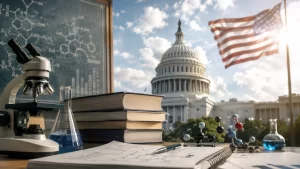
In a single overnight email, the Trump administration eliminated the independent oversight body that has guided the National Science Foundation for 76 years — scrapping expert governance in favor of unchecked executive control, and imperiling American scientific leadership for a generation.
On the morning of April 25, 2026, twenty-four of the nation’s most distinguished scientists, engineers, and academics checked their email and found the same message: a form letter from the Presidential Personnel Office informing them that their positions on the National Science Board had been “terminated, effective immediately.” No phone call. No explanation. No transition. Just a terse sign-off — “Thank you for your service” — and the sudden unraveling of 76 years of independent scientific governance.
The National Science Board is not a partisan body. It is the statutory backbone of the National Science Foundation — the $9 billion federal agency that has bankrolled the internet, CRISPR gene-editing, Doppler radar, and thousands of other innovations that define American life. The board’s members are appointed by the president to staggered six-year terms specifically to insulate them from political whim. They are academics, researchers, and industry leaders charged with one mission: ensuring that American science remains the best-funded, most merit-driven scientific enterprise on earth. That mission ended Friday.
What happened is not a reorganization. It is not efficiency. It is an assertion that the president of the United States should be able to dictate which science gets funded, by whom, and toward what political end — unchecked by any body of experts, any independent institution, or any tradition of evidence-based governance. It is, in a word, the politicization of American science.
1. What Was Destroyed — and Why It Matters
The National Science Foundation was established in 1950 by an act of Congress, designed from the outset to be independent of the executive branch. The National Science Board was its governing conscience — a group of presidentially appointed scientists charged not with serving the White House, but with serving American knowledge. Their statutory duties included approving the NSF’s budget, authorizing major research programs and infrastructure, and advising both the president and Congress on science policy. The structure was deliberate: science that advances human welfare cannot be guided by political cycles.
Under the Trump administration’s proposed 2027 budget, the NSF would be cut by more than 55 percent — from $9 billion to roughly $4 billion — the steepest proposed reduction in the agency’s history. Congress rejected a similar proposal for fiscal year 2026, but the administration did not accept the rebuke. Instead, per reporting by the American Physical Society, the NSF has issued just 613 grants this fiscal year — roughly 20 percent of the pace set in each of the four preceding years. The grants that did survive were overwhelmingly concentrated in administration-favored fields, with research on social sciences, behavioral economics, and climate stripped from the queue.
The board had publicly pushed back. In May 2025, the NSB formally criticized Trump’s proposed 55 percent budget cut — advice the administration could not forgive. According to former board member and Vanderbilt astrophysicist Keivan Stassun, the White House concluded that “this group of presidential appointees was advising the Congress to not follow the president’s wishes.” Independence, it turns out, was the offense.
Under DOGE’s direction, the administration scrapped or halted more than 1,600 NSF grants worth nearly $1 billion — research already in progress, already paid for by American taxpayers.
The NSF has lost more than 30% of its staff since January 2025 and was forced to cede its own headquarters to another federal agency in December. The agency has no permanent director.
Trump’s 2027 budget request seeks to cut NSF funding by more than half, eliminating entire directorates including Social, Behavioral, and Economic Sciences — while proposing a 44% increase in military spending.
The NSF has issued just 613 grants this fiscal year — roughly one-fifth of the pace maintained in each of the previous four fiscal years — with new and competitive renewals at similarly catastrophic lows.
Across NIH, NSF, and EPA combined, the Trump administration disrupted $29.86 billion in research grants in 2025 alone — cancer research, Alzheimer’s studies, climate science, and vaccine work among the casualties.
Not one of the 24 fired board members was given a reason for their termination. Roger Beachy, who was appointed to the board by Trump himself in 2020, said the email was “brief and to the point” — a form letter thanking him for his service.
2. The Human Cost: What Is Actually Being Lost
Abstract budget figures obscure what science actually does. NSF funding did not produce abstractions — it produced the internet, developed CRISPR gene-editing technology, built the Doppler radar systems that warn Americans of tornadoes, and trained the researchers who create medical treatments, clean energy systems, and agricultural innovations. Representative Zoe Lofgren of California, the ranking Democrat on the House Committee on Science, Space, and Technology, put it plainly: at one time, NSF grants were merit-based, awarded on the strength of scientific evidence. That standard has now been replaced with one of political loyalty.
The downstream effects are not hypothetical. At Western Washington University, professor Caroline Hardin’s three-year NSF grant — studying the shortage of computer science teachers in the United States — was terminated two-thirds of the way through, after $231,554 had already been spent. Her team had gathered the data. They had identified solutions. But because their grant was cancelled, the findings cannot be published. “You can’t tell me this is about efficiency,” Hardin told the National Education Association. “It’s throwing away results that taxpayers paid for.” At the University of Massachusetts Amherst, a $6 million grant studying energy transitions was similarly cancelled mid-study. At CUNY, mental health research that had identified promising patterns in college student well-being was cut off before conclusions could be drawn.
These are not edge cases. The American Physical Society reports that NIH — the nation’s premier medical research funder — has also seen its grant output fall by nearly half, issuing roughly 10,000 awards this fiscal year compared to 18,000 in prior years. The disease research pipeline for cancer, Alzheimer’s, and infectious disease is thinning. A generation of young scientists is watching this unfold and reconsidering their careers. The next breakthrough is being delayed in ways that will not be measured in dollars, but in lives.
“I have watched the systematic dismantling of the scientific advisory infrastructure of this government with growing alarm, and the National Science Board is simply the latest casualty.”
— Willie May, Former NSB Member & Ex-Director, National Institute of Standards and Technology
3. The Administration’s Pretext — and Why It Fails
The White House offered a justification for the firings, citing a 2021 Supreme Court decision — U.S. v. Arthrex — which addressed the authority of administrative patent judges who had not been confirmed by the Senate. The administration claimed the ruling raised “constitutional questions” about whether NSB members, who also do not require Senate confirmation (a change that dates to 2012), could legally exercise the authorities Congress granted them.
Legal scholars contacted by NPR found the argument baffling. Duke University law professor Jeff Powell, a leading authority on the Constitution’s appointments clause, identified “a puzzling disconnect between firing the Board members and the White House statement.” His reasoning is straightforward: if Arthrex creates a constitutional problem with the board’s authority, eliminating the board members does not resolve it — it simply leaves the problem unaddressed while stripping away the expertise needed to manage the NSF. The White House, in other words, did not use a constitutional ruling to fix a constitutional problem. It used a constitutional ruling as rhetorical cover for a political purge.
Dan Reed, a computer scientist at the University of Utah who chaired the NSB from 2022 to 2024, called the action “unprecedented.” Former board chair Victor McCrary, who was dismissed in the same wave, had spent the preceding months vocally opposing Trump’s proposed 55 percent budget cut to the NSF. The pattern is unmistakable: those who advised Congress to reject the president’s wishes were removed. The pretext is the Arthrex ruling. The cause is retaliation.
4. A Timeline of Systematic Dismantlement
“Will the president fill the NSB with MAGA loyalists who won’t stand up to him as he hands over our leadership in science to our adversaries?”
— Rep. Zoe Lofgren (D-CA), Ranking Member, House Committee on Science, Space & Technology
5. What This Says About the Fitness to Lead
A president who cannot tolerate independent advice is not leading — he is ruling. The distinction matters. The NSB was not a partisan opposition body. It included scientists appointed by Trump himself, including Roger Beachy, who served a Trump-appointed second term and was fired without explanation. The board’s offense was not partisanship. It was expertise. And under this administration, expertise — the capacity to tell power what it does not want to hear — has become a firing offense.
Get Involved Today
Contribute to our mission and turn your concerns into action.
Leadership requires the capacity to receive counsel from those who know more than you do about specific domains. A president who funds only the science that confirms his preferred conclusions, who fires the advisors who warn against budget recklessness, and who systematically dismantles the institutions designed to outlast any single presidency, is not governing — he is expressing the rage of a man who believes no constraint should apply to him. Willie May, a chemist and former director of the National Institute of Standards and Technology, captured it precisely: at the moment America faces its most intense global competition in science and technology from China and others, we are “systematically undermining the institutions and the people dedicated to keeping our country at the leading edge.” The beneficiaries of America’s self-inflicted retreat are its adversaries.
A Pew Research Center survey released in early 2026 found that 84 percent of Americans — Republicans and Democrats alike — believe investments in scientific research aimed at advancing knowledge are “usually worthwhile.” Nearly half believe the United States is already losing ground in scientific achievement relative to other nations. The American public understands what their president does not: science is a national security asset. Its dismantlement is not governance. It is dereliction.
When the Capacity to Govern Fails: The Case for the 25th Amendment
The 25th Amendment to the United States Constitution, ratified in 1967, provides the mechanism by which the Vice President and a majority of principal Cabinet officers may declare a sitting president “unable to discharge the powers and duties of his office.” Upon such a declaration, the Vice President immediately assumes the role of acting president. The threshold is not conviction of a crime. It is the demonstrated inability to fulfill the constitutional responsibilities of the office.
The dismantlement of the National Science Board is not, in isolation, a 25th Amendment issue. But it is one exhibit in an accumulating body of evidence that the president of the United States is governing not from considered policy judgment but from an incapacity to tolerate institutions that operate independently of his will. A president who cannot distinguish between advice that challenges him and a threat to his authority — who fires scientists for telling Congress the truth about his own budget — is exhibiting a pattern of institutional antagonism that transcends ordinary policy disagreement.
Lawmakers who have publicly and explicitly discussed the 25th Amendment in the context of Trump’s governance include Rep. Jamie Raskin (D-MD), who has been among the most vocal advocates for invoking the amendment’s provisions based on demonstrated behavioral unfitness, and Rep. Alexandria Ocasio-Cortez (D-NY), who has argued that the president’s erratic governance — including mass dismissals of expert advisors with no legal justification — constitutes a pattern warranting constitutional review. Sen. Ron Wyden (D-OR) has raised questions about whether the administration’s behavior reflects a coherent governing capacity at all.
The constitutional argument is this: Section 4 of the 25th Amendment exists not to remove presidents for unpopular decisions, but to provide a remedy when a president’s behavior demonstrates that he is incapable of exercising the office’s responsibilities rationally. The president who eliminates every scientific advisor who disagrees with him, proposes to slash the nation’s science budget by 55 percent for two consecutive years, and offers a constitutionally incoherent legal rationale for a mass purge — that president is not making difficult choices. He is demonstrating the inability to receive, process, and act upon evidence. That is a question of capacity, not policy.
The practical barriers to invoking the 25th Amendment are formidable. It requires the Vice President’s agreement, a majority of the Cabinet, and ultimately a two-thirds vote in both houses of Congress if the president contests the determination. No such process has ever been successfully completed in American history. Those barriers are real. They do not, however, negate the moral and constitutional case for naming what is happening: the systematic elimination of independent expertise is not a governing philosophy. It is a symptom.
Editorial Conclusion
The firing of the National Science Board is not a footnote. It is a declaration — that this administration will not be advised, will not be checked, and will not be told by experts that its priorities are wrong. The institution that helped produce the internet, CRISPR, and Doppler radar has been decapitated overnight for the offense of independence. The cost will not be measured in budget lines. It will be measured in the diseases we cannot cure, the storms we cannot predict, and the technologies we cede to nations that kept faith with their scientists. A government that cannot tolerate expert counsel has already conceded its capacity to lead. Congress must say so. The American people already know it.
Sources & References
- Al Jazeera — “Trump Administration Fires All Members of US National Science Board”
- NPR — “Scientists See Trump’s Firing of the NSB as an Attack on Research”
- Science / AAAS — “Trump Fires All 24 Members of the NSF’s Governing Body”
- Nature — “Entire NSF Science Advisory Board Fired by Trump Administration”
- ABC News — “Trump Administration Fires Members of National Science Board”
- The Washington Post — “National Science Board Members Dismissed by Trump”
- House Science Committee (Democrats) — Ranking Member Lofgren’s Official Statement
- Democracy Now! — “Trump Administration Fires All Members of the National Science Board”
- Scientific American — “Trump Administration Proposes Massive Budget Cuts to Science”
- Scientific American — “Trump Administration’s Science Cuts Come for NSF Funding”
- American Physical Society — “NSF Lags in Grant Awards as Trump Proposes Deep Cuts”
- The Hill — “NSF’s Future Uncertain Amid Trump’s Proposed Budget Cuts”
- National Education Association — “Trump Cancels Federal Research Grants: What Are the Consequences?”
- National Education Association — “Americans Want Scientific Research. The Government Cut It Anyway.”
- KPBS — “Scientists See Trump’s Firing of the NSB as an Attack on Research”
- Georgia Public Broadcasting — “Scientists See Trump’s Firing of the NSB as an Attack on Research”
Related News