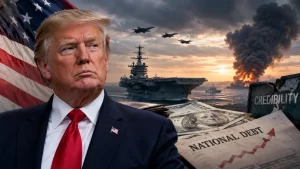
The abrupt firing of Navy Secretary John Phelan — executed without explanation while the U.S. Navy enforces a wartime blockade — caps a months-long purge of America’s senior defense leadership. Taken together with Trump’s ego-driven “Trump-class battleship” gambit, the pattern reveals an administration incapable of the sustained, rational decision-making that military command demands.
On the evening of April 22, 2026, Pentagon spokesman Sean Parnell posted a terse statement to X announcing that Secretary of the Navy John Phelan was “departing the administration, effective immediately.” No cause was given. No transition plan was announced. No successor was confirmed. The United States Navy, at that moment, was enforcing a live blockade of Iranian ports in the Persian Gulf — one of the most consequential naval operations in decades — and it had just lost its civilian leader without so much as a press conference.
This is not normal. It is not even close to normal. And the fact that it has become the defining rhythm of the Trump Pentagon — sudden, unexplained ousters of decorated and experienced officials, mid-crisis and without public accounting — tells us something profound not merely about Pete Hegseth’s management style, but about the president who installed him and the administration that enables him.
1. The Firing: What Happened and Why It Matters
Multiple outlets including CNN, Axios, and Bloomberg confirmed Thursday that Defense Secretary Pete Hegseth gave Phelan an ultimatum — resign or be fired — and that President Trump was aware of and sanctioned the decision. According to sources familiar with the situation, the grievances were multiple and petty: Hegseth believed Phelan was moving too slowly on shipbuilding reforms, and was furious that Phelan had maintained a direct line of communication with Trump, whose Mar-a-Lago club sits near Phelan’s Palm Beach mansion. In the paranoid architecture of Hegseth’s Pentagon, the sin was not incompetence but proximity — Phelan had the ear of the president, and Hegseth could not tolerate that.
A source described to Axios what amounts to a child’s complaint dressed in military language: “Phelan didn’t understand he wasn’t the boss. His job is to follow orders given, not follow the orders he thinks should be given.” That sentiment, applied to a civilian cabinet secretary managing the world’s most powerful naval force during wartime, is not a sign of disciplined chain-of-command thinking. It is the signature of a secretary who surrounds himself with loyalists and ejects anyone who shows independence — a posture that, in any serious organization, produces catastrophic blind spots.
“Here is a four-star general who is actively working to get equipment and people into theater — to protect U.S. forces — and you fire him? In the middle of a war?”
— Unnamed U.S. Military Official, on the firing of Army Chief of Staff Gen. Randy George, via Axios
The timing compounds the recklessness. Phelan had delivered a keynote address at the Navy League’s annual Sea-Air-Space conference just the day before his ouster, speaking with reporters about his shipbuilding agenda. He had, according to the Associated Press, hosted House Armed Services Committee leadership to discuss the Navy’s budget only hours before the axe fell. He was fired the same week the Navy submitted a $65.8 billion shipbuilding budget request to Congress. There is no credible reading of this sequence that suggests strategic coherence. There is every reason to read it as impulsive, personalized, and strategically dangerous.
2. The Purge in Full: Counting the Cost
Phelan’s firing is not an isolated event. It is the latest chapter in what the Task & Purpose military publication described as a systematic overhaul of senior Pentagon leadership — one that, by any standard, has no modern precedent in scale, speed, or disregard for institutional continuity. The following timeline documents the scope of the purge:
Hegseth removes Admiral Lisa Franchetti, Chief of Naval Operations, and Gen. James Slife, Air Force Vice Chief of Staff — within weeks of taking office. Trump simultaneously fires Gen. Charles “CQ” Brown Jr., Chairman of the Joint Chiefs of Staff.
Hegseth fires or forces out Lt. Gen. Jeffrey Kruse, director of the Defense Intelligence Agency, and Navy Vice Admiral leadership positions — more than a dozen senior officers purged across all branches, according to Task & Purpose.
During active U.S.-Israel military operations against Iran, Hegseth fires Gen. Randy George, Army Chief of Staff, in a terse phone call — along with Gen. David Hodne (Army Transformation Command) and Maj. Gen. William Green Jr. (Army Chaplain Corps). No public rationale given. Congressional members in both parties express alarm.
Navy Secretary John Phelan is fired effective immediately, mid-blockade of Iranian ports. Undersecretary Hung Cao — a Republican congressional candidate who twice lost Senate and House races in Virginia — named Acting Secretary with no Senate confirmation.
What the timeline reveals is not a leader cleaning house to install a superior team. It is a pattern of loyalty purges — each new face installed not for competence but for demonstrated deference. The Pentagon spokesperson described incoming acting Army Chief Gen. Christopher LaNeve as “completely trusted by Secretary Hegseth to carry out the vision of this administration without fault” — a formulation that should alarm anyone who understands that military command requires subordinates who will tell commanders when their orders are wrong, not merely execute them without question.
Get Involved Today
Contribute to our mission and turn your concerns into action.
3. The Battleship That Broke the Rules
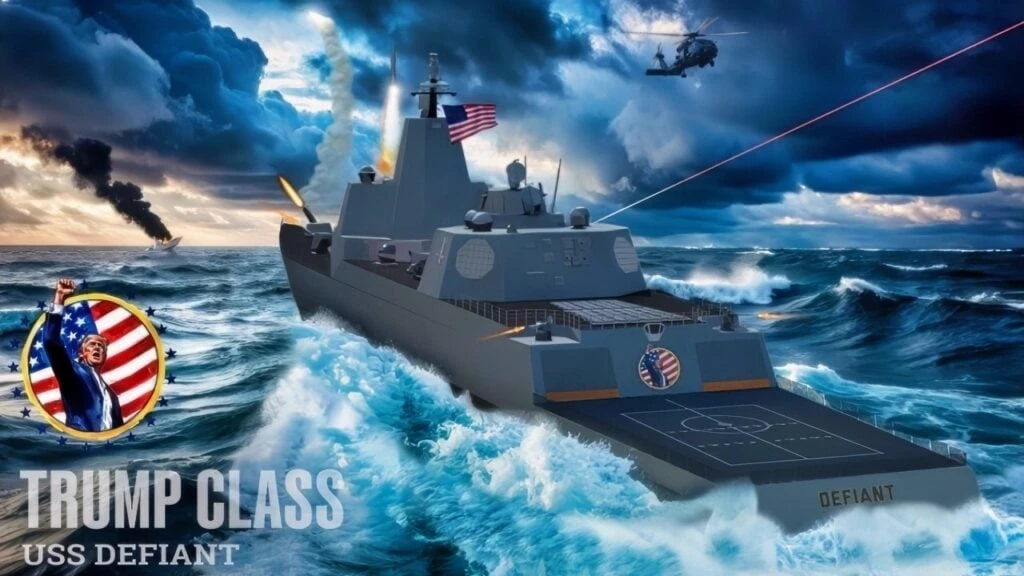
No episode better illustrates the chaos at the heart of this administration’s defense posture than the “Trump-class battleship” — a weapons program announced not in a National Security Council briefing, not in a Congressional authorization request, but at a party at Mar-a-Lago on December 22, 2025. As NBC News reported, Trump told the assembled crowd he would build a fleet of nuclear-capable warships — naming the entire class after himself — as the centerpiece of what he called a “Golden Fleet.”
The reaction from the Navy’s own acquisition leadership was not enthusiasm. It was something closer to shock. Rear Admiral Derek Trinque, the Navy’s surface warfare director and one of the service’s top procurement experts, told reporters plainly: “I did not expect to be told to build a battleship.” That a senior flag officer learned of a flagship naval program through a presidential party announcement — rather than through the normal requirements, budgetary, and design processes — is a staggering indictment of how this White House operates.
“I did not expect to be told to build a battleship.”
— Rear Admiral Derek Trinque, U.S. Navy Surface Warfare Director, January 2026
The program itself, analyzed by every serious defense institution in Washington, has been uniformly rejected as strategically incoherent and fiscally reckless. Mark Cancian, a retired Marine colonel and senior adviser at the Center for Strategic and International Studies (CSIS), assessed that the ship “will never sail” — citing a design that will take years to finalize, estimated per-hull costs ranging from $9 billion to over $20 billion, the total absence of Congressional appropriations, and a strategic concept that runs directly counter to the Navy’s own doctrine of distributed, networked firepower. The program also breaks multiple naming conventions: ships are not named after living persons, and classes are named for their lead vessel, not their patron. As CSIS noted, even these traditions have been set aside to serve presidential vanity.
Defense analysts at 19FortyFive note that modern naval warfare favors distributed, unmanned, networked fleets — not single giant capital ships. China’s DF-27 anti-ship missile, announced days after the battleship reveal, has a range covering the entire Indo-Pacific. The Trump-class would be an enormous, expensive target.
As of publication, the Trump-class has received zero Congressional appropriation. CSIS estimates the design alone will take years, and the first hull cannot realistically enter service before the mid-2030s — if it is ever funded at all.
The Washington Monthly reports that the U.S. industrial base for heavy naval armor plate has effectively collapsed — a key Cleveland Cliffs fabrication plant was idled in 2025 and is scheduled for permanent closure in 2026, while China is actively expanding its armor production capacity.
Stars and Stripes documents that the Trump-class designation breaks the longstanding prohibition on naming warships or ship classes after living persons — a convention maintained through every previous presidency, regardless of party.
The connection between the battleship fiasco and Phelan’s firing is direct. Bloomberg reported that Phelan was pushed out, in part, over disagreements with Hegseth and Deputy Defense Secretary Stephen Feinberg about how to implement the “Golden Fleet” initiative. The man chosen to champion Trump’s naval vanity project was then fired, without explanation, while the Navy was in the middle of an active blockade. The program that caused the friction remains unfunded, undesigned, and strategically contested. What has changed is only the roster of civilian leaders tasked with defending it — a roster that now turns over at a pace that makes serious policy continuity impossible.
4. The Pattern of Impulsive Command
A key feature of the Trump administration’s Pentagon management is that it systematically replaces institutional expertise with political loyalty. Gen. Randy George — a West Point graduate, combat veteran of Desert Storm, Iraqi Freedom, and Enduring Freedom, and a four-star officer with 38 years of service — was fired by Hegseth during active wartime operations, reportedly via a terse phone call, because Hegseth suspected him of leaking information to the press about the blocking of promotions for Black and female officers. No evidence of the leak was publicly established. No court-martial. No IG referral. Just a phone call and an “effective immediately.”
The Washington Times quotes retired Rear Admiral Mark Montgomery, an analyst at the Foundation for Defense of Democracies, saying of Phelan’s firing: “The blame for [the battleship] starts with the president.” Even conservative defense commentators have struggled to identify a coherent strategic vision in any of these personnel actions. What emerges instead is a portrait of a Defense Department run on personal grievance, institutional suspicion, and the demand for absolute deference — a posture that is, in any serious military context, the precise opposite of what produces battlefield effectiveness.
The CBS News account of Gen. George’s replacement is instructive: incoming acting Chief Gen. Christopher LaNeve was selected in part because he is “completely trusted by Secretary Hegseth to carry out the vision of this administration without fault.” The phrase “without fault” is doing enormous work here. It does not mean without error. It means without dissent. The United States military, which has historically cultivated a culture of candid subordinate advice to civilian leadership, is being restructured around the principle that disagreement with the secretary is itself grounds for removal.
When Management Failure Becomes a Constitutional Question
The Twenty-Fifth Amendment to the Constitution, ratified in 1967, provides the legal mechanism for addressing a president who is unable to discharge the powers and duties of his office. Section 4 — the most consequential and most discussed provision — allows the Vice President, together with a majority of the principal officers of the executive departments, to transmit to Congress a written declaration that the president is unable to fulfill his duties. Congress then has 21 days to vote; a two-thirds majority in both chambers removes the president from power.
The amendment was designed primarily with physical incapacitation in mind. But its text is broader than that. “Unable to discharge the powers and duties of his office” encompasses any condition — cognitive, psychological, or behavioral — that renders a president incapable of rational, sustained executive governance. The pattern documented in this article — the impulsive policy announcements made without institutional process, the systematic removal of anyone who provides independent counsel, the elevation of loyalty over expertise in the management of active military operations — constitutes a documented behavioral pattern that is directly relevant to that constitutional question.
Multiple Democratic lawmakers have, in recent months, raised the issue publicly. Sen. Chris Murphy of Connecticut wrote on X following Gen. George’s firing that “experienced generals are likely telling Hegseth his Iran war plans are unworkable, disastrous, and deadly” — and that the firings are the administration’s method of silencing that counsel. Sen. Tammy Duckworth, an Army combat veteran and member of the Senate Armed Services Committee, has called the pace of Pentagon purges “unprecedented and dangerous.” Rep. Adam Smith, the ranking Democrat on the House Armed Services Committee, stated that the administration is “removing the adults in the room at precisely the moment the country needs them most.”
The practical barriers to a Section 4 invocation are significant. Vice President JD Vance has shown no inclination to challenge Trump. Cabinet secretaries owe their positions to Trump’s approval. Congressional Republicans have, with few exceptions, declined to act as a check on executive excess. A two-thirds vote in both chambers — which would require substantial Republican defection — is a genuinely high bar. These barriers are real.
But barriers to a constitutional remedy do not negate the constitutional case for it. The drafters added Section 4 of the 25th Amendment precisely because they anticipated that moments would arise when the political costs of action were high but the institutional costs of inaction were higher. A president who announces major weapons systems at resort parties without consulting his acquisition leadership, who fires wartime generals via phone calls for suspected disloyalty, who fires his own Navy Secretary mid-blockade without explanation, and who has systematically dismantled the advisory infrastructure that protects against catastrophic military error — that president is presenting the Constitution with exactly the scenario Section 4 was written to address. The political obstacles are a measure of the difficulty of the remedy, not a reason to pretend the problem does not exist.
5. What It Means for National Security
The consequences of this management approach for actual American security are not abstract. The Navy is currently enforcing a blockade of Iranian ports — a tense, legally complex, and operationally demanding mission. The service is simultaneously managing three carrier strike groups in or moving toward the Middle East. It has just had its civilian leader abruptly removed. Its top uniformed officer, Admiral Lisa Franchetti, was fired over a year ago. The replacement acting secretary is a failed congressional candidate whose primary qualification appears to be political loyalty to the Trump movement.
Into this vacuum flows the Trump-class battleship — a program that even Phelan’s replacement critics acknowledge is strategically dubious, that has no funding, no approved design, no clear industrial base to build it, and that was announced at a Mar-a-Lago party because the president, as he told reporters, “is a very aesthetic person” who wants to play a role in the ship’s design. This is not how great powers maintain military dominance. It is how they squander it.
Editorial Conclusion
The firing of John Phelan, the purging of America’s senior military leadership, and the Mar-a-Lago battleship circus are not isolated episodes of managerial dysfunction. They are a single, coherent pattern: an administration that has replaced institutional expertise with personal loyalty, that treats the United States military as a prop for political theater, and that is, at this moment, conducting active military operations against Iran with a hollowed-out chain of command. The Constitution provides a remedy for a president unable to discharge his duties with rational consistency. The political will to use it must match the constitutional gravity of the moment. The alternative — to normalize the permanent purge, the vanity fleet, and the wartime firing — is to accept that no standard of serious governance remains. That is a price the republic cannot afford to pay.
Sources & References
- CNN — “Navy Secretary Phelan Ousted as Naval Blockade of Iran Continues” (April 22, 2026)
- Axios — “John Phelan Out as US Navy Secretary After Pete Hegseth Fires Him” (April 22, 2026)
- Bloomberg — “Navy Secretary Phelan Stepping Down Immediately, Pentagon Says” (April 22, 2026)
- CNBC — “U.S. Navy Secretary John Phelan Leaving Trump Administration: Pentagon” (April 22, 2026)
- PBS NewsHour — “Navy Secretary Phelan Is Leaving, Pentagon Says” (April 22, 2026)
- Task & Purpose — “Navy Secretary Leaving Role ‘Effective Immediately,’ Pentagon Announces” (April 22, 2026)
- The Washington Times — “Navy Secretary Out in Latest High-Level Departure from Trump’s Pentagon” (April 22, 2026)
- The Washington Post — “John Phelan Out as Navy Secretary After 13 Months” (April 22, 2026)
- CNN — “Hegseth Ousts US Army Chief of Staff and Two Other Generals Amid Iran War” (April 2, 2026)
- CBS News — “Hegseth Ousts Army Chief of Staff Gen. Randy George” (April 2, 2026)
- The Washington Post — “Hegseth Forces Out Army’s Top General, Two Other Senior Officers” (April 2, 2026)
- TIME — “What to Know About the Army Chief Hegseth Ousted” (April 3, 2026)
- NBC News — “Trump Announces New Class of U.S. Battleships Named After Himself” (December 23, 2025)
- Center for Strategic & International Studies (CSIS) — “The Golden Fleet’s Battleship Will Never Sail” (February 2026)
- The National Interest — “Why the Trump-Class ‘Battleship’ Will Never Set Sail” (January 23, 2026)
- Washington Monthly — “The Trump-Class Battleship: Worst Idea Ever” (January 21, 2026)
- Stars and Stripes — “‘Trump-class’ Battleship Is the Latest Twist in a Busy 2025 for Naming Navy Ships” (December 29, 2025)
- 19FortyFive — “The Trump-Class Is the U.S. Navy’s $15,000,000,000 Useless Battleship” (February 2026)
Related News