Seven weeks into Operation Epic Fury, internal Pentagon assessments reveal that the United States has burned through half its air-defense interceptors and nearly half its precision strike missiles. Adversaries in Beijing and Moscow are paying close attention. America’s armed forces are paying the price — and will be for years to come.
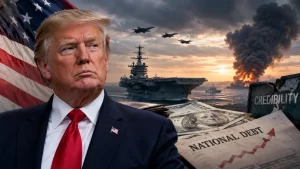
When a commander-in-chief orders the military into war, the expectation — the most basic compact between the executive and the armed forces — is that those men and women will not be squandered. That the decision to expend lives, treasure, and irreplaceable weaponry will have been subjected to rigorous scrutiny, to honest intelligence, to clear-eyed strategic calculus. What has been revealed in the weeks since President Donald Trump launched Operation Epic Fury against Iran is something categorically different: a reckless deployment that has burned through half of America’s most critical missile defenses, opened a dangerous window of vulnerability that could last years, and was initiated without congressional consent, over the explicit warnings of senior military commanders. The ledger is already damning. It will grow worse.
A new analysis by the Center for Strategic and International Studies — cross-referenced against three independent sources with direct knowledge of internal Department of Defense stockpile assessments — quantifies the damage with precision that the administration has refused to acknowledge publicly. The numbers represent not an acceptable cost of a necessary war, but the signature of strategic negligence at the highest level.
1. The Commanders Warned Him
What makes the current stockpile crisis categorically different from the ordinary costs of war is that it was foreseeable — and foreseen. According to reporting by CNN, Joint Chiefs of Staff Chairman General Dan Caine and other senior military leaders warned President Trump before the first bomb fell that a protracted military campaign would place significant strain on U.S. weapons inventories — particularly those earmarked to support Ukraine and Israel. Those warnings were set aside. The war began anyway.
The administration’s public posture has been one of breezy denial. Chief Pentagon spokesman Sean Parnell insisted in a statement that the military “has everything it needs to execute at the time and place of the President’s choosing.” Trump himself told reporters that the U.S. is “not running short of any weaponry,” a claim that now sits in direct and documented contradiction to the internal Defense Department assessments his own administration has conducted. He simultaneously requested additional emergency congressional funding for missiles — because the Iran campaign had depleted existing stockpiles. The dissonance was not merely rhetorical. It was a confession dressed as a boast.
“The high munitions expenditures have created a window of increased vulnerability in the western Pacific. It will take one to four years to replenish these inventories and several years after that to expand them to where they need to be.”
— Mark Cancian, Retired U.S. Marine Corps Colonel & CSIS Senior Analyst, CNN, April 21, 2026
2. A Gift to Beijing and Moscow
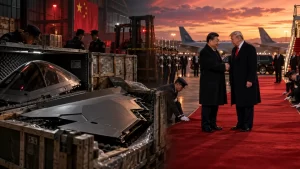
The strategic damage extends far beyond Iran’s borders. As Foreign Policy’s Stephen M. Walt analyzed in a sweeping assessment published this week, the decision to mount a sustained bombing campaign in Iran — while simultaneously defending regional allies against retaliatory missile barrages — has required a massive diversion of finite military assets away from the Indo-Pacific theater. The consequences for the defense of Taiwan, South Korea, and Japan are not abstract: the THAAD and Patriot batteries that would be required in any conflict with China are precisely those now depleted in Middle Eastern skies.
Russia has drawn its own dividend. Prior to the Iran war, the Kremlin was operating at a severe disadvantage — suffering extraordinary battlefield casualties and economic strain from Western sanctions. The war-induced oil price spike of approximately 50 percentage points has provided Moscow with what Walt estimates as hundreds of millions of dollars per day in additional revenue, potentially for months or years. Washington, desperate for energy relief, suspended sanctions on purchases of Russian oil in March. The geopolitical score sheet, at this early date, reads: Iran — significant military damage; Russia — economic windfall; China — window of Western Pacific vulnerability; United States — depleted arsenals, dead soldiers, and a fractured alliance structure.
3. Chronology of a War Without Sanction
Get Involved Today
Contribute to our mission and turn your concerns into action.
4. Congress, Abandoned
The war with Iran was initiated without a congressional declaration or authorization. The Trump administration did not seek a new Authorization for Use of Military Force. The War Powers Act was not complied with in any meaningful sense. Congress was informed only after the strikes had already begun. This is not a procedural complaint. It is a constitutional one — and it implicates directly the question of who bears responsibility when a war of choice leaves the nation’s military hollowed out.
Arizona Senator Mark Kelly, a former combat aviator and member of the Senate Armed Services Committee, framed the arithmetic plainly: “The Iranians do have the ability to make a lot of Shahed drones, ballistic missiles, medium range, short range and they’ve got a huge stockpile. So at some point…this becomes a math problem and how can we resupply air defense munitions. Where are they going to come from?” The Pentagon has no satisfying answer. Lockheed Martin has been tasked with quadrupling THAAD production — from 96 to 400 interceptors per year — over seven years. Seven years. The vulnerability is today.
“This is what happens when the President and Congress willfully remove restraints on U.S. stocks. That should never have been done and these are the consequences for it.”
— Loren Thompson, Defense Analyst, TIME Magazine, April 2026
Connecticut Senator Richard Blumenthal, a senior member of the Armed Services Committee, told TIME that he is “deeply concerned about Ukraine,” noting that America will be “hard pressed, at some point, to tell Ukraine what is coming.” Meanwhile, House Minority Leader Hakeem Jeffries and Democratic leadership issued a joint statement describing Trump’s conduct as “completely unhinged,” pressing Speaker Mike Johnson to reconvene the House to vote on war powers — a request that was refused.
An Arsenal Emptied by a President Who Cannot Be Trusted with One
Section 4 of the 25th Amendment to the United States Constitution provides a mechanism — never yet invoked — by which the Vice President and a majority of the Cabinet may declare that the President “is unable to discharge the powers and duties of his office.” Upon such a declaration, transmitted to Congress, the Vice President immediately assumes the role of Acting President. If the President contests the declaration, Congress has twenty-one days to decide the matter by a two-thirds vote of both chambers.
The provision was crafted primarily for physical incapacitation — but its text does not limit itself to that. “Unable to discharge the powers and duties of his office” is a broad constitutional standard. It encompasses not merely bodily infirmity but an inability, for any reason, to perform the essential executive function: the safeguarding of the national interest and the security of the American people.
The case that the current situation meets that threshold has been made by lawmakers of both parties. Representative Ro Khanna of California stated plainly: “If the United States Congress has any life left in it, every member of Congress and senator must be calling for Trump’s removal today based on the 25th Amendment.” Senator Ed Markey of Massachusetts wrote: “We cannot leave this man in charge of America’s nuclear weapons as he threatens to end an entire civilization. And Congress must not fund this reckless administration.” Former House Speaker Nancy Pelosi stated: “If the Cabinet is not willing to invoke the 25th Amendment and restore sanity, Republicans must reconvene Congress to end this war.” Representative Melanie Stansbury of New Mexico wrote: “Just because a President announces he’s agreed to a two week ceasefire moments before he threatened to commit war crimes, does not mean he is suddenly fit to serve.”
Representative Jamie Raskin, the ranking Democrat on the House Judiciary Committee, wrote formally to the White House physician demanding a cognitive assessment of the President, stating: “In recent days, the country has watched President Trump’s public statements and outbursts turn increasingly incoherent, volatile, profane, deranged, and threatening.” Raskin subsequently led a formal briefing for House Democrats on the mechanics of the 25th Amendment. The constitutional case being assembled is not merely rhetorical.
The practical barriers are severe. Vice President JD Vance and the Cabinet have given no public indication they are considering the amendment’s invocation. Republicans control both chambers of Congress. The two-thirds threshold for congressional override of a presidential contest would require a historic defection of Republican members. These barriers are real. They do not, however, negate the constitutional argument being made — nor the moral weight of a president who began a war without authorization, ignored his military commanders’ warnings, depleted American defenses for upwards of a decade or more, and then denied all of it in public. The 25th Amendment exists precisely for moments when the mechanisms of normal democratic accountability have been overwhelmed by the conduct of the executive. This is such a moment.
5. The Denials and the Record
The Trump administration has not been silent in its own defense. The White House released a lengthy document in April cataloguing the stated objectives of Operation Epic Fury — the destruction of Iran’s ballistic missile program, the elimination of its navy, the severing of its proxy networks, and the prevention of a nuclear weapon. Secretary of State Marco Rubio declared the mission was to “destroy the ability of this regime to launch missiles.” Secretary of Defense Pete Hegseth promised execution “with ruthless precision.”
These statements coexist with the fact that Trump’s own claims about the war’s justification shifted repeatedly over its course — from eliminating “imminent threats” to facilitating regime change to seizing Iranian oil resources. The Congressional Research Service documented in a March 2026 report that the administration offered “diverse and inconsistent explanations” for starting the conflict. Iranian officials and some U.S. intelligence assessments rejected the administration’s claims that Iran had been preparing an imminent attack. The International Atomic Energy Agency noted that while Iran had an ambitious nuclear program, it did not represent the imminent threat the President described at his State of the Union address.
What the record shows is a president who could not provide consistent strategic rationale for a war he started without congressional approval, who ignored military commanders who warned him of the consequences, who then publicly denied those consequences while simultaneously requesting emergency funding because of them. That is not a description of capable executive leadership. It is a clinical description of its failure.
Editorial Conclusion
The United States has spent seven weeks burning through irreplaceable weapons, losing service members to a war started without congressional sanction, alienating Indo-Pacific allies who now question whether Washington can defend them, and handing economic relief to Moscow that may sustain the Ukraine conflict for years. The cause is a single, documented failure of executive leadership: a president who was warned, who did not listen, who acted unilaterally, and who has since denied the consequences while the evidence accumulates in classified Pentagon assessments and CSIS spreadsheets alike. The 25th Amendment’s invocation faces real political barriers — but the constitutional case for it has never been more clearly written, in missile expenditure tables and unanswered casualty counts, than it is today. A republic that cannot hold its commander-in-chief accountable for strategic negligence of this magnitude is a republic that has abandoned its first obligation: the security of its people. Congress must act. The Cabinet must answer. The record will not wait.
Sources & References
- CNN — “US at Risk of Running Out of Missiles After Depleting Stockpile in Iran Operations” (April 21, 2026)
- TIME — “Iran War Burning Through Crucial US Weapons Stockpiles” (April 2026)
- NBC Palm Springs / CSIS — “US Missile Stockpile Dwindles Following Seven-Week Conflict with Iran” (April 21, 2026)
- Foreign Policy — “The Strategic Aftershocks of Trump’s Iran War” (April 20, 2026)
- CNN — “25th Amendment: Democrats and Right-Wing Voices Call for Removing Trump from Office” (April 7, 2026)
- TIME — “Democrats Demand GOP Leaders End Recess to Stop Trump’s Iran War” (April 7, 2026)
- CNBC — “Trump Faces Calls for Removal Over Threats to Wipe Out ‘Whole Civilization’ in Iran” (April 7, 2026)
- Axios — “Trump 25th Amendment Chatter Erupts Among Dems Over Iran Post” (April 7, 2026)
- CNN — “Raskin Calls for Trump to Take Cognitive Test in Wake of Iran Threats” (April 10, 2026)
- Wikipedia — “2026 Iran War” — Comprehensive chronology and background
- Congressional Research Service — “U.S. Conflict with Iran” (March 26, 2026)
- KRDO / CNN — “US at Risk of Running Out of Missiles if Another War Breaks Out” (April 21, 2026)
- ABC17 News / CNN — “US at Risk of Running Out of Missiles” (syndicated) (April 21, 2026)
- White House — “President Trump’s Clear and Unchanging Objectives Drive Decisive Success Against Iranian Regime” (April 2026)
Related News